
Results
-
 £25.00
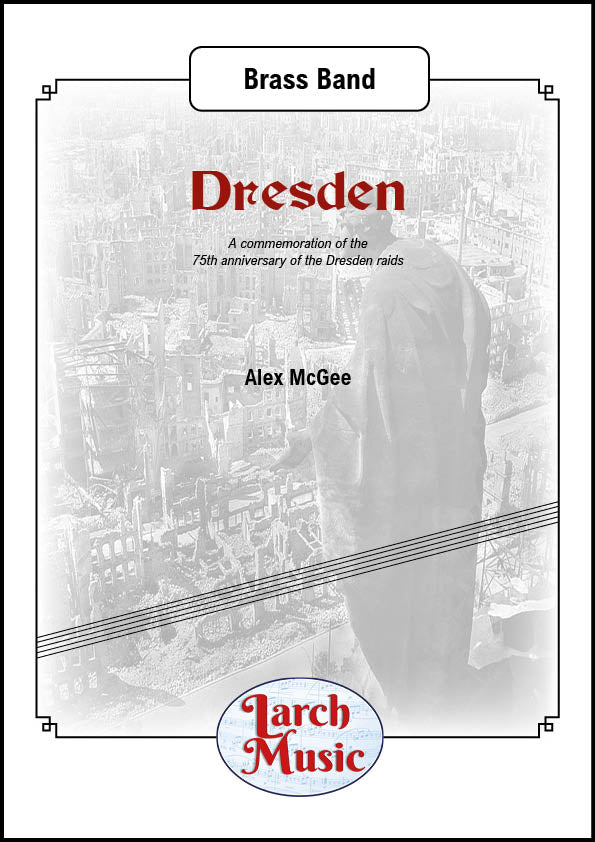
Dresden - Brass Band - Full Score & Parts - LM955
COMPOSER: Alex McGeeThebombing of Dresdenwas aBritish-Americanaerial bombing attackon the city ofDresden, the capital of the Germanstate ofSaxony, duringWorld War II.In four raids between 13th and 15th February 1945, 722 heavy bombers of theBritishRoyal Air Force(RAF) and 527 of theUnited States Army Air Forces(USAAF)dropped more than 3,900 tons ofhigh-explosivebombsandincendiary deviceson the city.The bombing and the resultingfirestormdestroyed more than1,600 acres (6.5km2) of the city centre.An estimated 22,700to 25,000people were killed.Three more USAAF air raids followed, two occurring on 2nd Marchaimed at the city'srailway marshalling yardand one smaller raid on 17th April aimed at industrial areas.
In Stock: Estimated dispatch 3-5 working days
-
 £25.00
From Waterloo To The Somme - Brass Band - LM774
COMPOSER: Traditional, Rossini, Will D. Cobb & Frederic WeatherlyARRANGER: Laurie JohnstonA great collection of war songs from The Battle of Waterloo to The SommeThe four main melodies in this piece are..1 Over the hills and Far Away.This song dates back as far as Queen Anne but was popular among soldiers during the Napoleonic Wars. Probably the most well known version these days is that by John Tams from the television series Sharpe.2 The Green Hills of Tyrol.This is one of the oldest tunes played by pipe bands today although originally written by Rossini for the William Tell ballet music. Pipe major John MacLeod of the 93rd Sutherland Highlanders heard it played by a Sardinian Military band during the Crimean War and transcribed it for pipes as a tribute to the number of VC's won by Scottish regiments in this conflict. It became very well known when Andy Stewart took the tune for his song The Scottish Soldier.3 Goodbye Dolly Gray.This is a music hall song by Will D. Cobb and was popularised as a Boer War anthem. It was written during the earlier Spanish - American and held it's popularity through to the first world war.4 Roses of Picardy.Written by Frederick Wetherly in 1916 it became a very big hit with the soldiers fighting in the trenches. Picardy is a region of northern France where the Somme battlefields are to be found which among other things possibly accounts for the songs great popularity. It sold on average 50.000 copies a month during the great war.
In Stock: Estimated dispatch 3-5 working days
-
 £125.00
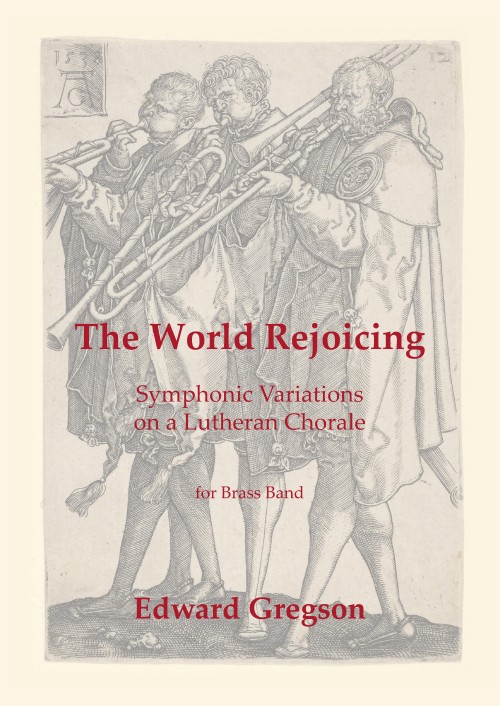
The World Rejoicing (Brass Band - Score and Parts) - Gregson, Edward
The World Rejoicing was commissioned by the National Brass Band Associations of Belgium, Netherlands, Norway, Switzerland, and the British Open, as the test piece for their competitions in 2020/21. Although the work was completed in 2019, the pandemic of 2020 meant that these competitions were postponed until 2021/22. The premiere took place in September 2021 at Symphony Hall, Birmingham, UK.In searching for a common link between the brass band traditions of the various European countries that commissioned this work, I considered the fact that hymns have always played an important role in the relationship that brass bands have with their particular communities; and thus I turned to a well- known Lutheran chorale, Nun danket alle Gott (Now thank we all our God), written around 1636 by Martin Rinkart, with the melody attributed to Johann Cruger. A number of composers have incorporated this chorale into their music, most famously J.S. Bach in his Cantatas no. 79 and 192, and Mendelssohn in the Lobsegang movement of his 2nd Symphony (the harmonisation of which is usually used when this hymn is sung).It seemed fitting therefore for me to return to a compositional form I have used many times before (Variations) and to write a work based on this hymn. I have used it in a similar way to that which I employed in my Variations on Laudate Dominum of 1976 - that is, rather than writing a set of variations using elaborations of the complete tune, I have taken various phrases from the chorale and used them within the context of other musical material, applying an overall symphonic process of continuous variation and development. The structure, or sub-divisions of the work, which is through composed and plays without a break, is as follows:Prelude, Capriccio, La Danza 1, Processional, La Danza 2, Arias and Duets, Fuga Burlesca, Chorale, and Postlude.The work, which is around 16 minutes in length, is also partly autobiographical - in the manner say of Strauss's Ein Heldenleben - in that I have incorporated into the score brief quotations from many of my other major works for brass band. In that respect, The World Rejoicing sums up a particular facet of my life as a composer, and reflects the admiration I have always had for what is surely one of the great amateur music-making traditions in the world.Duration: 16.00
Estimated dispatch 7-14 working days
-
£40.00
The World Rejoicing (Brass Band - Score only) - Gregson, Edward
The World Rejoicing was commissioned by the National Brass Band Associations of Belgium, Netherlands, Norway, Switzerland, and the British Open, as the test piece for their competitions in 2020/21. Although the work was completed in 2019, the pandemic of 2020 meant that these competitions were postponed until 2021/22. The premiere took place in September 2021 at Symphony Hall, Birmingham, UK.In searching for a common link between the brass band traditions of the various European countries that commissioned this work, I considered the fact that hymns have always played an important role in the relationship that brass bands have with their particular communities; and thus I turned to a well- known Lutheran chorale, Nun danket alle Gott (Now thank we all our God), written around 1636 by Martin Rinkart, with the melody attributed to Johann Cruger. A number of composers have incorporated this chorale into their music, most famously J.S. Bach in his Cantatas no. 79 and 192, and Mendelssohn in the Lobsegang movement of his 2nd Symphony (the harmonisation of which is usually used when this hymn is sung).It seemed fitting therefore for me to return to a compositional form I have used many times before (Variations) and to write a work based on this hymn. I have used it in a similar way to that which I employed in my Variations on Laudate Dominum of 1976 - that is, rather than writing a set of variations using elaborations of the complete tune, I have taken various phrases from the chorale and used them within the context of other musical material, applying an overall symphonic process of continuous variation and development. The structure, or sub-divisions of the work, which is through composed and plays without a break, is as follows:Prelude, Capriccio, La Danza 1, Processional, La Danza 2, Arias and Duets, Fuga Burlesca, Chorale, and Postlude.The work, which is around 16 minutes in length, is also partly autobiographical - in the manner say of Strauss's Ein Heldenleben - in that I have incorporated into the score brief quotations from many of my other major works for brass band. In that respect, The World Rejoicing sums up a particular facet of my life as a composer, and reflects the admiration I have always had for what is surely one of the great amateur music-making traditions in the world.Duration: 16.00
Estimated dispatch 7-14 working days
-
£15.00
The World Rejoicing (Brass Band - Study Score) - Gregson, Edward
The World Rejoicing was commissioned by the National Brass Band Associations of Belgium, Netherlands, Norway, Switzerland, and the British Open, as the test piece for their competitions in 2020/21. Although the work was completed in 2019, the pandemic of 2020 meant that these competitions were postponed until 2021/22. The premiere took place in September 2021 at Symphony Hall, Birmingham, UK.In searching for a common link between the brass band traditions of the various European countries that commissioned this work, I considered the fact that hymns have always played an important role in the relationship that brass bands have with their particular communities; and thus I turned to a well- known Lutheran chorale, Nun danket alle Gott (Now thank we all our God), written around 1636 by Martin Rinkart, with the melody attributed to Johann Cruger. A number of composers have incorporated this chorale into their music, most famously J.S. Bach in his Cantatas no. 79 and 192, and Mendelssohn in the Lobsegang movement of his 2nd Symphony (the harmonisation of which is usually used when this hymn is sung).It seemed fitting therefore for me to return to a compositional form I have used many times before (Variations) and to write a work based on this hymn. I have used it in a similar way to that which I employed in my Variations on Laudate Dominum of 1976 - that is, rather than writing a set of variations using elaborations of the complete tune, I have taken various phrases from the chorale and used them within the context of other musical material, applying an overall symphonic process of continuous variation and development. The structure, or sub-divisions of the work, which is through composed and plays without a break, is as follows:Prelude, Capriccio, La Danza 1, Processional, La Danza 2, Arias and Duets, Fuga Burlesca, Chorale, and Postlude.The work, which is around 16 minutes in length, is also partly autobiographical - in the manner say of Strauss's Ein Heldenleben - in that I have incorporated into the score brief quotations from many of my other major works for brass band. In that respect, The World Rejoicing sums up a particular facet of my life as a composer, and reflects the admiration I have always had for what is surely one of the great amateur music-making traditions in the world.Duration: 16.00
Estimated dispatch 7-14 working days
-
 £53.99
Grieg's Morning Mood (Brass Band - Score and Parts) - Grieg, Edvard - Cortland, Steve
Based on "Morgenstimmung" from Peer Gynt Suite No.1, Opus 46. Duration: 03:30
Estimated dispatch 7-14 working days
-
 £152.99
Between the Two Rivers (Brass Band - Score and Parts) - Sparke, Philip
Between the Two Rivers was commissioned by Fanfare Prins Hendrik, from Aalst in the Netherlands. The title derives from the fact that the town of Aalst lies between two tributaries of the River Dommel. The community is a highly religious one, so the famous Luther chorale, Ein' Feste Burg, was an obvious choice for Philip Sparke to use as the theme for this new work. It takes the form of a theme with four contrasting variations. Variation 1 is a moto perpetuo, variation 2 has a slower march like feel, variation 3 is a sinister slow movement and the final variation is in the form of a lyrical fugue. Between The Two Rivers is sure to become a major work in modern brass band repertoire.Duration: 15:00
Estimated dispatch 7-14 working days
-
 £85.00
Ave Maria (Alphorn Feature with Brass Band - Score and Parts) - Pelz, Lothar - Moren, Bertrand
for 1, 2 or 3 Alphorns in GbDuration: 3.00
Estimated dispatch 7-14 working days
-
 £44.95
CHALLENGING BRASS (Brass Band) - Vinter, Gilbert
Score & Parts. Duration: 5:08 Recorded on Polyphonic QPRL058D SPECTRUM: The Music of Gilbert Vinter Vol.1
Estimated dispatch 7-14 working days
-
£59.95
ENTERTAINMENTS (Brass Band Set - Score and Parts) - Vinter, Gilbert
Score & Parts. Three movements: Caprice, Elegy, March. Duration: 12:00 Recorded on Polyphonic QPRL058D SPECTRUM: The Music of Gilbert Vinter Vol.1
Estimated dispatch 7-14 working days
 View Music