
Results
-
 £54.99
X-mas for Three - David Well
David Well composed 'X-mas for Three' for three young pupils of his, who wished to give a Christmas concert. He arranged six well-known Christmas songs for them, and their first performance was a great success. This was reason for the composer to adapt the piece for 'orchestra' by adding percussion. The title has stayed the same, and the work can still be played by as few as three musicians, but as the saying goes: "The more, the merrier"! 'X-mas for Three' consists of the following parts : 1. Oh du frohliche 2. Kling, Glockchen, kling 3. Gloria in excelsis deo 4. Joy to the world! 5. The first Noel 6. We wish you a MerryChristmas
Estimated dispatch 5-14 working days
-
 £76.99
Match-Rhythm - Jan Bosveld
Match-Rhythm was the compulsory work for the B-division during the European Brass Band Championships of 2005 taking place in Groningen. It is a rhythmical (Rhythm) oriented opening work in which the bands have the opportunity to present themselves during the indisputable competitive character (Match) of these championships. To achieve the high standard required is intensive preparation alone not sufficient. The bands increase their level op performance during the customary try-out concerts so that a kind of competitive rhythm (Match) is acquired.
Estimated dispatch 5-14 working days
-
 £76.99
Crazy Crowd - David Well
A fascinating parade of people passing by. 1. A drum major who cannot control his platoon. 2. An unhandy clown who has known better times. 3. A robot that comes to life and dances of pleasure. 4. A charming princess displays her exceptional charms. 5. A funky guy who goes berserk, literally and figuratively. 6. A priest conducts a service and clearly enthrals his audience. 7. The old acrobat tries it one more time, however, not always with success. 8. A spy, who is shy, but a master of his profession. 9. And who are you? That is the big question.
Estimated dispatch 5-14 working days
-
 £60.99
Music for the Youngsters - Patrick Millstone
An easy suite with short parts for brass and percussion. 1. Entry - festive intrada 2. Choral - question and answer in a solemn choral 3. Tune - attention to articulation 4. Canon - many possibilities 5. Penta - eastern sounds 6. Swinging Out - a swinging encore piece
Estimated dispatch 5-14 working days
-
 £104.99
Scottish Dances - Peter Martin - Menno Haantjes
Scottish Dances is based on three Scottish traditionals: Cock of the North, The Bonnie Bank's O'Loch Lomond and Marie's Wedding. I. Cock of the North's name is used for multiple things or events. For example for a locomotive to a famous, it seems, delicious liqueur, and rallies to snowboard competitions. Furthermore is "Cock O' the North " a nickname of a famous Duke. (The 4th Duke of Gordon). In this composition Cock of the North (a Jig) is a traditional Scottish bagpipe tune, regularly played on tattoos by Pipe Bands. Not infrequently the drummers sing the text. Auntie Mary, had a canary, Up the leg of her trousers While she was sleeping Iwas peeping Up the leg of her trousers. II. " The Bonnie Bank's O'Loch Lomond " is about a sad story that took place during an revolt against the British. In 1745 Bonnie Prince Charlie had to retreat. Two of his men were captured. One was convicted and executed, while the other was released. The spirit of the executed soldier would arrive in Scotland via the 'low road' (underworld) before his companion, who had still a long way to go. You'll take the high road And I'll take the low road And I'll be in Scotland afore ye But me and my true love will never meet again On the Bonnie Bonnie Banks of Loch Lomond III. In a Scottish wedding, after the official ceremonies, there is often danced. This is called a ceilidh. For this we use traditional Scottish music such as "Marie's Wedding '. Mid dance we go back to the church, where a lovely song in honor of the couple sounds. Marie's Wedding has been recorded by Van Morrison (among many others). Step we gaely, on we go, heel for heel and toe for toe Arm and arm and on we go, all for Marie's wedding
Estimated dispatch 5-14 working days
-
 £84.99
Voyage with the VOC - William Vean
The Netherlands have been an important trading nation for a long time partly as a result of their geographical situation. One of the first multinationals in The Netherlands was the 'Verenigde Oostindische Compagnie' (VOC). The aim of the VOC was to send ships to Asia in order to buy pepper and spices, and to take over the Portuguese monopoly in this field. The Company was successful. An era of great prosperity resulted, in which the art of painting (Rembrandt van Rijn) as well as science (Constantijn Huygens) flourished alongside a thriving economy. 1. The Sails are set : There is a lot of hustle and bustle on the quay. The crew are preparing fordeparture. Goodbyes are said and once the sails have been hoisted the ship sets out to sea.2. A Visit to the Rajah of Yogyakarta: After a voyage of many months the place of destination is reached. A visit to the Radja, the king of the area around Yokyakarta, follows. The dishes and beverages and the native culture in general are very pleasant after having been on a diet of ship's biscuit and water for such a long time.3. The Holds have been loaded: The holds have been loaded to the brim, and the voyage home can be begin!4. Death sails along: Life at sea is rough. not seldom did a sailor die of a tropical disease or scurvy. After a memorial service, the Captain would speak the words 'One, two, three, in God's name ...' and the body, wrapped in canvas, would be committed to the sea.5. A joyful homecoming: After many months of hardship coming home is perhaps the best part of the entire voyage. The quay is filled with people eager to give the crew a warm welcome.
Estimated dispatch 5-14 working days
-
 £154.99
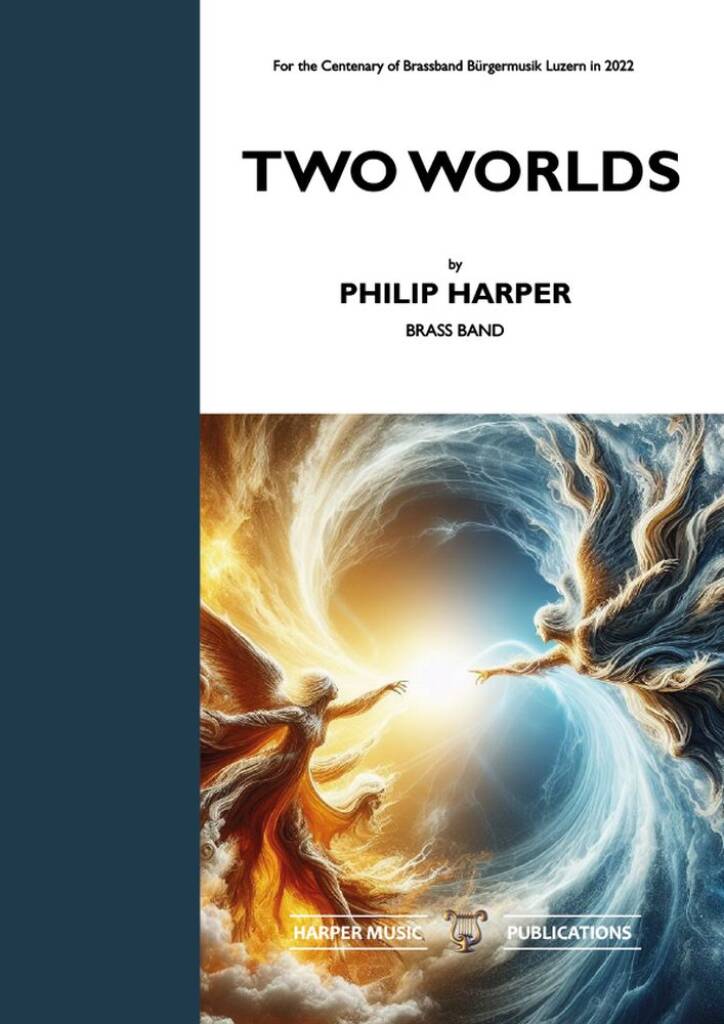
Two Worlds - Philip Harper
A powerful musical journey through time, Two Worlds explores the enduring force of storytelling. In an imaginary encounter, the Egyptian Pharaoh Tutankhamun and the American President Lincoln - in reality, separated by 5,000 years - meet to discuss the myths, truths and beliefs that shaped their respective civilizations. From the divine sun gods of Ancient Egypt to America's dream of equality, this evocative work blends fantasy and history with bold, cinematic music. At once dramatic and thought-provoking, Two Worlds reminds us that the stories we believe in can unite or divide, destroy or inspire.Commissioned for the centenary of the Swiss Brassband Burgermusik Luzern, in 2022.
Estimated dispatch 5-14 working days
-
£91.40
The Stars and Strips Forever - John Philip Sousa - Keith M. Wilkinson
The Stars And Stripes Forever is a composition by John Philip Sousa (arr. Keith M. Wilkinson). In the Obrasso webshop are the Sheet Music for Brass Band with the article no. 16535 available. The sheet music is classified in Difficulty level C (medium). More Marching music for Brass Band can be found using the flexible search function. Use the free trial score for The Stars And Stripes Forever and get a musical impression from the audio samples and videos available for the Brass Band piece. With the user-friendly search function in the Obrasso webshop, you can find in just a few steps more sheet music from John Philip Sousa for Brass Band. So that you can complete your concert program, show all music sheets can be displayed with one click on Marching music in Difficulty level C (medium) . The Stars And Stripes Forever is one of many brass music compositions that have been published by Musikverlag Obrasso. Next to John Philip Sousa over 100 composers and arrangers work for the Swiss music publishing house. In addition to the notes for Brass Band you will also find literature in other formats such as Brass Band, Concert Band, Junior Band, Brass Ensemble, Woodwind Ensemble, Symphony Orchestra as well as CDs and Music Education. A large part of the publisher's own literature from top brass bands such as the Black Dyke Band, Cory Band, Brighouse & Rastrick Band or the Oberaargauer Brass Band was recorded on Obrasso Records. All sound carriers are also available digitally on the popular portals of Apple, Amazon, Google, Spotify and other providers worldwide.
Estimated dispatch 5-14 working days
-
 £54.99
Images for Brass - Stephen Bulla
Stephen Bullas highly descriptive work was written to commemorate the 50th anniversary of the Battle of Iwo Jima, which took place between the 19th February and 26th March 1945.Casualties on both the American and Japanese sides were horrendously high before the famous image of the raising of the flag on top of Mount Suribachi signalled the end of one of the most significant and terrifying Pacific conflicts of the SecondWorld War.The work received its first performance by the brass choir of the U.S. Marine Band at the National Cathedral in Washington D.C. and is divided into four programmatic sections.The first portrays the sense of anticipation before conflict (Prologue), before the arduous journey to the scene of the battle (Approach by Sea) is followed by introspection and prayer featuring the hymn tune Melita (Chorale Prayer), andfinally, the hostile confrontation itself (Engagement).There are frequent references to the Marines Hymn and the US National Anthem, particularly in the closing bars, depicting the ultimate raising of the American flag.
Estimated dispatch 5-14 working days
-
£54.99
Vilja-Lied - Franz Lehár - John Blanken
Franz Lehar was born in Komarom, Hungary on 30th April 1870. From the age of fifteen he received composition and violin lessons at the Prague conservatory from Anton n Dvorak. In 1905 he composed The Merry Widow which became an instant worldwide success. The libretto of this operetta provides a succession of intimate arias and duets with festive ensembles. The Vilja-Lied is one of these arias. In this edition for brass band all the poignant beauty of the original remains.
Estimated dispatch 5-14 working days
 View Music