
Results
-
 £25.00
She's a Lassie From Lancashire
She's a Lassie from Lancashire is a British musical hall song from the pen of writing partnership C.W. Murphy, Dan Lipton and John Neat. The song gained widespread popularity through performances and recordings by the revered Florrie Forde. Commissioned by Mark Peacock for the Longridge Band , this reflective setting by Dan Price evokes the rolling Lancashire countryside, with subtle hints of industrialisation, mill machinery and the echoes of the song's musical hall origins. Duration: 00:03:50 Grade: 3/3.5
Estimated dispatch 5-7 working days
-
 £34.95
Behold the Power of God - Christopher Bond
Behold the Power of God (2010) was written for and premiered by the Cornwall Youth Brass Band in dedication to their Musical Advisor at the time; the late Cornish composer Goff Richards who later described the work as 'a remarkable piece of writing'. The work's title, while implying a religious meaning, actually references Goff's name, with his full name Godfrey translating as 'God-peace' and Richards meaning 'Power'. Two energetic outer sections fall either side of a more lyrical middle section featuring the solo cornet. The perfect opening item at any concert.
Estimated dispatch 10-14 working days
-
 £89.95
BLOCH-Party - Jonathan Bates
DIFFICULTY: Champ. DURATION: 18'00". . 'BLOCH-Party' is music inspired by and attributed to the Swiss-born composer Ernest Bloch and was composed for the own-choice section of the 2022 Swiss National Brass Band Championships held in the Stravniski Auditorium, Montreux on the banks of Lake Geneva. Bloch was born and raised in Geneva itself to Jewish parents in 1880 before emigrating permanently to the United States in 1916. His Jewish heritage never ledft him though, and much of his writing and titling of works remained heavily influenced by his upbringing. This work is divided into 5 through-composed sections, culminating in a rip-roaring multi-metre dance inspired by traditional Yiddish and Klezmer rhythms and harmonies.
In Stock: Estimated dispatch 1-3 working days
-
 £33.91
Stargazer - Kevin Ackford
Score & Parts Again, not a traditional march but a great opener. Stargazer is the third of Kevin's space trilogy. Again, this piece shows all the hallmarks of Kevin's writing with a great melody and plenty of energy with a little twist, as in the middle section the title is spelled out in the cornets using Morse code. A must for any band.
Estimated dispatch 5-7 working days
-
 £74.95
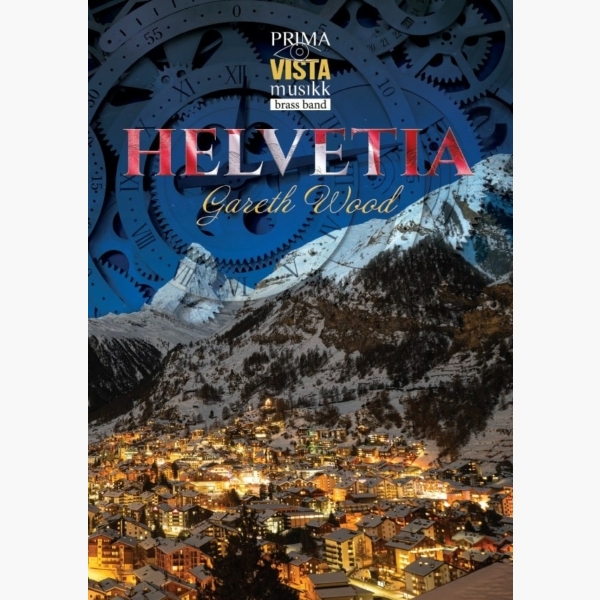
Helvetia - Gareth Wood
I first went to Switzerland in the early 1970s and regularly played at the Lucerne Festival with the Royal Philharmonic Orchestra. It is a beautiful city, one of my favourite European cities. In writing Helvetia (the Roman name for Switzerland),...
Estimated dispatch 5-7 working days
-
£29.95
MINNEAPOLIS IV (Brass Band Set) - Emil Soderstrom
This march was the outcome of a request from Minneapolis IV Corps to write a march to celebrate its 60th anniversary. At the time of its writing, Soderstrom had become a leading arranger for NBC Radio in Chicago and had mastered many contemporary American styles. His lush harmonies remind one of Gershwin, Porter, Berlin and Rodgers while even the scoring suggests an American big-band of the swing era! These and other novel touches make the march interesting to listen to, as well as to play, over 60 years on.
Estimated dispatch 7-14 working days
-
£44.95
EUPHONY (Euphonium Solo with Brass Band Set) - Robert Redhead
Previously only available in manuscript form, this euphonium solo with brass band accompaniment is now available in printed format. Euphony (meaning a pleasant, sweet sound) is based on the tunes of Sidney Cox with material taken from the songs; 'He found me', 'This one thing I know', 'You can tell out the sweet story' and 'Deep and wide'. At the time of writing, the composer remarked; 'The euphonium is often associated with melodies and harmonies that lend themselves to pleasing sounds'. That is true of this solo but it also presents considerable technical challenges for the soloist in terms of range and technique.
Estimated dispatch 7-14 working days
-
£34.95
TUCKER (Cornet Solo with Brass Band Set) - Erik Leidzen
Originally published in the Festival Series in 1933 and written by the master of solo writing, Erik Leidzen, this has become, in Salvation Army circles, a 'standard' for all aspiring cornetists, exploring the full range of the instrument from bottom F# to top D.
Estimated dispatch 7-14 working days
-
 £30.00
Man In His Labour Rejoiceth (Band Parts Only) - John Ireland
This beautiful piece written by John Ireland, with words by Robert Bridges, has now been reborn.Originally commissioned by the National Coal Board in 1947 it is believed to have been performed on May 1st 1948 at the the Haringey Stadium, involving 9 bands and 8 colliery bands. Since the original brass band parts (which bring the piece to life in its full glory) were lost over time, the John Ireland Trust committed to a project to ensure the music was not lost forever.Andrew Duncan was commissioned with the honour of recreating the brass band set to bring the full performance of band and choir back to the public's enjoyment. His attention to detail and widespread knowledge of Ireland's writing style have now enabled 'Man in his Labour Rejoiceth' to be fully recreated and appreciated in its original written form, offering bands a remarkable opportunity to perform an historically significant concert work.Choir parts are sold separately and are available from The Music Company (UK) Ltd (please call 0845 68 08452 for more details) or Stainer & Bell Ltd (Catalogue Ref: 20303)
In Stock: Estimated dispatch 3-5 working days
-
 £30.00
Sortie in E Flat - Louis Lefebure-Wely
Louis James Alfred Lefebure-Wely is historically associated with the development of French organ music, as well as with organ technique. As a composer he was instrumental in the evolution of the French symphonic organ style and his works include many pieces for church use, and lighter fare like marches and sorties.It is probably in the latter genre that Lefebure-Wely scored his most enduring successes on the organ, with pieces like the sorties in B flat and E flat.Sue Hopkins has artfully captured the magic of Lefebure-Wely's writing and produced this great new piece which offers a perfect complement to your concert programme.
In Stock: Estimated dispatch 3-5 working days