
Results
-
 £11.20
I was glad (Brass Band with Organ - Additional Parts) Parry trs. Wainwright
I was glad was originally a choral introit which is a popular piece in the musical repertoire of the Anglican church. It is traditionally sung in the Church of England as an anthem at the coronation of the British monarch, most recently that of King Charles III in May 2023. This transcription for brass band combines the choral and accompaniment parts meaning it is playable as a standalone arrangement. An optional organ part is included to augment the brass. The cornet section is divided into two choirs to create an antiphonal effect. The 'Vivats' are included in this transcription but an optional cut is provided for that section. To view a follow-the-score video please visit www.youtube.com/watch?v=Vx95uSp1yU8 PDF download includes additional parts. Purchase the full score and brass band parts here. Sheet music available from: UK - www.brassband.co.uk USA - www.solidbrassmusic.com Difficulty Level: 2nd Section + Parts included in this download: Solo Horn F 1st Horn F 2nd Horn F 1st Baritone Bass Clef 2nd Baritone Bass Clef 1st Trombone Bass Clef 2nd Trombone Bass Clef Euphonium Bass Clef Tuba 1 Bass Clef (Bass Eb equivalent) Tuba 2 Bass Clef (Bass Bb equivalent)
In Stock: Estimated dispatch 1-3 working days
-
 £91.10
Jesu, Joy Man's Desiring (with Organ Solo) - Johann Sebastian Bach - Jérôme Naulais
Estimated dispatch 5-14 working days
-
 £109.99
Fantasy for Brassband and Organ - Jan Bosveld
When I was approached to compose a work for brassband and church organ I already envisioned the concept I would use. It would indeed literally become a work for brassband and organ. Without the traditional solos, the organ would form an addition to the brassband orchestration as would the brassband provide an extra register for the organ. In short a homogeneous entity. The most important reason for doing this is quite simple. Since this work can only be performed in a church and because of the specific acoustics of the church, the brassband would sound in al its tone colour like an organ. By using certain registers of the organ and combining these with the brassband a wonderfulsound palette can be created. The use of complementary or contrasting tone quality is also possible. The primary theme of this composition is based on these three methods of "colouring". As far as structure is concerned this work consists of two parts. slow fast. It is built on a number of motifs in which some behave like a consecutive canon. In the fast movement the primary motif develops into a fugue-like section. The canon and fugato are techniques frequently used in classical and contemporary organ literature. The liberal use of structure and motif has lead to the title. "Fantasy for Brassband and Organ".
Estimated dispatch 5-14 working days
-
 £50.90
HIGHLAND CATHEDRAL (Brass Band with Organ ad.lib.) - Korb & Roever - Gygli, Andre
Medium
Estimated dispatch 7-14 working days
-
 £48.56
Finale from Symphony No.3 (Organ Symphony) (Brass Band) Saint-Saens arr. Norbury
Saint-Saens' magnificent Finale from Symphony No.3 (widely known as the 'Organ Symphony') has here been arranged for brass band with optional organ by Kevin Norbury. It was recorded by The International Staff Band on its CD Manuscripts, although this version has been revised in places. Saint-Saens decided to add the organ and piano to his 3rd symphony as a pragmatic orchestration innovation. The composition of this symphony was probably started in 1885 and a first draft was completed in Prague in 1886. Saint-Saens later recalled its eventful genesis: 'The Symphony in C was three-quarters sketched out when I found it impossible to write the finale. I did not know how to resolve this situation, until one night I suddenly woke up and, in a sort of hallucination, I heard the whole finale, which I hastily wrote down in outline, knowing that if I went back to sleep without having put anything on paper, I would have forgotten it all the next day.' The symphony was first performed under the composer's direction at Saint James's Hall in London on May 19, 1886. This arrangement by Kevin Norbury can both function as a stand-alone brass band piece, and be performed with an organ by omitting the notes found in square brackets in the parts and score. To view a rolling score video please visit www.youtube.com/watch?v=OlUd_FppBY8 PDF download includes score and parts. Additional parts (Horn in F and Baritone, Trombone, Euphonium & Tuba in Bass Clef) available here. Sheet music available from: UK - www.brassband.co.uk USA - https://satradecentral.org Difficulty Level: 1st Section + Length: 8.30 minutes Instrumentation: Soprano Cornet Eb Solo Cornet Bb Repiano Cornet Bb 2nd Cornet Bb 3rd Cornet Bb Flugel Horn Bb Solo Horn Eb 1st Horn Eb 2nd Horn Eb 1st Baritone Bb 2nd Baritone Bb 1st Trombone Bb 2nd Trombone Bb Bass Trombone Euphonium Bb Bass Eb Bass Bb Timpani Glockenspiel Percussion Organ (optional)
In Stock: Estimated dispatch 1-3 working days
-
£14.94
Finale from Symphony No.3 (Organ Symphony) (Brass Band) Additional Parts
Saint-Saens' magnificent Finale from Symphony No.3 (widely known as the 'Organ Symphony') has here been arranged for brass band with optional organ by Kevin Norbury. It was recorded by The International Staff Band on its CD Manuscripts, although this version has been revised in places. Saint-Saens decided to add the organ and piano to his 3rd symphony as a pragmatic orchestration innovation. The composition of this symphony was probably started in 1885 and a first draft was completed in Prague in 1886. Saint-Saens later recalled its eventful genesis: 'The Symphony in C was three-quarters sketched out when I found it impossible to write the finale. I did not know how to resolve this situation, until one night I suddenly woke up and, in a sort of hallucination, I heard the whole finale, which I hastily wrote down in outline, knowing that if I went back to sleep without having put anything on paper, I would have forgotten it all the next day.' The symphony was first performed under the composer's direction at Saint James's Hall in London on May 19, 1886. This arrangement by Kevin Norbury can both function as a stand-alone brass band piece, and be performed with an organ by omitting the notes found in square brackets in the parts and score. To view a rolling score video please visit www.youtube.com/watch?v=OlUd_FppBY8 PDF download includes additional parts as listed below. Full set including score available here. Sheet music available from: UK - www.brassband.co.uk USA - https://satradecentral.org Difficulty Level: 1st Section + Length: 8.30 mins. Alternative Parts included in this download: Solo Horn F 1st Horn F 2nd Horn F 1st Baritone B.C. 2nd Baritone B.C. 1st Trombone B.C. 2nd Trombone B.C. Euphonium B.C. Tuba 1 B.C. (Bass Eb equivalent) Tuba 2 B.C. (Bass Bb equivalent)
In Stock: Estimated dispatch 1-3 working days
-
£37.35
I was glad (Brass Band with optional Organ) Hubert Parry trs. Andrew Wainwright
I was glad was originally a choral introit which is a popular piece in the musical repertoire of the Anglican church. It is traditionally sung in the Church of England as an anthem at the coronation of the British monarch, most recently that of King Charles III in May 2023. This transcription for brass band combines the choral and accompaniment parts meaning it is playable as a standalone arrangement. An optional organ part is included to augment the brass. The cornet section is divided into two choirs to create an antiphonal effect. The 'Vivats' are included in this transcription but an optional cut is provided for that section. To view a follow-the-score video please visit https://www.youtube.com/watch?v=Vx95uSp1yU8 PDF download includes score and parts. Sheet music available from: UK - www.brassband.co.uk USA - www.solidbrassmusic.com Difficulty Level: 2nd Section + *Instrumentation: Soprano Cornet Eb Cornets 1-5 Bb (9 players required as a minimum) Flugel Horn Bb Solo Horn Eb 1st Horn Eb 2nd Horn Eb 1st Baritone Bb 2nd Baritone Bb 1st Trombone Bb 2nd Trombone Bb Bass Trombone Euphonium Bb Bass Eb Bass Bb Timpani Percussion *Additional transposed parts are available here for Horns in F, and Baritones, Trombones, Euphoniums and Tubas in Bass Clef.
In Stock: Estimated dispatch 1-3 working days
-
 £7.46
£7.46Adoration (Cornet Solo with Brass Band - Additional Parts) Price arr. Wainwright
Florence Price was an American classical composer, pianist, organist and music teacher. She is noted as the first African-American woman to be recognised as a symphonic composer, and the first to have a composition played by a major orchestra. Price composed over 300 works: four symphonies, four concertos, as well as choral works, art songs, chamber music and music for solo instruments. In 2009, a substantial collection of her works and papers that had been previously considered lost was found in her abandoned summer home. Amongst these was this delightful work, Adoration, which had been composed in the 1950s for organ. According to IMSLP.org, the piece "failed to meet notice or renewal requirements to secure statutory copyright with no 'restoration' under the GATT amendments" and therefore is in the public domain. A version for violin and piano by Elaine Fine has become popular. This setting for cornet soloist with brass band has been arranged by Andrew Wainwright. It is also available as a Bb solo with piano here. The additional parts included in this download are for low brass in bass clef. The full brass band set is available here. To view a video of Andrew Roe performing the work, please visit: www.youtube.com/watch?v=_7UYlz8Fzxo Difficulty Level: 4th Section + Length: 3.15 minutes Sheet music available from: UK - www.brassband.co.uk USA - https://satradecentral.org Included in download: 1st Baritone B.C. 2nd Baritone B.C. 1st Trombone B.C. 2nd Trombone B.C. Euphonium B.C. Tuba B.C. (Eb Bass Part) Tuba B.C. (Bb Bass Part)
In Stock: Estimated dispatch 1-3 working days
-
£33.62
Adoration (Cornet Solo with Brass Band) Florence Price trs. Andrew Wainwright
Florence Price was an American classical composer, pianist, organist and music teacher. She is noted as the first African-American woman to be recognised as a symphonic composer, and the first to have a composition played by a major orchestra. Price composed over 300 works: four symphonies, four concertos, as well as choral works, art songs, chamber music and music for solo instruments. In 2009, a substantial collection of her works and papers that had been previously considered lost was found in her abandoned summer home. Amongst these was this delightful work, Adoration, which had been composed in the 1950s for organ. According to IMSLP.org, the piece "failed to meet notice or renewal requirements to secure statutory copyright with no 'restoration' under the GATT amendments" and therefore is in the public domain. A version for violin and piano by Elaine Fine has become popular. This setting for cornet soloist with brass band has been arranged by Andrew Wainwright. It is also available as a Bb solo with piano here. To view a video of Andrew Roe performing the work, please visit: www.youtube.com/watch?v=_7UYlz8Fzxo Difficulty Level: 4th Section + Length: 3.15 minutes Sheet music available from: UK - www.brassband.co.uk USA - https://satradecentral.org Instrumentation: Cornet Soloist Bb Soprano Cornet Eb Solo Cornet Bb Repiano Cornet Bb 2nd Cornet Bb 3rd Cornet Bb Flugel Horn Bb Solo Horn Eb 1st Horn Eb 2nd Horn Eb 1st Baritone Bb 2nd Baritone Bb 1st Trombone Bb 2nd Trombone Bb Bass Trombone Euphonium Bb Bass Eb Bass Bb (Percussion Tacet)
In Stock: Estimated dispatch 1-3 working days
-
 £40.00
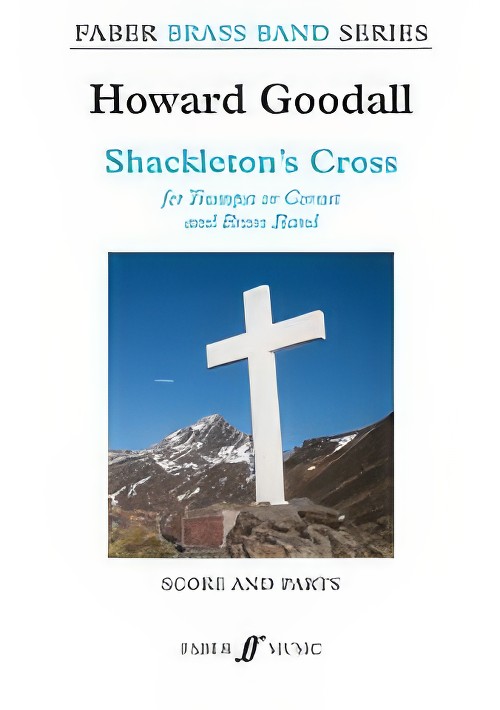
Shackleton's Cross (Cornet Solo with Brass Band - Score and Parts) - Goodall, Howard - Hall, Daniel
Shackleton's Cross was inspired by a painting created in 1957 by the English artist Edward Seago (1910 1974). The title refers to a cross which was erected to the memory of Sir Ernest Shackleton, who led a number of explorations to the Antarctic. Shackleton died in 1922 whilst on a Polar expedition, and the cross can be found on a promontory at the entrance to the bay at Grytviken Whaling Station in South Georgia. The painting is owned by HRH The Duke of Edinburgh, and was part of an exhibition at Buckingham Palace from October 2011 to April 2012. Originally scored for oboe, trumpet and small orchestra, Daniel Hall's sensitive arrangement for trumpet or cornet and brass band follows the composer's alternative version for solo trumpet and organ, created for Crispian Steele-Perkins (trumpet) and David Goode (organ). Duration: 5.00
Estimated dispatch 7-14 working days
 View Music