
Results
-
 £84.99
Voyage with the VOC - William Vean
The Netherlands have been an important trading nation for a long time partly as a result of their geographical situation. One of the first multinationals in The Netherlands was the 'Verenigde Oostindische Compagnie' (VOC). The aim of the VOC was to send ships to Asia in order to buy pepper and spices, and to take over the Portuguese monopoly in this field. The Company was successful. An era of great prosperity resulted, in which the art of painting (Rembrandt van Rijn) as well as science (Constantijn Huygens) flourished alongside a thriving economy. 1. The Sails are set : There is a lot of hustle and bustle on the quay. The crew are preparing fordeparture. Goodbyes are said and once the sails have been hoisted the ship sets out to sea.2. A Visit to the Rajah of Yogyakarta: After a voyage of many months the place of destination is reached. A visit to the Radja, the king of the area around Yokyakarta, follows. The dishes and beverages and the native culture in general are very pleasant after having been on a diet of ship's biscuit and water for such a long time.3. The Holds have been loaded: The holds have been loaded to the brim, and the voyage home can be begin!4. Death sails along: Life at sea is rough. not seldom did a sailor die of a tropical disease or scurvy. After a memorial service, the Captain would speak the words 'One, two, three, in God's name ...' and the body, wrapped in canvas, would be committed to the sea.5. A joyful homecoming: After many months of hardship coming home is perhaps the best part of the entire voyage. The quay is filled with people eager to give the crew a warm welcome.
Estimated dispatch 5-14 working days
-
 £33.62
E lucevan le stelle (Cornet/Euphonium Duet with Brass Band) Puccini arr.Bushnell
Tosca is an opera in three acts by the Italian composer Giacomo Puccini. The opera is set in June 1800 in Rome, and tells the story of the Kingdom of Naples and the threat to its control of Rome by Napoleon's invasion of Italy. Some of Puccini's best-known arias can be found in Tosca. The opera is based on Victorien Sardou's dramatic play of the same name (La Tosca). Puccini saw the play at least twice in 1889 and begged his publisher, Giulio Ricordi, to obtain the rights to turn it into an opera, which were secured in 1891 - although Puccini relinquished the rights to Alberto Franchetti before being recommissioned in 1895. Puccini wrote "I see in this Tosca the opera I need, with no overblown proportions, no elaborate spectacle, nor will it call for the usual excessive amount of music." It took four years to write, with Puccini arguing with his librettists (Luigi Illica and Giuseppe Giacosa) and his publisher. Although the first performance was delayed by a day due to the unrest in Rome at the time, the opera was premiered on 14 January 1900 at the Teatro Costanzi in Rome. The critics reviews were indifferent, but it was an immediate success with the public. The opera is through-composed, with the different musical elements weaved from piece to piece. Puccini used the Wagner's leitmotif concept to identity different parts of the opera. Taken from Act 3, E lucevan le stelle is sung by Cavaradossi, a painter, who has fallen for the singer Tosca. The corrupt Chief of Police, Baron Scarpia, longs for Tosca himself and, upon suspecting Cavaradossi of helping a political prisoner escape, he takes the opportunity to get rid of Cavaradossi and blackmail Tosca into being with him. The guards lead Cavaradossi to the roof of Castel Sant'Angelo, where he is told he has 1 hour to live before being executed. He asks to write a letter to Tosca, overcome by memories, he sings E lucevan le stelle (And the stars shone). It was selected by the tenor Wynne Evans as one of the most romantic songs for his top ten arias for Classic FM. He described it as "another tenor classic, both tragic and beautiful." This arrangement (for cornet and euphonium duet with brass band) includes alternative parts for horns in F and lower brass in bass clef. A recording of the original song can be found here: www.youtube.com/watch?v=EAqHQMX7GHY
In Stock: Estimated dispatch 1-3 working days
" frameborder="0" allowfullscreen> -
 £25.00
Ring'd with the Azure World
DescriptionRing'd with the Azure World was commissioned by the Harmonia Brass quintet for their final recital at the University of Huddersfield in 2016.He clasps the crag with crooked hands; Close to the sun in lonely lands, Ring'd with the azure world, he stands.The wrinkled sea beneath him crawls; He watches from his mountain walls, And like a thunderbolt he falls.- The Eagle by Alfred, Lord TennysonThe music was inspired by Tennyson's poem reproduced above; it seeks simply to reflect the spirit of the poem. It opens in sparse, lonely mood as the eagle surveys the world beneath. The work quickens in three bursts using metrical modulation to disguise the actual moment of acceleration, reflecting the lazy energy stored in the circling raptor before concluding dramatically in a fall 'like a thunderbolt'. Tennyson's poem, although brief, has inspired much analysis and writing, and is notable for being written in the (then somewhat unfashionable) iambic tetrameter, indicating a foursquare emphasis reflected in the main theme of the music. This is heard first in an octatonic version and later in a purely tonal (if somewhat modal) version. The instrumentation reflects that of Harmonia Brass, a quintet composed of brass band instruments (two B flat cornets, an E flat tenor horn, tenor trombone and E flat tuba). However the music is also available for the more conventional brass quintet of two trumpets, french horn, trombone and tuba.To listen to an audio export preview and follow the music, click play on the video below!Performance Notes1st cornet/trumpet requires a cup mute, ideally with an adjustable cup (the marking "tight" denotes that the cup should be adjusted closer to the bell), and a harmon mute with the tube removed (denoted by "TR" in the score). 2nd cornet/trumpet requires a fibre straight mute and a harmon mute with the tube removed. Tenor horn require a fibre straight mute and a practice mute (any sort) - in the orchestral brass version the french horn requires a stop mute. Trombone requires a cup mute (only). Tuba requires a fibre straight mute and a practice mute (of any sort).Metronome marks should be closely observed - starting either too fast or too slow will have a disproportionate effect on the tempi later in the piece due to the metrically controlled tempo changes.
Estimated dispatch 7-14 working days
-
 £40.00
Killing Me Softly With His Song - Tenor Horn Solo
ABOUT THIS PIECE: Introduce a moment of deep emotion to your next concert with this stunning arrangement of Killing Me Softly with His Song, for solo tenor horn and band. Written by Charles Fox with lyrics by Norman Gimbel, the song became a worldwide sensation after Roberta Flack's heartfelt interpretation in 1973, earning multiple Grammy Awards and cementing its place as a timeless classic. The song's reflective mood and expressive melody continue to resonate across generations, with notable covers by The Fugees and other artists bringing it to new audiences. This arrangement provides a perfect showcase for the soloist, capturing the intimacy and beauty of the original. ENSEMBLE: Solo Tenor horn with Band Accompaniment WHEN YOU BUY THIS PRODUCT, YOU GET: High-quality printed score and parts LEVEL: 3 LISTEN: DURATION: 5-minutes 30-seconds EXAMPLE SCORE: Click here LEVEL GUIDE: Level 1- Accessible to all Level 2 - c. UK third section and higher Level 3 - c. UK second section and higher Level 4 - c. UK first section and higher Level 5 - c. UK championship section level
Estimated dispatch 5-7 working days
-
 £30.00
Eriskay Love Lilt (with brass band) - Trad
Eriskay Love Lilt is a traditional Gaelic melody from the Western Isles of Scotland, sensitively arranged here by Andrew Duncan as a cornet solo with brass band accompaniment.This arrangement was written in 2001 for Phillip McCann and was first played by him with the Hepworth Band at the 2002 Leek Music Festival in Derbyshire, England. It has also since been recorded by Eleanor Ferguson with the Whitburn Band on Reflections of Freedom.Andrew Duncan comments: The Isle of Eriskay (Eirisgeigh) lies forty miles off the North West coast of Scotland in the North Atlantic. It is a small island, only two kilometres square and lies between the larger islands of South Uist and Barra. Eriskay is one of the islands which form the archipelago known as the Western Isles or Na h-Eileanan an Air. The Eriskay Love Lilt is a hauntingly beautiful tune which is typical of the greater number of traditional Gaelic melodies in that it is largely based on the Aeolian mode, the black notes on the piano.Also available with piano accompanimentor as a solo with brass ensemble (10-piece).
In Stock: Estimated dispatch 3-5 working days
-
 £33.62
The Red Kite (Euphonium Solo with Brass Band) Rob Wiffin
At one time the Red Kite was close to national extinction in the UK, but now it is possible to admire this distinctive bird of prey with its red colouring and forked tail, gracefully soaring through the sky. This solo, composed for Martin Smith, captures that feeling, with the euphonium gliding solitary and effortlessly, occasionally swooping down before reclaiming its high altitude. To create the desired atmosphere, root position chords are kept to a minimum, with added notes enhancing the feeling of floating and giving the harmony subtle colour. The harmonic rhythm is slow, but the movement shifts in the way the Red Kite makes slight changes of direction with minor adjustments of its tail, leaving the soloist free to sing with a sense of grace and freedom above the accompaniment. Audio demo: https://soundcloud.com/user-565396545/the-red-kite-euphonium-solo Duration: Approx. 3.45 minutes Difficulty Level (Band): Easy Soloist: Medium This PDF download includes the full score and parts. Sheet music available at www.brassband.co.uk (UK) or https://satradecentral.org (USA)
In Stock: Estimated dispatch 1-3 working days
-
 £95.00
Tenor Horn Concerto 'Three Gods' (Tenor Horn Solo with Brass Band - Score and Parts)
Edward Gregson's Tenor Horn Concerto (Three Gods) was commissioned by the Belgian tenor horn soloist Tim de Maeseneer for a recording of commissioned works he made in 2024 with his own band, Brass Band Willebroek.The subtitle of 'Three Gods' refers to three mythological Greek Gods: Zeus, Hermes and Apollo. The idea for this came from Gregson's Viola Concerto, which he composed in 2023 and which was similarly subtitled 'Three Goddesses'. Indeed, the first movement of the horn concerto shares some common material with the viola concerto, although the other movements are newly composed.The concerto exploits the noble character of the horn, but the writing is also virtuosic in character as well as lyrical and melodic, demanding an extended playing range of nearly four octaves with a variety of colouration in its sonorities. The unifying motif of the whole concerto is the interval of a rising 5th, heard at the outset. The opening also has some other surprises (both seen and heard).The musical ideas, cast in three separate movements, take their starting point from the characters of the Three Gods in the title:Zeus, ruled as King of the Gods on Mount Olympus, and was the God of Thunder and Lightning and of War. His music is often threatening and violent, but also has a more tender side as portrayed in the lyrical second subject. However, the dominant mood is one of foreboding.Hermes was the great messenger to the Gods who could travel between realms on his winged sandals. Thus, his music is fast, fleet of foot, and mercurial - a dashing scherzo, but with lyrical and expressive moments.Apollo, the God of Music and Dance (and the Sun), symbolises virtue and beauty. This final movement, 'Hymn to Apollo', is mainly slow and hymn-like and cast in a continuous stream of melody passed between soloist and band. Brief fanfares herald a triumphant march, before the music returns to its quiet opening, gradually rising to a triumphant climax with glittering melodic percussion leading the way. The music ends in a blaze of glory!Duration: 17.00
Estimated dispatch 7-14 working days
-
 £84.95
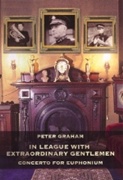
In League with Extraordinary Gentlemen (Euphonium Solo with Brass Band)
Concerto for EuphoniumIn League with Extraordinary Gentlemen combines two of composer Peter Graham's life interests - composition and 19th century popular fiction. Each of the concerto's three movements takes its musical inspiration from extraordinary characters who have transcended the original genre and have subsequently found mass audiences through film, television and comic book adaptations.The first movement follows a traditional sonata form outline with one slight modification. The order of themes in the recapitulation is reversed, mirroring a plot climax in the H.G. Wells novella The Time Machine (where the protagonist, known only as The Time Traveller, puts his machine into reverse bringing the story back full circle).The Adventure of the Final Problem is the title of a short story published in The Memoirs of Sherlock Holmes by Arthur Conan Doyle. This is an account of the great detective's final struggle with his long-time adversary Professor Moriarty at the Reichenbach Falls in Switzerland. The music takes the form of a slowed down lndler (a Swiss/Austrian folk dance) and various acoustic and electronic echo effects call to mind the alpine landscape. The final bars pose a question paralleling that of Conan Doyle in the story - have we really seen the last of Sherlock Holmes?The final movement, The Great Race, (available separately) follows Phileas Fogg on the last stage of his epic journey "Around the World in Eighty Days" (from the novel by Jules Verne). The moto perpetuo nature of the music gives full rein to the soloist's technical virtuosity. As the work draws to a conclusion, the frantic scramble by Fogg to meet his deadline at the Reform Club in Pall Mall, London, is echoed by the soloist's increasingly demanding ascending figuration, set against the background of Big Ben clock chimes.In League with Extraordinary Gentlemen was first performed in the brass band version by David Thornton and the Black Dyke Band, conductor Nicholas Childs, at the RNCM Concert Hall Manchester on January 30, 2009.
Estimated dispatch 7-14 working days
-
 £60.00
Fantastic Polka (Trombone Solo with Brass Band - Score and Parts)
Arthur Pryor is remembered primarily for his 12 years as the amazing trombone soloist with The Sousa Band. However, he was also a prolific composer and conductor, forming his own band following his years with Sousa. He wrote many trombone solos designed to dazzle audiences with his virtuosity.This brass band version was prepared at the request of The Black Dyke Band, musical director Nicholas J Childs, for a recording project with Ian Bousfield, principal trombone of the Vienna Philharmonic, titled Pryor Engagement. It has also been recorded by Brett Baker with Brass Band of the Western Reserve, musical director Keith M Wilkinson, on the CD Slides Rule!
Estimated dispatch 7-14 working days
-
 £30.00
Czardas (Eb solo with brass band) - Vittori Monti
Andrew Duncan has arranged this witty version of Vittori Monti's famous gypsy violin feature as a solo for Eb Bass/Tuba with brass band accompaniment, including a challenging (but optional!) showcase cadenza.Suitable for aspiring or advanced players, this piece is provided in print as a full score and band parts (solo parts are provided in both treble and bass clef).Also available as Eb Bass/Tuba solo with piano accompaniment; Bb Bass/Euphonium solo with piano accompaniment; and Eb Bass/tuba solo with quintet.Discography:Quintet version recorded by Halle Brass (Furioso)
In Stock: Estimated dispatch 3-5 working days
 View Music