
Results
-
In Dreams - Roy Orbison - Len Jenkins
"In Dreams" is a song composed and sung by rock and roll performer Roy Orbison, and was released as a single on Monument Records in February 1963. Orbison later claimed that the origin for "In Dreams" came to him while he was sleeping, as many of his songs did. When he woke up the next morning, the entire composition was written in 20 minutes. Like many of Orbison's songs, but unlike the majority of rock and roll ballads, in under 3 minutes it goes through seven movements with distinct melodies and chord progressions without repeating itself. It was for that reason that I have always believed it was a suitable piece for brass where one does not have lyrics to distinguish changes between verses to avoid monotony. Graham Cooper
-
 £30.00
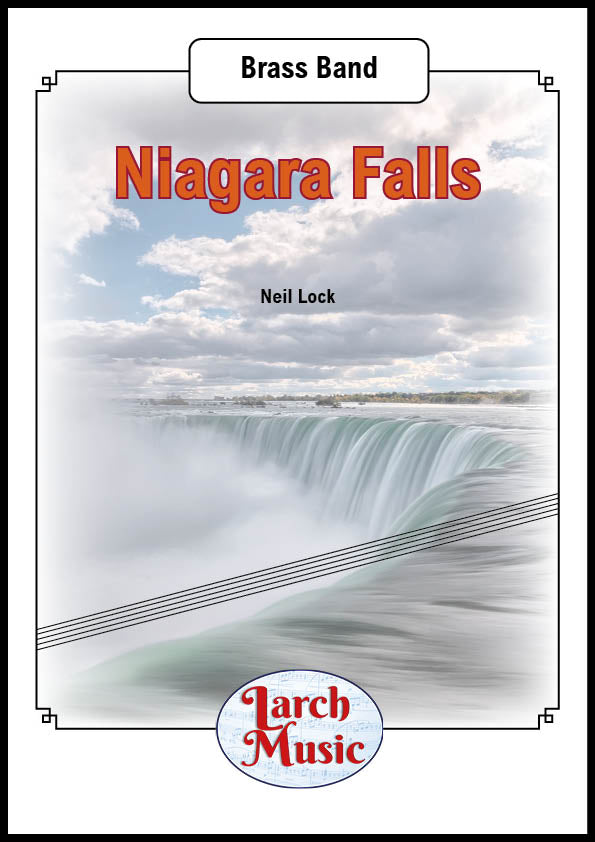
Niagara Falls - Brass Band - LM597
COMPOSER: Neil LockThis descriptive piece commemorates a visit I made to Niagara Falls back in October 1984.At the beginning, the music is very quiet; the falls are a long way away! But as it progresses, the noise of the falls becomes louder and louder. The piece has three principal motifs, whichrun through most of it. Descending crochets signify the water going over the cliff, and risingquavers the spray coming back up. And the frequent discord (a major chord with anadditional 2nd) represents wetness.Right after my first sight of the falls, I see the "Maid of the Mist" boat phut-phutting outinto the stream, with horns and E flat basses on the off-beat. There is also an "Indian"war-cry in this section from the trombone, euphonium and B flat bass. Then, an extendedclimax describes my first view of the full majesty of the falls.After this climax dies away, I go up the tower near the falls. The music goes into the minorkey, and loses the discord. It isn't wet up there!In the final section, I stand close to the falls; almost close enough, it seems, to put an armin. The music becomes very loud. Twice I look aside, but when I turn back the falls are stillthere. At the end, the descending crochet motif takes over entirely, and a timpani roll isfollowed by a classic final chord.
In Stock: Estimated dispatch 3-5 working days
-
 £44.95
Symphonic Rhapsody for Euphonium (Brass Band - Score and Parts) - Gregson, Edward
The Symphonic Rhapsody was published in 1976, although the genesis of the piece dates back to the early '60s when I was a teenager and played the euphonium in a Salvation Army band. The work incorporates an old gospel song - 'So we'll roll the old chariot along' - into a symphonically structured form. Motifs from the gospel song permeate the rest of the musical material so that the work hopefully has a unified whole. The 'variations' are less actual variations on the tune itself, but more a comment on certain melodic aspects.Although the writing is naturally virtuosic in a way which is obvious for such a solo instrument within the brass band, it never the less unfolds many more lyrical aspects of the instrument's capabilities. Towards the end of the piece the tune is heard once again in its full version, leading to a coda where the euphonium takes centre stage in a bravura manner.- Edward GregsonDuration: 10.00
Estimated dispatch 7-14 working days
-
 £54.99
Goodnight Saigon (Brass Band - Score and Parts) - Joel, Billy - Foster, Larry
Billy Joel began piano lessons when he was only 4 years old. At the age of 13 he discovered rock n roll and went on to produce countless hits in both rock and gentler styles. With this arrangement by Larry Foster De Haske has added on of Joel's most beautiful ballads to the brass band repertoire.Duration: 4.00
Estimated dispatch 7-14 working days
 View Music