
Results
-
 £39.95
Wizard of Oz Selection
Includes: The Merry Old Land of Oz; We're Off to See the Wizard; The Jitterbug; If I Only Had a Brain; Ding, Dong! The Witch is Dead; Over the Rainbow.
Estimated dispatch 7-14 working days
-
 £22.99
Albinus Variations (Brass Band - Score only)
Johann Georg Albinus wrote a number of Lutheran hymns set to music by various composers. Johann Sebastian Bach reworked and inserted some of these hymns into his cantatas, particularly the chorale "Alle Menschen mssen sterben" in BWV 162. Albinus Variations opens with a solemn cadenza followed by five contrasted variations on this chorale. Both versions of the chorale, in major and minor keys, were used as a reference for this work.Duration: 12.45
Estimated dispatch 7-14 working days
-
£114.99
Albinus Variations (Brass Band - Score and Parts)
Johann Georg Albinus wrote a number of Lutheran hymns set to music by various composers. Johann Sebastian Bach reworked and inserted some of these hymns into his cantatas, particularly the chorale "Alle Menschen mssen sterben" in BWV 162. Albinus Variations opens with a solemn cadenza followed by five contrasted variations on this chorale. Both versions of the chorale, in major and minor keys, were used as a reference for this work.Duration: 12.45
Estimated dispatch 7-14 working days
-
 £94.95
Contest Music (Brass Band - Score and Parts)
Butlins 2018 Champsionship Section. One of the three choices of set works. The others were Year of the Dragon (Sparke) and Concerto for Brass Band No.1 (Venables).
Estimated dispatch 7-14 working days
-
 £24.95
Judd: Ave Verum
During his brief career, Mozart wrote much music of various types, but some of his most valuable contributions were dedicated to the Church. Here is his beautiful 'Ave Verum'. The music simply breathes adoration and reverence, and because of this, if handled sympathectically, can hardly fail to stir within us deeply spiritual emotions. Adopt a vocal style of playing and observe intelligently the degrees of force and treat accordingly.
Estimated dispatch 7-14 working days
-
 £44.95
Oklahoma Show Selection
Includes: I Cain't Say No; Out Of My Dreams; The Surrey with the Fringe on Top; Oh What a Beautiful Mornin' Many a New Day; People Will Say We're in Love; Oklahoma.
Estimated dispatch 7-14 working days
-
 £39.95
A Touch of Irish Medley
Includes: If You're Irish Come into the Parlour; When Irish Eyes are Smiling; A Little Bit of Heaven; I'll Take You Home Again Kathleen; We're Irish and Proud of it Too.
Estimated dispatch 7-14 working days
-
 £109.99
Columbus - Rob Goorhuis
Christopher Columbus was born in Genoa in 1451. His father was a wool merchant. Originally he seemed destined to follow in his father's footsteps, and thus sailed the oceans to countries as far apart as Iceland and Guinea. In 1476 his ship was sunk during a battle off the coast of Portugal. Columbus saved his own life by swimming to shore. In 1484 he conceived the idea of sailing to the Indies via a westward sea route, but it was only in 1492 that he was able to realize this plan. On this first voyage he was in command of three ships: the flag-ship, called the Santa Maria, the Pinta, and the Ni?a. From Spain Columbus sailed via the Canary Islands to the Bahamas, whichhe sighted on October 12th 1492. Without being aware of it Columbus discovered the 'New World' he thought he had landed in the eastern part of Asia. The motif from Dvooak's 9th Symphony 'Aus der neuen Welt' forms a little counterfeit history at this point in the composition. After this first voyage Columbus was to undertake another three long voyages to America. These voyages were certainly not entirely devoid of misfortune. More than once he was faced with shipwreck, mutiny and the destruction of settlements he had founded. After Columbus had left for Spain from Rio Belen in 1503, he beached his ships on the coast of Jamaica. The crew were marooned there and it was only after a year that Columbus succeeded in saving his men and sailing back to Spain with them. In the music the misunderstanding about which continent Columbus discovered in his lifetime resounds, for does this part in the composition not contain Asiatic motifs? Poor Columbus! In 1506 the famous explorer died in Valladolid.
Estimated dispatch 5-14 working days
-
 £74.99
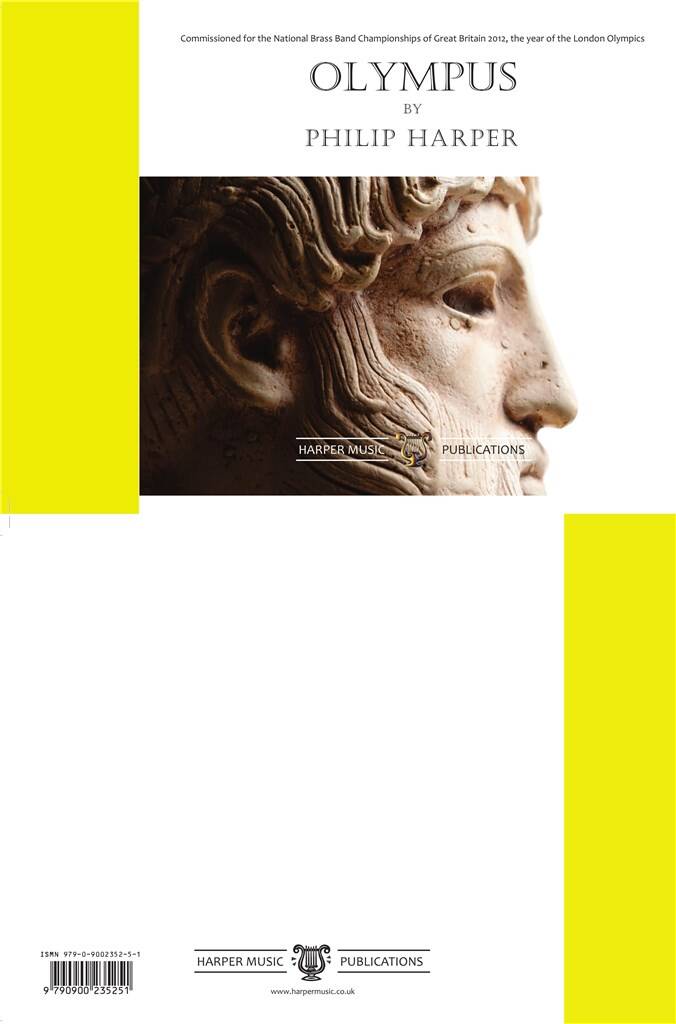
Olympus - Philip Harper
Selected as the test-piece for the 3rd Section Regional contests of the National Brass Band Championships 2012The music begins with a depiction of the exciting Opening Ceremony where noisy fanfares and sudden swells add to the cosmopolitan flag-waving clamour. Without a break the music leads to The Chariot Race, a fast compound-time gallop withthundering hooves in the basses and percussion, and a heroic melody introduced by the tenor horns. Chariot racing was the main equestrian event in the Ancient Greek Games, which were founded in memory of King Oenomaus. In the Greek legend he suffereddefeat in a chariot race to his son-in-law and Zeus' grandson, Pelops, but much of the music is bitter-sweet to symbolise the fact that Pelops had to cheat to win drawing parallels with some of the issues still facing modern-day athletics. A slow, mystical passage follows, describing The Temple of Zeus at Olympia. The statue of Zeus, who was honoured throughout the Ancient Games' history, was housed inside the temple and was one of the Seven Wonders of the Ancient World. Themusic depicts this period of the dawn of one of mankind's most ancient civilisations and there is a series of solo passages above a drone. The next section is called The Olympic Flame and a broad and lyrical anthem-like melody develops slowly in the euphoniums, which gradually ascends until the horns can take it over before passing upwards again to the cornets (Higher). The musicbursts into bright life at the lighting of the flame and the regular rhythmic pattern which has been established goes through an accelerando (Faster). The final section is called The Olympic Truce and aims to capture the cooperative spirit of the ancient practice of ending wars for the duration of the games. The anthem-like melody makes an affirmatory return (Stronger) and the work ends asit began with a blaze of colour and a real sense of optimism and global celebration. "Citius, Altius, Fortius" (Faster, Higher, Stonger)NOTES ON PERFORMANCEPercussion requirements: 1 to 3 players (3 Timpani, Snare Drum, Tenor Drum, Cymbals, Glockenspiel, Triangle)
Estimated dispatch 5-14 working days
-
 £54.99
My Way - Thijs Oud
The evergreen My Way, originally a French chanson (Comme d'Habitude), was written by Jacques Revaux and Gillies Thibault and first released by Claude Francois in 1967. Paul Anka wrote the English lyrics which were used by Frank Sinatra who made it in to the American charts with his world famous interpretation in 1969. Since then the song has been covered by a variety of pop stars, including Elvis Presley. This arrangement is based on the Elvis version and within it the chorus appears in a swinging blues style. This popular song will be ideal for that spectacular ending to your concert.
Estimated dispatch 5-14 working days
 View Music