
Results
-
 £44.95
Music of a Legacy - Contest Version (Brass Band - Score and Parts) - Ponsford, Steven
This piece pays tribute to the vast heritage of Salvation Army brass band music. Written in one movement, it is rhapsodic in nature and quotes references from just a few of the many iconic pieces from the past, progressing naturally through the different styles of music; firstly marches, followed by meditations, major works and then solos. The underpinning theme that binds the work together is the much-loved hymn, by Timothy Dudley-Smith, drawing particular attention to the last line of the first verse; 'Lord for the years, we bring our thanks today'. This is music of thanksgiving to the rich inheritance that inspires writers today to continue the mission of the gospel through this very special and unique genre.
Estimated dispatch 7-14 working days
-
£22.50
Music of a Legacy - Contest Version (Brass Band - Score only) - Ponsford, Steven
This piece pays tribute to the vast heritage of Salvation Army brass band music. Written in one movement, it is rhapsodic in nature and quotes references from just a few of the many iconic pieces from the past, progressing naturally through the different styles of music; firstly marches, followed by meditations, major works and then solos. The underpinning theme that binds the work together is the much-loved hymn, by Timothy Dudley-Smith, drawing particular attention to the last line of the first verse; 'Lord for the years, we bring our thanks today'. This is music of thanksgiving to the rich inheritance that inspires writers today to continue the mission of the gospel through this very special and unique genre.
Estimated dispatch 7-14 working days
-
 £119.95
Genesis (Sinfonia quasi una Fantasia) (Brass Band - Score and Parts) - Ellerby, Martin
One of the composer's most personal works, Genesis is cast in three independent movements but played in close (attacca) proximity to each other. Part One: Out of Darkness... quotes the German chorale Nun Danket (Now thank we all our God) text by Martin Rinkart (1586-1649) and the music by Johann Cruger (1598-1662) in a symbolic, somewhat cynical, style. Part Two: Les Chansons du Monde... (the songs of the earth or earth-songs) is composed with full attention to solo, duo and other combinations of instruments consistently in a cantabile style. Part Three: Into Light... concentrates on rhythmic agility and dance like qualities in a most exuberant fashion, bringing the work to a very positive conclusion. Duration: 14.45
Estimated dispatch 7-14 working days
-
£49.95
Genesis (Sinfonia quasi una Fantasia) (Brass Band - Score only) - Ellerby, Martin
One of the composer's most personal works, Genesis is cast in three independent movements but played in close (attacca) proximity to each other. Part One: Out of Darkness... quotes the German chorale Nun Danket (Now thank we all our God) text by Martin Rinkart (1586-1649) and the music by Johann Cruger (1598-1662) in a symbolic, somewhat cynical, style. Part Two: Les Chansons du Monde... (the songs of the earth or earth-songs) is composed with full attention to solo, duo and other combinations of instruments consistently in a cantabile style. Part Three: Into Light... concentrates on rhythmic agility and dance like qualities in a most exuberant fashion, bringing the work to a very positive conclusion. Duration: 14.45
Estimated dispatch 7-14 working days
-
£44.95
Music of a Legacy (Brass Band - Score and Parts) - Ponsford, Steven
This piece pays tribute to the vast heritage of Salvation Army brass band music. Written in one movement, it is rhapsodic in nature and quotes references from just a few of the many iconic pieces from the past, progressing naturally through the different styles of music; firstly marches, followed by meditations, major works and then solos. The underpinning theme that binds the work together is the much-loved hymn, by Timothy Dudley-Smith, drawing particular attention to the last line of the first verse; 'Lord for the years, we bring our thanks today'. This is music of thanksgiving to the rich inheritance that inspires writers today to continue the mission of the gospel through this very special and unique genre.
Estimated dispatch 7-14 working days
-
£22.50
Music of a Legacy (Brass Band - Score only) - Ponsford, Steven
This piece pays tribute to the vast heritage of Salvation Army brass band music. Written in one movement, it is rhapsodic in nature and quotes references from just a few of the many iconic pieces from the past, progressing naturally through the different styles of music; firstly marches, followed by meditations, major works and then solos. The underpinning theme that binds the work together is the much-loved hymn, by Timothy Dudley-Smith, drawing particular attention to the last line of the first verse; 'Lord for the years, we bring our thanks today'. This is music of thanksgiving to the rich inheritance that inspires writers today to continue the mission of the gospel through this very special and unique genre.
Estimated dispatch 7-14 working days
-
 £48.00
Tientos y Danzas (Brass Band - Score and Parts) - Wood, Gareth
Tientos y Danzas is a suite in four movements and was written especially for Superbrass. It is not literally descriptive, but conjures up a breezy, festive atmosphere. The title "Tientos" stems from the fact that a lot of the brass writing is reminiscent of virtuosic Renaissance keyboard finger-work (a "Tiento" is the Spanish equivalent of a toccata). Only later did we discover that the word is also the name of a style of flamenco dancing, which links nicely with Danzas (dances). The first movement is an extended fanfare, with military rhythms on the tenor drums and dramatic cornet and horn calls. Next comes a witty waltz featuring the horn. The music builds in complexity; the main horn theme returns before a playful coda. The following Andante makes effective use of the mutes, both in the haunting opening "pyramid" chords, and in the elaborate, recurrent cornet duets; the two cornets have the last word. After a couple of false starts, the finale sets off at a cracking pace, with dislocated accents creating an irregular rhythmic pulse. There are opportunities for every instrument to shine (metaphorically) and the music gets even faster for a thrilling conclusion. Duration: 10.30. Suitable for 1st Section Bands and above.
Estimated dispatch 7-14 working days
-
 £60.99
A Christmas Night (Brass Band - Score and Parts) - Jeanbourquin, Marc
In a Christmas Night, Marc Jeanbourquin revisits four great Christmas Eve classics in a fresh style. From the majestic chorale Adeste Fideles to the famous Joy to the World and a jazz version of the equally well-known Jingle Bells followed by We Wish You a Merry Christmas as a fitting conclusion, this medley expresses in music a traditional Christmastime to your audience.Duration: 4:15
Estimated dispatch 7-14 working days
-
 £29.95
The Dashing White Sergeant (Brass Band - Score and Parts) - Wiffin, Rob
This light programme piece is a creative and lateral tilt at the popular Scottish folk tune The Dashing White Sergeant. No composer is credited with the tune although, as early as 1884, it was thought to have been written by Henry Bishop, and there is a theory that there was a certain unwillingness to acknowledge that such a popular Scottish tune was written by an Englishman. The lyrics were written by Sir Hugh Roberton and include the line Dance away the hours together. There are many allusions to different types of dance in this piece, some traditional and others popular, and we travel around from Scotland to Siam and Spain.Duration: 3.00
Estimated dispatch 7-14 working days
-
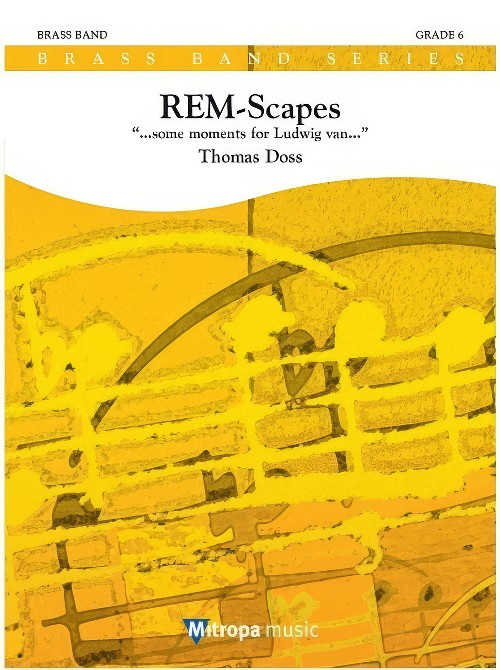 £29.50
REM-Scapes (Brass Band - Score only) - Doss, Thomas
Sweet echoes of Beethoven's Moonlight Sonata in the introduction bring a gentle slumber. Breathing is calm and sleep holds the promise of rest and relaxation. With the onset of the REM sleep phase, however, in which most dreams take place and where the day's events are worked through, we hear other sounds played. With distorted sounds, reminiscent of an old gramophone, the music pulls the listener inevitably ever deeper into the dreamscape, in a very realistic dangerous situation that comes to a dramatic head. It triggers a desperate struggle between the impulse to awaken and the exhausting urge to flee. For a short moment, it seems as if the wakeful urge has won out, before dream's powerful spell is again cast, and there's no escapeDuration: 17:00
Estimated dispatch 7-14 working days
 View Music