
Results
-
 £95.00
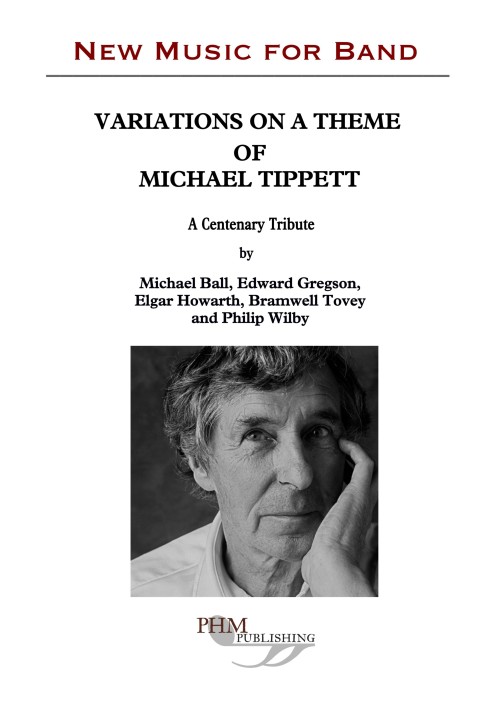
Variations on a Theme of Michael Tippett (Brass Band - Score and Parts) - Hindmarsh, Paul
A Centenary Tribute by Michael Ball, Edward Gregson, Elgar Howarth, Bramwell Tovey and Philip WilbyThis unique 'pice d'occasion' arose out of a telephone conversation in 2004 with Alan Wycherley, who was the soprano cornet player of the Foden's Richardson Band at the time. He indicated that the band would like to include an original birthday tribute for Edward Gregson (60) and Elgar Howarth (70) in its concert at the 2005 RNCM Festival of Brass in Manchester. I have been Artistic Director of Manchester's Festival of Brass since it was established in 1990 as a BBC Radio 3 series, As the centenary of the birth of Sir Michael Tippett fell on 5 January 2005, I devised this collective work as a way of embracing all three anniversaries in a novel way.The idea of joint compositions is not a new one in the classical music world. In the 1860s, Verdi was joined by a number of his contemporaries in a Requiem Mass for Rossini. In this country there have been a number of orchestral examples over the past fifty years, but never before for the brass band. Although Tippett composed only one work for brass band, Festal Brass with Blues, his orchestral works and operas are full of idiomatic brass writing. The theme I chose for this celebration is one of Tippet's most memorable miniatures featuring wind and brass. In the opera Midsummer Marriage it marks the entry of the Ancients. It is also included in the orchestral Suite in D (1948), for the Birthday of Prince Charles.I invited five of the leading contemporary voices in brass band music to add their own creative perspectives to the little Tippett theme, with it's characteristic rhythms, embellishments and modality - the Lydian mode. Each contribution was designed to fit into a tonal and formal template to give the whole work a flow and continuity. In Danse des Amis, Bramwell Tovey has composed a jazzy, humorous variation. Inspiration came from Tippett's love of jazz and, more personally, from the characteristically syncopated gait of the distinguished music critic John Amis, who Tovey once observed leaving a performance of Tippett's opera King Priam before the end. Incidentally, that performance was conducted by Elgar Howarth.We hear Edward Gregson in lyrical mode. His Midsummer Song is redolent of the sound world of Tippett's opera A Midsummer Marriage and it ends with a brief reference to a favourite of Gregson's, Tippett's Concerto for Orchestra. Michael Ball provides a brief moment of light, airy activity bringing to mind perhaps Tippett's love of Shakespearian fantasy, especially The Tempest. Elgar Howarth juxtaposes a slowed down version of the processional theme with distant recollections of fanfares from King Priam. Philip Wilby has rounded the tribute off with a spectacular fugue. During its inexorable progress Wilby ingeniously introduces the two other birthday references - the three-note musical signature that Elgar Howarth includes in much of his music and the characteristic theme which begins Edward Gregson's substantial work for brass an organ The Trumpets of the Angels. An elaborated reprise of Tippett's little theme is followed by a dynamic coda.- Paul HindmarshDuration: 13.00
Estimated dispatch 7-14 working days
-
£40.00
Variations on a Theme of Michael Tippett (Brass Band - Score only) - Hindmarsh, Paul
A Centenary Tribute by Michael Ball, Edward Gregson, Elgar Howarth, Bramwell Tovey and Philip WilbyThis unique 'pice d'occasion' arose out of a telephone conversation in 2004 with Alan Wycherley, who was the soprano cornet player of the Foden's Richardson Band at the time. He indicated that the band would like to include an original birthday tribute for Edward Gregson (60) and Elgar Howarth (70) in its concert at the 2005 RNCM Festival of Brass in Manchester. I have been Artistic Director of Manchester's Festival of Brass since it was established in 1990 as a BBC Radio 3 series, As the centenary of the birth of Sir Michael Tippett fell on 5 January 2005, I devised this collective work as a way of embracing all three anniversaries in a novel way.The idea of joint compositions is not a new one in the classical music world. In the 1860s, Verdi was joined by a number of his contemporaries in a Requiem Mass for Rossini. In this country there have been a number of orchestral examples over the past fifty years, but never before for the brass band. Although Tippett composed only one work for brass band, Festal Brass with Blues, his orchestral works and operas are full of idiomatic brass writing. The theme I chose for this celebration is one of Tippet's most memorable miniatures featuring wind and brass. In the opera Midsummer Marriage it marks the entry of the Ancients. It is also included in the orchestral Suite in D (1948), for the Birthday of Prince Charles.I invited five of the leading contemporary voices in brass band music to add their own creative perspectives to the little Tippett theme, with it's characteristic rhythms, embellishments and modality - the Lydian mode. Each contribution was designed to fit into a tonal and formal template to give the whole work a flow and continuity. In Danse des Amis, Bramwell Tovey has composed a jazzy, humorous variation. Inspiration came from Tippett's love of jazz and, more personally, from the characteristically syncopated gait of the distinguished music critic John Amis, who Tovey once observed leaving a performance of Tippett's opera King Priam before the end. Incidentally, that performance was conducted by Elgar Howarth.We hear Edward Gregson in lyrical mode. His Midsummer Song is redolent of the sound world of Tippett's opera A Midsummer Marriage and it ends with a brief reference to a favourite of Gregson's, Tippett's Concerto for Orchestra. Michael Ball provides a brief moment of light, airy activity bringing to mind perhaps Tippett's love of Shakespearian fantasy, especially The Tempest. Elgar Howarth juxtaposes a slowed down version of the processional theme with distant recollections of fanfares from King Priam. Philip Wilby has rounded the tribute off with a spectacular fugue. During its inexorable progress Wilby ingeniously introduces the two other birthday references - the three-note musical signature that Elgar Howarth includes in much of his music and the characteristic theme which begins Edward Gregson's substantial work for brass an organ The Trumpets of the Angels. An elaborated reprise of Tippett's little theme is followed by a dynamic coda.- Paul HindmarshDuration: 13.00
Estimated dispatch 7-14 working days
-
 £29.95
Dalaro (Brass Band - Score and Parts) - Gregson, Edward
The name of Edward Gregson is well known in Salvationist circles as well as in the wider music world, his music receiving performances and being recorded and published regularly. This music is individual and of high worth with an assured technique. It is always a pleasurable task for the musician to handle music with these qualities, whether one is editor, conductor or player.Written in connection with the International Salvation Army Students' Fellowship Conference held in Dalaro, Sweden in 1964, this is a 'festival' rather than processional march. Section C is a tune from the Swedish Tune Book (No. 303 in the 1945 edition), Jag gar till det land dar ovan (I go to that Land above). There is a slight divergence from the tune book version (labelled, by the way, as an English tune); this could well be the manner in which the tune is sung - we are all aware of the way in which congregations modify tunes.
Estimated dispatch 7-14 working days
-
 £54.95
WORLD WITHIN, A (Brass Band Parts) - Scott, Andy
Brass Band parts only. 'A World Within' is a one-movement work that starts with a simple theme stated by the Soprano Cornet before an ostinato figure in 6/8 time emerges (Vibraphone, Horns and muted 2nd and 3rd Cornets) over which firstly Solo Cornet, and then both Solo Cornets (1 & 2), play a sustained melody. A shift between major and minor harmonies characterises the 'B' section, before making way for a virtuosic Flugel solo. When the Flugel leaves centre stage the front line Cornets take over, leading to a full bodied reprise of the 'B' section. The low brass bridge the gap between what is in effect the end of the first main section of the piece and the second section. The constant time shift between 3/4 and 6/8 that has been prevalent through-out 'A World Within', re-emerges towards the end of the 'slow, heavy blues' section, leading into an intricate almost fugue-like passage (Horn and Baritone leading the way). Out of this comes a short transitional bridge section that leads us back to the (transposed) original 6/8 time theme and feel, this time scored with a bold directness that leads to a powerful 2/4 time passage. The climax of 'A World Within' is heralded by one dark and dissonant chord that is repeated three times. A flashback moment occurs where the 'hymn' is stated (muted Cornets) in a bitonal harmonic world. A final statement emerges from the denseness of sound, a re-working of the initial theme (Solo Cornet), with the last work being left to Solo Eb Bass. Dur: 13:00
Estimated dispatch 7-14 working days
-
£20.00
WORLD WITHIN, A (Brass Band Score) - Scott, Andy
Brass Band score only. 'A World Within' is a one-movement work that starts with a simple theme stated by the Soprano Cornet before an ostinato figure in 6/8 time emerges (Vibraphone, Horns and muted 2nd and 3rd Cornets) over which firstly Solo Cornet, and then both Solo Cornets (1 & 2), play a sustained melody. A shift between major and minor harmonies characterises the 'B' section, before making way for a virtuosic Flugel solo. When the Flugel leaves centre stage the front line Cornets take over, leading to a full bodied reprise of the 'B' section. The low brass bridge the gap between what is in effect the end of the first main section of the piece and the second section. The constant time shift between 3/4 and 6/8 that has been prevalent through-out 'A World Within', re-emerges towards the end of the 'slow, heavy blues' section, leading into an intricate almost fugue-like passage (Horn and Baritone leading the way). Out of this comes a short transitional bridge section that leads us back to the (transposed) original 6/8 time theme and feel, this time scored with a bold directness that leads to a powerful 2/4 time passage. The climax of 'A World Within' is heralded by one dark and dissonant chord that is repeated three times. A flashback moment occurs where the 'hymn' is stated (muted Cornets) in a bitonal harmonic world. A final statement emerges from the denseness of sound, a re-working of the initial theme (Solo Cornet), with the last work being left to Solo Eb Bass. Dur: 13:00
Estimated dispatch 7-14 working days
-
 £95.00
Tenor Horn Concerto 'Three Gods' (Tenor Horn Solo with Brass Band - Score and Parts) - Gregson, Edward
Edward Gregson's Tenor Horn Concerto (Three Gods) was commissioned by the Belgian tenor horn soloist Tim de Maeseneer for a recording of commissioned works he made in 2024 with his own band, Brass Band Willebroek.The subtitle of 'Three Gods' refers to three mythological Greek Gods: Zeus, Hermes and Apollo. The idea for this came from Gregson's Viola Concerto, which he composed in 2023 and which was similarly subtitled 'Three Goddesses'. Indeed, the first movement of the horn concerto shares some common material with the viola concerto, although the other movements are newly composed.The concerto exploits the noble character of the horn, but the writing is also virtuosic in character as well as lyrical and melodic, demanding an extended playing range of nearly four octaves with a variety of colouration in its sonorities. The unifying motif of the whole concerto is the interval of a rising 5th, heard at the outset. The opening also has some other surprises (both seen and heard).The musical ideas, cast in three separate movements, take their starting point from the characters of the Three Gods in the title:Zeus, ruled as King of the Gods on Mount Olympus, and was the God of Thunder and Lightning and of War. His music is often threatening and violent, but also has a more tender side as portrayed in the lyrical second subject. However, the dominant mood is one of foreboding.Hermes was the great messenger to the Gods who could travel between realms on his winged sandals. Thus, his music is fast, fleet of foot, and mercurial - a dashing scherzo, but with lyrical and expressive moments.Apollo, the God of Music and Dance (and the Sun), symbolises virtue and beauty. This final movement, 'Hymn to Apollo', is mainly slow and hymn-like and cast in a continuous stream of melody passed between soloist and band. Brief fanfares herald a triumphant march, before the music returns to its quiet opening, gradually rising to a triumphant climax with glittering melodic percussion leading the way. The music ends in a blaze of glory!Duration: 17.00
Estimated dispatch 7-14 working days
-
£40.00
Tenor Horn Concerto 'Three Gods' (Tenor Horn Solo with Brass Band - Score only) - Gregson, Edward
Edward Gregson's Tenor Horn Concerto (Three Gods) was commissioned by the Belgian tenor horn soloist Tim de Maeseneer for a recording of commissioned works he made in 2024 with his own band, Brass Band Willebroek.The subtitle of 'Three Gods' refers to three mythological Greek Gods: Zeus, Hermes and Apollo. The idea for this came from Gregson's Viola Concerto, which he composed in 2023 and which was similarly subtitled 'Three Goddesses'. Indeed, the first movement of the horn concerto shares some common material with the viola concerto, although the other movements are newly composed.The concerto exploits the noble character of the horn, but the writing is also virtuosic in character as well as lyrical and melodic, demanding an extended playing range of nearly four octaves with a variety of colouration in its sonorities. The unifying motif of the whole concerto is the interval of a rising 5th, heard at the outset. The opening also has some other surprises (both seen and heard).The musical ideas, cast in three separate movements, take their starting point from the characters of the Three Gods in the title:Zeus, ruled as King of the Gods on Mount Olympus, and was the God of Thunder and Lightning and of War. His music is often threatening and violent, but also has a more tender side as portrayed in the lyrical second subject. However, the dominant mood is one of foreboding.Hermes was the great messenger to the Gods who could travel between realms on his winged sandals. Thus, his music is fast, fleet of foot, and mercurial - a dashing scherzo, but with lyrical and expressive moments.Apollo, the God of Music and Dance (and the Sun), symbolises virtue and beauty. This final movement, 'Hymn to Apollo', is mainly slow and hymn-like and cast in a continuous stream of melody passed between soloist and band. Brief fanfares herald a triumphant march, before the music returns to its quiet opening, gradually rising to a triumphant climax with glittering melodic percussion leading the way. The music ends in a blaze of glory!Duration: 17.00
Estimated dispatch 7-14 working days
-
 £60.99
Cityscape (Brass Band - Score and Parts) - Hadermann, Jan
Cityscape was commissioned for the 't Stad Geblazen event, which took place during the weekend of European Heritage Days in 2024.This short concert piece describes the impressions given when approaching and visiting the beautiful Belgian city of Antwerp from the north across the river Scheldt. We first pass the busy bustle of the harbour, home to the impressive Port House. Then the old city comes into view: the graceful cathedral tower, surrounded by smaller church spires and modern buildings, dominates the distinctive skyline. After setting foot ashore, we are struck by the beautiful way the medieval buildings here blend harmoniously with modern architecture. Our walk through the city continues: we visit the serene cathedral and are impressed by the picturesque facades of and around the city hall, as well as the Brabo Fountain on the Grote Markt (Large Market Square). Finally, it is time to enjoy the merriment taking place on the many squares of the lively city centre.Duration: 5.30
Estimated dispatch 7-14 working days
-
 £68.99
Wicked, Selections from (Brass Band - Score and Parts) - Schwartz, Stephen - Bocook & Jeanbourquin
Rarely has a musical in modern times taken Broadway by storm the way this huge hit from Stephen Schwartz has done. The story line of the Wicked Witch of the West is intriguing and the music is filled with depth and beauty. This powerful medley includes:No One Mourns The WickedDancing Through LifeNo Good DeedFor GoodDefying GravityDuration: 8.30
Estimated dispatch 7-14 working days
-
 £68.99
Majesty (Brass Band - Score and Parts) - Deleruyelle, Thierry
Majesty is a powerful and spectacular overture. The work opens with a brilliant fanfare before making way for a majestic hymn. The end of the piece repeats the opening fanfare as a monumental finale in the style of an American symphonic march. This composition is dedicated to Queen Elizabeth II.Duration: 6.15
Estimated dispatch 7-14 working days
 View Music