
Results
-
 £79.99
Valerius Variations - Philip Sparke
Dutch composer, artist and poet Adriaen Valerius is mostly remembered today for his collection of 79 songs for voice and lute or cittern, published posthumously in 1626. Philip Sparke has taken one melody from this collection that tells of the War of Independence with Spain. The beautiful slow melody is followed by a series of lively variations to form an extremely entertaining piece that will bring great joy to all who perform and listen to it.
Estimated dispatch 5-14 working days
-
 £54.99
Images for Brass - Stephen Bulla
Stephen Bullas highly descriptive work was written to commemorate the 50th anniversary of the Battle of Iwo Jima, which took place between the 19th February and 26th March 1945.Casualties on both the American and Japanese sides were horrendously high before the famous image of the raising of the flag on top of Mount Suribachi signalled the end of one of the most significant and terrifying Pacific conflicts of the SecondWorld War.The work received its first performance by the brass choir of the U.S. Marine Band at the National Cathedral in Washington D.C. and is divided into four programmatic sections.The first portrays the sense of anticipation before conflict (Prologue), before the arduous journey to the scene of the battle (Approach by Sea) is followed by introspection and prayer featuring the hymn tune Melita (Chorale Prayer), andfinally, the hostile confrontation itself (Engagement).There are frequent references to the Marines Hymn and the US National Anthem, particularly in the closing bars, depicting the ultimate raising of the American flag.
Estimated dispatch 5-14 working days
-
 £60.99
Washington Grays - Traditional - James Curnow
Claudio S Grafulla was born on the Spanish island of Minorca in 1818 and emigrated to the United States in 1838. Although he was a composer of many original works, the one that is still regarded as one of the finest marches ever written is his Washington Grays March. This arrangement strives to recreate the original lost version written for an American Civil War brass band.
Estimated dispatch 5-14 working days
-
£69.99
El Cumbanchero - Rafael Hernandez - Naohiro Iwai
Rafael Hernandez (1892-1965) was probably the greatest composer in Puerto Rico. After serving in World War I, he worked in the USA, in Mexico and in Puerto Rico as a musician, composer, band-leader and actor. Masato Myokoin has written this new, exciting arrangement of Rafael Hernandez' biggest international hit, El Cumbanchero.
Estimated dispatch 5-14 working days
-
 £78.20
The Rocketeer - James Horner - Roland Smeets
Before Titanic,James Horner was not above composing scores for cartoonish family films, and many of those that brought him on their production board owe him greatly. The Rocketeer entails the story of a young pilot during World War II who happens upon a rocket pack that allows him to fly. The film is based on the tradition of old film serials that left theater-goers hanging with "To be continued," and aside from modern production, it is old fashioned and innocent fun. Horner's score begins and ends with the brilliant "Main Title," which is so moving it was used in previews for later films that did not yet have finished scores. Most of th Rocketeersoundtrack elicits the adventure and lifting spirit of the film and reveals how Horner incorporates rich instrumentals in the tiniest crevices. Even when the film involves danger, as in "Jenny's Rescue," the composer takes care when it is hardly even required. Instead of some "duh-duh-duhs," he brings on a full, stunning orchestra and when he overdoes it, it is in a jolly way -- he never exhausts his medium. That is what separates him from inferior composers, and what makes a nice film like The Rocketeer extra nice. It is a soundtrack worth listening to.
Estimated dispatch 5-14 working days
-
 £59.95
Blitz - Derek Bourgeois
The dictionary definition of Blitz is any sudden, overwhelming attack, particularly from the air. It is shortened form of the German word Blitzkrieg, literally meaning a lightning war. The piece is a test of skill, nerve and stamina, culminating in an aural 'Blitz' of great ferocity. The tempo markings in this piece are intended merely as a guide to performers. The composer is particularly anxious that they should not be considered inviolate. Commissioned with funds provided by the Arts Council of Great Britain for the finals of National Brass Band Championships held in the Royal Albert Hall, London, on the 3rd October, 1981.
Estimated dispatch 5-14 working days
-
£104.99
Firestorm - Stephen Bulla
The inspiration for this piece, commissioned by the United States Army Band, came from the Gulf and its constant presentation to the world as a media event on television. The composer wanted to capture the colour and events of war as they were played out on the television screen. Composed as a single movement rhapsody, the work is framed by the riveting sounds of airborne bombing raids with brass and percussion combining to create a gripping sense of tension.
Estimated dispatch 5-14 working days
-
 £154.99
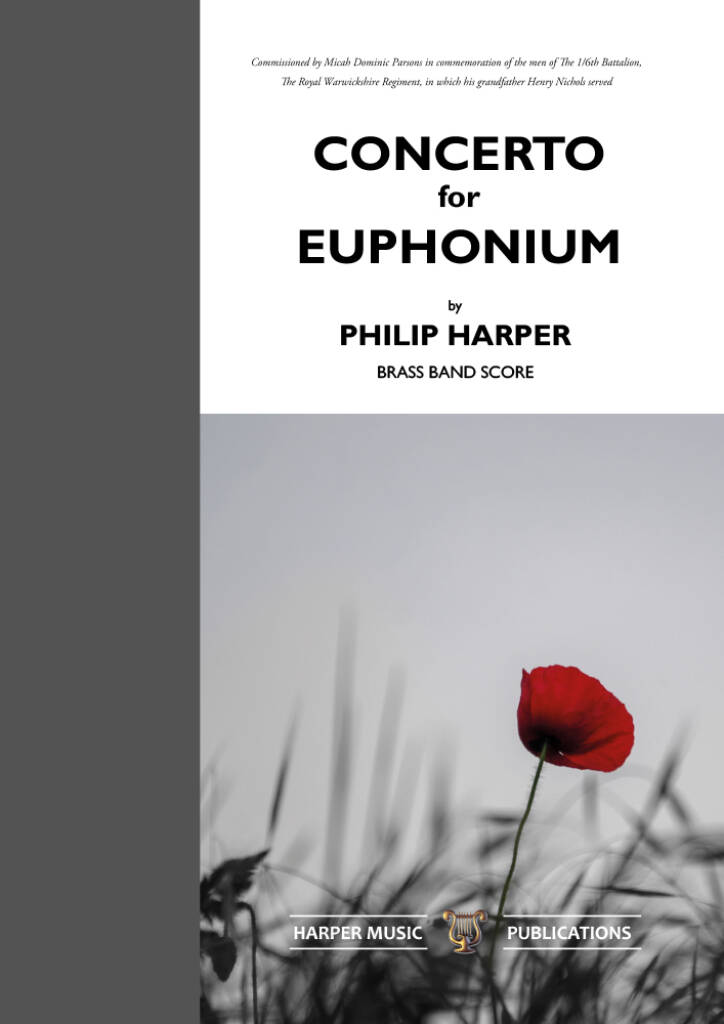
Concerto for Euphonium - Philip Harper
This Concerto for Euphonium casts the euphonium soloist as one of the young soldiers in a World War I battalion for an intensely intimate and visceral experience of events. However the music also portrays a more general human journey, and will appeal on a number of levels. There are three movements which have the following subtitles: I - Summer 1916 - Days of YouthII - Winter 1916 - The Weight of MaturityIII - 4th February 1917 - ReleaseAlthough challenging, the solo part is designed to be achievable by all ambitious euphonium soloists.
Estimated dispatch 5-14 working days
-
 £115.60
Starship Battle - Roar Minde Fagerli
Startship Battle is a catchy composition inspired by music written for film an series who describes war in space.The form of the composition is a typical ABA structure. It starts with a fast A-part with a transition to a slow choral in the B-part and ends with a repetition of the A-part. With a duration of approx. five mins, this is a quite long composition from the composer at this grade level. The piece will fit to any contest- or concert use.
Estimated dispatch 5-14 working days
-
 £76.99
Free World Fantasy - Jacob de Haan
This piece was commissioned by the Dutch province of Groningen for the celebrations commemorating the liberation festivities in 1987. In the composition, the dream of a world without war is symbolized. It is the first composition in a series in which Jacob de Haan combines concert music with pop music in a style, which reminds one of film music. Later compositions in which he has reaped much success with the same formula in style are Oregon, La Storia and Utopia.
Estimated dispatch 5-14 working days
 View Music