
Results
-
 £40.00
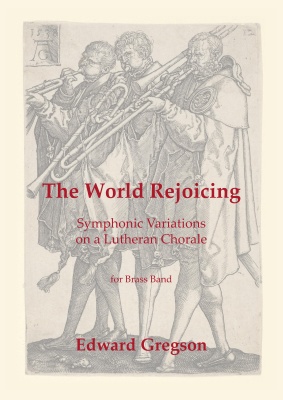
The World Rejoicing (Brass Band - Score only)
The World Rejoicing was commissioned by the National Brass Band Associations of Belgium, Netherlands, Norway, Switzerland, and the British Open, as the test piece for their competitions in 2020/21. Although the work was completed in 2019, the pandemic of 2020 meant that these competitions were postponed until 2021/22. The premiere took place in September 2021 at Symphony Hall, Birmingham, UK.In searching for a common link between the brass band traditions of the various European countries that commissioned this work, I considered the fact that hymns have always played an important role in the relationship that brass bands have with their particular communities; and thus I turned to a well- known Lutheran chorale, Nun danket alle Gott (Now thank we all our God), written around 1636 by Martin Rinkart, with the melody attributed to Johann Cruger. A number of composers have incorporated this chorale into their music, most famously J.S. Bach in his Cantatas no. 79 and 192, and Mendelssohn in the Lobsegang movement of his 2nd Symphony (the harmonisation of which is usually used when this hymn is sung).It seemed fitting therefore for me to return to a compositional form I have used many times before (Variations) and to write a work based on this hymn. I have used it in a similar way to that which I employed in my Variations on Laudate Dominum of 1976 - that is, rather than writing a set of variations using elaborations of the complete tune, I have taken various phrases from the chorale and used them within the context of other musical material, applying an overall symphonic process of continuous variation and development. The structure, or sub-divisions of the work, which is through composed and plays without a break, is as follows:Prelude, Capriccio, La Danza 1, Processional, La Danza 2, Arias and Duets, Fuga Burlesca, Chorale, and Postlude.The work, which is around 16 minutes in length, is also partly autobiographical - in the manner say of Strauss's Ein Heldenleben - in that I have incorporated into the score brief quotations from many of my other major works for brass band. In that respect, The World Rejoicing sums up a particular facet of my life as a composer, and reflects the admiration I have always had for what is surely one of the great amateur music-making traditions in the world.Duration: 16.00
Estimated dispatch 7-14 working days
-
 £15.00
The World Rejoicing (Brass Band - Study Score)
In searching for a common link between the brass band traditions of the various European countries that commissioned this work, I considered the fact that hymns have always played an important role in the relationship that brass bands have with their particular communities; and thus I turned to a well-known Lutheran chorale, Nun danket alle Gott (Now thank we all our God), written around 1636 by Martin Rinkart, with the melody attributed to Johann Crger. A number of composers have incorporated this chorale into their music, most famously J.S.Bach in his Cantatas no. 79 and 192, and Mendelssohn in the Lobsegang movement of his 2nd Symphony (the harmonization of which is usually used when this hymn is sung).It seemed fitting therefore for me to return to a compositional form I have used many times before (Variations) and to write a work based on this hymn. I have used it in a similar way to that which I employed in my Variations on Laudate Dominum of 1976 - that is, rather than writing a set of variations using elaborations of the complete tune, I have taken various phrases from the chorale and used them within the context of other musical material, applying an overall symphonic process of continuous variation and development. The structure, or sub-divisions of the work, which is through composed and plays without a break, is as follows: Prelude, Capriccio, La Danza 1, Processional, La Danza 2, Arias and Duets, Fuga Burlesca, Chorale, and Postlude.The work is also partly autobiographical - in the manner say of Strauss's Ein Heldenleben - in that I have incorporated into the score brief quotations from many of my other major works for brass band. In that respect, The World Rejoicing sums up a particular facet of my life as a composer, and reflects the admiration I have always had for what is surely one of the great amateur music-making traditions in the world.The World Rejoicing is dedicated 'in loving memory of my brother', Bramwell Logan Gregson, who sadly passed away in the Autumn of 2018.Edward Gregson
Estimated dispatch 7-14 working days
-
 £59.95
Judd: Caelum Corona - Stephen Bulla
Stephen Bulla's 'Caelum Corona' ('Crown of Heaven') portrays, in sound, a Christian's walk in faith, intended metaphorically via a musical narrative reminiscent of the early church pilgrims, their struggles and triumphs. The composer initially evokes the atmosphere of Rome at the time of St. Paul and other martyrs, thus the Latin title. Bulla marks his imaginative tone poem with dark, brooding music in the first two of three parts, in each of which he has embedded an appropriate hymn or song reference as thematic material. The first of these sounds in a minor key following a symphonic exposition made up primarily of fanfare-like motives, the music at times quite harsh and abrasive. The song is Paul's statement of exuberant faith (2 Timothy 1:12) in the midst of prison and persecution: 'For I know whom I have believed, and am persuaded that he is able to keep that which I've committed unto him against that day.' More challenging, aggressive music returns until a further point of reflection on Christ's sacrifice is reached. The music graphically evokes the barren landscape of Golgatha, the horror of the crucifixion, including stark wind sounds, a loss of stability via eerie, dissonant chord clusters, and even the nails being driven into Christ's body. The Baritones and then Flugel Horn softly play 'He died of a broken heart.' Yet the Christian life, despite its perils - both at the time of Paul and now - is a victorious life, and the composer resolves the tensions of the work in a scintillating finale, a brilliant setting of the old song about spiritual warfare and the ultimate triumph of Christ the King: 'Victory for me!' (T.B. 841). The chorus of that tune proclaims: 'No retreating, hell defeating, shoulder to shoulder we stand; God look down, with glory crown our conq'ring band.' That crowning is the same one sought and claimed by St. Paul (2 Timothy 4:8): 'Now there is in store for me a crown of righteousness, which the Lord, the righteous judge, will award me on that day, but also to all who have longed for his appearing.' Believers look forward to participating in the final coronation of their Saviour - King of Kings and Lord of Lords - while humbly desiring their own 'crown of heaven.'
Estimated dispatch 7-14 working days
-
 £48.56
Perspectives from Gallipoli (Brass Band) Fendall Hill
This powerful and evocative work by Australian-New Zealand composer Fendall Hill pays tribute to the ANZAC soldiers who passed through Weymouth, Dorset during World War I. Inspired by first-hand accounts, the piece follows the emotional journey of a young soldier - from eager enlistment, through the harrowing Gallipoli campaign, to recovery and reflection in Weymouth. Structured in four movements, the music captures anticipation, fear, fierce resistance, and eventual healing, culminating in a moment of remembrance. The hymn tune Wareham -written by Dorset composer William Knapp - features prominently as a thematic thread, honouring the region's historical connection to the ANZAC legacy. A deeply moving addition to the brass band repertoire, this work is both a musical narrative and a heartfelt gesture of gratitude to the people of Dorset for their care and ongoing commemoration of the ANZACs. To view a performance of the work featuring ANZAC Brass please visit www.youtube.com/watch?v=diz9TRz7rwE Duration: approx. 8.00 minutes Difficulty Level: 1st Section + PDF download includes parts and score. Sheet music available at www.brassband.co.uk (UK) or https://satradecentral.org (USA) Instrumentation: Soprano Cornet Eb Solo Cornet Bb Repiano Cornet Bb 2nd Cornet Bb 3rd Cornet Bb Flugel Horn Bb Solo Horn Eb 1st Horn Eb 2nd Horn Eb 1st Baritone Bb 2nd Baritone Bb 1st Trombone Bb 2nd Trombone Bb Bass Trombone Euphonium Bb Bass Eb Bass Bb Timpani Percussion 1-3
In Stock: Estimated dispatch 1-3 working days
-
 £33.62
Veni, Sancte Spiritus (Brass Band) Vaughan Williams arr. Geoffrey Nobes
Originally conceived as a ceremonial work for the Band of the Royal Air Force Regiment, Veni, Sancte Spiritus was written for a Thanksgiving Service at St Clement Danes Church - the Central Church of the RAF in London. This evocative piece was inspired by the church's thousand-year-old architecture and resonant acoustic, creating a soundscape that is both reverent and atmospheric. In adapting the work for brass band, the composer introduces Vaughan Williams's hymn tune Down Ampney, seamlessly woven into the final sections of the piece. This lyrical addition enhances the spiritual tone of the music, aligning perfectly with the hymn text 'Come Down, O Love Divine', and lending the work its new title and emotional depth. Perfect for concert, ceremonial, or liturgical use, Veni, Sancte Spiritus offers a profound and reflective experience for performers and audiences alike. To view a video of the International Staff Band performing the work, please visit https://youtu.be/y5YGmKRAaic?si=7x8mBppMDEVh21Dt Duration: approx. 4.00 minutes Difficulty Level: 4th Section + PDF download includes parts and score. Sheet music available at www.brassband.co.uk (UK) or https://satradecentral.org (USA) Instrumentation: Soprano Cornet Eb Solo Cornet Bb 1st Cornet Bb 2nd Cornet Bb Flugel Horn Bb Solo Horn Eb 1st Horn Eb 2nd Horn Eb 1st Baritone Bb 2nd Baritone Bb 1st Trombone Bb 2nd Trombone Bb Bass Trombone Euphonium Bb Bass Eb Bass Bb Timpani
In Stock: Estimated dispatch 1-3 working days
-
 £89.95
Songs of Ascent - Jonathan Bates
DURATION: 14 minutes. DIFFICULTY: Championship. 'Songs of Ascent' was composed for the Royal Northern College of Music Brass Band, as part of their programme for the 2019 RNCM Festival of Brass. In my view, the festival itself is the leading showcase for original contemporary music for the medium (in a concert setting) in the world and therefore an ideal place to explore new ideas and sounds, which was a notion fundamental to the construction of this work. The piece is subtitled 'Out of the Depths, I cry to you, O Lord'; the opening line of Psalm 130 (which forms part of a set of 15 psalsm, 120-134 known as the Songs of Ascent") which forms the main inspiration for much of the musical material. Following an extended opening for four individual tuba lines, there are a number of solos for members of the band off stage, with bleak and deep accompaniment lines, reflecting the words of Psalm 130. Amongst these 'songs of ascents', the most common and strong themes are repentance and redemption; with the central core of this work emerging 'from the depths' to reveal one of very few calming and reflective passages of the work utilising the tune of 'Guide Me O Thy Great Redeemer' in a new setting, featuring the Solo Horn and Bass Trombone, before returning to the ethereal and dark timbres that form much of the music up to this point. In terms of compositional technique, this work is solely based on a set of 4 9-note scales in their various unique transpositions (below). Each of these scales provide a set of 2 whole tone scales, 6 minor triads, 6 major triads and is built on 9 augmented triads. Whilst most of the music in this work is based melodically on the set of notes (heard right at the outset in the motif in the tuba line), the central section delves into the harmonic capabilities of these 'modes', using a number of the 7 'keys' which can be derived from the minor & major chords derived in each scale. All 4 scales are used independantly to each other, with whole sections of the work focussing on each mode. 'Songs of Ascent' was selected as the set work for the Championship Section at the Butlin's Mineworker's Championships in 2020.
In Stock: Estimated dispatch 1-3 working days
-
 £69.00
Enjoy Your Weekend! - Peter Goosensen
Enjoy your Weekend! is a fun and varied composition that offers lots of playing pleasure for both youth and smaller bands. The composition is based on a simple and pretty theme. The first part, Lazy Sunday, is built around a relaxed swinging tune. The second part, Close Friends, is more melodic and serious in nature. In Party Rock, the third part, the drummer plays a central role and the band can play their hearts out. Enjoy your Weekend!
Estimated dispatch 10-14 working days
-
 £18.00
Scarborough Fair
DescriptionScarborough Fair is a traditional English ballad about the Yorkshire town of Scarborough. The song relates the tale of a young man who instructs the listener to tell his former love to perform for him a series of impossible tasks, such as making him a shirt without a seam and then washing it in a dry well, adding that if she completes these tasks he will take her back. Often the song is sung as a duet, with the woman then giving her lover a series of equally impossible tasks, promising to give him his seamless shirt once he has finished.As the versions of the ballad known under the title Scarborough Fair are usually limited to the exchange of these impossible tasks, many suggestions concerning the plot have been proposed, including the theory that it is about the Great Plague of the late Middle Ages. The lyrics of "Scarborough Fair" appear to have something in common with an obscure Scottish ballad, The Elfin Knight which has been traced at least as far back as 1670 and may well be earlier. In this ballad, an elf threatens to abduct a young woman to be his lover unless she can perform an impossible task.As the song spread, it was adapted, modified, and rewritten to the point that dozens of versions existed by the end of the 18th century, although only a few are typically sung nowadays. The references to the traditional English fair, "Scarborough Fair" and the refrain "parsley, sage, rosemary, and thyme" date to 19th century versions. A number of older versions refer to locations other than Scarborough Fair, including Wittingham Fair, Cape Ann, "twixt Berwik and Lyne", etc.The earliest notable recording of it was by Ewan MacColl and Peggy Seeger, a version which heavily influenced Simon and Garfunkel's later more famous version. Amongst many other recordings, the tune was used by the Stone Roses as the basis of their song "Elizabeth my Dear".
Estimated dispatch 7-14 working days
-
£34.95
COVENANTERS, The (Brass Band Set) - Kenneth Downie
In 1638, many members of the Presbyterian Church of Scotland signed a document called the National Covenant. By doing so, they were declaring that they acknowledged only Jesus Christ as the spiritual head of their church, and not any king or queen. This had become necessary because the Stuart kings believed in the Divine Right of Monarchs and saw themselves as head of the church. In the previous year, Charles I had forcibly introduced the Book of Common Prayer, invoking the wrath of the common people who faced the threat of torture, transportation or execution if they did not use the new liturgy and worship at their local church. The net result of this was that many met illegally in the countryside or in barns and large houses. These meetings became known as 'conventides' and many took place in the south-west of the country. Anyone caught attending was at risk of execution by the muskets of the dragoons who were employed in the area for that specific purpose. This music was written to honour the bravery and loyalty of these Christians to their faith, in the face of extreme danger, in the hope that it will inspire us also to be faithful. There are overtones of military threat, secrecy and solidarity. An old pentatonic tune is used, which the composer heard as a boy being sung to the words The Lord's My Shepherd.
Estimated dispatch 7-14 working days
-
£59.95
MY STRENGTH, MY TOWER Rhapsodic Variations (Brass Band Set) - Dean Goffin
This music consists of a theme followed by five extensive variations. The theme is the composer's own tune set to the words, 'Thee will I love, my strength, my tower', a hymn by Johann Scheffler translated by John Wesley. A strong modal flavour is characteristic of the theme. Variation 1: This is a light and graceful variation with a good deal of imitative writing. It leads, without a break, into the next variation. Variation 2: Fire and ferocity are asked for in the course of this variation. Variation 3: This variation demonstrates the original approach of the composer. Solo lines for cornet and euphonium are included with their arabesques and arpeggii. Variation 4: Taking the form of a passacaglia, the 'ground' is given out at once by the basses. Fragments of the 'ground', plain or decorated, are combined and used in a number of ways, revealing the composer's mastery of counterpoint. Variation 5: The briskly moving and scintillating final variation abounds in sudden variations of dynamic. The tempo remains constant until an increase is called for in the coda. This 'contest' version has been prepared by Brian Bowen who was asked to re-work the percussion part and introduce a repiano cornet part (Salvation Army band publications do not, in general, have a part for repiano cornet).
Estimated dispatch 7-14 working days
 Watch video
 View Music