
Results
-
 £45.00
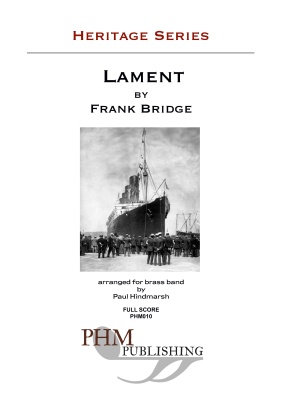
Lament (Brass Band - Score and Parts)
The English composer Frank Bridge (1879 - 1941) did not take an active part in the First World War. However, he was devastated by the slaughter on the western and the eastern fronts, especially the loss of so many of his musicians friends and colleagues. Writing in 1963, his former pupil Benjamin Britten confessed that 'a lot of my feelings about the First World War which people seemed to see in the War Requiem came from Bridge. He had written a piano sonata in memory of a friend killed in France and though he didn't encourage me to take a stand for the sake of a stand, he did make me argue and argue and argue. His own pacifism was not aggressive, but typically gentle'.Bridge composed this Lament for string orchestra on 14 June 1915, in memory of Catherine Crompton, who drowned when the Cunard liner Lusitania was torpedoed by a German submarine on 7 May, 1915. According to figures researched by Liverpool historian Kevin Roach (www.lusitania.net), 1201 men, women and children lost their lives out of the 1962 people aboard. Ninety-four children died, including Catherine, her twin brother Paul and four other siblings. Paul Crompton, Snr. (44), a British businessman working in Philadelphia, his wife Gladys (40) and the family nanny were also drowned. How Bridge's dedication came about is uncertain. The music critic Edwin Evans, who knew Bridge well, has written that the Catherine was a young friend. It is also possible that he came across the family photograph which was published in many newspapers in the wake of the tragedy. By that time, Bridge was greatly distressed by the war as a whole. It seems perfectly in keeping with his pacifist leanings and the strength of his reaction, that this poignant and deeply touching 'war memorial' should mourn a child who he did not know, rather than one of the thousands of young men who fell in battle.Through the musical tears of this melancholy lullaby, Bridge may have regarded the death of young Catherine Crompton as symbolic of the loss of so many innocent lives in wartime. His response to this personal tragedy was characteristically spontaneous and utterly sincere. It is one of his most effective miniatures, poignant yet restrained in its lyrical beauty, with a compelling directness and simplicity of construction.This brass band transcription is pitched one tone lower than the original for string orchestra.- Paul HindmarshDuration: 5.00
Estimated dispatch 7-14 working days
-
 £34.95
Elixir of Youth (Brass Band - Score and Parts)
Elixir of Youth (2013) was written for the 2013 Brass for Heroes charity event where it was premiered on 19th October 2013 at St Paul's Hall in Huddersfield under the baton of Philip Harper. The title of the work reflects the nature of the band that was put together for that premiere performance; an all-star youth band comprising a selection of the country's young brass banding talent, with the term Elixir referring here to the everlasting talent seen in young brass players throughout the United Kingdom's brass bands and bands' and teachers abilities to keep producing such high quality musicians for the banding movement.The work, structured in three sections, is a showcase for band with a heroic opening where fanfare-like gestures in the cornets and trombones juxtapose rapid euphonium and baritone runs, alongside sweeping horns and percussion effects. As the piece progresses, a grove is introduced - just in the tubas at first, accompanied by a hi-hat - before spreading through the band, definitely stuff to tap your toes to! The middle, slower section of the work sees both flugel and cornet solos, with additional inputs from the euphonium and solo horn before a climax and return to the tempo and music of the opening section. A rousing close concludes the work where all of the work's themes are interweaved to create a sense of power, unity and grandeur; an Elixir of Youth.
Estimated dispatch 7-14 working days
-
 £95.00
A Wartime Sketchbook (Brass Band - Score and Parts)
Early in 1941 William Walton, 39, received his call-up papers. He was by then one of the most eminent of British composers and was exempted from military service on condition that he provided music for films deemed to be of 'national importance'. Scoring Lawrence Olivier's Shakespeare epic Henry V in 1943 was the most substantial of these wartime projects. His role in patriotic films from 1941 and 42 like The Foreman went to France, Next of Kin, Went the day Well and The First of the Few was to provide appropriate title music and some underscoring at key moments. Walton extracted the most substantial portions of the latter as the popular Spitfire Prelude and Fugue for orchestra. The remaining music remained unpublished until 1990, when Christopher Palmer assembled the highlights into A Wartime Sketchbook. I was intrigued to hear these examples of Walton's wartime music and having discovered that they would fit naturally and idiomatically onto the brass band, I arranged six of the numbers into a suite for Besses o' th' Barn Band, which I was conducting at the time.In 1995 the brass band suite was recorded by the famous Black Dyke Mills Band as part of an all Walton album which I produced for the ASV label (ASV CD WHL 2093). This award- winning CD also included Walton's First Shoot, in the edition by Elgar Howarth, my transcription of movements from Music for Children and two substantial brass versions by Edward Watson of the suite from Henry V (with narrator) and the March and Siegfried Music from The Battle of Britain music.Prologue: This is the stirring title music from Went the day Well, a screen play by Graham Greene about a German airborne invasion of an English village. The main theme leads toBicycle Chase: Characteristic musical high-jinks for J.B.Priestley's The Foreman went to France.Refugees: From the same film, this is a poignant accompaniment to the long march of refugees. As Ernest Irving, the film's musical director, put it, "this really makes your feet sore and your knees sag."Young Siegfrieds: This lively movement comes from the music that Walton composed for The Battle of Britain in 1968, with the assistance of Malcolm Arnold, but which the film's producer rejected. It portrays first the Berliners, cheerfully ignoring the black-out and then, in the trio, the Young Siegfrieds of the Luftwaffe, courtesy of a parody of Siegfried's horn call from Wagner's opera.Romance: A soldier and a Dutch refugee snatch a few tender moments together in Next of Kin.Epilogue: At the end of The Foreman went to France, the French look forward with hope and optimism to eventual liberation.- Paul HindmarshDuration: 14.00
Estimated dispatch 7-14 working days
-
£40.00
A Wartime Sketchbook (Brass Band - Score only)
Early in 1941 William Walton, 39, received his call-up papers. He was by then one of the most eminent of British composers and was exempted from military service on condition that he provided music for films deemed to be of 'national importance'. Scoring Lawrence Olivier's Shakespeare epic Henry V in 1943 was the most substantial of these wartime projects. His role in patriotic films from 1941 and 42 like The Foreman went to France, Next of Kin, Went the day Well and The First of the Few was to provide appropriate title music and some underscoring at key moments. Walton extracted the most substantial portions of the latter as the popular Spitfire Prelude and Fugue for orchestra. The remaining music remained unpublished until 1990, when Christopher Palmer assembled the highlights into A Wartime Sketchbook. I was intrigued to hear these examples of Walton's wartime music and having discovered that they would fit naturally and idiomatically onto the brass band, I arranged six of the numbers into a suite for Besses o' th' Barn Band, which I was conducting at the time.In 1995 the brass band suite was recorded by the famous Black Dyke Mills Band as part of an all Walton album which I produced for the ASV label (ASV CD WHL 2093). This award- winning CD also included Walton's First Shoot, in the edition by Elgar Howarth, my transcription of movements from Music for Children and two substantial brass versions by Edward Watson of the suite from Henry V (with narrator) and the March and Siegfried Music from The Battle of Britain music.Prologue: This is the stirring title music from Went the day Well, a screen play by Graham Greene about a German airborne invasion of an English village. The main theme leads toBicycle Chase: Characteristic musical high-jinks for J.B.Priestley's The Foreman went to France.Refugees: From the same film, this is a poignant accompaniment to the long march of refugees. As Ernest Irving, the film's musical director, put it, "this really makes your feet sore and your knees sag."Young Siegfrieds: This lively movement comes from the music that Walton composed for The Battle of Britain in 1968, with the assistance of Malcolm Arnold, but which the film's producer rejected. It portrays first the Berliners, cheerfully ignoring the black-out and then, in the trio, the Young Siegfrieds of the Luftwaffe, courtesy of a parody of Siegfried's horn call from Wagner's opera.Romance: A soldier and a Dutch refugee snatch a few tender moments together in Next of Kin.Epilogue: At the end of The Foreman went to France, the French look forward with hope and optimism to eventual liberation.- Paul HindmarshDuration: 14.00
Estimated dispatch 7-14 working days
-
 £34.95
Island Whirl (Brass Band - Score and Parts)
Island Whirl was commissioned by Margaret Milligan who wanted a brand new piece of music composed as a present for Ian, her husband for his 70th birthday. Ian Milligan is a keen and dedicated musician and he is the musical director of Callendar Brass, based in Callendar near Stirling in Scotland.Margaret contacted me about the possibility of composing a short lively piece which had a Scottish theme that would be ideal for Callendar Brass Band and any other ensemble to get their teeth into. This piece takes its inspiration from the traditional Scottish folk song 'An Eriskay Love Lilt' which is a particular favourite of both Margaret and Ian.With thunderous Celtic drums the piece opens in a whirlwind of sound with fanfare brass and an off-stage soloist that can perform using either the cornet or trumpet. After the exciting opening, the brass and drums die away to allow the off-stage soloist to air the traditional tune 'An Eriskay Love Lilt'.The beautiful haunting melody, keeping its originality throughout undergoes a series of changes in the accompanying harmonic material before dying away to allow the Celtic drums to return. The percussion whip the band into a frenzy as the piece gets faster and faster. Just prior to the final notes the band diminuendo to allow one last closing statement from the Eriskay Love Lilt lead by the off-stage soloist before the ensemble charge to a dramatic close.When performing this piece I would recommend the off-stage soloist taking a position somewhere in the audience, so they can almost feel part of the performance. In addition, with the two tom-tom parts that represent the Celtic drums, bands should make the most of showcasing them by getting the two drummers out to the front of the band to perform. The ideal stage position would be with the players set up in stereo with one player in front of the soprano cornet and the other in front of the solo trombone.With the various choreographed movements from both the off-stage soloist and the percussionists. This piece is a great addition to any concert repertoire and is an ideal showcase for bands who want to try something a little different.I wish Ian at 70 years young, all the very best with his music making in the many years to come and I hope this piece, composed especially for him and Callender Brass brings them many years of musical enjoyment.Paul Lovatt-Cooper
Estimated dispatch 7-14 working days
-
 £54.50
Carnival of Venice (Bb Solo with Brass Band - Score and Parts)
Bb Solo with Brass BandThe Carnival Of Venice is arguably everyone's favourite solo, especially the version by Arban (1820 - 1869), author of the famous brass-playing method book still in regular use today. Young soloists aspire to master the necessary techniques, accomplished soloists know that it is a "sure fire" winner with audiences and listeners love to be dazzled by a virtuoso display of variations on a theme they easily recognise.The theme is a traditional Italian song and has inspired variations for almost every possible instrument. Arban's famous variations were written in 1864. The arrangement remains faithful to the original while maintaining interest in the accompaniments by varying the orchestration. Although the arrangement is listed as featuring the euphonium as the solo instrument, it can also be used successfully as accompaniment for a cornet soloist.The arrangement has been recorded by Jeff Binns, euphonium, and St Louis Brass Band, musical director Keith M Wilkinson, on the CD Strike Up The Band and by Anthony Avitollo, euphonium, and Cuyahoga Valley Brass Band, musical director Keith M Wilkinson, on the CD Around The World.
Estimated dispatch 7-14 working days
-
 £19.99
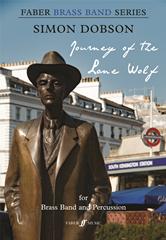
Journey of the Lone Wolf (Brass Band - Score Only)
Championship Section Test Piece for the 2016 National Finals of the British Brass Band Championship.The Lone Wolf of the title is the great Hungarian composer and folklorist Bla Bartok. Bartok's journey took him from the hills of the Balkans to the heart of the new world. His singular vision may have meant a life out in the cold, a life without warmth and love, a life without true happiness, a death mourned by a few in a strange land.The first of the three linked movements is capturing the Peasants' Song and follows the young Bartok and fellow composer Zoltan Kolday as they embark on Summertime adventures through the Hungarian countryside to collect and catalogue the astonishing variety of Gypsy and folk music heard in the Balkan hills. The arrival of WW1 plunges Bartok's beloved Hungary into chaos.Bartok was at times a cold man, aloof and lonely. The occasional moments of tenderness he showed are portrayed in Night Music. His brief but intense affairs speak of a love he could only long for. Jazz is my night music and here there are hints of what Bartok may have heard in the USA later in his life.Having been forced by the world's evils to leave his homeland of Hungary for America Bartok, the anti-fascist, felt isolated and angry. In the finale, Flight and Fight, we hear his longing for a simpler time of Gypsy folk dances as well as his maturity and depth as a composer finally exploring deeper colours and darker themes.Duration: 15.00
Estimated dispatch 7-14 working days
-
 £24.00
O Mio Babbino Caro (Trombone Solo with Brass Band - Score and Parts)
This famous aria is from the opera Gianni Schicchi. Lauretta, daughter of Gianni Schicchi, has fallen in love with Rinuccio but there are huge tensions between their two families which threaten to keep the young couple apart. The rather discordant music which opens portrays these tensions before giving way to Lauretta's tender appeal to her father to allow her to marry the man she loves. This arrangement was prepared at the request of Brett Baker to be performed with Brass Band Of The Western Reserve, musical director Dr Keith M Wilkinson, during his visit in May, 2011.
Estimated dispatch 7-14 working days
-
 £29.95
Amidst a Celtic Dream (Euphonium Solo with Brass Band - Score and Parts)
This is an original composition for euphonium and brass band from the pen of bright young composing talent, Benjamin Tubb. The work begins with an expressive lament incorporating a clever quote from Amazing Grace, a melody associated by many with Celtic Scotland but known to be of American origin. Following an expressive cadenza, the music moves quickly through a variety of styles featuring complex rhythms before arriving at a grandstand close.Amidst a Celtic Dream was commissioned by, and composed, for David Childs.
Estimated dispatch 7-14 working days
-
 £46.50
Believe Me If All Those Endearing Young Charms - Bb Cornet & Brass Band - MM002
COMPOSER: Traditional - Donald HunsbergerARRANGER: Tim MiddletonThis arrangement of "Believe Me If All Those Endearing Young Charms" is a Brass Band adaptation of the Donald Hunsburger arrangement from the Wynton Marsalis CD "Carnival".It is a Solo Cornet Feature which is true to the original and not too challenging for the good cornet player.
In Stock: Estimated dispatch 3-5 working days
