
Results
-
 £37.35
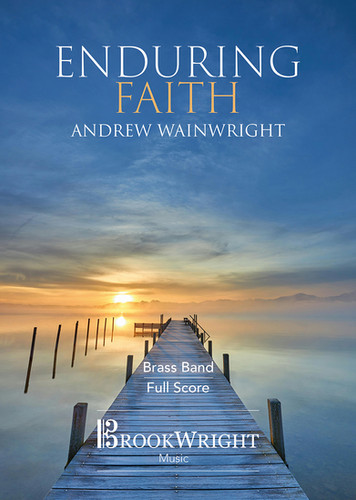
Enduring Faith (Brass Band) Andrew Wainwright
Enduring Faith was commissioned by Christopher Ward and the Five Lakes Silver Band and is a lyrical work for brass band that explores the intersection of hope, resilience, and conviction. Designed with a focus on melodic clarity and expressive phrasing, the composition moves through a series of nuanced emotional shifts - ranging from quiet, reflective passages to moments of expansive lyricism and affirmation. The harmonic structure travels through several keys, serving as a musical metaphor for the changing seasons of life. Throughout the piece, the texture is enriched by featured soloists from across the ensemble, including flugel horn, cornet, euphonium, baritone, and trombone. This work is dedicated to Doug and Stephanie Bayne, long-standing members of the Five Lakes Silver Band, in recognition of their commitment to their community and their steadfast support of the ensemble. It was recorded by the Five Lakes Silver Band on their 2025 album, Legacy. To view a video of the Five Lakes Silver Band performing the work please visit https://youtu.be/84NU_OXMs3Y Duration: Approx. 5.30 minutes Difficulty Level: 3rd Section + This PDF download includes the full score and parts. Sheet music available at www.brassband.co.uk (UK) or https://satradecentral.org (USA) Instrumentation: Soprano Cornet Eb Solo Cornet Bb Repiano Cornet Bb 2nd Cornet Bb 3rd Cornet Bb Flugel Horn Bb Solo Horn Eb 1st Horn Eb 2nd Horn Eb 1st Baritone Bb 2nd Baritone Bb 1st Trombone Bb 2nd Trombone Bb Bass Trombone Euphonium Bb Bass Eb Bass Bb Timpani Percussion 1-2
In Stock: Estimated dispatch 1-3 working days
-
 £44.83
Hero (Tenor Horn Solo with Brass Band) Fendall Hill
This piece was written as a full length virtuosic solo based on an earlier work called Humble Hero, which is also available from BrookWright Music. It is an extension of that work and still dedicated to Ken Bradley, designed to provide a reflection of his technical skills and a platform to emulate musicianship for which he was renowned. Ken Bradley (1962 - 2022) was one of Australia's best-known, well-loved, and talented brass musicians. The solo is also available from this website with piano accompaniment. To view a rolling score video of the work please visit https://www.youtube.com/watch?v=WIqS9xak_Es Duration: approx. 7.30 minutes Difficulty Level: 2nd Section + PDF download includes parts and score. Sheet music available at www.brassband.co.uk (UK) or https://satradecentral.org (USA) Instrumentation: Tenor Horn Soloist Eb Soprano Cornet Eb Solo Cornet Bb Repiano Cornet Bb 2nd Cornet Bb 3rd Cornet Bb Flugel Horn Bb 1st Horn Eb 2nd Horn Eb 1st Baritone Bb 2nd Baritone Bb 1st Trombone Bb 2nd Trombone Bb Bass Trombone Euphonium Bb Bass Eb Bass Bb Timpani Percussion 1-3
In Stock: Estimated dispatch 1-3 working days
-
 £74.72
Mind Dances (Brass Band) Fendall Hill
This highly descriptive and personal work for brass band is autobiographical, and based on a seven-year period of the composer Fendall Hill's life. He comments: "...external events had severe personal consequences, and my previously self assured self woke in the early mornings, way before my body wanted. My mind would fret, regret, and attempt to fix things beyond my control or powers, carving out an anxiety-shaped hole in my soul. This piece is an exploration of the sheer range of thought processes I went through, the mind dances I would perform to either calm myself back to sleep, or somehow come to terms with my situation. So often I would get to the point of mental exhaustion after phases of semi-calm, imagined alternate realities, and sheer panic. Your mind knows there is no benefit to worrying, but that doesn't stop the flow of emotions, the fear, and the anxiety." To view a performance video of the work please visit www.youtube.com/watch?v=pUhy33KKCKY&t=3s PDF download includes score and parts. Sheet music available from: UK - www.brassband.co.uk USA - https://satradecentral.org Difficulty Level: First Section + Length: 15.00 minutes Instrumentation: Soprano Cornet Eb Solo Cornet Bb Repiano Cornet Bb 2nd Cornet Bb 3rd Cornet Bb Flugel Horn Bb Solo Horn Eb 1st Horn Eb 2nd Horn Eb 1st Baritone Bb 2nd Baritone Bb 1st Trombone Bb 2nd Trombone Bb Bass Trombone Euphonium Bb Bass Eb Bass Bb Timpani Percussion Vibraphone Marimba
In Stock: Estimated dispatch 1-3 working days
-
 £33.62
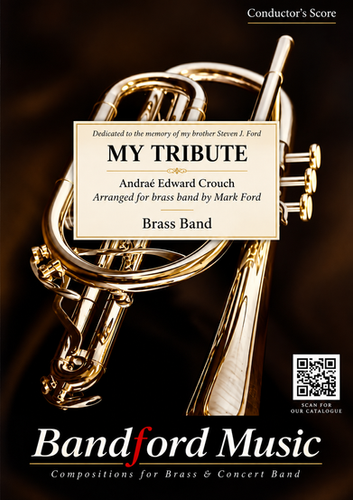
My Tribute (Euphonium Solo with Brass Band) Andrae Crouch arr. Mark Ford
My Tribute (To God Be The Glory) is a gospel song written by American gospel singer and songwriter Andrae Edward Crouch. He first recorded the song in 1972 on his album Keep on Singin'. The song is considered to be one of Crouch's most well-known songs. It is sometimes included in Christian children's song books. This arrangement for brass band from the pen of Mark Ford, features the euphonium as the soloist in a delightful setting sure to be popular with audiences. To view a performance video of the solo featuring Aaron Ford please visit https://youtu.be/6WGtAVgAsWc Duration: 1.30 minutes Difficulty Level: 3rd Section + This PDF download includes the full score and parts. Sheet music available at www.brassband.co.uk (UK) or https://satradecentral.org (USA) Instrumentation: Euphonium Soloist Bb Soprano Cornet Eb Solo Cornet Bb Repiano Cornet Bb 2nd Cornet Bb 3rd Cornet Bb Flugel Horn Bb Solo Horn Eb 1st Horn Eb 2nd Horn Eb 1st Baritone Bb 2nd Baritone Bb 1st Trombone Bb 2nd Trombone Bb Bass Trombone Euphonium Bb Bass Eb Bass Bb Drum Set Percussion
In Stock: Estimated dispatch 1-3 working days
-
 £33.62
O Little One Sweet (Brass Band) J.S Bach arr. Andrew Wainwright
This delightful German lullaby-carol first appeared in print in Samuel Scheidt's Tablaturbuch of 1650, though it may have been written before then, either by Scheidt himself or by an unknown author. J. S. Bach's version (in the form of a melody and figured bass) was included in Schemelli's Gesangbuch of 1736, and it is that which this arrangement for brass band by Andrew Wainwright is based on. This setting includes all four verses. To view a rolling score video of the work please visit https://www.youtube.com/watch?v=YryayLe_uJo Duration: Approx. 3.45 minutes Difficulty Level: 4th Section + PDF download includes parts and score. Sheet music available from www.brassband.co.uk (UK) or https://satradecentral.org (USA) Instrumentation: Soprano Cornet Eb Solo Cornet Bb Repiano Cornet Bb 2nd Cornet Bb 3rd Cornet Bb Flugel Horn Bb Solo Horn Eb 1st Horn Eb 2nd Horn Eb 1st Baritone Bb 2nd Baritone Bb 1st Trombone Bb 2nd Trombone Bb Bass Trombone Euphonium Bb Bass Eb Bass BbTimpani
In Stock: Estimated dispatch 1-3 working days
-
 £59.77
Variations on 'Sine Nomine' (Brass Band) Andrew Wainwright
This magnificent work was written in 2019 for the London Central Fellowship Band and Bandmaster David Rudd. It is based on the hymn tune by Ralph Vaughan Williams, which is also known as For all the Saints. Its release in the summer of 2022 marks the 150th anniversary of Vaughan Williams' birth. The work is set in four contrasting movements, which follow an opening statement of the hymn in its full form. Variation I (Leggiero) is based on the first few notes of the chorale and is lively and sprightly in nature, with regular time changes permeating throughout. There are regular statements of the hymn, with the movement closing with a full statement of the tune in its full glory. Variation II (Andante Espressivo) derives its material from the final strain of the verse. The music is generally calm and ethereal in nature before building to an impassioned fortissimo featuring the full band, and finally dying away. Variation III (Allegro Vivace) is in compound time and, like Variation I, is based on the first few notes of the hymn. The music is joyful and playful, epitomised by syncopated rhythms, and snippets of the tune are heard throughout. Variation IV (Allegro Giocoso) is in the form of a fugue which commences with the cornets, before the theme is handed to each section of the band at various points. After several statements of the theme, the music grows into the final strain of the chorale, which is given a grandiose setting. A frenzied Presto coda leads into organ-like chords, before a series of upward major scales bring the work to its final chord. To view a video of the Canadian Staff Band performing the work please visit https://www.youtube.com/watch?v=QZ1pYH0ftv0 Sheet music available from: UK - www.brassband.co.uk USA - www.solidbrassmusic.com Difficulty Level: Second Section + Instrumentation: Soprano Cornet Eb Solo Cornet Bb 1st Cornet Bb 2nd Cornet Bb Flugel Horn Bb Solo Horn Eb 1st Horn Eb 2nd Horn Eb 1st Baritone Bb 2nd Baritone Bb 1st Trombone Bb 2nd Trombone Bb Bass Trombone Euphonium Bb Bass Eb Bass Bb Timpani Percussion 1-2
In Stock: Estimated dispatch 1-3 working days
-
 £42.00
Patapan. Arranged for brass band by Lynda Nicholson
Arranged for brass band by Lynda Nicholson Patapan is a French Christmas Carol written by the French composer, Bernard de la Monnoye (1641-1720). The words are written from the perspective of the Shepherds in Bethlehem, playing their drums and flutes at the birth of Jesus. " Patapan" mimics the sound of the drums and the scale passages on the the flutes. Patapan begins with a solo side drummer playing a punchy rhythm in 2/2 with a tambourine being added before this rhythm underpins the melody played by the full band. A section featuring the trombones follows before the main theme returns after which a short duet for Euphonium and flugal leads into a rousing final section with a Rock feel. This final section has the full band playing with the tunes in the cornets, a fast quaver movement in the middle of the band and cleverly, the melody in counterpoint in augmentation played by the trombones. This arrangement is part of the Lynda Nicholson Collection To hear a sound file of Patapan scroll down.
-
£24.95
DAVID OF THE WHITE ROCK (Cornet Solo with Brass Band Set) - Ray Bowes
This melody is reputed to have originated in Caernarvonshire, North Wales. Tradition holds that a bard called David, lying on his deathbed, called for his harp and performed this plaintive tune, expressing a desire that it should be played at his funeral. Ever since the tune has been called by his name and that of his house 'Garagwen' ('Druid Stone' or 'White Rock'). The solo is not just a slow melody with brass band accompaniment but is a composite whole, the band needing as much sensitivity as the soloist in the presentation.
Estimated dispatch 7-14 working days
-
 £33.62
Finale - Suite No.3 (Brass Band) Tchaikovsky arr. Ruben Schmidt
This arrangement by Ruben Schmidt is the exciting polonaise finale from the last movement of Tchaikovsky's thrilling Suite No.3 in G Major for Orchestra. This was first performed in Saint Petersburg on January 12th, 1885, at the fifth symphony concert of the Russian Musical Society, conducted by Hans von Bulow. The suite also was Tchaikovsky's first American success when it was performed by the New York Symphony Society at Carnegie Hall on May 7,1891. First intended as its own symphony, it became the most played and most successful of Tchaikovsky's four suites. The finale of the last movement is an invigorating polonaise dance to finish the suite. Tchaikovsky often enjoyed conducting this final movement as an independent work himself. To view a rolling score video of the work please visit www.youtube.com/watch?v=M-Ht80Lnk-c Duration: 4.00 minutes Difficulty Level: 1st Section + PDF download includes parts and score. Sheet music available here. Instrumentation: Soprano Cornet Eb Solo Cornet Bb Repiano Cornet Bb 2nd Cornet Bb 3rd Cornet Bb Flugel Horn Bb Solo Horn Eb 1st Horn Eb 2nd Horn Eb 1st Baritone Bb 2nd Baritone Bb 1st Trombone Bb 2nd Trombone Bb Bass Trombone Euphonium Bb Bass Eb Bass BbTimpani Percussion (Tambourine, Suspended Cymbal & Bass Drum)
In Stock: Estimated dispatch 1-3 working days
-
 £33.62
Hark! (Brass Band) William Gordon
This celebratory work by American composer William Gordon is a rhythmic play on two well known carols - Hark! The Herald Angels Sing and Angels, We Have Heard On High! Although much of the music is set in 10/8, once the groove is achieved this piece need not be very complicated for the players and will serve as an ideal opener to your band's Christmas concert. Sheet music available from: UK - www.brassband.co.uk USA - www.solidbrassmusic.com Difficulty Level: 2nd Section + Instrumentation: Soprano Cornet Eb Solo Cornet Bb 1st Cornet Bb 2nd Cornet Bb Flugel Horn Bb Solo Horn Eb 1st Horn Eb 2nd Horn Eb 1st Baritone Bb 2nd Baritone Bb 1st Trombone Bb 2nd Trombone Bb Bass Trombone Euphonium Bb Bass Eb Bass Bb Percussion 1-4
In Stock: Estimated dispatch 1-3 working days
 Watch video