
Results
-
 £14.00
A Song for Bram (Brass Band - Score only) - Gregson, Edward
A Song for Bram is a short work, originally composed piano and brass band, and is dedicated to the memory of Bramwell Tovey, a close friend and colleague of the composer, and a conductor, composer, pianist and musician of huge talent, who sadly passed away before his time in the summer of 2022. In this short piece the composer has tried to imagine what kind of tune Bram would have improvised at the piano, something he frequently engaged in. No doubt it would have been a mixture of bluesy jazz, hymn tune, and love song, and this is how the solo piano takes off. In the middle section of a what is a simple tertiary structure, introduced are quotes from two hymn tunes Bram particularly loved, never having forgotten his Salvation Army roots. Bram's 'Song' returns, this time on a plaintive flugelhorn horn, and which reaches a climax with the full band before receding, literally, into the distance.....(to a new life beyond?).Duration: 6.00
Estimated dispatch 7-14 working days
-
 £45.00
A Song for Bram (Piano Solo with Brass Band - Score and Parts) - Gregson, Edward
A Song for Bram is a short work, originally composed piano and brass band, and is dedicated to the memory of Bramwell Tovey, a close friend and colleague of the composer, and a conductor, composer, pianist and musician of huge talent, who sadly passed away before his time in the summer of 2022. In this short piece the composer has tried to imagine what kind of tune Bram would have improvised at the piano, something he frequently engaged in. No doubt it would have been a mixture of bluesy jazz, hymn tune, and love song, and this is how the solo piano takes off. In the middle section of a what is a simple tertiary structure, introduced are quotes from two hymn tunes Bram particularly loved, never having forgotten his Salvation Army roots. Bram's 'Song' returns, this time on a plaintive flugelhorn horn, and which reaches a climax with the full band before receding, literally, into the distance.....(to a new life beyond?).Duration: 6.00
Estimated dispatch 7-14 working days
-
£15.00
A Song for Bram (Piano Solo with Brass Band - Score only) - Gregson, Edward
A Song for Bram is a short work, originally composed piano and brass band, and is dedicated to the memory of Bramwell Tovey, a close friend and colleague of the composer, and a conductor, composer, pianist and musician of huge talent, who sadly passed away before his time in the summer of 2022. In this short piece the composer has tried to imagine what kind of tune Bram would have improvised at the piano, something he frequently engaged in. No doubt it would have been a mixture of bluesy jazz, hymn tune, and love song, and this is how the solo piano takes off. In the middle section of a what is a simple tertiary structure, introduced are quotes from two hymn tunes Bram particularly loved, never having forgotten his Salvation Army roots. Bram's 'Song' returns, this time on a plaintive flugelhorn horn, and which reaches a climax with the full band before receding, literally, into the distance.....(to a new life beyond?).Duration: 6.00
Estimated dispatch 7-14 working days
-
 £44.95
Turris Fortissima (Brass Band - Score and Parts) - Ponsford, Steven
The geographical position of Plymouth (the composer's home city) means that, at various times in history, the city has been the United Kingdom's first line of defence. A series of forts around the coast bears testimony to this and forts have featured on the city's coat of arms ever since. However, the city's forefathers believed that physical security was worthless without a faith in God's protection and this is reflected in the city motto; Turris fortissima est nomen Jehovah (The name of Jehovah is our strongest tower) (Proverbs 18:10). Written for Enfield Citadel Band's tour of the USA in 2007, the music attempts to portray this assurance with the use of the tune Ein' Fest Burg (A mighty fortress is our God) along with the more contemporary Blessed be the Name of the Lord and Shout to the Lord. There is also an apt reference to Dean Goffin's My Strength, My Tower as the music builds to its dramatic final bars.
Estimated dispatch 7-14 working days
-
£22.50
Turris Fortissima (Brass Band - Score only) - Ponsford, Steven
The geographical position of Plymouth (the composer's home city) means that, at various times in history, the city has been the United Kingdom's first line of defence. A series of forts around the coast bears testimony to this and forts have featured on the city's coat of arms ever since. However, the city's forefathers believed that physical security was worthless without a faith in God's protection and this is reflected in the city motto; Turris fortissima est nomen Jehovah (The name of Jehovah is our strongest tower) (Proverbs 18:10). Written for Enfield Citadel Band's tour of the USA in 2007, the music attempts to portray this assurance with the use of the tune Ein' Fest Burg (A mighty fortress is our God) along with the more contemporary Blessed be the Name of the Lord and Shout to the Lord. There is also an apt reference to Dean Goffin's My Strength, My Tower as the music builds to its dramatic final bars.
Estimated dispatch 7-14 working days
-
 £35.00
GOD ONLY KNOWS (Flugel feature/Brass Band) - Baker, Leigh
Recorded in 1966 as a part of the Beach Boys' landmark?Pet Sounds?album, this ballad has become a prime example of Brian Wilson's innovative approach to songwriting and recording. Hailed for its formal and harmonic complexities as well as a memorable hook, "God Only Knows" has remained popular through the years, and was featured prominently in the biographical film Love & Mercy?about the life of Brian Wilson.This Beach Boys Classic is arranged as a Flugel Solo, and features a Trombone Quartet (spotlight your 'sectret' Trombonist or use a Baritone/Valve Trombone soloist from your Euphonium/Baritone Team.Commissioned by The Leland Band for their Brass in Concert performance 2012 this is a real favourite with audiences and something a little bit different. This is ripe for Choreography.
Estimated dispatch 7-14 working days
-
 £95.00
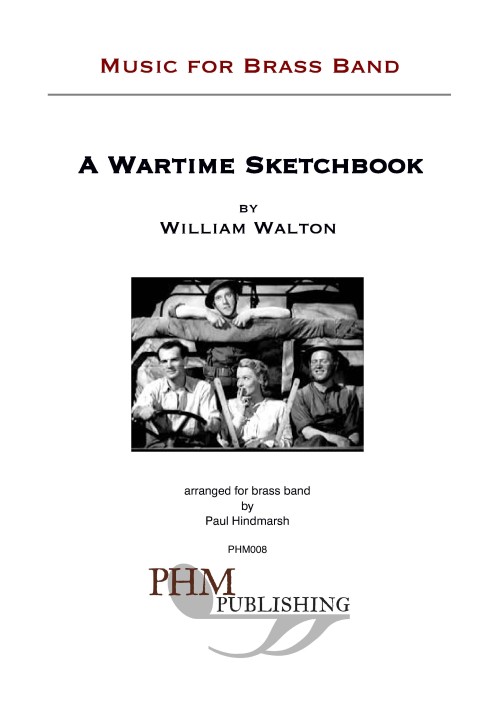
A Wartime Sketchbook (Brass Band - Score and Parts) - Walton, William - Hindmarsh, Paul
Early in 1941 William Walton, 39, received his call-up papers. He was by then one of the most eminent of British composers and was exempted from military service on condition that he provided music for films deemed to be of 'national importance'. Scoring Lawrence Olivier's Shakespeare epic Henry V in 1943 was the most substantial of these wartime projects. His role in patriotic films from 1941 and 42 like The Foreman went to France, Next of Kin, Went the day Well and The First of the Few was to provide appropriate title music and some underscoring at key moments. Walton extracted the most substantial portions of the latter as the popular Spitfire Prelude and Fugue for orchestra. The remaining music remained unpublished until 1990, when Christopher Palmer assembled the highlights into A Wartime Sketchbook. I was intrigued to hear these examples of Walton's wartime music and having discovered that they would fit naturally and idiomatically onto the brass band, I arranged six of the numbers into a suite for Besses o' th' Barn Band, which I was conducting at the time.In 1995 the brass band suite was recorded by the famous Black Dyke Mills Band as part of an all Walton album which I produced for the ASV label (ASV CD WHL 2093). This award- winning CD also included Walton's First Shoot, in the edition by Elgar Howarth, my transcription of movements from Music for Children and two substantial brass versions by Edward Watson of the suite from Henry V (with narrator) and the March and Siegfried Music from The Battle of Britain music.Prologue: This is the stirring title music from Went the day Well, a screen play by Graham Greene about a German airborne invasion of an English village. The main theme leads toBicycle Chase: Characteristic musical high-jinks for J.B.Priestley's The Foreman went to France.Refugees: From the same film, this is a poignant accompaniment to the long march of refugees. As Ernest Irving, the film's musical director, put it, "this really makes your feet sore and your knees sag."Young Siegfrieds: This lively movement comes from the music that Walton composed for The Battle of Britain in 1968, with the assistance of Malcolm Arnold, but which the film's producer rejected. It portrays first the Berliners, cheerfully ignoring the black-out and then, in the trio, the Young Siegfrieds of the Luftwaffe, courtesy of a parody of Siegfried's horn call from Wagner's opera.Romance: A soldier and a Dutch refugee snatch a few tender moments together in Next of Kin.Epilogue: At the end of The Foreman went to France, the French look forward with hope and optimism to eventual liberation.- Paul HindmarshDuration: 14.00
Estimated dispatch 7-14 working days
-
£40.00
A Wartime Sketchbook (Brass Band - Score only) - Walton, William - Hindmarsh, Paul
Early in 1941 William Walton, 39, received his call-up papers. He was by then one of the most eminent of British composers and was exempted from military service on condition that he provided music for films deemed to be of 'national importance'. Scoring Lawrence Olivier's Shakespeare epic Henry V in 1943 was the most substantial of these wartime projects. His role in patriotic films from 1941 and 42 like The Foreman went to France, Next of Kin, Went the day Well and The First of the Few was to provide appropriate title music and some underscoring at key moments. Walton extracted the most substantial portions of the latter as the popular Spitfire Prelude and Fugue for orchestra. The remaining music remained unpublished until 1990, when Christopher Palmer assembled the highlights into A Wartime Sketchbook. I was intrigued to hear these examples of Walton's wartime music and having discovered that they would fit naturally and idiomatically onto the brass band, I arranged six of the numbers into a suite for Besses o' th' Barn Band, which I was conducting at the time.In 1995 the brass band suite was recorded by the famous Black Dyke Mills Band as part of an all Walton album which I produced for the ASV label (ASV CD WHL 2093). This award- winning CD also included Walton's First Shoot, in the edition by Elgar Howarth, my transcription of movements from Music for Children and two substantial brass versions by Edward Watson of the suite from Henry V (with narrator) and the March and Siegfried Music from The Battle of Britain music.Prologue: This is the stirring title music from Went the day Well, a screen play by Graham Greene about a German airborne invasion of an English village. The main theme leads toBicycle Chase: Characteristic musical high-jinks for J.B.Priestley's The Foreman went to France.Refugees: From the same film, this is a poignant accompaniment to the long march of refugees. As Ernest Irving, the film's musical director, put it, "this really makes your feet sore and your knees sag."Young Siegfrieds: This lively movement comes from the music that Walton composed for The Battle of Britain in 1968, with the assistance of Malcolm Arnold, but which the film's producer rejected. It portrays first the Berliners, cheerfully ignoring the black-out and then, in the trio, the Young Siegfrieds of the Luftwaffe, courtesy of a parody of Siegfried's horn call from Wagner's opera.Romance: A soldier and a Dutch refugee snatch a few tender moments together in Next of Kin.Epilogue: At the end of The Foreman went to France, the French look forward with hope and optimism to eventual liberation.- Paul HindmarshDuration: 14.00
Estimated dispatch 7-14 working days
-
 £64.95
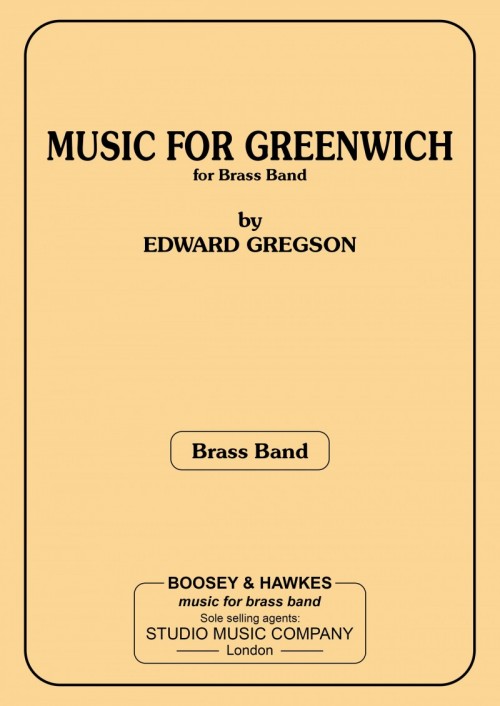
Music for Greenwich (Brass Band - Score and Parts) - Gregson, Edward
Music for Greenwich was commissioned in 1980 by the Greenwich Theatre, London, for a new production of Peter Buckman's play 'All Together Now'.In this play, about a down-at-heels brass band in the North of England brought to a new level of self-confidence and achievement by an incoming conductor, the whole cast performed a test piece on stage every night (i.e. Music for Greenwich), in readiness for a competition which they have entered and, of course, win. Although the play is as much a social commentary as anything to do with music-making, every member of the cast had to be able to play a brass instrument to a greater or lesser extent (a difficult challenge for the casting Director!).For obvious reasons, the music is not technically difficult. The work is structured as follows: a brief fanfare-like opening is followed by an allegro section, rhythmic and playful; a slow lyrical section is then introduced (a suitably nostalgic melody featuring solos for cornet and trombone), before a return to the fast music, a hint of the fanfare, and finally a climactic flourish to round things off. This is music to be enjoyed, as hopefully it was every night by the audience and actors alike.Duration: 5.00
Estimated dispatch 7-14 working days
-
£24.95
Music for Greenwich (Brass Band - Score only) - Gregson, Edward
Music for Greenwich was commissioned in 1980 by the Greenwich Theatre, London, for a new production of Peter Buckman's play 'All Together Now'.In this play, about a down-at-heels brass band in the North of England brought to a new level of self-confidence and achievement by an incoming conductor, the whole cast performed a test piece on stage every night (i.e. Music for Greenwich), in readiness for a competition which they have entered and, of course, win. Although the play is as much a social commentary as anything to do with music-making, every member of the cast had to be able to play a brass instrument to a greater or lesser extent (a difficult challenge for the casting Director!).For obvious reasons, the music is not technically difficult. The work is structured as follows: a brief fanfare-like opening is followed by an allegro section, rhythmic and playful; a slow lyrical section is then introduced (a suitably nostalgic melody featuring solos for cornet and trombone), before a return to the fast music, a hint of the fanfare, and finally a climactic flourish to round things off. This is music to be enjoyed, as hopefully it was every night by the audience and actors alike.Duration: 5.00
Estimated dispatch 7-14 working days
 View Music