
Results
-
 £60.99
Hymn of Faith - Louis Bourgeois - John Blanken
The French composer Louis Bourgeois lived from c.1510 to 1560. Bourgeois was cantor in Geneva and, commissioned by John Calvin, he composed melodies for metrical (rhyming) versions of the psalms. After completing about a hundred one-part psalms, he made some four-part arrangements, which were denounced and even resulted in his imprisonment for a day. Later, Bourgeois published a number of psalm collections, and judging from his book Le droict chemin de musique he was also an excellent educator. The melodies Bourgeois composed, are (contrary to Gregorian chants) particularly suitable for community singing. This applies to his hymn tune Saint Michael, which is why this melody hasbeen used for various texts, written for many occasions. John Blanken made this arrangement for a wedding ceremony: an occasion in which faith and trust play a large - if not the largest - role. Hence the title Hymn of Faith. The arrangement contains four verses of the hymn. After a majestic opening the hymn follows twice, the second verse being embellished in the tenor register. After a short interlude verse three follows, played by a quartet. The majestic opening is then repeated as a modulation into the fourth verse, which concludes the work in a brilliant tutti.
Estimated dispatch 5-14 working days
-
 £60.99
Golden Pass - Jacob de Haan
The Golden Pass is a rail line in the Swiss Alps that connects Montreux, located by Lake Geneva, to Lucerne, in central Switzerland. This composition echoes the thoughts and feelings of a passenger who watches the changing landscapes he observes on this journey: green meadows full of grazing cows and traditional chalets, beautiful mountain lakes, waterfalls and mountain tops, including the scenic Bruning Pass. Is this real or just a dream? We may never know!
Estimated dispatch 5-14 working days
-
 £119.99
The Binding of the Wolf - Torstein Aagaard-Nilsen
This piece was commissioned by Nordhordland Brass Seminar in 1990 and written for a youth band. The title referes to a story from norse mythology. "The Binding of the Wolf" is not a programmatic piece of music, but I felt that there was a kind of coherence between the music and the dramatic story: "...The wolf Fenrir was one of the demonic offspring of Loki, and as he grew up in Asgard among the gods, he became so huge and fierce that only Tyr was willing to feed him. It was decided that he must be bound, and Odin in his wisdom caused the cunning dwarfs to forge a chain which could not be broken. It was made from the invisible and yet potent powers ofthe world, such as the roots of a mountain, the noise of a moving cat, the breath of a fish. When completed, this chain seemed to be no more than a silken cord, but the wolf refused to let it be laid upon him unless one of the gods would put a hand between his jaws as a pledge that it was harmless. Only Tyr was prepared to do this, and when the wolf found that the chain was unbreakable, the gods rejoiced, but Tyr lost his hand. The binding of the wolf may be seen as a means of protecting the world of men, as well as that of the gods, from destruction. The story of the god losing his hand appears to be one of the fundamental myths of nothern Europe..."
Estimated dispatch 5-14 working days
-
 £119.99
Delta Energy - Jan Bosveld
The assignment to write a test piece for the National Brass Band Championships ended up also being a 'test piece' for myself as a composer. Although being quite familiar with the Brass Band phenomenon, as a composer I still have the feeling ofbeing an outsider. Delta Energy turned out to be a non-program composition. The Brass Band as orchestra form is depicted musically in this piece. All the specific characteristics are portrayed in varying settings. Solo passages for Euphonium,Flugelhorn and Cornet alternating with extensive tutti-passages and of course technical highlights form the ingredients for this work written in rhapsodic form. The title "Delta Energy" is derived from a project of the N.V. NederlandseGasunie in Groningen which also contributed in making this composition possible.
Estimated dispatch 5-14 working days
-
 £54.99
Soldiers Song - Patrick Millstone
As long as we can remember, trumpets and percussion have been the instruments most closely associated with the army and its soldiers. Just think of the medieval herald who publicly proclaimed all the king's important announcements. This work opens with a festive fanfare which immediately calls for your attention. No tidings of disaster, but a festive parade of soldiers passing by while whistling merrily. This idea was the composer's starting point when writing this cheerful little piece.
Estimated dispatch 5-14 working days
-
 £56.90
Windsor Great Park - P. Yorke
The sparkling overture of this piece is no doubt 'great' and it is followed by a terrific melodic line with several beautiful romantic highlights. By means of a slowing down we get a more moderate tempo (tempo II) which enables a kind of concert march theme to develop. This is Peter York at best. Steve Sykes was most happy to recover this composition which was considered as being untraceable for many years.
Estimated dispatch 5-14 working days
-
 £186.20
E.T. - John Williams - Ton van Grevenbroek
Steven Spielberg made this big box office success film 'E.T.', telling the story of a boy, named Eliot, and his friendship with a fascinating little alien 'E.T.'. The film score, written by the internationally famous composer and conductor John Williams, brings their 'adventures on earth' back to life. This science fiction fantasy appeals to the imagination of both young and older people. Ton van Grevenbroek signs this fine orchestration for symphonic band.
Estimated dispatch 5-14 working days
-
 £49.10
Mary Young and Fair - Patrick Millstone
This traditional Scottish folksong tells the story of Mary and her lover. Impressed by her young and charming figure, he sings his love to her. No doubt, this love ballad will make us daydream. Patrick Millstone wrote a fine and attractive arrangement of this Highland air. A composition that will bring peace and quiet in your next concert program.
Estimated dispatch 5-14 working days
-
 £52.70
Irish Air - Willy Hautvast
The complete title of this Irish tune is : 'Believe me if all those endearing young charms'. The character of this song is rather nostalgic, but yet it is popular all over the world as it has been sung and performed by all kinds of ensembles and singers. This piece can be used at several occasions and the well-known tune will be a huge success.
Estimated dispatch 5-14 working days
-
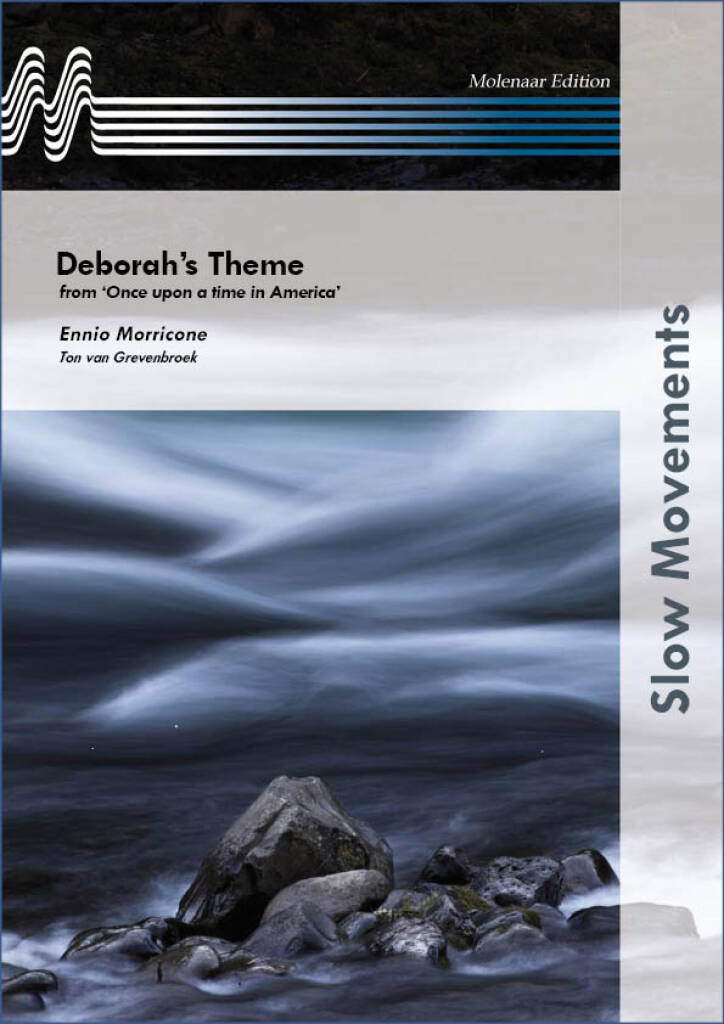 £69.90
Deborah's Theme - Ennio Morricone - Ton van Grevenbroek
Yet another classic from master film composer Ennio Morricone. This is an arrangement of the title song from the film "Once Upon A Time in America". This film is an Italian-American crime film from 1984 directed by Sergio Leone. This very playable arrangement is from the pen of Ton van Grevenbroek, and is of medium difficulty.
Estimated dispatch 5-14 working days
 View Music