
Results
-
 £92.60
Impresario (Brass Band - Score and Parts) - Schwarz, Otto M.
Impresario is a solemn concert march by Otto M. Schwarz, equally suitable as a work to open a concert or indeed as a finale. The main theme of the first section is processed in different harmonic and rhythmic variations and finally leads to a trio with numerous technical refinements and a catchy melody. This somewhat out-of-the-ordinary concert march in Otto M. Schwarz' well-known style ends with a frenzied finale.Duration: 3.45
Estimated dispatch 7-14 working days
-
 £80.00
Haven't Met You Yet (Optional Vocal Solo with Brass Band - Score and Parts) - Kjaernes, Bjorn Morten
Haven't Met You Yet is the first single from Canadian singer Michael Buble's sixth album, Crazy Love, released on August 31, 2009. According to Buble, the single and its official music video are about everyone's dream of finding a relationship and love. Buble co-wrote Haven't Met You Yet with Alan Chang and Amy Foster-Gillies, and dedicated it to his then fiancee and now wife, Luisana Lopilato (who appears as his love interest in the music video).In 2012, Nick Jonas covered the song in the TV series Smash, so this music can also be used in a TV/Movie theme concert.
Estimated dispatch 7-14 working days
-
 £69.99
The Green Hills of Tyrol (Euphonium Solo with Brass Band - Score and Parts) - Sparke, Philip
The Green Hills of Tyrol was commissioned by Jrena and Beat Knusel for their son, Swiss euphonium player Joel Knusel, to celebrate his 20th birthday in 2019. The request was for a piece suitable for use in a solo competition, possibly using a Scottish or Irish melody, and composer Philip Sparke suggested an old-fashioned air varie might be a suitable idea. The piece follows the well-established formula of a theme followed by four variations. The history of the original melody is fascinating and, although it is now well-known as a bagpipe tune, its background is Austrian or Italian, rather than Scottish. The tune appears as a chorus of Swiss soldiers in Rossini's 1829 opera William Tell but was possibly an existing Tyrolean folk tune. In 1854, during the Crimean War, Pipe Major John MacLeod of the 93rd Highlanders heard a band of the Sardinian contingent playing selections from the opera in camp before the Siege of Sebastopol. He was struck by the melody and arranged it for his pipers, calling it The Green Hills of Tyrol, referring to Tell's visit to that corner of Austria in the opera. It has since become universally popular among pipe bands who usually refer to it as A Scottish Soldier, following the addition of new lyrics in a 1961 hit by Andy Stewart.Duration: 5.45
Estimated dispatch 7-14 working days
-
 £54.99
Free Mind (Brass Band - Score and Parts) - Jeanbourquin, Marc
For Free Mind, a light and dynamic piece, Marc Jeanbourquin drew inspiration from a gospel song, namely "Oh, Freedom", a post-Civil War African-American freedom song. In these times of crisis, the composer wanted to retain a positive and energetic spirit to symbolise the hope for better days. The four notes of the theme "Oh, Freedom" occur throughout the work and are brightened up by lively percussions, giving Free Mind a sparkling character that will lift the opening of a concert with enthusiasm. Duration: 3.00
Estimated dispatch 7-14 working days
-
 £99.99
Compostela (Brass Band - Score and Parts) - Deleruyelle, Thierry
The Way of St. JamesFour roads lead to Santiago, so begins the Book of the Pilgrim. Written in the 12th century, the Codex Calixtinus opened the way for pilgrimage from most cities in Europe and North Africa to Santiago de Compostela, in Spain. Compostela - The Way of St James describes the pilgrims' journey. After a slow introduction, a brilliant theme announces the start of the journey. The arrival in Spain is indicated by incantatory chants and majestic chords. Finally, the music softens as the pilgrims venerate St James.Duration: 11.00
Estimated dispatch 7-14 working days
-
 £91.99
Hermitage (Brass Band - Score and Parts) - De Haan, Jan
Concertante Variations on an original theme after Pyotr Ilyich TchaikovskyJan de Haan drew inspiration for this work from five paintings exhibited in The Hermitage in Saint Petersburg, one of the largest and most versatile museums in the world. He used the melodious Andante cantabile from the String Quartet Op. 11 by the Russian composer Pyotr Ilyich Tchaikovsky as its starting point. Thus, he created his own musical painting, which is just as varied as the underlying canvases, from Cheerful Company by Dirck Hals to Dance II by Henri Matisse. A true work of art!Duration: 13.30
Estimated dispatch 7-14 working days
-
 £57.00
A Glorious Fanfare (Brass Band - Score and Parts) - Cesarini, Franco
Franco Cesarini was commissioned to write A Glorious Fanfare by the Band Association of the Zug Canton in Switzerland (Zuger Blasmusikverband), to celebrate the centenary of the Association (1922-2022). The composition is the third in a trilogy of scintillating concert opening pieces (which make up opus 38), together with A Triumphant Fanfare and A Joyful Fanfare. A majestic fanfare entrusted to the trumpets introduces the piece. Subsequently a cantabile variant of the same theme is presented leading to a finale with rich and impressive sounds. An ideal opening piece that will delight your audience! Duration: 3.30
Estimated dispatch 7-14 working days
-
 £49.99
The Mandalorian (Brass Band - Score and Parts) - Goransson, Ludwig - Bond & Murtha
This popular Star Wars series follows the exploits of a bounty hunter in the post-Return of the Jedi era. Featuring a stunning soundtrack by Ludwig Goransson, here is the iconic main theme in a dramatic and powerful setting for the concert stage. This arrangement was transcribed for brass band by Christopher Bond.Duration: 2.30
Estimated dispatch 7-14 working days
-
 £49.99
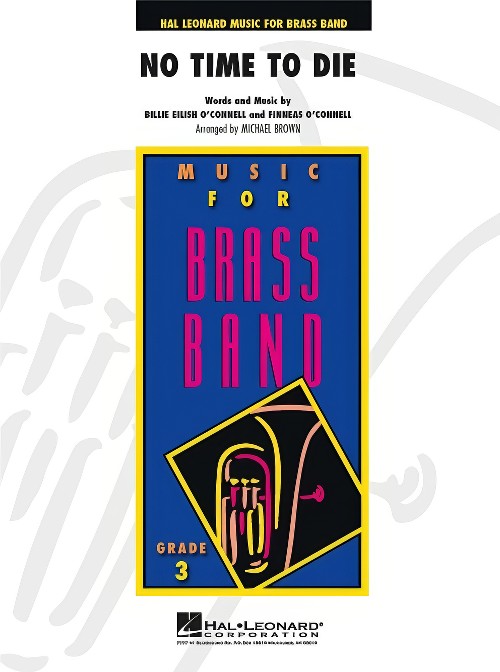
No Time to Die (Brass Band - Score and Parts) - O'Connell & O'Connell - Bond & Brown
Delayed by the pandemic but released in 2021, the much-anticipated James Bond film No Time to Die features a darkly beautiful and moody theme song recorded by Billie Eilish. With hints of the signature Bond harmonic flavour and stylish setting, this song is already on its way to becoming a classic, perfectly transcribed for brass band by Christopher Bond.
Estimated dispatch 7-14 working days
-
 £68.80
When the Lights Go Down (Brass Band - Score and Parts) - Houben, Kevin
Kevin Houben created with When the Lights Go Down, a wonderful chorale that can be a moment of reflection in any concert program. The resigned, magnificent melodies at the beginning of this composition slowly build up to a highlight with an increasing orchestration. The piece starts with a suggestive Adagio Meditativo, after which the main theme is immediately announced. A central bridge section takes the listener along through the different spheres at which the melodic and rhythmic drums embellish the chorale melodies. Thematic elements from the introduction brings the piece to a quiet and peaceful end. The sheer simplicity with which this work is written, makes it a resplendent, magnificent concert piece. 'When the Lights Go Down', refers to a moment when time stand still for a while, stillness within and around yourself.Duration: 9.00
Estimated dispatch 7-14 working days
 View Music