Results
-
 £30.00
Is That The Time ? - Paul Mottram
Is That The Time ? was written in 2014 for UK national award winning band 'Youth Brass 2000'. It's a showpiece in a jazzy fusion idiom with a full and central role for the kit drummer and percussionists. The temptation must be resisted to play the piece too quickly and in so doing losing the 16th note syncopations inherent within the rhythmic groove. The challenge is not so much one of getting the notes, although there are a few harmonic surprises along the way, as one of playing as a cohesive rhythmic unit.
-
£42.00
The Very Best Time of Year - Rutter, J - Griffiths, D
This new arrangement for Solo Euphonium & brass band by David Griffiths, truly evokes that feeling of nostalgia and longing anticipation of the joyous season and is a true celebration of all that we love about Christmas time!4th section +Duration 3 mins 30 secs
In Stock: Estimated dispatch 1-3 working days
-
 £49.99
No Time To Die - Christopher Bond
Delayed by the pandemic but scheduled for release in 2021, the much-anticipated James Bond film No Time to Die features a darkly beautiful and moody theme song recorded by Billie Eilish. With hints of the signature Bond harmonic flavour and stylish setting, this song is already on its way to becoming a classic. Note: whilst the demo video demonstrates the concert band arrangement, the version available to purchase on this website is the brass band transcription by Christopher Bond.
Estimated dispatch 10-14 working days
-
 £79.95
Lost Village of Imber, The - Christopher Bond
The village of Imber on Salisbury Plain had been inhabited for over one thousand years when it was evacuated in 1943 to make way for military training in the Second World War. At the time, with preparations for the Allied invasion of Europe underway, most villagers put up no resistance, despite being upset, with the belief that they'd return once the war had concluded. To this day, Imber and its surrounding land remain a military training ground. The villagers never returned, and just the shell of what was once a community remains. Structured in three movements, it is on this very real story that the work is based, setting out the series of events of 1943 in chronological order. The first movement, On Imber Downe, portrays a sense of jollity and cohesiveness - a community of individuals living and working together before news of the evacuation had broken. Sounds of the village are heard throughout, not least in a series of percussive effects - the anvil of the blacksmith; the cowbell of the cattle and the bells of the church. The second movement, The Church of St. Giles, begins mysteriously and this sonorous, atmospheric opening depicts Imber in its desolate state and the apprehension of residents as they learn they have to leave their homes. Amidst this is the Church, a symbol of hope for villagers who one day wish to return, portrayed with a sweeping melodic passage before the music returns to the apprehension of villagers facing eviction around their sadness at losing their rural way of life. In complete contrast, the third movement, Imemerie Aeternum, portrays the arrival of the military, complete with the sounds of the ammunition, firing and tanks - sounds which were all too familiar to those living in the surround areas. To close, the Church of St. Giles theme returns in a triumphant style, representing the idea that the church has always been, even to this day, a beacon of hope for the villagers and local community - both the centrepiece and pinnacle of a very real story. The work was commissioned by Bratton Silver Band in celebration of the band's 160th Anniversary, with funding from the Arts Council National Lottery Project Grants Fund and the Brass Bands England Norman Jones Trust Fund.
Estimated dispatch 10-14 working days
-
 £67.24
Dreams of America (Brass Band) Derek Jenkins
Dreams of America was commissioned by the National Youth Brass Band of America. The concept of the 'American Dream' is an indelible part of the American psyche. Over time, notions of success, fame, and fortune have become synonymous with this idea. Some have achieved their personal 'American Dreams', and yet for others they often remain only a dream. Dreams of America takes a look at certain, generalised aspects of the 'American Dream' and pits them against the harsh realities faced by many, both in the past and present. To heighten these dichotomies, each movement is accompanied by a slideshow of historic and modern images related to the issues at hand. Movement 1: Yearning to Breathe Free explores the anger, fear, and subjugation that seems rampant in recent years, but has been present throughout the country's founding. Movement 2: Take my Stand looks at the role that change, protest, and equality has had and continues to have in our society. Movement 3: It Beckons and Beckons examines the beauty of nature and our role in preserving and protecting this country's natural wonders while illustrating the ease of which our environment can be ruined and destroyed. Movement 4: Sweet Land of Liberty reflects onthe composer's interpretation at what truly makes the United States of America a great country - the people who call this place home. The patriotic tune America the Beautiful has been woven throughout, in part for its poetic depiction of the American landscape and its call for "brotherhood from sea to shining sea!" Sheet music available from: UK - www.brassband.co.uk USA - www.solidbrassmusic.com Difficulty Level: 1st Section + Instrumentation: 1 Soprano Cornet (Eb) 9 Cornets (Bb) 1 Flugelhorn 3 Tenor Horns (Eb) 2 Baritones (Bb) 2 Trombones (Bb) 1 Bass Trombone 2 Euphoniums (Bb) 2 Basses (Eb) 2 Basses (Bb) 4 Percussion
In Stock: Estimated dispatch 1-3 working days
-
 £11.21
Fanfare of Joy (Brass Band - Additional Transposing Parts) Andrew Wainwright
Fanfare of Joy was commissioned by the Burbage Band (Buxton) and its conductor Steven Critchlow in 2017. Based on Joy to the World and The First Nowell, this spectacular work opens with a majestic brass fanfare, before breaking in a Celtic-style dance which builds to a dramatic conclusion. The fanfare opening serves to announce the arrival of something special. In this case, the fanfare announces the arrival of Christmas, a time of joy and celebration. The Celtic-style dance is a lively and energetic movement that captures the spirit of Christmas. The music is full of syncopated rhythms and intricate melodies, driven by percussion. The final movement of the piece is a dramatic conclusion that brings the work to a rousing finish. The music is full of excitement and energy, and a fitting celebration of the Christmas season. To view a video of Dallas Brass Band performing the work please visit https://www.youtube.com/watch?v=CHl_oj1A-E8 PDF download includes additional transposing parts. Full brass band set available here. Sheet music available exclusively from World of Brass - www.worldofbrass.com Difficulty Level: 1st Section + Parts included in this download: Solo Horn F 1st Horn F 2nd Horn F 1st Baritone Bass Clef 2nd Baritone Bass Clef 1st Trombone Bass Clef 2nd Trombone Bass Clef Euphonium Bass Clef Tuba 1 Bass Clef Tuba 2 Bass Clef
In Stock: Estimated dispatch 1-3 working days
-
£33.62
Fanfare of Joy - Brass Band (Andrew Wainwright)
Fanfare of Joy was commissioned by the Burbage Band (Buxton) and its conductor Steven Critchlow in 2017. Based on Joy to the World and The First Nowell, this spectacular work opens with a majestic brass fanfare, before breaking in a Celtic-style dance which builds to a dramatic conclusion. The fanfare opening serves to announce the arrival of something special. In this case, the fanfare announces the arrival of Christmas, a time of joy and celebration. The Celtic-style dance is a lively and energetic movement that captures the spirit of Christmas. The music is full of syncopated rhythms and intricate melodies, driven by percussion. The final movement of the piece is a dramatic conclusion that brings the work to a rousing finish. The music is full of excitement and energy, and a fitting celebration of the Christmas season. To view a video of Dallas Brass Band performing the work please visit https://www.youtube.com/watch?v=CHl_oj1A-E8 PDF download includes score and full set of parts. Additional transposing parts for Horns in F, and Baritones, Trombones, Euphonium and Tubas in Bass Clef are available here. Sheet music available exclusively from World of Brass - www.worldofbrass.com Difficulty Level: 1st Section + Instrumentation: Soprano Cornet Eb Solo Cornet Bb Repiano Cornet Bb 2nd Cornet Bb 3rd Cornet Bb Flugel Horn Bb Solo Horn Eb 1st Horn Eb 2nd Horn Eb 1st Baritone Bb 2nd Baritone Bb 1st Trombone Bb 2nd Trombone Bb Bass Trombone Euphonium Bb Bass Eb Bass Bb Timpani Percussion 1-3
In Stock: Estimated dispatch 1-3 working days
-
 £34.95
Song of the Night Sky - Christopher Bond
Orpheus is known as the most talented music player of the ancient times. It is said that god Apollo was his father, from whom took his extreme talent in music, and the Muse Calliope was his mother. Tragedy struck when his wife, Eurydice stepped on a viper which in turn bit her, injecting its fatal venom. Nothing could stop his cries of anguish and sheer pain and sorrow upon realizing his beautiful Eurydice was dead. Orpheus decided to go into the Underworld to get his wife back. Apollo, his father, would talk to Hades, the god of the Underworld to accept him and hear his plea. And so Orpheus set off into the Underworld and was warned that for no reason must he look back while his wife was still in the dark, for that would undo everything he hoped for. As Orpheus was reaching the exit of the Underworld, he could hear the footfalls of his wife approaching him. As his was approaching the exit, his heart was beating faster and faster. The moment he stepped on the world of the living, he turned his head to hug his wife. Unfortunately, he got only a glimpse of Eurydice before she was once again drawn back into the underworld. When Orpheus turned his head, Eurydice was still in the dark, she hadn't seen the sun and, was drowned back to the dark world of the dead. Waves of anguish and despair swept over him and shuddering with grief he approached the Underworld again but this time, he was denied entry, the gates were standing shut and god Hermes, sent by Zeus, wouldn't let him in. His songs were no more joyful but extremely sad. His only comfort was to lay on a huge rock and feel the caress of the breeze, his only vision were the open skies. Song of the Night Sky was recorded by Tom Hutchinson and the Cory Band in June 2015, featuring on his debut solo album.
Estimated dispatch 10-14 working days
-
£100.00
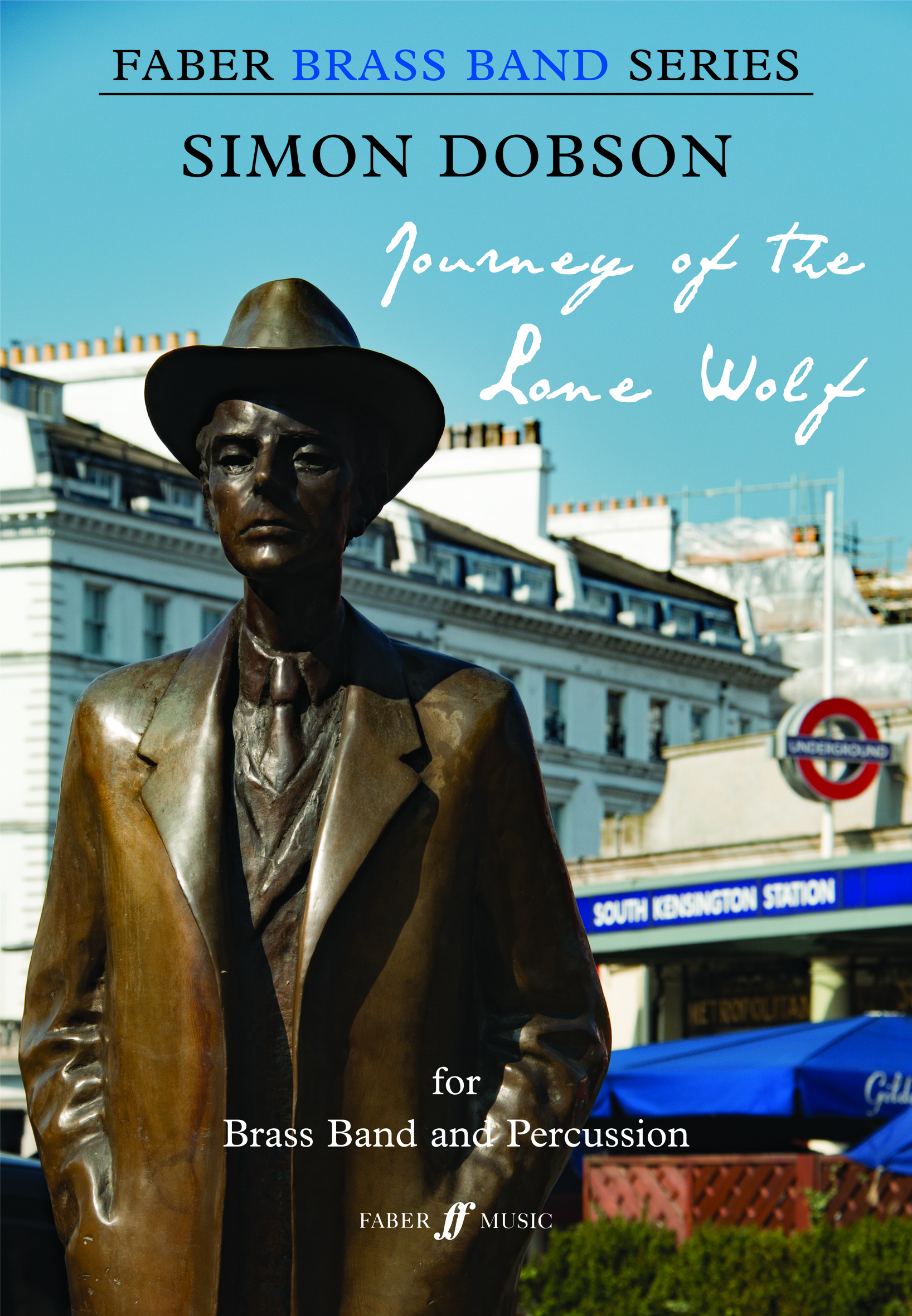
Journey of the Lone Wolf (score & parts) - Simon Dobson
Journey of the Lone Wolf tells the story of the hungarian composer Bla Bartk. It was commissioned by Dr. Nicholas Childs for Black Dyke Band, who gave the first performance on Sunday 26 January 2014 at the Bridgewater Hall, Manchester as part of the Royal Northern College of Music Festival of Brass.The composer's programme notes for each movement: 1. Capturing the Peasants' SongAfter the upheaval of moving to Budapest the young Bla Bartk meets Zoltn Kodly and the pair embark on summertime adventures throughout the Hungarian countryside to collect and catalogue the astonishing variety (both harmonically and rhythmically) of gypsy and folk music heard in the Balkans. The arrival of WW1 plunges Bartk's beloved Hungary into chaos.2. Night MusicBartk was at times a cold man, aloof and lonely. The odd moments of tenderness he showed are portrayed here in a series of evocative solos. His brief but intense affairs speak of a love he could only long for. Jazz is my night music and here there are hints of what Bartk may have heard in the USA later in his life.3. Flight and FightHaving been forced by the world's evils to leave his homeland of Hungary for America, Bartk, the anti-fascist, felt isolated and angry. In this movement we hear his longing for a simpler time of gypsy folk dances as well as his maturity and depth as a composer finally exploring deeper colours and darker themes. Duration: 15 minutes.Level: Championship
In Stock: Estimated dispatch 1-3 working days
-
 £30.00
The Sword and the Star
DescriptionThe Sword and the Star was written in 2006 for the Middleton Band at the request of their Musical Director, Carl Whiteoak. The inspiration for the work was the band's badge, which features a medieval archer. The town of Middeton's historical link with the symbol of the Archer came from the English victory at the Battle of Flodden in September 1513, where bowmen from Middleton and Heywood under the command of Sir Richard Assheton played a vital part in crushing the invading Scottish army. Sir Richard captured one of the Scottish commanders and presented the prisoner's sword to the St Leonard's church in Middleton in recognition of the town's contribution. As long time Lords of the Manor, the Assheton family crest was for centuries featured in the coat of arms of Middleton council, and when Middleton became part of the Metropolitan Borough of Rochdale the black star from the Assheton crest was used to represent Middleton in the new borough's coat of arms. Hence the title The Sword and the Star, for a piece which attempts to give an impression of the town as it was then and as it is now.The music is in three short sections - a fanfare, a lament and a bright scherzo - and simply aims to contrast the medieval hamlet of Middleton with the bustling urban centre it has now become. The central lament features a Scottish song called "The Flowers of the Forest", written to mourn the loss of so many of Scotland's young men on the field of Flodden; the song returns in a much more positive form at the end of the piece.
Estimated dispatch 7-14 working days
 View Music
 Watch video