
Results
-
 £7.99
£7.99Christmas Collection - March Card Size
Christmas Collection is a newly revised carol book with original, additional and rearranged carols from New Christmas Praise as well as 10 extended pieces. Parts are now also available in large print A4 size!Titles:A child this day is bornA Christmas lullabyA great and mighty wonderAll I want for Christmas is youAll my heart this night rejoicesAngels, from the realms of Glory (Come and worship)Angels, from the realms of Glory (Iris)Angels we have heard on highA starry nightAs with gladness men of oldAuld lang syneA virgin most pureAway in a manger (The manger scene)Away in a manger (Traditional)A winter's taleBethlehemBrightest and best (Spean)Brightest and best (Traditional)Calypso CarolCarol for the NativityCarol of the bellsCarol of the drumChild of MaryChristians Awake!Christ is born (Il est n)Christ was born on Christmas DayCome and join the celebrationCome, children, come quicklyCoventry CarolDeck the hallDing dong! merrily on highDo you hear what I hear?Frosty the snowmanGabriel's MessageGaudeteGlory in the highestGlory in the highest HeavenGod of God, the uncreatedGod rest you merry, gentlemenGood Christian men, rejoiceGood King WenceslasGo, tell it on the mountain!Happy Christmas (War is over)Hark the glad sound!Hark! the herald angels singHave yourself a merry little ChristmasHere we come a-wassailingHow far is it to Bethlehem?Huron CarolInfant HolyIn the bleak midwinter (Cranham)In the bleak midwinter (Darke)I saw mommy kissing Santa ClausI saw three ships come sailing inIt came upon a midnight clear (Traditional)It came upon a midnight clear (Willis)It's beginning to look a lot like ChristmasIt's the most wonderful time of the yearI wish it could be Christmas everydayI wonder as I wanderJesus, good above all otherJingle BellsJingle bell rockJoy to the world!Last ChristmasLet it snow!Little baby JesusLittle children, wake and listenLittle DonkeyLittle Jesus, sweetly sleepLo! he comes with clouds descendingLong, long agoLove came down at ChristmasMary's boy childMary's ChildMasters in this hallMerry Christmas everyoneMistletoe and wineNoelO Christmas treeO come, all ye faithfulO come, ImmanuelO Heaven-sent KingO holy night!O little town of Bethlehem (Christmas Carol)O little town of Bethlehem (Forest Green)O little town of Bethlehem (St Louis)Once in royal David's cityPast three o'clockPatapanPersonent HodiePraise ye the LordRing the bellsRise up, shepherd!Rockin' around the Christmas treeRudolph, the red-nosed reindeerSans day carolSanta Claus is comin' to townSaviour's DaySee, amid the winter's snowSilent Night!Sleigh RideSoftly the night is sleepingSo here it is, merry ChristmasStars are shiningStill, still, stillStop the cavalrySussex CarolSweet chiming bellsSweet chiming Christmas bellsThe candle songThe cherry tree carolThe Christmas songThe first NowellThe holly and the ivyThe infant KingThe light has comeThe shepherds' farewellThe stable doorThe star in the eastThe twelve days of ChristmasThe virgin Mary had a baby boyThey all were looking for a kingThou didst leave thy throneThree kings' marchUnto us a boy is bornWalking in the airWe gather round the manger-bedWe three kings of Orient areWe wish you a merry ChristmasWhat child is this?When a child is bornWhen Santa got stuck up the chimneyWhence is that goodly fragrance flowing?When wise men came seekingWhile shepherds watched (Cranbrook)While shepherds watched (Handel)While shepherds watched (Winchester Old)White ChristmasWho is he?Winter WonderlandWorldwide Christmas messageZither CarolA starry nightChristmas JoyChristmas PraiseCoventry CarolInfant HolyMid-winterRudolph, the red-nosed reindeerThe everlasting lightTo celebrate his birthYuletide Rag
Estimated dispatch 7-14 working days
-
 £95.00
Concertante (Piano Solo with Brass Band - Score and Parts)
This work was written in 1966, when I was a student at the Royal Academy of Music in London. It was the first major work to be written for this combination. The Concertante is unashamedly romantic in idiom and is cast in three movements: Prelude, Nocturne and Rondo.The Prelude is in sonata form with a contracted recapitulation. There are two main themes, the first announced after the opening flourish on piano. The second theme is lyrical in character and the interplay between these two themes forms the main focus of the movement.The pensive Nocturne opens with an introduction from the band which contains hints of the two main ideas to follow. The solo piano announces the main theme, which has a slightly 'blues' character in its flattened third and seventh notes of the scale. The band enters with the chorale theme already heard in the introduction. Eventually the first theme returns, this time from piano and band and building to a powerful climax before subsiding to a peaceful ending.The Rondo is full of energetic rhythms and changing time patterns. The main theme is 'giocoso' in character and in the first episode there is more than a hint of the tune 'Onward Christian Soldiers' in what amounts to a good humoured parody. Before the final coda there is a long piano cadenza underlying the virtuoso element of the work.The work had a number of public performances leading up to a memorable one in the Royal Albert Hall in 1989 as part of the Gala Concert that used to be held after the National Brass Band Championship in the Royal Albert Hall. That year, the 'centre band' in the massed bands concert were the GUS Band (then known for sponsorship reasons as 'Rigid Containers Group Band'!) conducted by my great friend and champion, Bramwell Tovey, with myself as the soloist.- Edward GregsonDuration: 18.00
Estimated dispatch 7-14 working days
-
.jpg) £64.95
£64.95Partita (Brass Band - Score and Parts)
Selected as the Section 4 test piece for the National Brass Band Championships of Great Britain 2025Partita dates from 1971, when it was commissioned by the Redbridge Youth Band. The musical thread that runs through the work is the 13th century plainsong Dies Irae from the Requiem Mass. This gives the work a rather sombre tone which is audible right from the start of its first movement Intrada. The initial hammer-like chords of the opening and conclusion are only interrupted momentarily by a more lyrical modal tune. Even here, on its repetition, it is surrounded by more insistent textural patterns.The second movement, Chorale and Variations, uses the Dies Irae as the basis for an extended melody in the manner of a baroque sarabande. The five variations that follow are varied in texture, tempi, and dynamics. The final March is more optimistic in mood and presents as its main idea a rather jaunty theme which gets developed throughout the movement. However, the ominous presence of the Dies Irae has the last say with a final statement to round off the work.Duration: 11.00
Estimated dispatch 7-14 working days
-
£32.50
Partita (Brass Band - Score only)
Selected as the Section 4 test piece for the National Brass Band Championships of Great Britain 2025Partita dates from 1971, when it was commissioned by the Redbridge Youth Band. The musical thread that runs through the work is the 13th century plainsong Dies Irae from the Requiem Mass. This gives the work a rather sombre tone which is audible right from the start of its first movement Intrada. The initial hammer-like chords of the opening and conclusion are only interrupted momentarily by a more lyrical modal tune. Even here, on its repetition, it is surrounded by more insistent textural patterns.The second movement, Chorale and Variations, uses the Dies Irae as the basis for an extended melody in the manner of a baroque sarabande. The five variations that follow are varied in texture, tempi, and dynamics. The final March is more optimistic in mood and presents as its main idea a rather jaunty theme which gets developed throughout the movement. However, the ominous presence of the Dies Irae has the last say with a final statement to round off the work.Duration: 11.00
Estimated dispatch 7-14 working days
-
 £89.99
Penlee (Brass Band - Score and Parts)
2013 Finals of the National Brass Band Championships of Great Britain - 3rd SectioTo some, the tragic story of the Penlee lifeboat, Solomon Browne, would need no introduction, and to some the pain felt is still very much a reality. The composer, born just a few weeks before that fateful night on the 19th December 1981, has created this work as a musical homage to the bravery of the souls who lost their lives and has dedicated it to their memory.Penlee was commissioned by the Cornwall Youth Brass Band using funds bequeathed by Michael Pickett. The first performance was given by the Cornish Youth Brass Band, conducted by Ian Porthouse, at St. Michael's Church, Newquay, on 30th December 2008.Penlee has been voted into the Classic FM Hall of Fame 2011 at No.106. Not only is it the first time a brass work has been featured in the Hall of Fame, but it was also the highest new entry.The work has subsequently been recorded by the Leyland Band, conducted by Jason Katsikaris, on the CD entitled Penlee.Suitable for Advanced Youth/3rd Section Bands and aboveDuration: 13:30
Estimated dispatch 7-14 working days
-
 £44.95
Metropolis 1927 (Brass Band - B4 Score only)
Fritz Lang's 1927 science fiction epic Metropolis is considered to be a masterpiece of cinematic vision and a high point of German Expressionist filmmaking. Set in a future dystopian world the film introduces the viewer to two contrasting communities living in the vast city of Metropolis. Those above ground live a life of privilege and pleasure serviced by the underground-dwelling drone workers whose role is to maintain and operate the banks of machines which provide the city's power.Lang's film, which can be considered a type of 20th century morality play, draws upon a range of themes and influences from Marxist ideals and social satire to overt religious symbolism.The music does not attempt to precis the plot, such as it is, but simply reflects my musical responses to Lang's noirish visual style and set designs - the brooding machine rooms, the decadent nightclubs, the gothic cathedral and so on - paradoxically a world of terrifying beauty.Metropolis 1927 was commissioned by Bramwell Tovey and The National Youth Brass Band of Great Britain with funds provided by The Arts Council of England. The first performances took place in the Winter Gardens, Weston-super-Mare on Saturday 19th April and in the Cheltenham Town Hall on Sunday 20th April 2014.This revised version was premiered by The Black Dyke Band, conductor Nicholas Childs, at the 38th European Brass Band Championships in the Konzerthaus Freiburg, Germany, on Saturday 2 May 2015.Peter Graham
Estimated dispatch 7-14 working days
-
 £124.95
Metropolis 1927 (Brass Band - Score and Parts)
Fritz Lang's 1927 science fiction epic Metropolis is considered to be a masterpiece of cinematic vision and a high point of German Expressionist filmmaking. Set in a future dystopian world the film introduces the viewer to two contrasting communities living in the vast city of Metropolis. Those above ground live a life of privilege and pleasure serviced by the underground-dwelling drone workers whose role is to maintain and operate the banks of machines which provide the city's power.Lang's film, which can be considered a type of 20th century morality play, draws upon a range of themes and influences from Marxist ideals and social satire to overt religious symbolism.The music does not attempt to precis the plot, such as it is, but simply reflects my musical responses to Lang's noirish visual style and set designs - the brooding machine rooms, the decadent nightclubs, the gothic cathedral and so on - paradoxically a world of terrifying beauty.Metropolis 1927 was commissioned by Bramwell Tovey and The National Youth Brass Band of Great Britain with funds provided by The Arts Council of England. The first performances took place in the Winter Gardens, Weston-super-Mare on Saturday 19th April and in the Cheltenham Town Hall on Sunday 20th April 2014.This revised version was premiered by The Black Dyke Band, conductor Nicholas Childs, at the 38th European Brass Band Championships in the Konzerthaus Freiburg, Germany, on Saturday 2 May 2015.Peter Graham
Estimated dispatch 7-14 working days
-
 £0.99
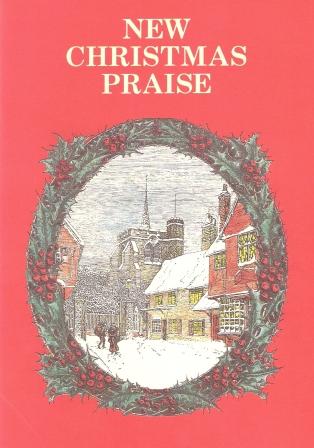
£0.99New Christmas Praise Song Book 1 - 95
These books are now an archive publication and, although are still available, have been superseded by Christmas Collection (available in marchcard size: https://www.sps-shop.com/cc-marchcard or A4 size https://www.sps-shop.com/cc-largeprint). Christmas Collection includes 46 new carols and songs as well as 10 extended carols (originally seen in the Sounds of Christmas books).Ideal for congregational singing.CONTENTS 1. A child this day is born 2. A Christmas Lullaby 3. A great and mighty wonder 4. A starry night 5. A virgin most pure 6. All my heart this night rejoices 7. Angels from the realms of Glory (Come and worship) 8. Angels from the realms of Glory (Iris) 9. Angels, sing again? 10.Angels we have heard on high 11.As with gladness men of old 12. Away in a manger 13. Away in a manger (The manger scene) 14. Bethlehem 15. Brightest and best 16. Brightest and best (Spean) 17. Child of Mary 18.. Calypso Carol 19. Carol for the Nativity 20. Carol of the bells 21.Carol of the drum 22. Christ was born on Christmas Day 23. Christians Awake 24. Come, children, come quickly 25. Coventry carol 26. Do you hear what I hear 27. Ding dong! merrily on high 28. Gabriels message 29. Glory in the highest 30. Go, tell it on the mountain 31. God of God, the uncreated 32. God rest you merry, gentlemen 33. Good Christian men, rejoice 34. Good King Wenceslas 35. Hark the glad sound! 36. Hark! the herald angels sing 37. How far is it to Bethlehem 38. I saw three ships come sailing in 39. I wonder as I wander 40. Il est n 41. Immanuel Appears 42. In the bleak mid-winter 43. Infant Holy 44. It came upon the midnight clear (Traditional) 45. It came upon the midnight clear (Willis) 46. Jesus, good above all other 47. Joy to the world 48. Little baby Jesus 49. Little Jesus, sweetly sleep. 50. Little donkey 51. Long, long ago 52. Marys boy child 53. Masters in this hall 54. Noel 55. o come, all ye faithful 56. o come, Immanuel 57. O come with me to Bethlehem 58. O little town of Bethlehem (Christmas Carol) 59. O little town of Bethlehem (Forest Green) 60. O little town of Bethlehem (St Louis) 61. O Heaven-sent King 62. O holy night 63. Once, in royal Davids city 64. Past three oclock 65. Personent hodie 66. Praise ye the Lord 67. Rise up, shepherd! 68. Sans day carol 69. See, amid the winters snow 70. Silent night! 71. Sleep, holy Babe 72. Softly the night is sleeping 74. Stars are shining 73. Sussex carol 76. Sweet chiming bells 75. Sweet chiming Christmas bells 77. The angels sang the story 78. The first Nowell 79. The holy Boy 80. The holly and the ivy 81. The infant King 82. The shepherds farewell 83. The virgin Mary had a baby boy 84. The stable door 85. They all were looking for a king 86. Three kings march 87. Unto us a boy is born 88. Wayfaring 89. We gather round the manger-bed 90. We three kings of Orient are 91. What child is this 92. When wise men came seeking 93. While shepherds watched 94. Who is he 95. Zither carol
Estimated dispatch 7-14 working days
-
 £38.95
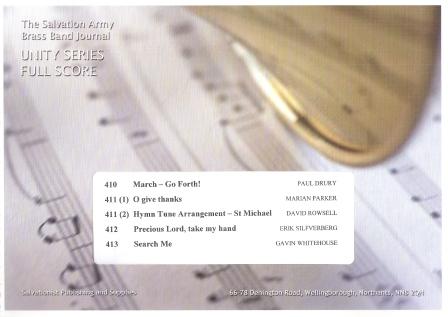
Unity Series Band Journal October 2013 Numbers 410 - 413
No. 410 March - Go Forth! (Paul Drury)This march was written as a tribute to Bandmaster Jack Spowart and the Bo'ness Salvation Army Band. The composer lives in the twon of Bo'ness and has had numerous opportunities to share with the band and the wider corps at various events. This march serves as recognition of the faithful service given in the Lord's name in the town by The Salvation Army for over 100 years. Two tunes are featured, both well-known and instantly recognisable, namely, Forward! be our watchword and We're marching on.No.411 (1) O give thanks (Marian Parker)The composer, Marian Parker, is a new contributor and is the Recruiting Sergeant at Leicester South Corps. This simple, yet rhythmic piece should not pose any technical problems for most bands and features the attractive arrangement of Joanne Pond's contemporary song, 'O give thanks'.No.411 (2) Hymn Tune Arrangement - St Michael (David Rowsell)The hymn tune 'St Michael' was composed in 1551 by French composer Louis Bourgeois and the composer provides a very useful arrangement of this historic hymn.No. 412 Precious Lord, take my hand (Erik Silfverberg O.F.)This well-known Gospel Song is a favourite of many. It has been recorded by many great artists, including Rosetta Tharpe, Elvis Presley and Aretha Franklin. The words were written by Reverend Thomas A. Dorsey, who is often known as the 'Father of Gospel song'.No. 413 Search Me (Gavin Whitehouse)The second new contributor to this journal is Gavin Whitehouse. gavin is the Assistant Music Director for the Greater New York Division and is also the USA Eastern Territorial Songster Leader. This piece combines two songs - one old and one new - which speak of a God who knows us intimately. 'Search me, O God and know my heart today' (associated with the beautiful Maori melody, 'Now is the hour') is woven with a contemporary setting of Psalm 139 by Rebecca St James, the first line of which says, 'You searchme, you know me'.
Estimated dispatch 7-14 working days
-
 £89.95
Judd: Infinity
In the post-modern age in which we live, 'absolutes' are difficult for many to comprehend. Yet infinity, which means absolute, total, all-embracing, having no limits or boundaries in time, space, extent, or magnitude, has always been central to the Christian's concept of God.Through the ages, as human understanding has grown, particularly at a remarkable rate from the latter part of the twentienth century, Christianity has been continually challenged to interpret traditional beliefs in the light of new discoveries, but always within the reality of the infinite Being. In addition, scripture tells us that 'humanity was made in God's image'. Humankind is part of God's creation and as such, responsible for its upkeep. Such a commission has never been more relevant than in this present age. Psalm 8 creates a great picture of the majesty, eternal, infinte quality of God and yet reveals the desire of God to share in spirit with humankind. It recognises humankind as being, not a tool of the infinite, but as a creative contributing part of the ongoing movement and activity of the infinite.The music is deliberately melodic in context, creating a sense of unity with the infinite, in tandem with the varying expressions of individuality. It is not based on the Psalm but reflects some of the sentiments lying therein. The 'hymn-like' theme expresses the nature of the Divine using the Old Testament image of the infinite God coming to finite humankind, not in the 'wind', the 'earthquake', the 'fire', but in the 'still small voice' of quietness (1 Kings 19: 11-13). The ensuing musical development, in different styles and patterns, expresses this continual link between infinite and finite. Thus the conclusion, rather than being a symbol of might, power and magnificence, reflects the same sentiment as the opening.
Estimated dispatch 7-14 working days