
Results
-
 £20.00
CONCERTO FOR EUPHONIUM (Brass Band Score) - Scott, Andy
Brass Band score only. The 'Concerto for Euphonium' with Brass Band is scored in three movements: The Lure of the Red Jacket; Far Beyond the Stars; The Dragon's Den. The Lure of the Red Jacket responds musically to these ideas and attitudes; a non-relenting riff that signifies the hard slog of practice, scorings which find members of the band supporting the soloist, all the time the soloist putting together new riffs and ideas. Stylistically all this happens within a frame of minimalism and funk. Far Beyond the Stars is a simple folk-like melody that is stated by the soloist, which develops with different harmonic backdrops being introduced. The poignant words form the focus of the emotional intensity of this piece. The Dragon's Den is a fierce and fiery fusion of energy, virtuosic playing and intricate ensemble work, the finale of the Concerto for Euphonium draws upon the composers experience of big band and small group performance and writing. Dur: 15:00
Estimated dispatch 7-14 working days
-
 £45.00
Crown Imperial, March (Brass Band - Score and Parts) - Walton, William - Littlemore, Phillip
William Walton composed his Crown Imperial for performance at the coronation of King Edward VIII, which was scheduled for the 12th May 1937. However, due to the dramatic abdication of Edward, it was in fact performed at the Coronation of the new monarch, King George VI, which took place on the same scheduled date. The march became popular immediately, and arrangements for piano solo, organ, small orchestra and military band were all published within a year. It has been used at all Royal events since, most notably the Coronation of Queen Elizabeth II in 1953. This new brass band transcription?is in keeping with the shorter, 6-minute concert version that Walton created immediately following the Coronation of George VI. However, the scoring is more in keeping with contemporary brass band voicings, and provides an exciting version for brass band.?Duration: 7:00
Estimated dispatch 7-14 working days
-
 £44.95
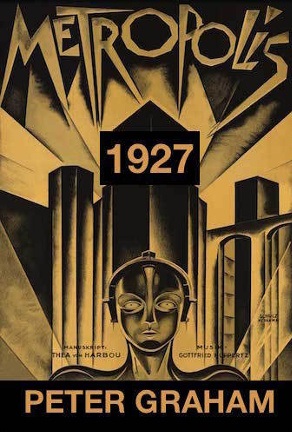
Metropolis 1927 (Brass Band - Score only) - Graham, Peter
Fritz Lang's 1927 science fiction epic Metropolis is considered to be a masterpiece of cinematic vision and a high point of German Expressionist filmmaking. Set in a future dystopian world the film introduces the viewer to two contrasting communities living in the vast city of Metropolis. Those above ground live a life of privilege and pleasure serviced by the underground-dwelling drone workers whose role is to maintain and operate the banks of machines which provide the city's power.Lang's film, which can be considered a type of 20th century morality play, draws upon a range of themes and influences from Marxist ideals and social satire to overt religious symbolism.The music does not attempt to precis the plot, such as it is, but simply reflects my musical responses to Lang's noirish visual style and set designs - the brooding machine rooms, the decadent nightclubs, the gothic cathedral and so on - paradoxically a world of terrifying beauty.Metropolis 1927 was commissioned by Bramwell Tovey and The National Youth Brass Band of Great Britain with funds provided by The Arts Council of England. The first performances took place in the Winter Gardens, Weston-super-Mare on Saturday 19th April and in the Cheltenham Town Hall on Sunday 20th April 2014.This revised version was premiered by The Black Dyke Band, conductor Nicholas Childs, at the 38th European Brass Band Championships in the Konzerthaus Freiburg, Germany, on Saturday 2 May 2015.- Peter GrahamDuration: 15.00
Estimated dispatch 7-14 working days
-
£124.95
Metropolis 1927 (Brass Band Set - Score and Parts) - Graham, Peter
Fritz Lang's 1927 science fiction epic Metropolis is considered to be a masterpiece of cinematic vision and a high point of German Expressionist filmmaking. Set in a future dystopian world the film introduces the viewer to two contrasting communities living in the vast city of Metropolis. Those above ground live a life of privilege and pleasure serviced by the underground-dwelling drone workers whose role is to maintain and operate the banks of machines which provide the city's power.Lang's film, which can be considered a type of 20th century morality play, draws upon a range of themes and influences from Marxist ideals and social satire to overt religious symbolism.The music does not attempt to precis the plot, such as it is, but simply reflects my musical responses to Lang's noirish visual style and set designs - the brooding machine rooms, the decadent nightclubs, the gothic cathedral and so on - paradoxically a world of terrifying beauty.Metropolis 1927 was commissioned by Bramwell Tovey and The National Youth Brass Band of Great Britain with funds provided by The Arts Council of England. The first performances took place in the Winter Gardens, Weston-super-Mare on Saturday 19th April and in the Cheltenham Town Hall on Sunday 20th April 2014.This revised version was premiered by The Black Dyke Band, conductor Nicholas Childs, at the 38th European Brass Band Championships in the Konzerthaus Freiburg, Germany, on Saturday 2 May 2015.- Peter GrahamDuration: 15.00
Estimated dispatch 7-14 working days
-
 £139.99
Missa Brevis Brass Band (Score & Parts)
Missa Brevis is a major work for choir and brass band for performance in church or in the concert hall. For this mass, there are many performance possibilities depending on the musicians available. In addition to the standard orchestration of choir and band a brass quartet can also play the choral parts. For this it is desirable for the brass quartet to be positioned separately from the rest of the band (on a gallery, for example), so that the idea of two choirs is heard. It is also possible to perform the work with brass band and organ. A truly flexible religious masterpiece. 20:00
Estimated dispatch 7-14 working days
-
 £159.99
RUSH HOUR (Brass Band) - Crausaz, Etienne
Rush Hour was commissioned by the Swiss Brass Band Association (SBBV) on the occasion of the 38th Swiss National Brass Band Championships 2012 (Montreux SBBW) as the test piece in the Championship division. Structured in three parts without breaks, the work opens in a heavy, oppressive atmosphere, sometimes even noisy. After a short passage in a lighter mood a quick tempo takes over, the music becomes nervous and unrelenting, with constant twists and turns. The tension builds, leading to a slower movement in which various soloists are highlighted. A few humorous touches are heard in contrast to a majestic, powerful and dramatic chorale. The end of this part is brighter and more peaceful. This atmosphere is soon replaced by a return of the thematic material heard in the first movement, developing into an oppressive moos. The piece concludes with a last ecstatic tutti, reusing the harmonies of the introduction in a kind of final flurry. Rush Hour attempts to express the range of feelings we may experience when caught in various stressful situations in the middle of the rush hour. Duration: 13:45
Estimated dispatch 7-14 working days
-
 £24.95
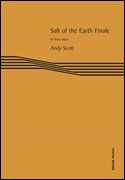
SALT OF THE EARTH, FINALE (Brass Band Parts) - Scott, Andy
Brass Band parts only. A full band arrangement created by the composer from the third movement of 'Salt of the Earth', a Concerto for Tuba & Brass Band is a fiery mix of Latin rhythms and big band power! With a virtuosic introduction from the solo cornets and percussion, the full band then enters with the catchy melody, before a two part contrapuntal passage that leads into a series of short 'solo breaks'. The main theme returns, re-scored for added impact, before an extended contrapuntal section, which leads to two closing paused chords, which may be separated by an optional extended drum/percussion solo if required. Dur: 3:30
Estimated dispatch 7-14 working days
-
£15.00
SALT OF THE EARTH, FINALE (Brass Band Score) - Scott, Andy
Brass Band score only. A full band arrangement created by the composer from the third movement of 'Salt of the Earth', a Concerto for Tuba & Brass Band is a fiery mix of Latin rhythms and big band power! With a virtuosic introduction from the solo cornets and percussion, the full band then enters with the catchy melody, before a two part contrapuntal passage that leads into a series of short 'solo breaks'. The main theme returns, re-scored for added impact, before an extended contrapuntal section, which leads to two closing paused chords, which may be separated by an optional extended drum/percussion solo if required. Dur: 3:30
Estimated dispatch 7-14 working days
-
£74.95
SONG OF FREEDOM (Brass Band - Score and Parts) - Arnold, Malcolm
Children's Voices SA parts available separately. Op.109 Song of Freedom was commissioned by the National School Brass Band Association to commemorate the Association's 21st Anniversary. The first performance was given on 12th May 1973 at the Harlow Sportscentre by the Netteswell School Band and Choir, conducted on that occasion by the composer. The idea sprang out of a desire by the N.S.B.B.A. to mark it's 'coming of age' by bringing into being a work for chorus and Brass Band which was within the scope of an average School Band and Choir. The four movements are: Prelude; Hymn; Intermezzo; Postlude. Duration: 19:00
Estimated dispatch 7-14 working days
-
£37.95
SONG OF FREEDOM (Brass Band - Score only) - Arnold, Malcolm
Children's Voices SA parts available separately. Op.109 Song of Freedom was commissioned by the National School Brass Band Association to commemorate the Association's 21st Anniversary. The first performance was given on 12th May 1973 at the Harlow Sportscentre by the Netteswell School Band and Choir, conducted on that occasion by the composer. The idea sprang out of a desire by the N.S.B.B.A. to mark it's 'coming of age' by bringing into being a work for chorus and Brass Band which was within the scope of an average School Band and Choir. The four movements are: Prelude; Hymn; Intermezzo; Postlude. Duration: 19:00
Estimated dispatch 7-14 working days
 View Music