
Results
-
 £45.00
The Pilgrim - Josiah Walters
Josiah describes his composition'The Pilgrim' as a journey of development and emotion, encompassing three key stages of emotional state: from the opening sounds which are full of anticipation and uncertainty, through to a passage of disillusionment and frustration, then moving on to a concluding stage which reintroduces the positive elements of the opening optimism, yet closing quietly, symbolizing an inner peace and contentment at the end of the musical journey.The composer's emotive approach to the creation of the work embraces a wealth of passion, anguish and enlightenment. Through his use of imaginative melody, themes and harmonic texture, Josiah has represented a collection of powerful emotions. Essentially non-programmatic, the piece opens in a contemplative manner, building with enthusiasm, and first introducing the use of bells and bell effects as a musical metaphor which is used throughout the piece to signify the journey's destination.As the sentiment continues, the music evolves in to an Allegro Furioso section, opening up a strong sense of frustration. At this section's climax, the symbolic use of the bells is reintroduced to create an over-tone of hope and purpose, although this does not last long as they fade into the Misterioso Molto Rubato section.As the melodies and harmonies develop onwards, 'The Pilgrim' evolves into a more reflective phase, reintroducing the sounds and motifs of the more strident opening.This closing section symbolizes the realisation that everything needed was already available to The Pilgrim, but travelling the journey, confronting and overcoming all of the challenges was the only route of discovery - peacefulness prevails, bringing the work to a close with a sense of contentment and enlightenment.'The Pilgrim', highly emotive in its creation, offers a wealth of musical imagery.Even to the uninformed listener, this fascinating, powerful and beautiful work stirs and stimulates a variety of emotional reactions - offering each listener an opportunity to apply the music to their own journey, their own personal pilgrimage.
In Stock: Estimated dispatch 3-5 working days
-
 £127.95
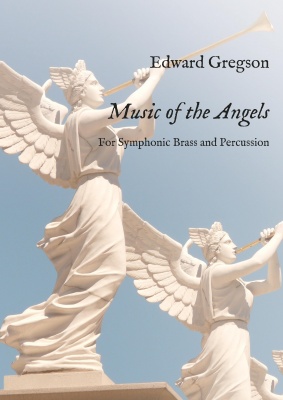
Music of the Angels (Symphonic Brass Ensemble - Score and Parts)
In 1998 Gregson was commissioned by conductor Martyn Brabbins to write a short concert opener with choir to mark his debut as Music Director of the Huddersfield Choral Society. Entitled ...and the seven trumpets... this ten minute flourish is founded on a verse from Chapter 8 of the Revelation To John (The Apocalypse), the last book in the Bible: 'and I saw the seven Angels which stood before God: and to them were given seven trumpets'. The performance employed the full power of the Huddersfield Town Hall organ and the brass section of the BBC Philharmonic, including seven trumpets and four horns placed strategically around hall.The following year, when Gregson received a commission from the Cheshire-based Foden's Brass Band (conducted at that time by Nicholas Childs) for a work to mark its centenary in 2000, he turned to the first portion of ...and the seven trumpets... as the basis for an ambitious celebratory work entitled The Trumpets of the Angels. "The opportunity to create an extended work which would break out of the brass band mould was an important milestone for me," the composer says. In 2015 he was asked by Nicholas Childs to create a new performing edition without organ for the Black Dyke Band. This received its first performance in April 2016 at the European Brass Band Festival in Lille. In 2018, Gregson revisited the music for a third time, returning the opening fanfares to orchestral brass and transforming substantial portions of the 'Black Dyke' version to create Music of the Angels, a dramatic canvas for symphonic brass and percussion.An array of bells and gongs offer an unmistakable key to the source of Gregson's inspiration. Inscribed In tribute to Olivier Messiaen, the work's principal material and its sound world, but crucially not the underlying musical processes, are influenced by Messiaen's masterpiece for wind and percussion, Et exspecto ressurectionem mortuorum (1964). Music of the Angels begins with braying of horns suggestive of the start of an ancient ritual. Six 'angel' trumpeters, set behind the ensemble, answer in sequence, with the evocative sound of tam-tams creating the Messiaen-like aura. Once the horns have reached the performing space, four of the trumpeters deliver highly contrasting fanfare cadenzas. At the climax of this episode, the individual fanfares are presented together, as if, perhaps, to reflect the Biblical writer's apocalyptic visions of hail, fire, seas of blood and the cataclysmic destruction of man and beast.This powerful vision of death and destruction gives way to a prayerful lament, re-imagining a sung Kyrie Eleison from the 'Black Dyke' edition, with flugel horn and euphonium obligati. The hushed atmosphere is broken by tenor and side drums, and trumpets five and six, which gallop away like the Horsemen of the Apocalypse. In the biblical account their steeds had 'heads like lions with fire and smoke and sulphur issuing from their mouths'.As the reverberation of a dramatic climax dies we hear the entry of the seventh trumpet, from 'on high', blazing forth with a version of the main that extends across the entire compass of the instrument - almost three octaves. Supported by a 'holy trinity' of gongs, an 'epic' final cadenza introduces new material which is further developed in a frenetic final section. This is announced by two sets of timpani, to the left and right. Braying brass (euphoniums and horns) once more adds an air of foreboding. As the music builds towards a magisterial conclusion, the Messiaen-inspired tritones of the principal motif are smoothed out into perfect 5ths and combined with the earlier material in a full-voiced chorale, over which the seventh trumpet blazes in triumph.- Programme note by Paul HindmarshScored for1 Trumpet in E flat (Trumpet 5)6 Trumpets in B flat (Trumpet 4 doubling Flugel Horn)4 Horns in F3 Tenor Trombones1 Bass TromboneEuphonium2 Tubas2 Timpani (Percussion 3 doubles Timpani 2)Percussion (3 players): 3 Tam-tams, 3 Suspended Cymbals, Bass Drum, Tenor Drum, Snare Drum, Tubular Bells.Duration: 16.00
Estimated dispatch 7-14 working days
-
 £30.00
 -
 £104.99
A Fanfare of Bells - Hermann Pallhuber
A Fanfare of Bells is festival music composed for a particular occasion: in 2012 the young 3BA Brass Band from Germany took part in the champion section of the Flemish Open Brass Band Championship in Mechelen, Belgium, for the first time: a festival of premieres. A Fanfare of Bells, accordingly, is music that creates festival atmosphere. Big melodies designed to touch the heart are cut through with brilliant fanfares. The piece contains lyrical and melodic passages that bring the skills and general musicianship of the 3BA Brass Band to the fore, along with various technical passages that spotlight the excellence of the individual musicians. Peels of bells at thestart and end of the work ring in a new atmosphere for brass band music in Germany and Austria. A Fanfare of Bells is, however, also a tribute to the wonderful sound of brass instruments, that blend together to create the most subtle sonorities: bells as a symbol of the beauty of the instruments--both sonically and visually: let the bells ring...
Estimated dispatch 5-14 working days
-
 £154.99
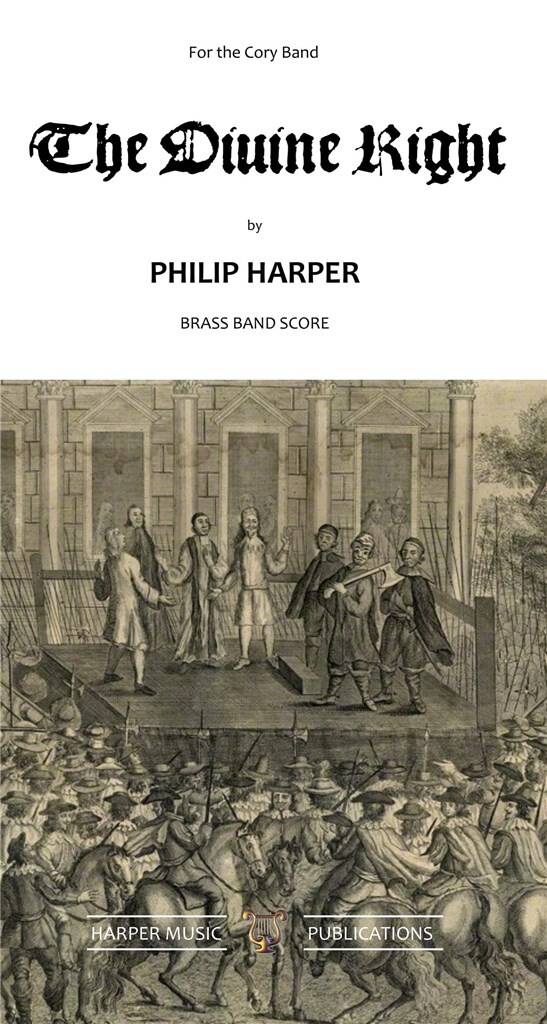
The Divine Right - Philip Harper
At the time of composing this piece, the Arab Spring was sweeping through the Middle East. It seemed that almost every week a new countrys people had risen up against the regimes and dictatorships which had prevailed for generations, leaving manynations at a defining crossroads in their history. There were so many possible ways ahead: so many hopes, yet so many uncertainties.My music is a depiction of these revolutionary times, and several musical themes are in turn presented, discussed, considered, fought over, altered, rejected or accepted. Most nations have had, or probably will have, their own Arab Spring, including my own, the United Kingdom. Events of 17th Century Britain provide the context for this piece, particularly those following the execution of the tyrant King Charles I on30 January 1649. The regicide was in part due to Charless steadfast belief in the Divine Right of Kings, and led to a tumultuous interregnum, where England stood at its own defining crossroads.The music begins turbulently, before King Charles appears and is led to the gallows outside Banqueting House in central London where he is brutally decapitated. From the assembled crowd rose, according to one observer, a moan as I never heard before and desire I may never hear again.The music descends to emptiness. The musical argument which follows is not strictly programmatic, but a number of musical themes are all thrown into the melting pot, representing ideas such as: religion; military force; reasoned Parliamentary debate; and the chattering,irrepressible voice of the people. Additionally, there are some quotations from the music of royalist composer Thomas Tomkins (1572-1656), who was often in tune with the feeling of the times. This defining episode in Englands history was brought to a close with the Restoration of the monarchy in 1660, and as the exiled King Charles II rode back into London the diarist John Evelyn wrote: Never was so joyful a day seen in this nation. I stood in the Strand and beheld it, and blessed God.At the end of the piece the bells ring out, and the musical appearance of the King has transformed from turbulent to triumphant. Philip Harper, 2013
Estimated dispatch 5-14 working days
-
 £102.60
Cherubic Hymn of Ukraine - Yakiv Yatsynevych - John Philip Hannevik
Ukraine was invaded on February 24, 2022, and the world again became spectators to a conflict between unequal opponents. Once again we saw lies, injustice and brutality up close.I must admit that a feeling of powerlessness arose when experiencing this, an empty feeling of not being able to do anything useful.One early Monday morning, a few weeks into the conflict, I sat down to listen to Ukrainian music.I hardly knew any Ukrainian music, but I was familiar with the composer Mykola Leontovych, the man who composed "Carol of the Bells". He was a member of the Ukrainian liberation movement, and he was assassinated by a Soviet agent in 1921.One of his contemporary colleagues was the composer, teacher and conductor Yakiv Yatsynevych (1869-1945). He wrote church music and choral music, and I became very taken by his Hymn to the Cherubim, a part of the Orthodox Mass.I could not find any sheet music for this. But I have listened to numerous choral recordings, and I have tried to notate the music as I believe the composer himself has done originally.I chose to do the arrangement for a solo group of 4 players. These players can be placed at a distance from the ensemble, maybe on a gallery or at the back of your concert hall.The arrangement was made for Brottum Brass for their participation in the Oslo Brass Festival in April 2022.The performance in the church this particular night was met with a long-lasting silence after the last note. The warm respect, the moving response and love we felt from the audience is a memory I will carry with me for a long time.In the lyrics to this psalm, one finds the phrase:Let us now lay aside all earthly cares- John Philip Hannevik -
Estimated dispatch 5-14 working days
-
 £69.50
End of The Year Special - Andrew Pearce
The end of the year special is an original composition not based on any carols, written originally for orchestra for a French TV channel to celebrate their end of the year festivities. It's a short 2 1/2 minute opener with lots of tuned percussion and sleigh bells, plus some solo work for the euphonium. It's fun and festive and a great way to open any Holiday concert. There's even an optional part for women's chorus if you like. End of the Year Special could very well be the perfect opening for your Christmas concert.
Estimated dispatch 5-14 working days
-
£47.50
Fanfare of the Bells - William Gordon
Estimated dispatch 5-14 working days
-
 £87.40
 -
 £34.95
Fanfare: The Crowning - Jonathan Bates
DURATION: 3 minutes. DIFFICULTY: Championship. "Trumpets sound in the Abbey, bells ring out, & a 62-gun salute booms from the Tower of London.". 'The Crowning' is a ceremonial fanfare and chorale based upon the hymn tune 'Westminster', the London Abbey in which coronations and subsequent 'crownings' take place at the change of every Monarch. You will hear 62 bass drum strikes in the intrada representing the 62 gun-salute which accompanies the ceremony as the 'trumpets sound and bells ring out in the Abbey'. .
In Stock: Estimated dispatch 1-3 working days
 View Music