
Results
-
 £29.50
REM-Scapes (Brass Band - Score only) - Doss, Thomas
Sweet echoes of Beethoven's Moonlight Sonata in the introduction bring a gentle slumber. Breathing is calm and sleep holds the promise of rest and relaxation. With the onset of the REM sleep phase, however, in which most dreams take place and where the day's events are worked through, we hear other sounds played. With distorted sounds, reminiscent of an old gramophone, the music pulls the listener inevitably ever deeper into the dreamscape, in a very realistic dangerous situation that comes to a dramatic head. It triggers a desperate struggle between the impulse to awaken and the exhausting urge to flee. For a short moment, it seems as if the wakeful urge has won out, before dream's powerful spell is again cast, and there's no escapeDuration: 17:00
Estimated dispatch 7-14 working days
-
 £154.99
REM-Scapes (Brass Band - Score and Parts) - Doss, Thomas
Sweet echoes of Beethoven's Moonlight Sonata in the introduction bring a gentle slumber. Breathing is calm and sleep holds the promise of rest and relaxation. With the onset of the REM sleep phase, however, in which most dreams take place and where the day's events are worked through, we hear other sounds played.With distorted sounds, reminiscent of an old gramophone, the music pulls the listener inevitably ever deeper into the dreamscape, in a very realistic dangerous situation that comes to a dramatic head. It triggers a desperate struggle between the impulse to awaken and the exhausting urge to flee. For a short moment, it seems as if the wakeful urge has won out, before dream's powerful spell is again cast, and there's no escape...Duration: 17:00
Estimated dispatch 7-14 working days
-
 £29.95
Light Walk (Brass Band - Score and Parts) - Gott, Barrie
The 'big-band' arrangement that brought the arranging skills of Barrie Gott instantly to the attention of the brass world. Still a hit wherever it is played, this 'great fun' music allows the band to 'let its hair down' and the Flugel Horn the chance to take centre stage.
Estimated dispatch 7-14 working days
-
£14.95
Light Walk (Brass Band - Score only) - Gott, Barrie
The 'big-band' arrangement that brought the arranging skills of Barrie Gott instantly to the attention of the brass world. Still a hit wherever it is played, this 'great fun' music allows the band to 'let its hair down' and the Flugel Horn the chance to take centre stage.
Estimated dispatch 7-14 working days
-
 £76.99
Avatar Soundtrack Highlights (Brass Band - Score and Parts) - Horner, James - Bocook & Sparke
4th Section. James Horner composed the soundtrack to the stunning science-fiction film Avatar, which millions of enthusiastic movie-goers have already seen. Jay Bocook combines all the action, adventure, drama, and romance Horner wrote into his music and has created a medley, adapted for brass band by Philip Sparke, that will take your audience on an exciting voyage.Duration: 6:45
Estimated dispatch 7-14 working days
-
 £32.50
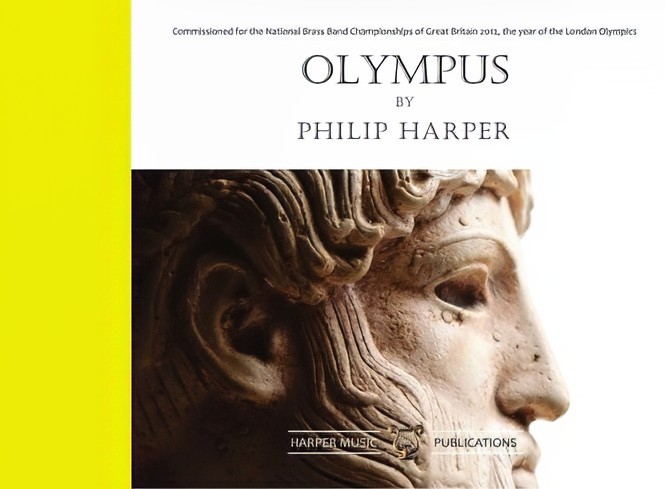
Olympus (Brass Band - Score only) - Harper, Philip
Selected as the test-piece for the 3rd Section Regional contests of the National Brass Band Championships 2012The music begins with a depiction of the exciting Opening Ceremony where noisy fanfares and sudden swells add to the cosmopolitan flag-waving clamour. Without a break the music leads to The Chariot Race, a fast compound-time gallop with thundering hooves in the basses and percussion, and a heroic melody introduced by the tenor horns. Chariot racing was the main equestrian event in the Ancient Greek Games, which were founded in memory of King Oenomaus. In the Greek legend he suffered defeat in a chariot race to his son-in-law and Zeus' grandson, Pelops, but much of the music is bitter-sweet to symbolise the fact that Pelops had to cheat to win - drawing parallels with some of the issues still facing modern-day athletics.A slow, mystical passage follows, describing The Temple of Zeus at Olympia. The statue of Zeus, who was honoured throughout the Ancient Games' history, was housed inside the temple and was one of the Seven Wonders of the Ancient World. The music depicts this period of the dawn of one of mankind's most ancient civilisations and there is a series of solo passages above a drone.The next section is called The Olympic Flame and a broad and lyrical anthem-like melody develops slowly in the euphoniums, which gradually ascends until the horns can take it over before passing upwards again to the cornets (Higher). The music bursts into bright life at the lighting of the flame and the regular rhythmic pattern which has been established goes through an accelerando (Faster).The final section is called The Olympic Truce and aims to capture the cooperative spirit of the ancient practice of ending wars for the duration of the games. The anthem-like melody makes an affirmatory return (Stronger) and the work ends as it began - with a blaze of colour and a real sense of optimism and global celebration.Citius, Altius, Fortius (Faster, Higher, Stonger)Duration: 11:30
Estimated dispatch 7-14 working days
-
£74.99
Olympus (Brass Band - Score and Parts) - Harper, Philip
Selected as the test-piece for the 3rd Section Regional contests of the National Brass Band Championships 2012The music begins with a depiction of the exciting Opening Ceremony where noisy fanfares and sudden swells add to the cosmopolitan flag-waving clamour. Without a break the music leads to The Chariot Race, a fast compound-time gallop with thundering hooves in the basses and percussion, and a heroic melody introduced by the tenor horns. Chariot racing was the main equestrian event in the Ancient Greek Games, which were founded in memory of King Oenomaus. In the Greek legend he suffered defeat in a chariot race to his son-in-law and Zeus' grandson, Pelops, but much of the music is bitter-sweet to symbolise the fact that Pelops had to cheat to win - drawing parallels with some of the issues still facing modern-day athletics.A slow, mystical passage follows, describing The Temple of Zeus at Olympia. The statue of Zeus, who was honoured throughout the Ancient Games' history, was housed inside the temple and was one of the Seven Wonders of the Ancient World. The music depicts this period of the dawn of one of mankind's most ancient civilisations and there is a series of solo passages above a drone.The next section is called The Olympic Flame and a broad and lyrical anthem-like melody develops slowly in the euphoniums, which gradually ascends until the horns can take it over before passing upwards again to the cornets (Higher). The music bursts into bright life at the lighting of the flame and the regular rhythmic pattern which has been established goes through an accelerando (Faster).The final section is called The Olympic Truce and aims to capture the cooperative spirit of the ancient practice of ending wars for the duration of the games. The anthem-like melody makes an affirmatory return (Stronger) and the work ends as it began - with a blaze of colour and a real sense of optimism and global celebration.Citius, Altius, Fortius (Faster, Higher, Stonger)Duration: 11:30
Estimated dispatch 7-14 working days
-
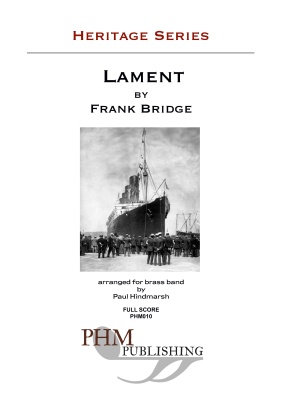 £45.00
Lament (Brass Band - Score and Parts)
The English composer Frank Bridge (1879 - 1941) did not take an active part in the First World War. However, he was devastated by the slaughter on the western and the eastern fronts, especially the loss of so many of his musicians friends and colleagues. Writing in 1963, his former pupil Benjamin Britten confessed that 'a lot of my feelings about the First World War which people seemed to see in the War Requiem came from Bridge. He had written a piano sonata in memory of a friend killed in France and though he didn't encourage me to take a stand for the sake of a stand, he did make me argue and argue and argue. His own pacifism was not aggressive, but typically gentle'.Bridge composed this Lament for string orchestra on 14 June 1915, in memory of Catherine Crompton, who drowned when the Cunard liner Lusitania was torpedoed by a German submarine on 7 May, 1915. According to figures researched by Liverpool historian Kevin Roach (www.lusitania.net), 1201 men, women and children lost their lives out of the 1962 people aboard. Ninety-four children died, including Catherine, her twin brother Paul and four other siblings. Paul Crompton, Snr. (44), a British businessman working in Philadelphia, his wife Gladys (40) and the family nanny were also drowned. How Bridge's dedication came about is uncertain. The music critic Edwin Evans, who knew Bridge well, has written that the Catherine was a young friend. It is also possible that he came across the family photograph which was published in many newspapers in the wake of the tragedy. By that time, Bridge was greatly distressed by the war as a whole. It seems perfectly in keeping with his pacifist leanings and the strength of his reaction, that this poignant and deeply touching 'war memorial' should mourn a child who he did not know, rather than one of the thousands of young men who fell in battle.Through the musical tears of this melancholy lullaby, Bridge may have regarded the death of young Catherine Crompton as symbolic of the loss of so many innocent lives in wartime. His response to this personal tragedy was characteristically spontaneous and utterly sincere. It is one of his most effective miniatures, poignant yet restrained in its lyrical beauty, with a compelling directness and simplicity of construction.This brass band transcription is pitched one tone lower than the original for string orchestra.- Paul HindmarshDuration: 5.00
Estimated dispatch 7-14 working days
-
£29.95
Rhapsody in Brass (Score Only)
Rhapsody in Brass is in three movements and was written for the British Open Championships in 1949, held at Belle Vue in Manchester. The contest winners were Fairey Aviation Works Band under the baton of Harry Mortimer. Eric Ball came second with Ransome & Marles and Stanley Boddington 3rd with Munn and Felton Band. Rhapsody in Brass had the unusual distinction of being written as a test piece by a Salvation Army composer. Eric Ball's Resurgam was the only other piece to achieve that dual personality in that era.Dean Goffin was born in 1916 in Wellington, New Zealand, son of Henry Goffin, a Salvation Army officer and composer. At 19 he was appointed Bandmaster of the Wellington South Band and when World War II started, he enlisted in the New Zealand Armed Forces where he became Bandmaster of the 20th Infantry Battalion and later the 4th Brigade Band. During the time he served with them in the Middle East and Europe, he composed and arranged numerous pieces among which Rhapsody in Brass and the march Bel Hamid, later adapted for Salvation Army use and renamed Anthem of the Free.After the war, Dean kept on composing and his work was featured by the Wellington South Band. Later he transferred to Timaru for another job and became Bandmaster there. He was studying music at the time and as he wanted to take part in a competition for devotional selections for Salvation Army use, he sent some of his compositions to the International Headquarters. When Rhapsody for Brass was chosen as the test-piece for the British Open Championships, people at the Salvation Army started asking questions about the lack of publications of his work. It was discovered that the pieces submitted for the competition didn't meet the exact criteria. Among these pieces was one of his most appealing works The Light of the World which was published a year later, in 1950, the same year as he completed his Bachelor of Music studies at Otagu University.After entering the Salvation Army Training College in Wellington with his wife, Marjorie, Dean was in 1956 appointed National Bandmaster in the British Territory. Later he became National Secretary for Bands and Songster Brigades and in this period he organised the yearly festival in the Royal Albert Hall and was responsible for the national music schools in the UK. Dean returned to his home country in 1966 and to mark the centenary of the Salvation Army in New Zealand he was knighted by the Queen in 1983. Sir Dean Goffin died on 23 January 1984.
Estimated dispatch 7-14 working days
-
£69.95
TRANSFORMATION (Brass Band Set) - Kenneth Downie
I believe in transformation, God can change the hearts of men, And refine the evil nature, till it glows with grace again'. So wrote John Gowans in the second verse of his great hymn, 'I believe that God the Father, can be seen in God the Son', written specifically to affirm Salvationists' beliefs. It is sung to the tune Bethany and in seeking to explore this great subject at the heart of the Christian gospel in musical terms, the composer has used this fine tune as the basis. Although it never appears in its entirety, it is seldom out of the picture and much of the work is derived from it. The other main source of material is the lovely, simple chorus, 'Some day I shall be like him, changed to heavenly beauty, when his face I see'. This chorus is especially prominent in the middle section but there are important references to it throughout. There are also brief references to Charles Wesley's hymn, 'Love Divine' and, in particular, the telling lines, 'Changed from glory into glory, till in Heaven we take our place'. The work suggests that, at times, the process of being transformed is a struggle, portrayed with many passages of fraught and demanding music. Considerable reserves of stamina and technique are required while, in contrast, the chorus, 'Some day I shall be like him' provides the warm, gentle centre of the work. The premiere of the work was given by The International Staff Band of The Salvation Army in Cadogan Hall on Friday 3rd June 2011, as part of the band's 120th anniversary celebrations.
Estimated dispatch 7-14 working days
 View Music