
Results
-
 £69.99
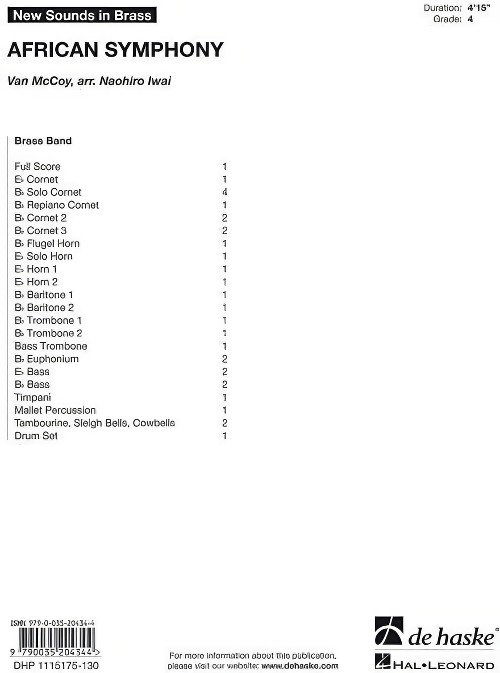
African Symphony (Brass Band - Score and Parts) - McCoy, Van - Iwai, Naohiro
American music producer, songwriter and musician Van McCoy became famous for his instrumental hit The Hustle. His African Symphony was released in the 1970's and was soon arranged for brass band by Naohiro Iwai. His brilliant arrangement helped to establish his excellent reputation as an arranger of band music.Duration: 4:15
Estimated dispatch 7-14 working days
-
 £73.00
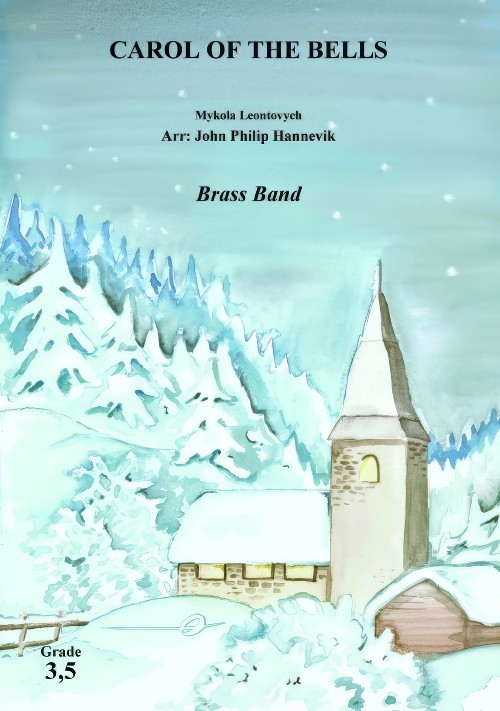
Carol of the Bells (Brass Band - Score and Parts) - Leontovych, Mykola Dmytrovich - Hannevik, John Philip
Ukrainian composer Mykola Leontyovich composed this famous Christmas Carol in 1914. The carol is based on a folk chant called Shchedryk. The composer was a supporter of the independence movement in Ukraina, and was assassinated by a Soviet agent in 1921.The carol was made famous after the adaption by Peter J. Wilhousky in 1936. Wilhousky worked as an arranger for the NBC symphony orchestra. It is also well known from popular culture, like the film Home Alone (1990), and a version by the vocal group Pentatonix.Duration: 2.30
Estimated dispatch 7-14 working days
-
 £42.95
ANDANTE (from 6th Symphony) (Brass Band) - Barry, Darrol
This famous melody is adored around the world. It was also the basis for a very popular 'pop' song Story of a Starry Night.
Estimated dispatch 7-14 working days
-
 £40.00
Ninth of January (Brass Band) - Shostakovich, Dmitri - Stephens, Denzil
The second movement, Allegro, from Symphony No.11
Estimated dispatch 7-14 working days
-
£37.95
TOCCATA from Organ Symphony No.5 (Brass Band) - Widor, Charles-Marie - Sparke, Philip
Recorded on Polyphonic QPRL056D National Brass Band Championships of Great Britain and Gala Concert - 1992, Polyphonic QPRL040D Pageantry
Estimated dispatch 7-14 working days
-
 £50.00
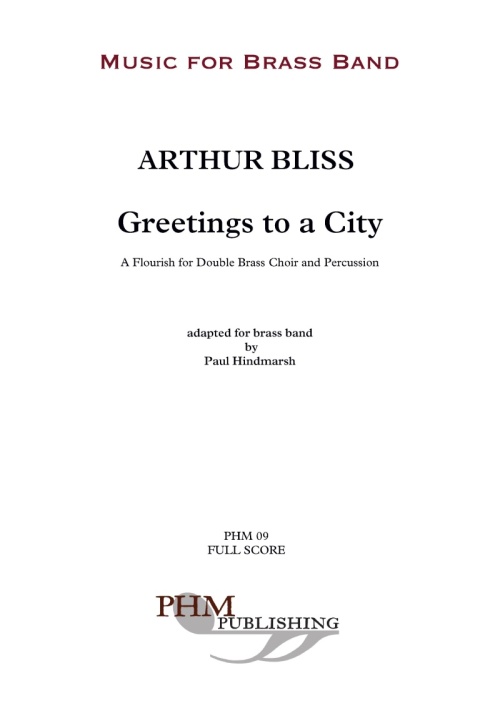
Greetings to a City (Brass Band - Score and Parts)
Sir Arthur Bliss (1891 - 1975) was a significant composer and pillar of the British musical establishment. Although Born in London, his father was from the United States and both countries were important in his life and career. A pupil of Stanford at the Royal College of Music, Bliss travelled to the United States with his father in 1923, taking a prominent part in Elizabeth Sprague Coolidge's Pittsfield Music Festival, as well as undertaking some teaching and conducting. In 1925 he married Trudy Hoffman and they returned to the UK early in 1926. Bliss's most influential scores were his ballets and film scores. In 1953 Sir Arthur was appointed Master of the Queen's Music, after which he added a steady stream of fanfares and ceremonial works to his list of works. In 1960 he was commissioned by the American Wind Symphony of Pittsburgh, which requested for festive work to feature on an extensive European tour, including a performance in London.Bliss scored Greetings to a City for antiphonal brass, a choir each of 2 trumpets, 2 horns and three trombones, with tuba and percussion. This adaptation for brass band instruments retains an element of antiphony, emphasing the contrast between the fanfare instruments (cornets and trombones) and the horns and tubas. Greetings to a City is cast in three connected sections, with extended fanfare episodes separated by a short lyrical interlude.- Paul HindmarshDuration: 6.00
Estimated dispatch 7-14 working days
-
 £51.65
A Renaissance Christmas (Brass Band) Kevin Norbury
VIEW SCORE PDF This magnificent festive suite was written by Kevin Norbury for the Pierre Elliott Trudeau High School Wind Symphony and features several well known carols set in a Renaissance style. Here it has been set for brass band. Three contrasting movements comprise the work: i. Processional (Personent hodie - On this day earth shall ring) This is a short piece imagining a torchlight Yuletide procession (perhaps bearing the traditional roasted wild boar), using a well-known Christmas melody from the large collection of music compiled in the 16th century called Piae Cantiones (1582). The tune is presented twice with accompanying, related melodic material. ii. Pastorale (Quem pastores laudavere - Shepherds sang their praises o'er him) This is a 14th-century melody which was originally collected by Michael Praetorius at the end of the 16th-century. The treatment throughout is very lyrical without overly complex harmonies. The melody is heard three times with brief linking episodes and a short coda. iii. Celebration! (In dulci jubilo - In sweet celebration - Ding-dong merrily on high)) This magnificent 13th-century melody was also a part of Michael Praetorius's collection. It is traditional associated with the words 'Good Christian men, rejoice!' The opening is a straight transcription of the great chorale prelude for organ by J.S.Bach. After the grandeur of the opening, the tune is heard in more of a 'folky' style. A lot of related melodic material is then presented before the tune Ding-dong merrily on high is heard. After another episode of previously used music In dulci jubilo reappears in a joyful conclusion to the piece. Sheet music available from: UK - www.brassband.co.uk USA - www.solidbrassmusic.com Difficulty Level: 3rd Section + Instrumentation: Soprano Cornet Eb Solo Cornet Bb Repiano Cornet Bb 2nd Cornet Bb 3rd Cornet Bb Flugel Horn Bb Solo Horn Eb 1st Horn Eb 2nd Horn Eb 1st Baritone Bb 2nd Baritone Bb 1st Trombone Bb 2nd Trombone Bb Bass Trombone Euphonium Bb Bass Eb Bass Bb Percussion 1-4
In Stock: Estimated dispatch 1-3 working days
-
 £24.50
Sospiri - Elgar - Max Stannard
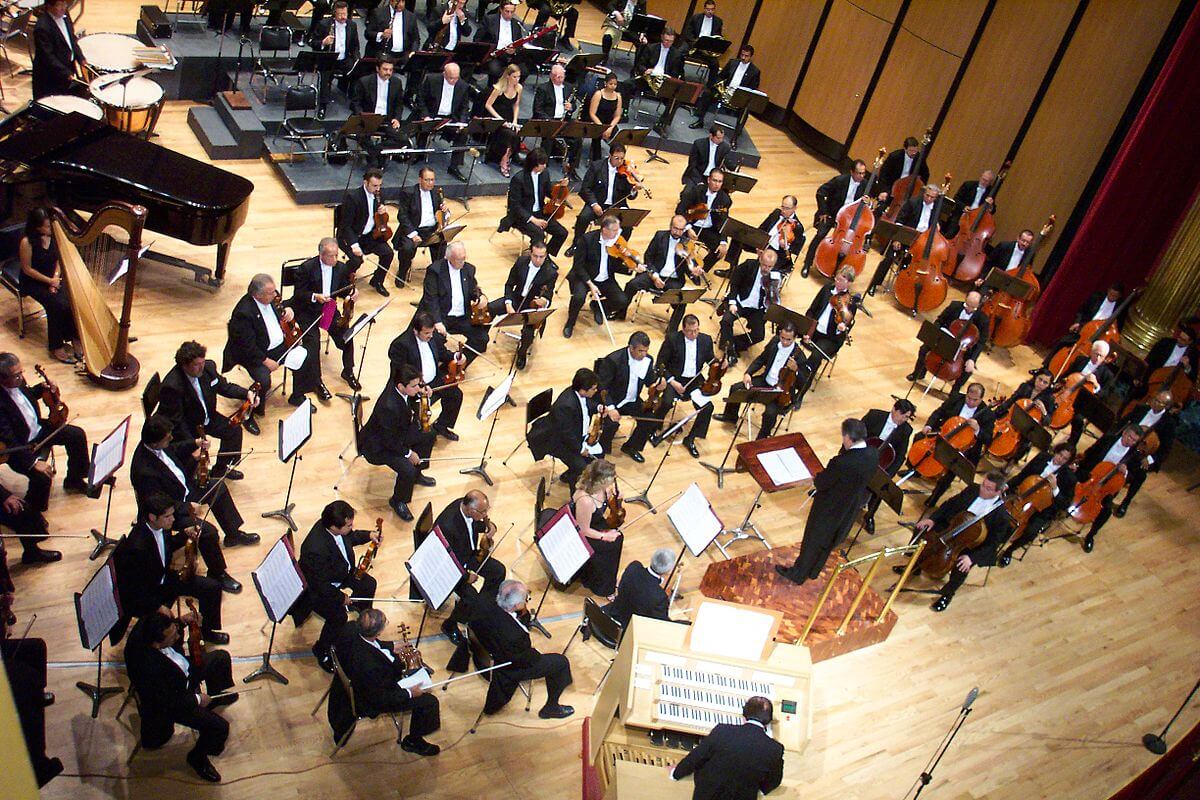
Originally scored for string orchestra, harp and organ, this Adagio was composed by Sir Edward Elgar shortly before the outbreak of the First World War and you can perhaps hear the gathering storm clouds of war in the music which became a bleak adagio that would not be out of place as the slow movement of an Elgar symphony. The work was dedicated to the leader of the London Symphony orchestra W.H. (Billy) Reed.
In Stock: Estimated dispatch 1-3 working days
-
 £29.50
Sibelius Fantasy - Gavin Somerset
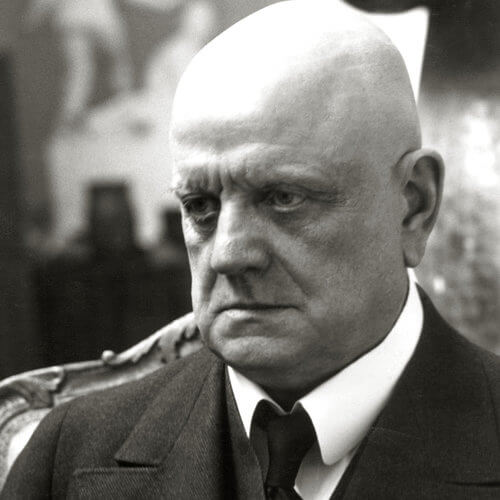
Composed in 2003 for a composition competition, this work uses elements of three major work by the Finnish composer Jean Sibelius (1865-1957). The three being... Symphony No.5, Finlandia, Karelia Suite (March) The piece starts with an atmospheric opening before setting of in bar 10 with a tempo that will remain for most of the piece. The main original theme is brought in at A before the famous sequence from Sibelius' Symphony No.5 enters at B and then very distinctly at C. The music then rollercoasts through keeping all sections of the band busy, until we reach J when the solo Euphonium can shine, helped along by Flugel and Repiano. The Molto Vivo before K sets off with dazzling trills from the cornet section, and bringing with it the theme from Finlandia in bar 165, followed shortly by the March from the Karelia Suite. From N to the end, all three pieces are brought to a final climax together. A rousing piece and makes an interesting change to a direct transcription.
In Stock: Estimated dispatch 1-3 working days
-
£24.50
New World Melody - Dvorak - Graham Robinson
Made famous many years ago by the "Hovis" advert, the slow theme from Dvorak's New World Symphony has since become a popular favorite with the classical concert audience. This arrangement brings many of the popular themes from Dvorak's symphony together to produce a smooth calm and relaxing piece for your audience to sit back, and enjoy.
In Stock: Estimated dispatch 1-3 working days
 View Music
 Watch video