
Results
-
 £55.00
Triumph Series Brass Band Journal, Numbers 1363 - 1366, July 2024
1363: Festival March - Collect the harvest (Anders Beijer)This march is a call to tell others about the salvation we have received and bring people to Jesus. Jesus has bought us with his blood, and we now belong to him and stand under his protection, surrounded by his love and care. After brief references to the melody Bringing in the sheaves (S.A.S.B. 58) (also appearing later in the work in full) and an original melody, we hear the familiar tune Saviour, like a shepherd. This music should be performed with great joy and enthusiasm.1364: O come, Immanuel (Steve Kellner)The text of this beautiful Advent hymn (C.C. 62) dates to the 8th century and its chant-like tune to the 15th century. While the text alludes to Israel's captivity in Babylon and the coming Messiah, it in fact refers to the believer's anticipation of Jesus' second coming. The original chant melody was call and response, so the opening motif serves as the call, returning throughout the arrangement.1365: Our Consecration (Marcus Venables)This arrangement uses the tune St Margaret (T.B. 427) to the beloved hymn by George Matheson, O love that wilt not let me go (S.A.S.B. 616), which highlights the powerful and enduring nature of God's love. The use of the melodic fragment on the word 'go' serves as a subtle question mark, inviting the listener to reflect on the human qualities that may cause doubt in the steadfastness of God's love for us. However, as the piece ends, there is a sense of peace and assurance that we can truly rely on the never-ending love of God in our lives. This powerful and emotive arrangement will leave the listener feeling uplifted and encouraged by the knowledge that they are held securely in the arms of God's love.1366: March - The bell ringer (David Rowsell)The title of this march refers to someone who stands by the iconic Salvation Army Christmas kettle and receives donations from passers-by. They ring a bell to attract attention and subtly invite people to give a donation in support of The Salvation Army's work. This march was written as a tribute to the many volunteers worldwide who support this campaign each year. The music features the choruses from two Christmas carols, Sweet chiming Christmas bells (C.C. 83) and Sweet chiming bells (C.C. 82).
Estimated dispatch 7-14 working days
-
 £0.99
New Christmas Praise Song Book 1 - 95
These books are now an archive publication and, although are still available, have been superseded by Christmas Collection (available in marchcard size: https://www.sps-shop.com/cc-marchcard or A4 size https://www.sps-shop.com/cc-largeprint). Christmas Collection includes 46 new carols and songs as well as 10 extended carols (originally seen in the Sounds of Christmas books).Ideal for congregational singing.CONTENTS 1. A child this day is born 2. A Christmas Lullaby 3. A great and mighty wonder 4. A starry night 5. A virgin most pure 6. All my heart this night rejoices 7. Angels from the realms of Glory (Come and worship) 8. Angels from the realms of Glory (Iris) 9. Angels, sing again? 10.Angels we have heard on high 11.As with gladness men of old 12. Away in a manger 13. Away in a manger (The manger scene) 14. Bethlehem 15. Brightest and best 16. Brightest and best (Spean) 17. Child of Mary 18.. Calypso Carol 19. Carol for the Nativity 20. Carol of the bells 21.Carol of the drum 22. Christ was born on Christmas Day 23. Christians Awake 24. Come, children, come quickly 25. Coventry carol 26. Do you hear what I hear 27. Ding dong! merrily on high 28. Gabriels message 29. Glory in the highest 30. Go, tell it on the mountain 31. God of God, the uncreated 32. God rest you merry, gentlemen 33. Good Christian men, rejoice 34. Good King Wenceslas 35. Hark the glad sound! 36. Hark! the herald angels sing 37. How far is it to Bethlehem 38. I saw three ships come sailing in 39. I wonder as I wander 40. Il est n 41. Immanuel Appears 42. In the bleak mid-winter 43. Infant Holy 44. It came upon the midnight clear (Traditional) 45. It came upon the midnight clear (Willis) 46. Jesus, good above all other 47. Joy to the world 48. Little baby Jesus 49. Little Jesus, sweetly sleep. 50. Little donkey 51. Long, long ago 52. Marys boy child 53. Masters in this hall 54. Noel 55. o come, all ye faithful 56. o come, Immanuel 57. O come with me to Bethlehem 58. O little town of Bethlehem (Christmas Carol) 59. O little town of Bethlehem (Forest Green) 60. O little town of Bethlehem (St Louis) 61. O Heaven-sent King 62. O holy night 63. Once, in royal Davids city 64. Past three oclock 65. Personent hodie 66. Praise ye the Lord 67. Rise up, shepherd! 68. Sans day carol 69. See, amid the winters snow 70. Silent night! 71. Sleep, holy Babe 72. Softly the night is sleeping 74. Stars are shining 73. Sussex carol 76. Sweet chiming bells 75. Sweet chiming Christmas bells 77. The angels sang the story 78. The first Nowell 79. The holy Boy 80. The holly and the ivy 81. The infant King 82. The shepherds farewell 83. The virgin Mary had a baby boy 84. The stable door 85. They all were looking for a king 86. Three kings march 87. Unto us a boy is born 88. Wayfaring 89. We gather round the manger-bed 90. We three kings of Orient are 91. What child is this 92. When wise men came seeking 93. While shepherds watched 94. Who is he 95. Zither carol
Estimated dispatch 7-14 working days
-
 £110.00
Diversions After Benjamin Britten (Brass Band - Score and Parts)
Suite by Lucy Pankhurst, Simon Dobson, Paul McGhee and Gavin HigginsHaving devised a collective centenary tribute for Michael Tippett at the 2006 RNCM Festival of Brass (Variations on a Theme of Michael Tippett by five eminent composers of brass band music, PHM002), I commissioned this companion piece as a Benjamin Britten tribute for the 2013 festival. In the late 1970s, while researching a book about the English composer, and Britten's first teacher, Frank Bridge (1879 - 1941), I came across a copy of the printed score of Benjamin Britten's Variations on a Theme of Frank Bridge (Op.10) for string orchestra, in which Britten had written descriptive titles for each of the variations suggesting appropriate character traits of his much loved mentor and guide. The character variations are cast in march, song and dance forms.Taking inspiration from Britten's youthful tribute, I invited four award-winning composers, who have all made significant contributions to the brass band medium, to create their own personal reflections on four aspects of Britten's character and music, designed to form a suite of Diversions after Benjamin Britten, but which can also be played separately.Lucy Pankhurst's hauntingly lyrical Prelude: His Depth refers to the emotional and symbolic subtexts that underpin Britten's operas, taking its musical cue from Britten's many arrangements of folk songs. The flugel horn takes a prominent role throughout.Simon Dobson's breathless Scherzo: His Vitality reminds us with its rapid passage work and leaping bass 'groove' that Britten loved tennis and fast cars in his younger days.Paul McGhee's evocative interpretation of the March: His Sympathy represents Benjamin Britten's pacifism, as the composer writes: 'We view the music through the eyes of a pacifist. Whilst war and violence surround us, we do not engage in it and though it continues to happen around us. With the use of muted effects in most of the band throughout the piece, the flugel horn is the lone voice of reason, standing firm against the mechanical and destructive society in which it is forced to live. As the machine of war continues around the lone voice, the voice is gradually dismissed and mocked as the war machine rumbles on into the distance.'In an extended finale, entitled Toccata: His Skill, Gavin Higgins celebrates Benjamin Britten's consummate creativity. For the RNCM Festival of Brass premiere, the four contrasting movements were framed and connected by Britten's Fanfare for St. Edmundsbury for three trumpets, with the trumpet soloists spaced round the hall. I am grateful to the Britten Estate and publishers Boosey & Hawkes for giving permission for the elements of Britten's fanfare to be incorporated in the collective work.- Paul HindmarshDuration: 19.30
Estimated dispatch 7-14 working days
-
£45.00
Diversions After Benjamin Britten (Brass Band - Score only)
Suite by Lucy Pankhurst, Simon Dobson, Paul McGhee and Gavin HigginsHaving devised a collective centenary tribute for Michael Tippett at the 2006 RNCM Festival of Brass (Variations on a Theme of Michael Tippett by five eminent composers of brass band music, PHM002), I commissioned this companion piece as a Benjamin Britten tribute for the 2013 festival. In the late 1970s, while researching a book about the English composer, and Britten's first teacher, Frank Bridge (1879 - 1941), I came across a copy of the printed score of Benjamin Britten's Variations on a Theme of Frank Bridge (Op.10) for string orchestra, in which Britten had written descriptive titles for each of the variations suggesting appropriate character traits of his much loved mentor and guide. The character variations are cast in march, song and dance forms.Taking inspiration from Britten's youthful tribute, I invited four award-winning composers, who have all made significant contributions to the brass band medium, to create their own personal reflections on four aspects of Britten's character and music, designed to form a suite of Diversions after Benjamin Britten, but which can also be played separately.Lucy Pankhurst's hauntingly lyrical Prelude: His Depth refers to the emotional and symbolic subtexts that underpin Britten's operas, taking its musical cue from Britten's many arrangements of folk songs. The flugel horn takes a prominent role throughout.Simon Dobson's breathless Scherzo: His Vitality reminds us with its rapid passage work and leaping bass 'groove' that Britten loved tennis and fast cars in his younger days.Paul McGhee's evocative interpretation of the March: His Sympathy represents Benjamin Britten's pacifism, as the composer writes: 'We view the music through the eyes of a pacifist. Whilst war and violence surround us, we do not engage in it and though it continues to happen around us. With the use of muted effects in most of the band throughout the piece, the flugel horn is the lone voice of reason, standing firm against the mechanical and destructive society in which it is forced to live. As the machine of war continues around the lone voice, the voice is gradually dismissed and mocked as the war machine rumbles on into the distance.'In an extended finale, entitled Toccata: His Skill, Gavin Higgins celebrates Benjamin Britten's consummate creativity. For the RNCM Festival of Brass premiere, the four contrasting movements were framed and connected by Britten's Fanfare for St. Edmundsbury for three trumpets, with the trumpet soloists spaced round the hall. I am grateful to the Britten Estate and publishers Boosey & Hawkes for giving permission for the elements of Britten's fanfare to be incorporated in the collective work.- Paul HindmarshDuration: 19.30
Estimated dispatch 7-14 working days
-
 £34.95
Elixir of Youth (Brass Band - Score and Parts)
Elixir of Youth (2013) was written for the 2013 Brass for Heroes charity event where it was premiered on 19th October 2013 at St Paul's Hall in Huddersfield under the baton of Philip Harper. The title of the work reflects the nature of the band that was put together for that premiere performance; an all-star youth band comprising a selection of the country's young brass banding talent, with the term Elixir referring here to the everlasting talent seen in young brass players throughout the United Kingdom's brass bands and bands' and teachers abilities to keep producing such high quality musicians for the banding movement.The work, structured in three sections, is a showcase for band with a heroic opening where fanfare-like gestures in the cornets and trombones juxtapose rapid euphonium and baritone runs, alongside sweeping horns and percussion effects. As the piece progresses, a grove is introduced - just in the tubas at first, accompanied by a hi-hat - before spreading through the band, definitely stuff to tap your toes to! The middle, slower section of the work sees both flugel and cornet solos, with additional inputs from the euphonium and solo horn before a climax and return to the tempo and music of the opening section. A rousing close concludes the work where all of the work's themes are interweaved to create a sense of power, unity and grandeur; an Elixir of Youth.
Estimated dispatch 7-14 working days
-
 £30.00
Let All Mortal Flesh Keep Silence
ABOUT THIS PIECE: Let All Mortal Flesh Keep Silence by Edward Bairstow is a setting of the ancient hymn text from the Liturgy of St. James, and embodies a profound sense of reverence and awe. Bairstow, a renowned composer and organist, served as Master of Music at the iconic York Minster, one of the most famous Gothic cathedrals in the world. His tenure at York Minster significantly influenced his compositions, many of which are celebrated for their spiritual depth and grandeur, and that use the incredible acoustic of the cathedral as part of their very structure. This arrangement translates Bairstow's choral masterpiece into a stirring brass setting, maintaining the richness and gravitas that makes it so memorable. Ideal for concerts, services, or ceremonial occasions, the piece provides a powerful and reflective experience for performers and audiences alike. ENSEMBLE: Standard British Brass Band WHEN YOU BUY THIS PRODUCT, YOU GET: High-quality printed score and parts LEVEL: 1 LISTEN: Click here to listen to a computer generated version Watch below a quintet version of this piece: DURATION: 3-minutes 20-secondsEXAMPLE SCORE: Click here LEVEL GUIDE: Level 1- Accessible to all Level 2 - c. UK third section and higher Level 3 - c. UK second section and higher Level 4 - c. UK first section and higher Level 5 - c. UK championship section level
Estimated dispatch 5-7 working days
-
 £12.00
Ave Maria
DescriptionJohann Sebastian Bach (1685 - 1750) was a German composer and musician of the Baroque period. Bach's compositions include the Brandenburg Concertos, the Goldberg Variations, the Mass in B minor, two Passions, and over three hundred cantatas of which approximately two hundred survive. His music is revered for its technical command, artistic beauty, and intellectual depth. Bach's abilities as an organist were highly respected during his lifetime, although he was not widely recognised as a great composer until a revival of interest in and performances of his music in the first half of the 19th century. He is now generally regarded as one of the greatest composers of all time.Charles-Francois Gounod (1818 - 1893) was a French composer, best known for his Grand Operas, most famously 'Faust', written in 1859 and his 'St Cecilia Mass' written in 1854. However possibly his most performed work is his arrangement of the latin text Ave Maria based on a work by Bach.You can listen to a computer realisation of the score while following the music below:
Estimated dispatch 7-14 working days
-
 £25.00
Autumn Bacchanale (from The Seasons) - Alexander Glazunov
A lively, joyous item, ideal as a light interlude in any concert and especially appropriate for late season/Christmas themed events with its jaunty, positive sounds. Sue Hopkins has shown great creativity in crafting this arrangement of Glazunov's 'Autumn' movement, a bacchanale from his ballet The Seasons, hence its fondly referenced title of Autumn Bacchanale.Alexander Glazunov (1865 - 1936) was a Russian composer, music teacher and conductor. He was a child prodigy and was taught privately byRimsky-Korsakov, who said Glazunov's musical progress did not increase day by day but hour by hour. He began composing at age eleven and wrote his first symphony at age 16 in 1881 and it was premiered one year later.His ballet The Seasonswas first performed by the Imperial Ballet in St Petersburg on 20 February 1900 and was choreographed by Marius Petipa.It was written in one act and four scenes, and this piece represents the moment when all The Seasons take part in a glorious dance while leaves from autumn trees rain upon their merriment.
In Stock: Estimated dispatch 3-5 working days
-
 £50.00
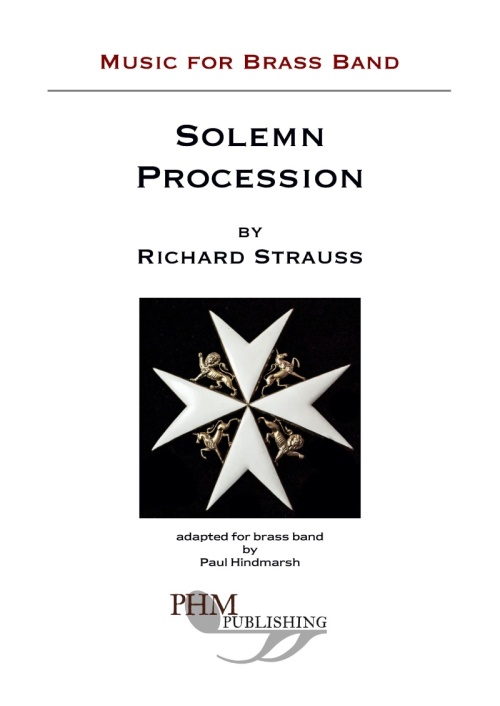
Solemn Procession (Brass Band - Score and Parts)
Richard Strauss (1864 - 1949) was a famous conductor and composer when he wrote Feierlicher Einzug der Ritter des Johanniter-Ordens (Solemn Entrance of the Knights of the Order of Saint John) in 1909. One of only a handful of his works written exclusively for winds, Strauss composed Feierlicher Einzug for the investiture ceremonies of the Order of St. John, a Christian military order that was founded in Jerusalem in 1023 to care for poor, sick, or injured pilgrims journeying to the Holy Land.Strauss scored Feierlicher Einzug (TrV 224) for a large ensemble of fifteen trumpets, four horns, four trombones, two tubas and timpani. He saw enough potential in its stately character and majestic conclusion to produce a version for symphony orchestra with organ and it has been arranged for a variety of brass ensembles with or without organ since then.This version for British style brass band was adapted from the original in 1990 by Paul Hindmarsh for the exclusive use of Besses o' th' Barn Band, of which he was then the musical director. Now that the music of Richard Strauss published in his lifetime is in the public domain, Solemn Procession, as it has been rendered in English, can be enjoyed by all brass bands and their audiences.- Paul HindmarshDuration: 6.00
Estimated dispatch 7-14 working days
-
 £75.00
Iceni Autumn (Brass Band - Score and Parts)
The piece is in four movements; SPQR, Cockley Cley, Boudicca - Battles and Requiem and Venta Icenorum.S.P.Q.R. is an initialism of a Latin noun phrase, Senatus Populusque Romanus ("The Senate and the Roman People"). This movement attempts to portray the mood in England under Roman occupation and contains important themes developed throughout the suite.Cockley Cley is a reconstruction of the type of village occupied by the Iceni. For many years it was a popular tourist attraction in Norfolk.Boudicca (also known as Boadicea) was the wife of King Prasutagus of the Iceni, a British tribe that lived in East Anglia during the time of the Roman Emperor Nero. When Prasutagus, an ally of the Romans died, the local Roman government officials decided that they would seize her wealth and lands for themselves. When Boudicca protested, saying she was a Roman ally who was being treated no better than a slave, the Roman soldiers fogged her and raped her daughters. Boudicca called her tribe to arms and revolted against their Roman oppressors; this saw the complete devastation of Colchester, St Albans and London. In the final battle the Romans slaughtered about 80,000 Britons including women, children and old men, repaying atrocities in kind. Boudicca and her two daughters poisoned themselves rather than be captured and taken to Rome as prisoners of war.Venta Icenorum was the capital of the Iceni Tribe, who inhabited the flatlands and marshes of Norfolk and earned immortality for their revolt against Roman rule under their queen Boudicca in the winter of 61 AD. This triumphant march brings various themes together and ends with a final reference.
Estimated dispatch 7-14 working days