
Results
-
 £69.95
Triquetra (Brass Band - Score and Parts) - Graham, Peter
Triquetra takes the form of a free fantasia on the familiar hymn Old Hundreth. The tune appears in full in four different guises - harmonically and rhythmically altered on each occasion. Fragments of the melody are also used to generate new ideas, most notably in the contrasting middle section where the opening phrase of the hymn appears in inversion.As to the title, the Triquetra (from the Latin triquetrus meaning three-corned) symbol is representative of the Christian Trinity and in that respect relates to the final line of text in Old Hundreth, also known as the Doxology: Praise God from whom all blessings flow; Praise Him, all creatures here below; Praise Him above, ye heavenly host; Praise Father, Son and Holy Ghost.Triquetra was written for Stephen Cobb in recognition of 30 years outstanding service as conductor of the International Staff Band of the Salvation Army.Duration: 7.00
Estimated dispatch 7-14 working days
-
 £69.99
The Green Hills of Tyrol (Euphonium Solo with Brass Band - Score and Parts) - Sparke, Philip
The Green Hills of Tyrol was commissioned by Jrena and Beat Knusel for their son, Swiss euphonium player Joel Knusel, to celebrate his 20th birthday in 2019. The request was for a piece suitable for use in a solo competition, possibly using a Scottish or Irish melody, and composer Philip Sparke suggested an old-fashioned air varie might be a suitable idea. The piece follows the well-established formula of a theme followed by four variations. The history of the original melody is fascinating and, although it is now well-known as a bagpipe tune, its background is Austrian or Italian, rather than Scottish. The tune appears as a chorus of Swiss soldiers in Rossini's 1829 opera William Tell but was possibly an existing Tyrolean folk tune. In 1854, during the Crimean War, Pipe Major John MacLeod of the 93rd Highlanders heard a band of the Sardinian contingent playing selections from the opera in camp before the Siege of Sebastopol. He was struck by the melody and arranged it for his pipers, calling it The Green Hills of Tyrol, referring to Tell's visit to that corner of Austria in the opera. It has since become universally popular among pipe bands who usually refer to it as A Scottish Soldier, following the addition of new lyrics in a 1961 hit by Andy Stewart.Duration: 5.45
Estimated dispatch 7-14 working days
-
 £118.99
I Shall Love But Thee (Vocal Solo (Soprano) with Brass Band - Score and Parts) - Van der Roost, Jan
I Shall Love But Thee is an occasional work in the literal sense of the word, since it was originally written on the occasion of the composer's youngest son's wedding. The texts, by William Shakespeare, inspired Jan Van der Roost to compose profound and appealing music, largely in the style of Henry Purcell (in the first part) and Georg Friedrich Handel (in the second part)--although no literal quotations have been used. The rather rare combination of soprano and brass band makes this piece a unique addition to the repertoire!Duration: 10.30
Estimated dispatch 7-14 working days
-
 £35.00
Weary Laddie (Brass Band - Score and Parts) - Skinner, Colin
Whilst Colin's wonderful wife, Nicole, was busy giving birth, he helped out in the most useful way... by writing a wee tune! The result is a Scottish themed ballade with a gentle folk rock feel for voice and piano, dedicated to their first son, Tom.?Duration: 5:00
Estimated dispatch 7-14 working days
-
 £56.99
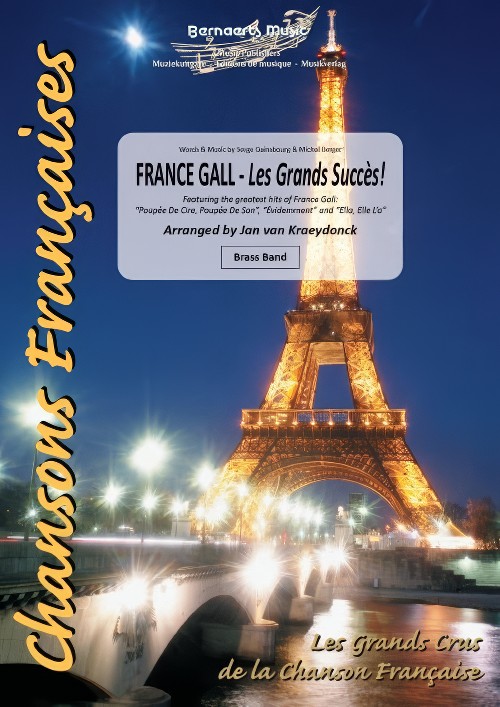
France Gall - Les Grands Succes! (Brass Band - Score and Parts) - Berger & Gainsbourg - Kraeydonck, Jan van
Including the titles: Poup?e De Cire, Poup?e De Son, ?videmment & Ella, Elle L'a. Performed by France Gall. Duration: 05:30
Estimated dispatch 7-14 working days
-
 £79.95
Corineus (Brass Band - Score and Parts) - Bond, Christopher
Regionals 2024 - 3rd Section test piecePremiered by Cory Band at the 2018 Festival of Brass, Manchester. Selected as the set-work for the Championship Section at the 2019 National Youth Championships of Great Britain.Corineus, in medieval British legend, was a prodigious warrior, a fighter of giants, and the eponymous founder of Cornwall. The first of the legendary rulers of Cornwall, he is described as a character of strength and power. It is on the medieval ruler that this new work, Corineus, is based, presented in three contrasting sections. The work opens with heraldic fanfares and a sense of jubilance before presenting musical material which changes and develops organically, portraying the journey taken by Corineus, Brutus, and the Trojans from modern-day mainland Europe to Britain. The central section of the work is slower, creating a feeling of longing. Brutus' son, Locrinus, had agreed to marry Corineus' daughter, Gwendolen, but instead fell in love with a German princess. In writing this part of the work, the composer portrays the longing of Gwendolen for her husband, knowing he is in love with somebody else. After Corineus died, Locrinus divorced Gwendolen, who responded by raising an army in Cornwall and making war against her ex-husband. Locrinus was killed in battle, and legend suggests that Gwendolen threw Locrinus' lover into the River Severn. This dramatic battle provides the inspiration for the final part of the work. In writing this work, the composer hopes to flare the imagination of young brass players around the country, in an engaging new take on a firm fixture in British folklore.Duration: 11.00
Estimated dispatch 7-14 working days
-
£29.95
Corineus (Brass Band - Score only) - Bond, Christopher
Regionals 2024 - 3rd Section test piecePremiered by Cory Band at the 2018 Festival of Brass, Manchester. Selected as the set-work for the Championship Section at the 2019 National Youth Championships of Great Britain.Corineus, in medieval British legend, was a prodigious warrior, a fighter of giants, and the eponymous founder of Cornwall. The first of the legendary rulers of Cornwall, he is described as a character of strength and power. It is on the medieval ruler that this new work, Corineus, is based, presented in three contrasting sections. The work opens with heraldic fanfares and a sense of jubilance before presenting musical material which changes and develops organically, portraying the journey taken by Corineus, Brutus, and the Trojans from modern-day mainland Europe to Britain. The central section of the work is slower, creating a feeling of longing. Brutus' son, Locrinus, had agreed to marry Corineus' daughter, Gwendolen, but instead fell in love with a German princess. In writing this part of the work, the composer portrays the longing of Gwendolen for her husband, knowing he is in love with somebody else. After Corineus died, Locrinus divorced Gwendolen, who responded by raising an army in Cornwall and making war against her ex-husband. Locrinus was killed in battle, and legend suggests that Gwendolen threw Locrinus' lover into the River Severn. This dramatic battle provides the inspiration for the final part of the work. In writing this work, the composer hopes to flare the imagination of young brass players around the country, in an engaging new take on a firm fixture in British folklore.Duration: 11.00
Estimated dispatch 7-14 working days
-
 £69.95
Transformation (Brass Band - Score and Parts) - Downie, Kenneth
I believe in transformation, God can change the hearts of men, And refine the evil nature, till it glows with grace again'. So wrote John Gowans in the second verse of his great hymn, 'I believe that God the Father, can be seen in God the Son', written specifically to affirm Salvationists' beliefs. It is sung to the tune Bethany and in seeking to explore this great subject at the heart of the Christian gospel in musical terms, the composer has used this fine tune as the basis. Although it never appears in its entirety, it is seldom out of the picture and much of the work is derived from it. The other main source of material is the lovely, simple chorus, 'Some day I shall be like him, changed to heavenly beauty, when his face I see'. This chorus is especially prominent in the middle section but there are important references to it throughout. There are also brief references to Charles Wesley's hymn, 'Love Divine' and, in particular, the telling lines, 'Changed from glory into glory, till in Heaven we take our place'. The work suggests that, at times, the process of being transformed is a struggle, portrayed with many passages of fraught and demanding music. Considerable reserves of stamina and technique are required while, in contrast, the chorus, 'Some day I shall be like him' provides the warm, gentle centre of the work. The premiere of the work was given by The International Staff Band of The Salvation Army in Cadogan Hall on Friday 3rd June 2011, as part of the band's 120th anniversary celebrations.
Estimated dispatch 7-14 working days
-
£34.95
Transformation (Brass Band - Score only) - Downie, Kenneth
I believe in transformation, God can change the hearts of men, And refine the evil nature, till it glows with grace again'. So wrote John Gowans in the second verse of his great hymn, 'I believe that God the Father, can be seen in God the Son', written specifically to affirm Salvationists' beliefs. It is sung to the tune Bethany and in seeking to explore this great subject at the heart of the Christian gospel in musical terms, the composer has used this fine tune as the basis. Although it never appears in its entirety, it is seldom out of the picture and much of the work is derived from it. The other main source of material is the lovely, simple chorus, 'Some day I shall be like him, changed to heavenly beauty, when his face I see'. This chorus is especially prominent in the middle section but there are important references to it throughout. There are also brief references to Charles Wesley's hymn, 'Love Divine' and, in particular, the telling lines, 'Changed from glory into glory, till in Heaven we take our place'. The work suggests that, at times, the process of being transformed is a struggle, portrayed with many passages of fraught and demanding music. Considerable reserves of stamina and technique are required while, in contrast, the chorus, 'Some day I shall be like him' provides the warm, gentle centre of the work. The premiere of the work was given by The International Staff Band of The Salvation Army in Cadogan Hall on Friday 3rd June 2011, as part of the band's 120th anniversary celebrations.
Estimated dispatch 7-14 working days
-
 £21.95
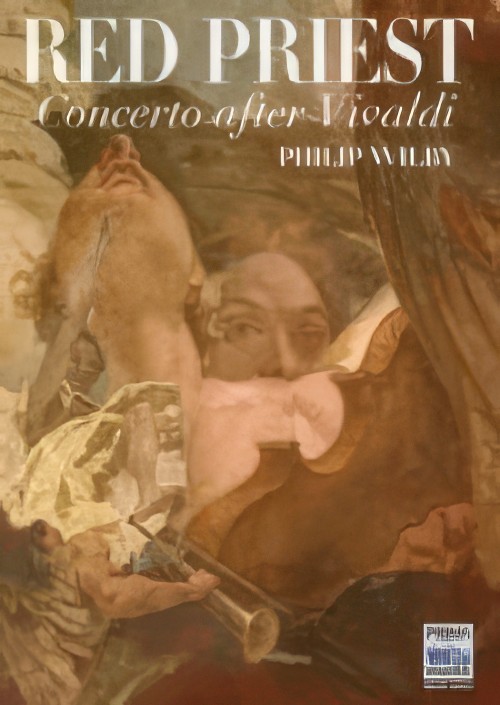
Red Priest (Brass Band - Study Score) - Wilby, Philip
Concerto After VivaldiDuring his lifetime, Antonio Vivaldi was known as 'il Prete Rosso', the Red Priest, thanks to his youthful ordination and his flaming red hair. The son of a violinist at San Marco in Venice, Vivaldi's musical pedigree was impeccable and an excellent start to his career was coupled with astounding energy and productivity. His vast output of concerti grossi, using soloists in groups, inspired this composition and performers may choose appropriate stage positions for the various groupings of cornets and trombones, spaced around the performance area. The score quotes freely from some of Vivaldi's most popular compositions, including 'Winter' from The Four Seasons, the motet Nisi Dominus, the famous Gloria and the fugue from the Concerto grosso in D minor found in L'Estro Armonico.However, it is the musical spirit of Vivaldi, a close contemporary of both Handel and Casanova, that inspired this music, which should be played with a mixture of accuracy and abandoned virtuosity. The musical images in this piece have clear associations in the composer's mind with individual Venetian locations, ranging from bustling street scenes to vaulted interiors, and describing the famous journey down the Grand Canal, past the Doge's Palace, to the Ospedale della Pieta where Vivaldi worked for so many years.Duration: 14.00
Estimated dispatch 7-14 working days
 View Music