
Results
-
 £60.00
Fantastic Polka (Trombone Solo with Brass Band - Score and Parts)
Arthur Pryor is remembered primarily for his 12 years as the amazing trombone soloist with The Sousa Band. However, he was also a prolific composer and conductor, forming his own band following his years with Sousa. He wrote many trombone solos designed to dazzle audiences with his virtuosity.This brass band version was prepared at the request of The Black Dyke Band, musical director Nicholas J Childs, for a recording project with Ian Bousfield, principal trombone of the Vienna Philharmonic, titled Pryor Engagement. It has also been recorded by Brett Baker with Brass Band of the Western Reserve, musical director Keith M Wilkinson, on the CD Slides Rule!
Estimated dispatch 7-14 working days
-
 £14.95
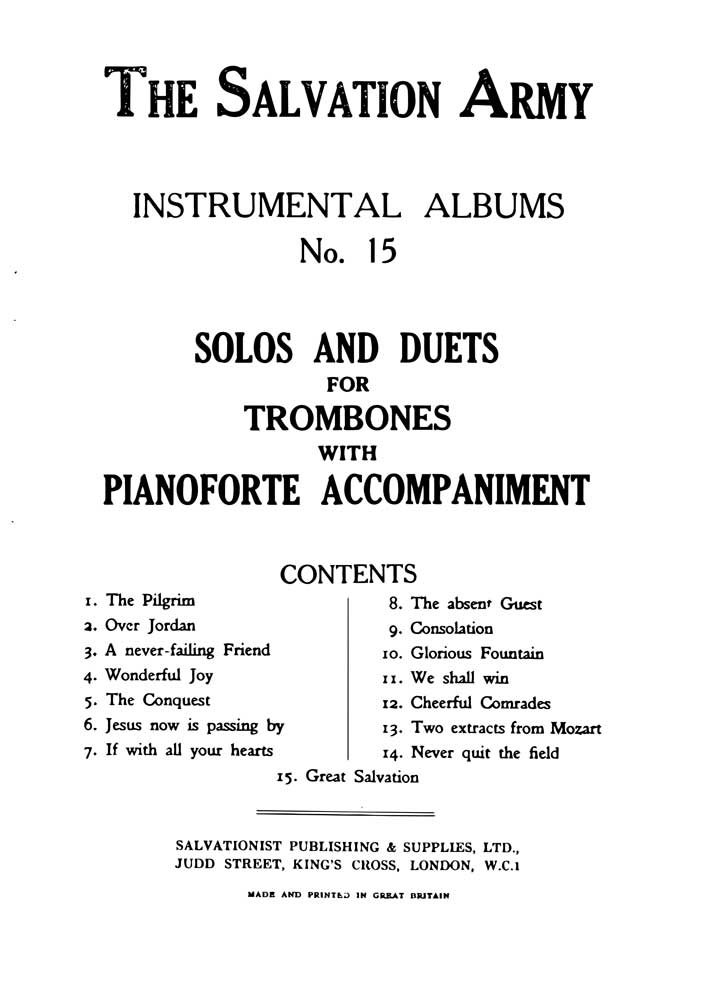
Instrumental Album No.15 - Solos & Duets Trombone
Includes: The Pilgrim; Over Jordan; A never-failing friend; Wonderful Joy; The Conquest; Jesus now is passing by; If with all your hearts; The absent guest; Consolation; Glorious Fountain; We shall win; Cheerful Comrades; Two extracts from Mozart; Never quit the field; Great SalvationInstrumentation: Trombone with Piano Accompaniment
Estimated dispatch 7-14 working days
-
 £14.95
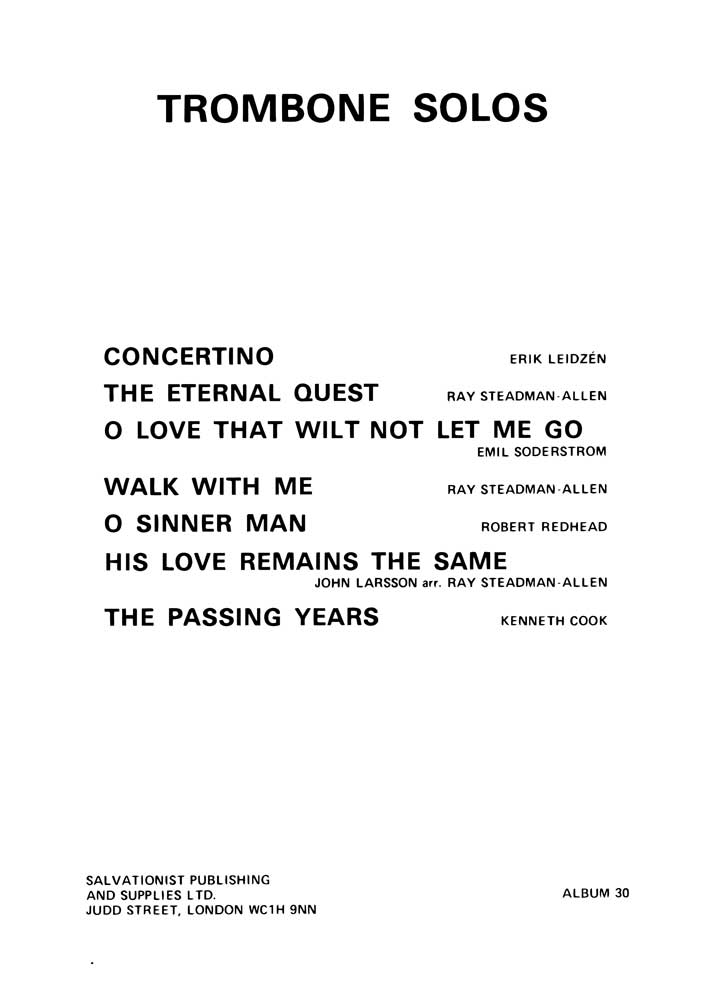
Instrumental Album No.30 - Trombone Solos
Includes: Concertino; The Eternal Quest; O love that wilt not let me go; Walk with me; O sinner man; His love remains the same; The passing yearsInstrumentation: Trombone with Piano Accompaniment
Estimated dispatch 7-14 working days
-
 £60.00
Fantastic Polka (Trombone Solo with Brass Band - Score and Parts) - Pryor, Arthur - Wilkinson, Keith M.
Arthur Pryor is remembered primarily for his 12 years as the amazing trombone soloist with The Sousa Band. However, he was also a prolific composer and conductor, forming his own band following his years with Sousa. He wrote many trombone solos designed to dazzle audiences with his virtuosity.This brass band version was prepared at the request of The Black Dyke Band, musical director Nicholas J Childs, for a recording project with Ian Bousfield, principal trombone of the Vienna Philharmonic, titled Pryor Engagement. It has also been recorded by Brett Baker with Brass Band of the Western Reserve, musical director Keith M Wilkinson, on the CD Slides Rule!
Estimated dispatch 7-14 working days
-
 £26.95
Do You Recall? (Trombone Solo with Brass Band - Score and Parts) - Wiffin, Rob
A slow, bluesy solo for trombone with band accompanimentLike many people, I took the opportunity offered by the COVID lockdown in Spring of 2020 to sort through old paperwork. I discovered a lot of songs that had not seen the light of day for many years and were mostly written with just the melody and chord symbols. Some offered the potential of becoming instrumental solos with a combination of heart-on-the-sleeve melodies the like of which I would not write now, together with maybe a greater sophistication in the instrumental writing. I had the notion in the back of my mind that Do you recall?; would work as a trombone solo but it seemed to fight me all the way. However, once finished it has proved to appeal to trombonists and has already been recorded by Brett Baker. It is not intrinsically difficult but needs a sense of the appropriate slow swing style and good control throughout the range.- Rob WiffinDuration: 4.15
Estimated dispatch 7-14 working days
-
 £55.50
Autumn Dreams (Valse Brillante) (Trombone Solo with Brass Band - Score and Parts) - Zimmerman, Leopold A. - Wilkinson, Keith M.
Leopold A Zimmerman (1866 - 1935) succeeded the legendary Arthur Pryor as trombone soloist in the Sousa Band and, following his predecessor's example as well as that of other soloists in the band, composed several solos to demonstrate his considerable talents. This arrangement was been requested by Brett Baker for a recording with Black Dyke Band.
Estimated dispatch 7-14 working days
-
 £42.95
Shout! (Trombone Solo with Brass Band - Score and Parts) - Wiffin, Rob
Shout! was written for Brett Baker to demonstrate a particular musical aspect of his trombone playing.It is a Latin jazz piece subtitled CCC 4 BB - Cha cha cha for Brett Baker - and shows the trombone's ability to act as a declamatory jazz voice, covering much of the range and expressive power of the instrument. In one sense the title also refers to the jazz tradition of a Shout chorus which often appears towards the end of a jazz piece, bringing the players together after they have all taken their improvised solos.Shout! should hopefully be enjoyable to listen to and, although not without its technical challenges, fun to play.Duration: 3.45Recorded on Polyphonic QPRL227D SHOUT!
Estimated dispatch 7-14 working days
-
£37.50
Midnight in Cairo - Steven Ponsford
Midnight in Cairo is a fun and light piece of music, suitable for anywhere in a concert. It is atmospheric in its nature, conjuring up images of the lively nightlife in the streets against the backdrop of the Nile and the other ancient wonders of this vibrant city. The music starts in a mysterious mood, with soft vocals around the band accompanying the main theme, before the piece takes off. There are solos for trombone and cornet, which will benefit from the players standing up to play, and improvising if possible.
In Stock: Estimated dispatch 1-3 working days
-
 £127.30
Haven't Met You Yet - Michael Bublé - Bjørn Morten Kjærnes
"Haven't Met You Yet" is the first single from Canadian singer Michael Buble's sixth album, Crazy Love, released on August 31, 2009. According to Buble, the single and its official music video are "about everyone's dream of finding a relationship and love." Buble co-wrote "Haven't Met You Yet" with Alan Chang and Amy Foster-Gillies and dedicated it to his then fiancee and now wife, Luisana Lopilato (who appears as his love interest in the music video).2012, Nick Jonas covered the song in the TV series Smash, so this music can also be used in a TV/Movie theme concert.Soloist options:Attached is a vocal lead that can be used with the arrangement. It is then recommended to dampen the melody in the ensemble, especially on the verses. (See list below)There are some performers or groups that can have these bars as solos:9-17 Flugelhorn17-24 Euphonium/Horn37-45 Euphonium45-52 Baritone/Trombone61-69 Horn/ Flugelhorn78-85 Euphonium/Baritone86-95 Flugelhorn107-end Flugelhorn/EuphoniumIf you want to use an instrumental soloist throughout the piece, they can use the vocal lead and transpose it to their instrument. Then the conductor should dampen or remove the above solos in the band.
Estimated dispatch 5-14 working days
-
 £70.00
Tango - Gavin Higgins
Tango for Trumpet and Trombone solos with Brass Band accompaniment was written for Ian Porthouse and Brett Baker in 2008. The first performance was given by the Black Dyke Bandconducted by Nicholas Childs, at the Black Dyke Brass Arts Festival. Brass Band Grade 5: 1st Section Duration: 9 minutes
Estimated dispatch 5-14 working days
 View Music
 Listen to MP3