
Results
-
 £60.99
Love Can Build a Bridge (Brass Band - Score and Parts) - Sebregts, Ron
This arrangement for brass band of the successful song Love Can Build a Bridge includes a beautiful cornet solo. A splendid addition to any concert.Duration: 3:45
Estimated dispatch 7-14 working days
-
 £44.95
The New Jerusalem (Brass Band - Score only) - Wilby, Philip
The New Jerusalem was commissioned by the National Youth Brass Band of Great Britain, and first performed by them at City Hall, Salisbury on 20 April 1990 and then the following day in London's Queen Elizabeth Hall. The original version was thus intended for their very large group of gifted players, and is available from the Novello Hire library.This present Contest Version is a thorough revision of that original score, redesigned for a conventional number of players, and recast as a score which contains considerable scope for solo performers within the band.Recorded on Polyphonic QPRL056D National Brass Band Championships of Great Britain and Gala Concert - 1992
Estimated dispatch 7-14 working days
-
 £94.95
The New Jerusalem (Brass Band - Score and Parts) - Wilby, Philip
The New Jerusalem was commissioned by the National Youth Brass Band of Great Britain, and first performed by them at City Hall, Salisbury on 20 April 1990 and then the following day in London's Queen Elizabeth Hall. The original version was thus intended for their very large group of gifted players, and is available from the Novello Hire library.This present Contest Version is a thorough revision of that original score, redesigned for a conventional number of players, and recast as a score which contains considerable scope for solo performers within the band.Recorded on Polyphonic QPRL056D National Brass Band Championships of Great Britain and Gala Concert - 1992
Estimated dispatch 7-14 working days
-
 £22.99
Beecher Variations (Brass Band - Score only) - Bulla, Stephen
In this beautiful composition, melodic fragments of the hymn tune Beecher are morphed into a series of variations, showing the melody in various moods from expressive, then quiet and soft, to bright and triumphant in the end. Written as a test piece in the 4th division for the Dutch Brass Band Championships in 2015, the music features challenging solo parts for cornet, soprano cornet, flugelhorn and euphonium. A great work for the concert or contest stage!Duration: 12.00
Estimated dispatch 7-14 working days
-
 £45.00
Crown Imperial, March (Brass Band - Score and Parts) - Walton, William - Littlemore, Phillip
William Walton composed his Crown Imperial for performance at the coronation of King Edward VIII, which was scheduled for the 12th May 1937. However, due to the dramatic abdication of Edward, it was in fact performed at the Coronation of the new monarch, King George VI, which took place on the same scheduled date. The march became popular immediately, and arrangements for piano solo, organ, small orchestra and military band were all published within a year. It has been used at all Royal events since, most notably the Coronation of Queen Elizabeth II in 1953. This new brass band transcription?is in keeping with the shorter, 6-minute concert version that Walton created immediately following the Coronation of George VI. However, the scoring is more in keeping with contemporary brass band voicings, and provides an exciting version for brass band.?Duration: 7:00
Estimated dispatch 7-14 working days
-
 £35.00
GOD ONLY KNOWS (Flugel feature/Brass Band) - Baker, Leigh
Recorded in 1966 as a part of the Beach Boys' landmark?Pet Sounds?album, this ballad has become a prime example of Brian Wilson's innovative approach to songwriting and recording. Hailed for its formal and harmonic complexities as well as a memorable hook, "God Only Knows" has remained popular through the years, and was featured prominently in the biographical film Love & Mercy?about the life of Brian Wilson.This Beach Boys Classic is arranged as a Flugel Solo, and features a Trombone Quartet (spotlight your 'sectret' Trombonist or use a Baritone/Valve Trombone soloist from your Euphonium/Baritone Team.Commissioned by The Leland Band for their Brass in Concert performance 2012 this is a real favourite with audiences and something a little bit different. This is ripe for Choreography.
Estimated dispatch 7-14 working days
-
 £40.00
I SEE THE LIGHT (from Tangled) (Brass Band) - Barry, Darrol
This beautiful song is taken from Pixar's animated feature?Tangled. The opening section features the solo horn against a light accompaniment. The music builds to a change of key where the melody moves over to the euphoniums and baritones. This is a useful concert item and playable by all levels of bands. Grade: 4th section +. Duration: 3:44
Estimated dispatch 7-14 working days
-
 £33.00
LUX AETERNA (Brass Band) - Harper, Philip
The title Lux Aeterna (Eternal Light) can he interpreted on a number of levels. Musically it has a rather mystical feel to it,?and the single note with which the piece begins continues uninterrupted throughout, like an inextinguishable flame, or?a constant source of hope. There are lyrical and song like solo lines for cornet, flugel and euphonium. This composition was performed as part of the Cory Band's winning Brass in Concert programme in 2012.
Estimated dispatch 7-14 working days
-
 £85.00
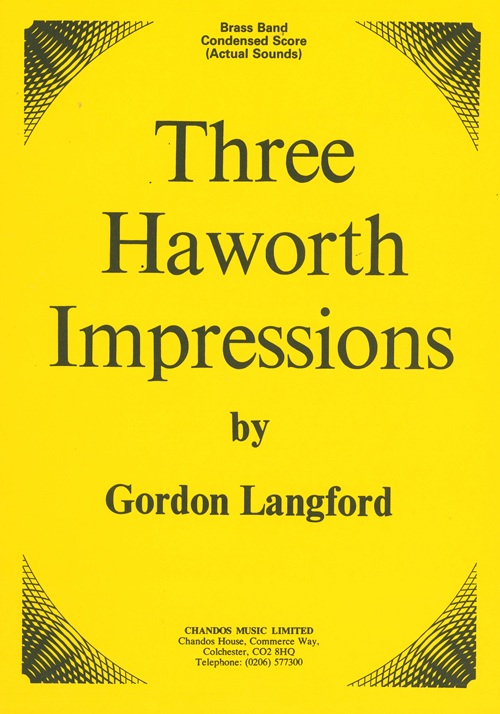
Three Haworth Impressions (Brass Band - Score and Parts) - Langford, Gordon
A wonderful three movement suite which conjures up fabulous musical imagery of the lands of northern England. Well worth including as a concert item in your next programme, but this great original composition should really should be set again as a test-piece soon - rewarding musically for audience and bandsmen alike.Includes:TOP WITHENS - A GENERAL EVOCATION OF THE ATMOSPHERE OF WUTHERING HEIGHTS The sinister opening motif symbolises the influence of the evil Heathcliffe, Soon this motif experiences several changes of character in order to portray emotions other than those of hatred and jealousy. The overall mood is, however, one of gloom and foreboding.THE THREE BELLS This is a reference to the pseudonyms adopted by Ann, Charlotte and Emily Bronte. The music begins with three "bell"-notes; Ab for Acton Bell, Cb for Currer Bell and Eb for Ellis Bell, and these three notes form the basis of a wistful waltz tune. Again the mood is rather sombre -- save for a brighter middle section -- and the opening motif from "Top Withens" is to be heard, again symbolising the frustrations and ill-fortune by which their lives were plagued.THE WORTH VALLEY RAILWAY The Brontes were not the only people in Haworth and not all is desperation and gloom. The third impression is a celebration of the victory of the people of Haworth in their fight to retain their railway. The nine-eight rhythm of a slow train is prominent, and our once-sombre motif is transformed into a triumphant fanfare.Duration: 12.00Please note that there are only 3 solo cornet parts included in this set
Estimated dispatch 7-14 working days
-
£16.00
Three Haworth Impressions (Brass Band - Score only) - Langford, Gordon
A wonderful three movement suite which conjures up fabulous musical imagery of the lands of northern England. Well worth including as a concert item in your next programme, but this great original composition should really should be set again as a test-piece soon - rewarding musically for audience and bandsmen alike.Includes:TOP WITHENS - A GENERAL EVOCATION OF THE ATMOSPHERE OF WUTHERING HEIGHTS The sinister opening motif symbolises the influence of the evil Heathcliffe, Soon this motif experiences several changes of character in order to portray emotions other than those of hatred and jealousy. The overall mood is, however, one of gloom and foreboding.THE THREE BELLS This is a reference to the pseudonyms adopted by Ann, Charlotte and Emily Bronte. The music begins with three "bell"-notes; Ab for Acton Bell, Cb for Currer Bell and Eb for Ellis Bell, and these three notes form the basis of a wistful waltz tune. Again the mood is rather sombre -- save for a brighter middle section -- and the opening motif from "Top Withens" is to be heard, again symbolising the frustrations and ill-fortune by which their lives were plagued.THE WORTH VALLEY RAILWAY The Brontes were not the only people in Haworth and not all is desperation and gloom. The third impression is a celebration of the victory of the people of Haworth in their fight to retain their railway. The nine-eight rhythm of a slow train is prominent, and our once-sombre motif is transformed into a triumphant fanfare.Duration: 12.00Please note that there are only 3 solo cornet parts included in this set
Estimated dispatch 7-14 working days
 View Music