
Results
-
 £34.95
Elixir of Youth (Brass Band - Score and Parts)
Elixir of Youth (2013) was written for the 2013 Brass for Heroes charity event where it was premiered on 19th October 2013 at St Paul's Hall in Huddersfield under the baton of Philip Harper. The title of the work reflects the nature of the band that was put together for that premiere performance; an all-star youth band comprising a selection of the country's young brass banding talent, with the term Elixir referring here to the everlasting talent seen in young brass players throughout the United Kingdom's brass bands and bands' and teachers abilities to keep producing such high quality musicians for the banding movement.The work, structured in three sections, is a showcase for band with a heroic opening where fanfare-like gestures in the cornets and trombones juxtapose rapid euphonium and baritone runs, alongside sweeping horns and percussion effects. As the piece progresses, a grove is introduced - just in the tubas at first, accompanied by a hi-hat - before spreading through the band, definitely stuff to tap your toes to! The middle, slower section of the work sees both flugel and cornet solos, with additional inputs from the euphonium and solo horn before a climax and return to the tempo and music of the opening section. A rousing close concludes the work where all of the work's themes are interweaved to create a sense of power, unity and grandeur; an Elixir of Youth.
Estimated dispatch 7-14 working days
-
 £74.00
Fantasie Concertante (Parts only) - Philip Wilby
This exciting new concerto is a welcome addition to the repertoire of french and tenor horn players alike. Like the 18th-Century Serenade form there are five movements, arranged symmetrically around a slow movement - Soliloquy - which separates movements entitled Burlesque (two) and Valse Caprice (three) respectively. The first and last movements share common material of a more symphonic stature, and the concerto ends with a brisk fugato. The solo horn is (in the band version) accompanied by a quintet of solo players (two cornets, euphonium, trombone, and tuba) who provide the lion's share of the counterpoint and contrast with the main body of musicians who provide musical punctuation in the more sonorous tutti sections. The first movement, Don Quixote's Dream, contains references to Cervantes' famous hero, the Spanish nature of his stories, and the ambling gait of his horseback adventures.
Estimated dispatch 7-9 working days
-
 £29.95
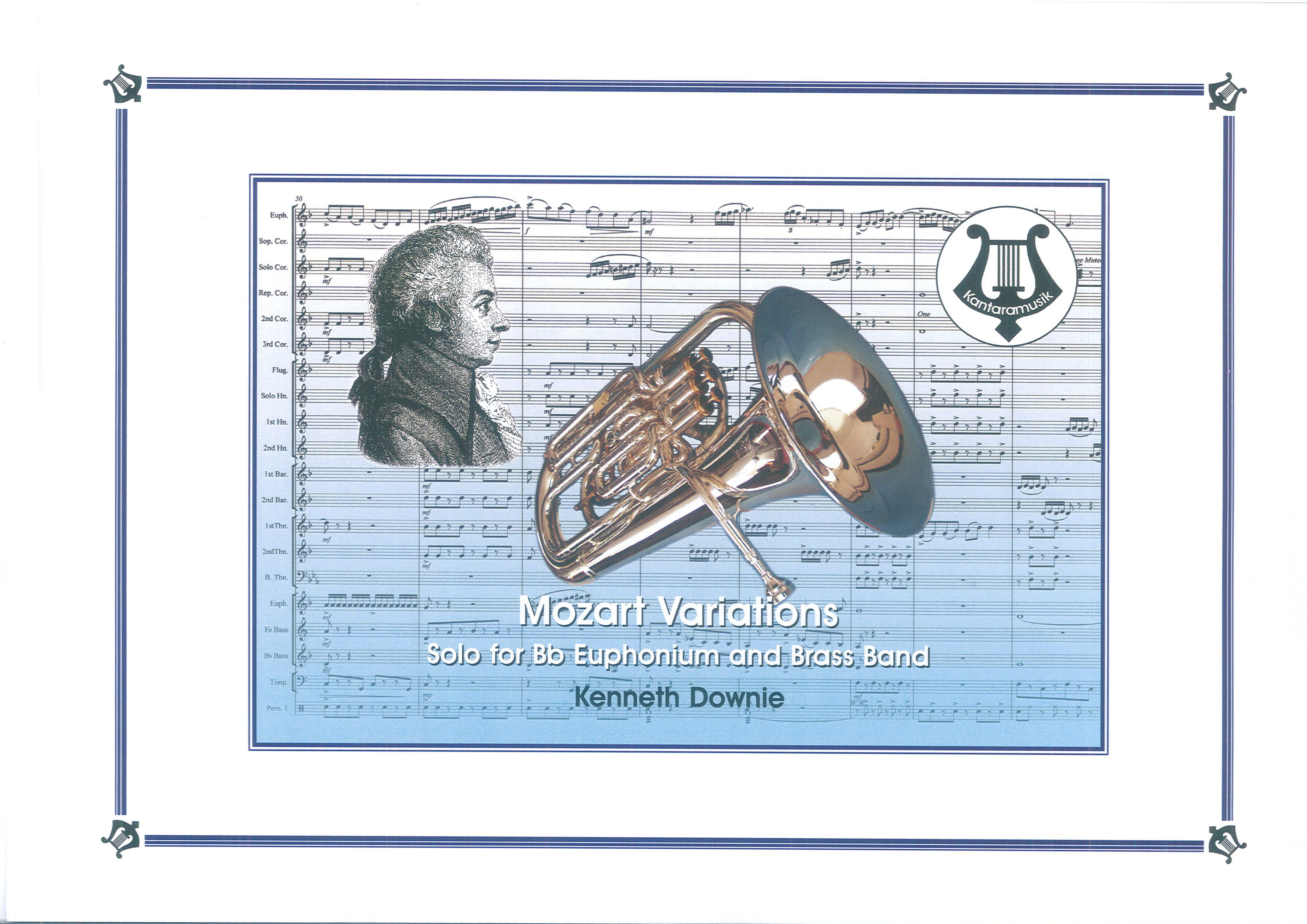
Mozart Variations - Euphonium Solo (Brass Band - Score and Parts)
The main theme of this music comes from Mozart's opera The Magic Flute, a very well-known melody which is sometimes associated with sacred words. It is a beautiful tune which lends itself to variation treatment including these very light-hearted examples. While working on this music, the composer had the idea of incorporating references to other well-known Mozart themes, again, with a rather tongue-in-cheek approach. The result is a high-spirited, flamboyant solo that will be fun to play and to listen to.
Estimated dispatch 7-14 working days
-
 £87.95
Masquerade (Score and Parts)
The first performance took place on the 4th. September 1993 at the Free Trade Hall in Manchester during the British Open Brass Band Championships.Note by Philip Wilby:Masquerade is a centenary tribute to Verdi's last opera Falstaff and takes its final scene as the basis for my own piece. Thus I have used some of Verdi's music, and some of Shalespeare's plot, and woven them into a fabric with highly demanding music of my own to produce a work in the great tradition of operatically-based brass band pieces. Such scores date from the very beginnings of band repertory and are often not direct arrangements in the established sense but new compositions produced in homage to a past master. They may still offer performers and audience alike something familiar interwoven with something new. My own piece reuses some elements from the original story: . .Falstaff has been caught in a web of his own lies by the ladies of the town, who propose to teach him a lesson. The story opens at night in Windsor Great Park. The plotters, variously disguised in Hallowe'en fashion (as fairies,elves hobgoblins etc!) assemble in the park to await Falstaff's arrival (musicologists will, perhaps, note a rare use of 'large bottle in F' being used during this scene of suppressed alcoholic revelry!). Falstaff's companions, Bardolph,Piston and Robin, enter (represented here by the three trombones!), and are variously abused by the masqueraders. At the height of the Tout an alarm sounds and Falstaff (euphonium cadenza) enters as Midnight strikes. From a safe hiding place he watches as the disguised Nanetta (principal comet) sings a serene solo as the moon appcars above the trees. With sudden force the others seize him and drag him from his hiding place. As in the traditional game 'Blind Man's Buff', he is roughly turned seven times (a sequence of solo accelerandi) until, at last, he recognizes his assailants as his sometime friends. Far from complaining, Verdi's character concludes the opera with a good-humoured fugue on the words.... 'All the World's a Joke... Every mortal laughs at the others, But he laughs best who has the final laugh. Philip Wilby.
Estimated dispatch 7-14 working days
-
 £89.95
Partita (Score and Parts)
Partita was written in 1989 to a commission from Eikanger/Bjrsvik Musikklag (Norway) who were European Champions at the time.There are three movements.1 The first movement is almost a miniature concerto for band. It opens with a relentless quaver passage in the basses, which builds until the whole band is involved. Horns and baritones are first to take centre-stage in close harmony and the euphoniums and basses follow them. These forces combine to introduce the cornets that have a 10-part fanfare to themselves before the trombones interrupt. The opening quaver figure returns, somewhat ominously, and, after the full band recalls previous material, brings the movement to a close.2. Starts with a cornet solo over a pulsating accompaniment after which the band builds to a noble tune on the trombones. The full band takes over and brings back the opening cornet tune with which the soloist, with the aid of a euphonium counter-melody, quietly ends the movement, leading directly into:3. A sparkling vivo, which opens with the fanfare-like figures throughout the band until a solo cornet, emerges with an acrobatic tune. The whole band takes this up until horns; baritones and trombones introduce an energetic second subject, which leads to a full band climax in the form of a jubilant chorale. This died away to reintroduce the opening fanfare against a new theme from the trombones, which eventually leads back to a recapitulation. We are then thrown headlong into a 12/8 presto, which hurtles to a coda, which recalls the opening themes.
Estimated dispatch 7-14 working days
-
 £33.43
Because you asked (Euphonium Solo with Brass Band) Rob Wiffin
This calm and expressive solo was written at the direct request of an instrumentalist, hence the title. There is nothing technically difficult in the piece, but it does need good control of line and dynamics.Audio Demo: https://soundcloud.com/user-565396545/because-you-asked-euphoniumDuration: Approx. 4.20 minutesDifficulty Level: MediumThis PDF download includes the full score and parts.Sheet music available at www.brassband.co.uk (UK) or https://satradecentral.org (USA)
In Stock: Estimated dispatch 1-3 working days
-
 £33.43
Love Eternal (Trombone Solo with Brass Band) Jarrod Cooper arr. Gavin Lamplough
Love Eternal was arranged by Gavin Lamplough for trombone virtuoso Isobel Daws to perform in a special concert with the Melbourne Staff Band to honour its Bandmaster Ken Waterworth, on the occasion of his retirement after 30 years of leading the band.The arranger uses Jarod Cooper's popular contemporary worship song King of Kings, Majesty as the basis for the work and the piece seeks to provide a vehicle for the rich timbres of the trombone to be enjoyed by the listener.To view a rolling score video featuring Isobel Daws and the Melbourne Staff Band please visit www.youtube.com/watch?v=AEpbHNFPMxsThis title is also available as a tenor horn solo with brass band here.PDF download includes score and parts.Sheet music available from:UK - www.brassband.co.ukUSA - https://satradecentral.orgDifficulty Level: 4th Section +Length: 5.00 minutesInstrumentation:Trombone Soloist EbSoprano Cornet Eb1st Cornet Bb2nd Cornet BbFlugel Horn Bb1st Horn Eb2nd Horn Eb1st Baritone Bb2nd Baritone Bb1st Trombone Bb2nd Trombone BbBass TromboneEuphonium BbBass EbBass BbPercussion 1-3
In Stock: Estimated dispatch 1-3 working days
-
 £14.86
Finale from Symphony No.3 (Organ Symphony) (Brass Band) Additional Parts
Saint-Saens' magnificent Finale from Symphony No.3 (widely known as the 'Organ Symphony') has here been arranged for brass band with optional organ by Kevin Norbury. It was recorded by The International Staff Band on its CD Manuscripts, although this version has been revised in places.Saint-Saens decided to add the organ and piano to his 3rd symphony as a pragmatic orchestration innovation. The composition of this symphony was probably started in 1885 and a first draft was completed in Prague in 1886.Saint-Saens later recalled its eventful genesis: 'The Symphony in C was three-quarters sketched out when I found it impossible to write the finale. I did not know how to resolve this situation, until one night I suddenly woke up and, in a sort of hallucination, I heard the whole finale, which I hastily wrote down in outline, knowing that if I went back to sleep without having put anything on paper, I would have forgotten it all the next day.'The symphony was first performed under the composer's direction at Saint James's Hall in London on May 19, 1886.This arrangement by Kevin Norbury can both function as a stand-alone brass band piece, and be performed with an organ by omitting the notes found in square brackets in the parts and score.To view a rolling score video please visit www.youtube.com/watch?v=OlUd_FppBY8PDF download includes additional parts as listed below. Full set including score available here.Sheet music available from:UK - www.brassband.co.ukUSA - https://satradecentral.orgDifficulty Level: 1st Section +Length: 8.30 mins.Alternative Parts included in this download:Solo Horn F1st Horn F2nd Horn F1st Baritone B.C.2nd Baritone B.C.1st Trombone B.C.2nd Trombone B.C.Euphonium B.C.Tuba 1 B.C. (Bass Eb equivalent)Tuba 2 B.C. (Bass Bb equivalent)
In Stock: Estimated dispatch 1-3 working days
-
 £7.43
Fanfare Prelude - Now thank we all our God arr. Downie (Additional Parts)
This rousing fanfare prelude for Brass Band and optional Organ by Kenneth Downie is based on the monumental hymn Now thank we all our God, which dates from 17th century Germany. The arrangement is featured on the CD Classic Hymns for Orchestra - The Symphonic Music of Kenneth Downie (available here) as a symphonic brass setting.The arranger writes: 'The depth of the words is underpinned by the grandeur of the music, so I have tried to reflect the same regal approach in my setting for brass band.'This arrangement will be an ideal opener or prelude for concerts or church services.To view a rolling score video of the work please visit https://www.youtube.com/watch?v=olrdFskDfacPDF download includes score and parts.Sheet music available from:UK - www.brassband.co.ukUSA - https://satradecentral.orgDifficulty Level: 2nd Section +Length: 3.15 minutesPDF download includes additional parts as listed below. Full set including score available here.Alternative Parts included in this download:Solo Horn F1st Horn F2nd Horn F1st Baritone B.C.2nd Baritone B.C.1st Trombone B.C.2nd Trombone B.C.Euphonium B.C.Tuba 1 B.C.Tuba 2 B.C.
In Stock: Estimated dispatch 1-3 working days
-
 £7.43
The Lord Bless You and Keep You (Brass Band - Additional Parts) John Rutter
John Rutter's popular choral benediction is based on Numbers 6:24-26, and has here been arranged for brass band by Andrew Wainwright. It is a setting of a biblical benediction, followed by an extended 'Amen'. Rutter originally scored the piece for four vocal parts (SATB) and organ. He composed it in 1981 for the memorial service of Edward T. Chapman, the director of music at Highgate School, London, with whom he had studied when he attended the school.To view a rolling score video with Wellington Brass performing the work please visit www.youtube.com/watch?v=ijJ2Nir3wRQPDF download includes additional parts as listed below. Full set including score available here.Sheet music available from:UK - www.brassband.co.ukUSA - https://satradecentral.orgDifficulty Level: 4th Section +Alternative Parts included in this download:Solo Horn F1st Horn F2nd Horn F1st Baritone B.C.2nd Baritone B.C.1st Trombone B.C.2nd Trombone B.C.Euphonium B.C.Tuba 1 B.C.Tuba 2 B.C.
In Stock: Estimated dispatch 1-3 working days