
Results
-
 £19.95
Mythical Tales (Brass Quintet)
Mythical Tales (2012) is a ten minute work in three movements which represents three of the most popular folk stories or indeed in the case of the first movement, true stories, in Welsh culture.I. Owain GlyndwrOwain Glyn Dwr was born around the 1350s into an Anglo-Welsh gentry family. His estates provided him with a modest power base in north-east Wales. After a number of disputes, he proclaimed himself prince of Wales in September 1400.Glyn Dwr led several battles with the English, although he was never captured. Over the next few years punitive measures were enacted to keep control of Wales, but these were matched by many acts of Welsh rebellion - among them the capture of Conwy Castle in April 1401. In June 1402, at the Battle of Pilleth on Bryn Glas Hill, Glyn Dwr led his troops to victory over an English army. By now Glyn Dwr was leading a national revolt. In 1404, he led a march towards Wocester, but failed, with the English capturing parts of Wales. He died defending his country.II. MyfanwyMyfanwy was the most beautiful woman in Powys, but she was vain and liked nothing better than to be told how beautiful she was. Many handsome men would court her, but she would not show interest because they couldn't sing and play to her, reflecting her true beauty.Luckily, a penniless bard, Hywel ap Einion was in love with Myfanwy, and one day plucked up the courage to climb up the hill to the castle with his harp, to sing and play to her. He's allowed in to play for her, and while he's playing and complimenting her on her beauty she can neither listen nor look at any other man. Because of this Hywel believes that she has fallen in love with him. But his hopes are dashed when a richer, more handsome and more eloquent lover comes along. The music of the second movement portrays the despair and upset that Hywel must have felt.III. Battle of the DragonsMany centuries ago when dragons roamed the land, a white ice dragon descended on a small village and decided to live there, not knowing that a red fire dragon was already living nearby.Six months later the red dragon awoke to find a huge white dragon wrapped around his village that he cared for. He could tell that his people were ill from the cold. The Land was bare; nothing was able to grow not even the pesky dandelions. The people were starving. The people longed for the red dragon to free them from the icy misery, so that their life and land could return to the sunny and warm climate that it was once before.The red fire dragon challenged the white ice dragon to a single combat fight at the top of the cliff the next day. The people of the village watched in terror awaiting their fate. The red dragon beat the white dragon, and the crowd cheered with joy as the red dragon roared with triumph. The mayor of the village declared that the land should always fly a flag with the symbol of a Red dragon on it. The flag's background should be half green and half white; the green to represent the lush green grass of the land and the white to represent the ice. This way no one would ever forget what happened.
Estimated dispatch 7-14 working days
-
 £33.62
Menuet (Brass Band) Ravel arr. Rob Bushnell
Le Tombeau de Couperin (The Grave of Couperin) was written by Maurice Ravel between 1914 and 1917, originally a suite of piece for solo piano. Based on what was considered a traditional Baroque suite, Ravel wanted to pay homage to Baroque French keyboard music, whilst retaining his 20th-century chromaticism, making the work neoclassicist. Each movement is dedicated to the memory of a friend of the composer who died fighting in World War I. Ravel produced an orchestral version in 1919, omitting two of the original six movements. The Menuet was written in memory of Jean Dreyfus; Ravel had recuperated at his home. This arrangement is for the British-style brass band, with alternative parts for horns in F and bass-clef lower brass. A recording of the original composition can be found here: www.youtube.com/watch?v=jnNwEcBTSmk. Duration: Approx. 4 minutes Difficulty Level: 2nd Section + Duration: 4 minutes (depending on tempo and without any cuts) PDF download includes parts and score. Sheet music available at www.brassband.co.uk (UK) or https://satradecentral.org (USA) Instrumentation: Soprano Cornet Eb Solo Cornet Bb Repiano Cornet Bb 2nd Cornet Bb 3rd Cornet Bb Flugel Horn Bb Solo Horn Eb 1st Horn Eb 2nd Horn Eb 1st Baritone Bb 2nd Baritone Bb 1st Trombone Bb 2nd Trombone Bb Bass Trombone Euphonium Bb Bass Eb Bass Bb Timpani Percussion - Vibraphone & Glockenspiel
In Stock: Estimated dispatch 1-3 working days
-
£51.00
Charge of the Light Brigade
Charge of the Light Brigade was commissioned by the Foden's Youth Band in 2012. It tells the story of a battle in the Crimean War, where six hundred members of the light cavalry were sent to attack an Artillery Battery. However, due to miscommunications, they were sent to the wrong Artillery Battery, past the original target. The 600 soldiers then found themselves being attacked on two sides
In Stock: Estimated dispatch 1-3 working days
-
 £30.00
Deus in Adjutorium
DescriptionMonteverdi's Vespro della Beata Vergine (Vespers for the Blessed Virgin) is a musical setting by Claudio Monteverdi of the evening vespers on Marian feasts, scored for soloists, choirs, and orchestra. It is an ambitious work in scope, style and scoring, and has a duration of around 90 minutes. Published in Venice with a dedication to Pope Paul V dated 1 September 1610 as Sanctissimae Virgini Missa senis vocibus ac Vesperae pluribus decantandae, cum nonnullis sacris concentibus, ad Sacella sive Principum Cubicula accommodata ("Mass for the Most Holy Virgin for six voices, and Vespers for several voices with some sacred songs, suitable for chapels and ducal chambers"), it is mercifully regularly shortened to Monteverdi's Vespers of 1610.Monteverdi was born and spent the first part of his working life in Cremona before moving to Mantua (where he composed the Vespers) and finally attaining one of the top jobs in Italian renaissance music as Maestro di Capella at the Basilica di San Marco in Venice. He is most famous for his vocal music, notably his madrigals and the earliest surviving opera, Orfeo.Watch a preview video of the brass band score below:
Estimated dispatch 7-14 working days
-
 £19.95
Poco Allegretto from Symphony no. 3 - Johannes Brahms - Denis Burton
Allegretto or Poco Allegretto to give it its complete title, is the third movement of Johannes Brahms' Third Symphony. The Third Symphony was completed in 1883, some six years after his Second and is considered by critics as one of...
Estimated dispatch 5-7 working days
-
£44.95
NONE OTHER NAME (Brass Band Set) - Erik Leidzen
None Other Name was written for the 1960 tour of England by the New York Staff Band of The Salvation Army and can justifiably be termed a classic of brass band repertoire. It is best described as a symphonic medley of six songs focused on the name of Christ; The Saviour's Name; Jesus is the Sweetest Name I know; There's a Wonderful Name, 'tis Jesus; He's the Lily of the Valley; Jesus, the Very Thought of Thee (St. Agnes); All Hal the Power of Jesus' Name (Diadem).
Estimated dispatch 7-14 working days
-
 £39.95
Judd: None Other Name
None Other Name was written for the 1960 tour of England by the New York Staff Band of The Salvation Army and can justifiably be termed a classic of brass band repertoire. It is best described as a symphonic medley of six songs focused on the name of Christ; The Saviour's Name; Jesus is the Sweetest Name I know; There's a Wonderful Name, 'tis Jesus; He's the Lily of the Valley; Jesus, the Very Thought of Thee (St. Agnes); All Hal the Power of Jesus' Name (Diadem).
Estimated dispatch 7-14 working days
-
 £24.95
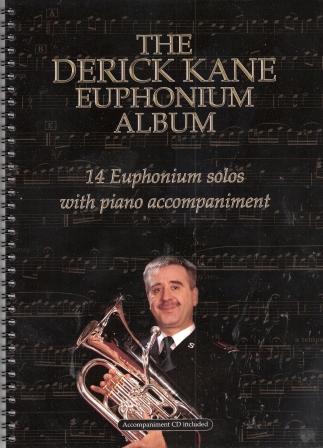
Derick Kane Euphonium Solo Album
Among the solos contained in this album are some of the 'heart songs' of The Salvation Army, some traditional melodies as well as four larger works. There are solos to challenge the younger player as well as some to test the most advanced soloist.These solos, many of which were only available with brass and accompaniment, have now been arranged with pianoforte accompaniment and come complete with an 'accompaniment CD'. Richard Phillips is the pianist. There is music suitable for all occasions, ranging from the Sunday morning worship meeting to the concert platform. Most importantly, the album contains solos that will appeal to the listener as well as the performer. A separate 'performance CD', featuring Derick Kane playing six of the solos with The International Staff Band and the remaining eight solos with Richard Phillips at the pianoforte, is also available (Go to our recordings section to view this product).The Better World Norman Bearcroft (trs. David Mortlock)Spirit of Life David Catherwood (trs. Susan Avison)My love is like a red, red rose Trad (arr. Kenneth Downie)Travelling Along Chris Mallett (trs. Derick Kane)Lyric Variations Ray Steadman-AllenThere will be God Joy Webb (arr. Richard Phillips)To live right Ivor BosankoWelsh Fantasy Ralph PearceJesus, I come to thee Norman BearcroftOchills Ernest Rance (arr. Derick Kane)Compelled by love Andrew BlythA new direction Derick KaneMenuet Bizet (trs. Kevin Norbury)Timepiece Norman Bearcroft
Estimated dispatch 7-14 working days
-
 £9.95
£9.95Second Quartet (Brass Quartet - Score and Parts)
My second Brass Quartet was written in 1968, immediately after I finished my studies at the Royal Academy of Music, and was in response to a request from my then publisher, R Smith & Co, to write some chamber music for brass band instruments. My Brass Quartet No 1 (also written in 1968) was scored for the usual combination of two cornets, horn and euphonium, but the second is scored for two horns, baritone, and tuba, giving the music a somewhat mellower sound world than the First Quartet. It is also a miniature in form in that it barely lasts six minutes. The music is in three movements: Prelude, Scherzo and Postlude. The outer movements are slow and thoughtful, while the middle Scherzo is rather astringent in character, with virtuoso demands made on the players. The Prelude begins with a duet for the two horns, answered by baritone and tuba, the material being rather rhetorical in style and although the Postlude begins in a similar fashion it also develops material from the Scherzo (slowed down of course) in the manner of a fugal exposition. The music ends with a series of quiet chords. - Edward Gregson
Estimated dispatch 7-14 working days
-
£40.00
A Whiter Shade of Pale - Reed, K & Brooker, G - Lewis, C
"A Whiter Shade of Pale," by Gary Brooker and Keith Reid, is a hauntingly beautiful 1967 classic that fuses baroque elegance with rock sensibility. Its signature organ melody--drawn in part from Bach-inspired motifs-- give the song a dreamlike, almost surreal quality. A smash hit in its day, it topped the UK charts for six weeks, and over the decades has become one of the most covered and enduring songs in popular music history.
In Stock: Estimated dispatch 1-3 working days
 View Music