
Results
-
£54.99
Joyful March - Bertrand Moren
As the title implies, this piece is all joy and cheerfulness. In Joyful March, the themes have been combined to make a spirited work that can give each concert an elated touch. From the opening vivid melody to the softer and colourful themes of the trio, Joyful March is full of joie de vivre. Its fairly simple structure makes it accessible to all brass bands.
Estimated dispatch 5-14 working days
-
£42.50
Fresena March - Jacob de Haan
Fresena is the original name for Friesland, a northern province of the Netherlands, with its own language and culture. In this simple mars, Jacob the Haan used two traditional Friesian folksongs. Together with his composition Fox from the North this mars was a part of the festival suite that Jacob de Haan once wrote by order of the council of Friesland.
Estimated dispatch 5-14 working days
-
 £55.00
Triumph Series Brass Band Journal, Numbers 1383 - 1386, March 2026
1383: Festival March - Lead On! (Andrew Wainwright)A dynamic march, commissioned by Majors Paul and Dawn McFarland during their appointment as Area Commanders of The Salvation Army's Dallas-Fort Worth Area, premiered at the 2023 Thanksgiving service at the Dallas Adult Rehabilitation Centre. Featuring the classic hymns Storm the forts of darkness (S.A.S.B. 980) and Lead on, O King eternal (S.A.S.B. 964), the piece captures the drive, hope, and mission at the heart of The Salvation Army's work in North Texas.1384: Confession (Kenneth Downie)This arrangement is based on the tune Lord of all (T.B. 440), one of the welcome additions to the 2015 Salvation Army tune book. Introduced to the arranger by Andrew Blyth, whose appreciation for the melody highlighted its gentle charm, the piece is dedicated to Andrew and the Peterborough Citadel Band, where he served as Bandmaster and continues to play.The music pairs the tune with the reflective words of We have not known thee as we ought (S.A.S.B. 630), a hymn often used in worship as a moment of confession and heart-searching before God. Its inclusion encourages both performers and listeners to approach worship with humility and sincerity.Although labelled simply as "German traditional," the tune's graceful simplicity is immediately evident. This arrangement preserves that character while introducing subtle harmonic colour and developing the tune's rising fourth motif as a unifying musical thread. The gentle nature of the melody remains central throughout, with a slightly heightened energy in the fifth phrase carefully drawn out without disrupting the overall serenity. The sharing of thematic material between Cornets and Horns calls for smooth, unobtrusive ensemble playing, allowing the tune's beauty to speak naturally.1385: God in good (Stephen Hull) This arrangement brings together two much'loved melodies: Goodness of God, a favourite from the final years of the arranger's service as Divisional Music Director in the Wisconsin/Upper Michigan Division, and the simple, enduring chorus God is so good. Heard often at summer camps, the song's message stayed with him, eventually inspiring this thoughtful musical pairing that highlights God's unwavering goodness throughout our lives.1386: A march in time (Martin Cordner)Written to celebrate the 130th anniversary of Thetford Corps (UKI Territory), this lively march pays tribute to a legacy of faithful witness, joyful service, and a community moving forward in God's light. Premiered by Cambridge Citadel Band during the anniversary weekend, the piece weaves together three cherished songs: Marching on in the light of God (S.A.S.B. 968), Jesus, precious Saviour (S.A.S.B. 501), and Light up the sunshine in your heart.
Estimated dispatch 7-14 working days
-
 £45.00
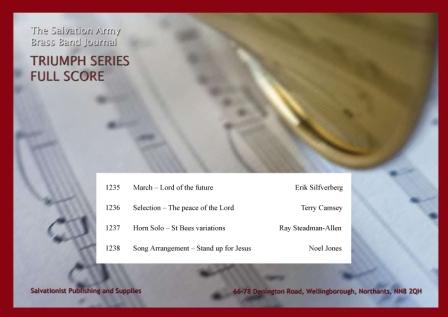
Triumph Series Band Journal March 2013 Numbers 1235 - 1238
No. 1235 March - Lord of the future (Erik Silfverberg)The title of this short, lively march is connected to the tune 'With Christ into the future' which appears in its second half.No. 1236 Selection - The peace of the Lord (Terry Camsey)This selection seeks to portray the peace that is found in Jesus, both in its style and the tunes used; 'Peace, peace, sweet peace', 'O the peace' and 'Brahms' Lullaby'.No. 1237 Horn Solo - St Bees variations (Ray Steadman-Allen)St Bees is a simple melody and this treatment is compatible with its character. Florid and meditative passages conclude with a brisk finale.No. 1238 Song Arrangement - Stand up for Jesus (Noel Jones)The old well-known gospel song appears here in a swing style.
Estimated dispatch 7-14 working days
-
 £50.00
Triumph Series Band Journal March 2021 Numbers 1323 - 1326
Includes:1323 - All creatures praise - Steven Ponsford1324 - What a friend - Ian Clarke1325 - Simple Prayers Stephen Gibson1326 - I'm in his hands - Ian Feltwell
Estimated dispatch 7-14 working days
-
 £54.99
Joyful March (Brass Band - Score and Parts)
As the title implies, this piece is all joy and cheerfulness. In Joyful March, the themes have been combined to make a spirited work that can give each concert an elated touch. From the opening vivid melody to the softer and colourful themes of the trio, Joyful March is full of joie de vivre. Its fairly simple structure makes it accessible to all brass bands. 03:30
Estimated dispatch 7-14 working days
-
 £72.70
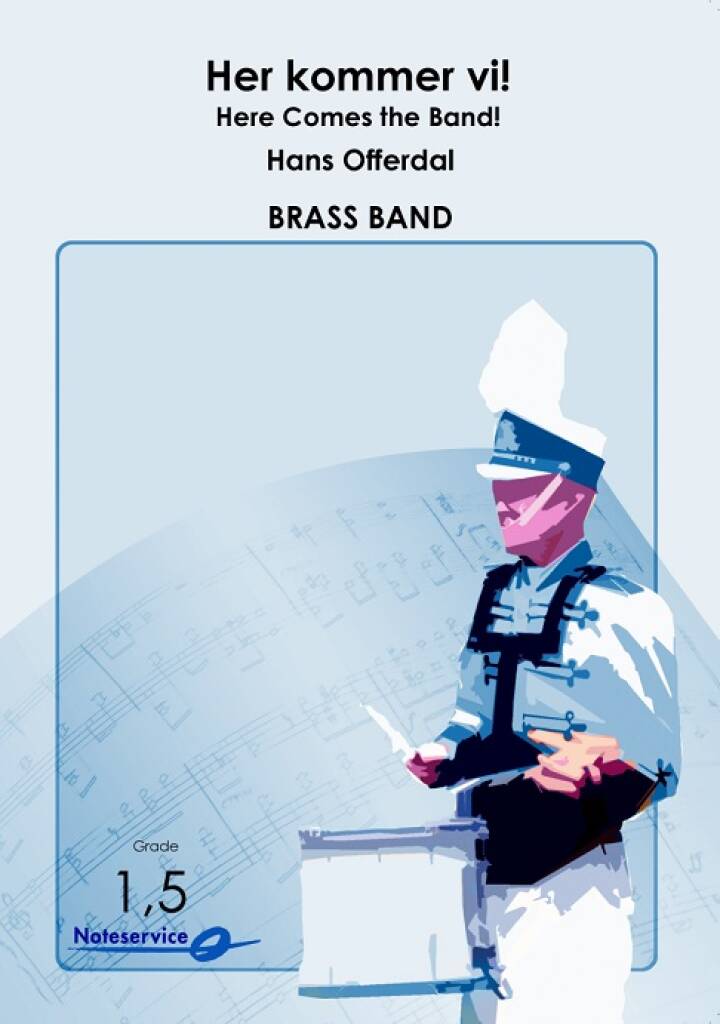
Here Comes the band! - Hans Offerdal
Hans Offerdal wrote this march for Furuset skoles musikkorps and Haugen skolekorps for the 17th of May 2007 and here it is now finally in a version for Brass! It has a simple texture that you will have sounding good with not too muchpractice. During rehearsal one should stress the melodic aspect of each part, and that all parts are just as important. Because of its title and duration of appx. two minutes, this march is perfect for presenting the band at various arrangements youtake part in.
Estimated dispatch 5-14 working days
-
 £54.99
Footprints - Jerry B. Bensman
Bring the house down with Jerry Bensman's sparkling Footprints. Everyone is, or at least feels, important in this simple but very effective march which works equally well on stage as on parade. Often a march does not have to be difficult to possess a thorougly pleasing 'full' sound. In understanding this, Jerry Bensman added a valuable repertoire-piece to the music available for youth-bands. In performing Footprints your beginning bandsmen take a major step forward in advancing their budding musical careers. Tip: Put the spotlights on your cymbals-player and make him (or her) the star of the evening.
Estimated dispatch 5-14 working days
-
 £19.95
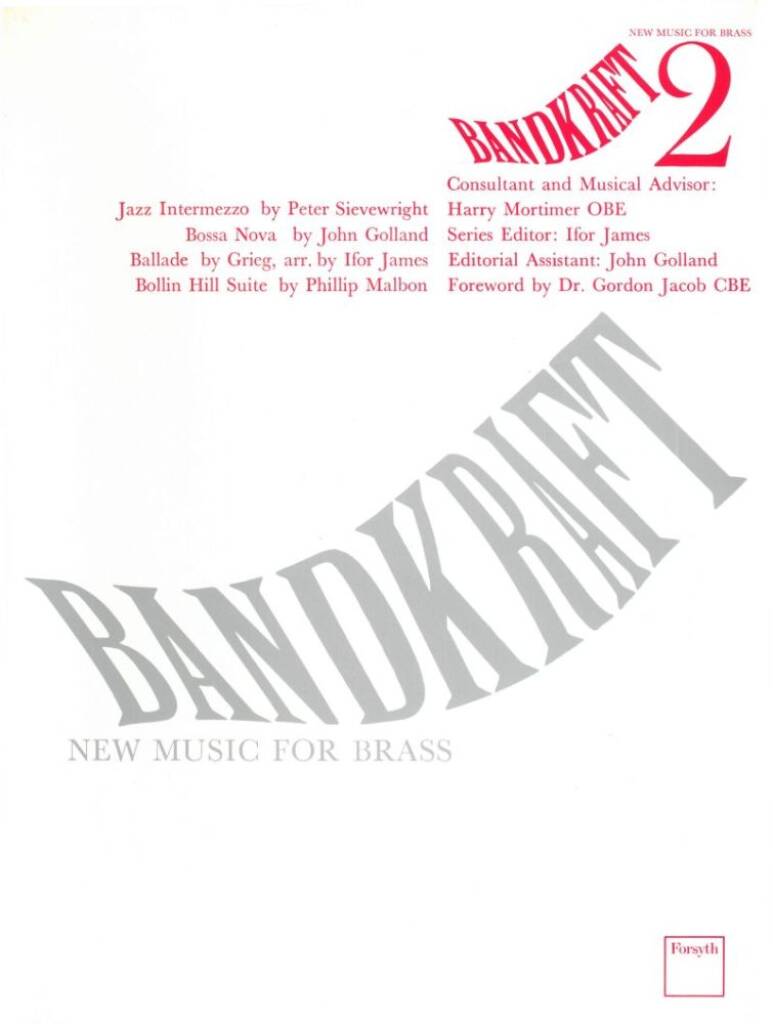
Bandkraft 2
The second of three superb sets of new music and arrangements for brass ensemble.Jazz Intermezzo - Peter Sievewright: Very close harmonies produce thick luscious tone colours, beneath an intriguing jazz theme.Bossa Nova - John Golland: A memorable tune, enjoyable and relaxed as a Bossa Nova should be, with much fun to be had in mastering the Bossa Nova rhythm.Ballade - Grieg, Arr. Ifor James: A simple enough melody, but a marvellous test for the phrasing and intonation of the horn section of the band.Bollin Hill Suite (Hoe Down, Passacaglia and March) - Phillip Malbon: A classic suite for brass band, concise yet complete.
Estimated dispatch 5-14 working days
-
 £38.95
Unity Series Band Journal June 2017 Numbers 454 - 457
Festival March Bega 125 (Dean Jones)This Festival March brings the majestic tune 'Miles Lane' as its central theme and is accompanied by the more reflective tune 'St. Bees'.Suite To Bethlehem (Ian Feltwell)Songster Leader Ian Feltwell of Nuneaton has provided a simple yet bright setting of the carols 'How far is it to Bethlehem', 'O little town of Bethlehem' and 'When wise men came seeking'.Carol Arrangement Who is he? (Jonathan Rowsell)This beautiful carol has been given a simple setting which will provide many groups with an accessible and easy to learn piece for the Christmas season.March Dedication (Christchurch) (Charles Craig)Originally dedicated to Major Clive Bishop who was a Salvation Army officer of fine distinction this is a traditional March from a composer who has provided accessible pieces of this nature to the Unity Series for many years.
Estimated dispatch 7-14 working days
 View Music