
Results
-
£29.50
Celebration - Lawrence Killian
Celebration for Brass Band is a suite of music in three movements.The piece's overall aim is to provide both the players and the audience with a positively uplifting and fun musical showcase. The listener is taken on a journey through the various moods and feelings associated with three types of celebration: birthday, anniversary, and jubilee. The music is generally light in character, a subtle blend of the familiar and not-so-familiar, with a few 'cheesy bits' to make you smile in between.The first movement is 'Birthday Treat', a light-hearted look at the fun and games surrounding a birthday party for any age. Opportunity is given within the music for the players and audience to join in and echo the sounds of a live party with exclamations of: "Happy Birthday!", "Congratulations!", "Well done!".The second movement in the suite is 'Anniversary', a touching musical tableau recalling memories of bygone days.The final movement, 'Jubilee', is precisely that. Full of jubilation, energy, and carnival, the music will engage the listener from the start. Listen out for musical snippets recalling the musical moods heard earlier in the first two movements.
In Stock: Estimated dispatch 1-3 working days
-
 £73.00
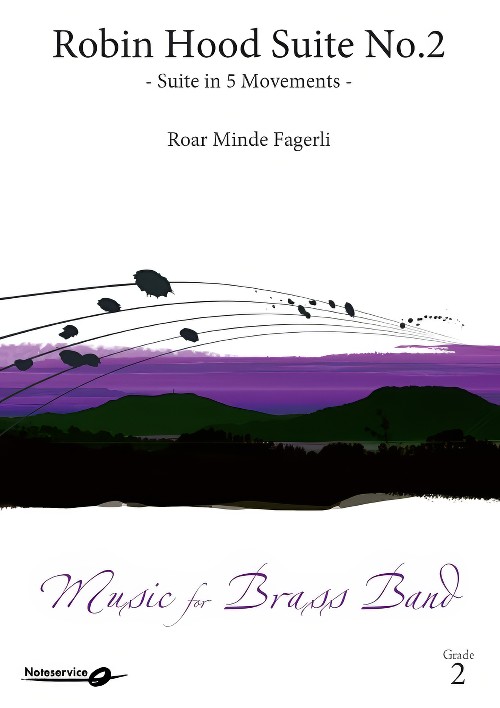
Robin Hood Suite No.2 (Brass Band - Score and Parts) - Minde Fagerli, Roar
Suite in Five MovementsRobin Hood suite 2 is five movements collected from a play written for a summer course arranged by The Norwegian Band Federation. The Composer is inspired by the story of Robin Hood; He who steals from the rich and gives to the poor.The composer describes different charters and places from the story in his music. In the first movement you will meet the merciless Sheriff of Nottingham. The second movement describes the caring Friar Tuck. In the third movement Robin Hood and Lady Marion sneaks around in the Castle. In the fourth movement Prince John's guards hunts Robin. In the fifth movement Robin Hood and his friends celebrate their victory!Duration: 9.15
Estimated dispatch 7-14 working days
-
£83.00
A Bournemouth Suite - Benjamin Tubb
Bournemouth Suite was written by Benjamin Tubb in 2005, when the composer was just 17 years of age. After spending many school holiday weeks with his grandparents in the coastal town of Bournmouth, it was obvious that these experiences would make a great basis for a composition.This testpiece is split into three separate movements: Balloon Ride, The Pier at Night and The BIC. Each movement has its own unique character, although there are ideas shared by all three throughout, one of which is the opening syncopation.Balloon RideThe First movement, Balloon Ride, describes a journey on "The Bournemouth Eye", a tethered hot air balloon that takes you up 500 feet. It's located in the middle of the town centre, which enables you to see surrounding countryside for up to 20 miles! The movement begins rather ominously as the balloon raises from the ground which leads into a more lively section caharacteresed by the repeating quavers in the lower brass and woodblock. The movement ends in much the same way as it started - signalling the return to terra firma.The Pier At NightDuring the summer there are several large firework displays in the town centre. The second movement, The Pier At Night descirbes an evening spent on the beach in deckchairs watching the montage of colours in the night-time sky. With demanding solos for horn and cornet, as well as exposed playing spread throughout the band, this slow movement will really test a band's expressive and lyrical playing.The 'BIC'The Bournemouth INternational Centre, also known as "The BIC" is one of Bournemouth's most visited attractions, and regularly hosts shows such as 'Riverdance' and pantomimes. Inside is a world of entertainment and the centre itself is just a stone's throw from both "The Bournemouth Eye" and the Pier. The 3rd movement has been written to describe the buzz of activity surrounding the BIC, and the entire works ends with the same syncopated motif from the beginning.A Bournemouth Suite was set as the 'set-test' at the Pontins Brass Band Championships 2009.
Estimated dispatch 7-14 working days
-
 £29.88
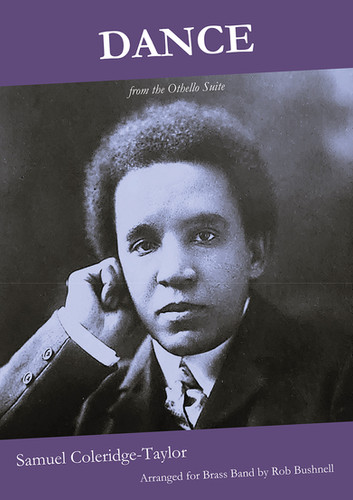
Dance from the Othello Suite (Brass Band) Coleridge-Taylor arr. Bushnell
Samuel Coleridge-Taylor is a British composer, who, from a young age, showed talent on the violin and entered the Royal College of Music, studying with Charles Villers Standford. His music become so popular that his Hiawatha trilogy was the second most performed choral piece (joint with Mendelssohn's Elijah, and only beaten by Handel's Messiah) with choral societies up and down the British Isles. In fact, Hiawatha was arranged by Charles Godfrey as a test-piece for the 1902 National Brass Band Championship of Great Britain, held at Crystal Palace.Commissioned by the theatre impresario Herbert Beerbohm, Coleridge-Taylor composed incidental music for His Majesty's Theatre London production of the Shakespeare play, Othello, in the West End, in 1909. In 1912, the play opened to the public, with a suite of five movements put together soon afterwards. The Dance, arranged here by Rob Bushnell, makes a great concert opener.This arrangement is for the British-style brass band, with alternative parts for horns in F and bass-clef lower brass. A recording of the original composition can be found at www.youtube.com/watch?v=OQeO_Ij9CV8 Duration: approx. 2.30 minutes Difficulty Level: 3rd Section + PDF download includes parts and score. Sheet music available at www.brassband.co.uk (UK) or https://satradecentral.org (USA) Instrumentation: Soprano Cornet Eb Solo Cornet Bb Repiano Cornet Bb 2nd Cornet Bb 3rd Cornet Bb Flugel Horn Bb Solo Horn Eb 1st Horn Eb 2nd Horn Eb 1st Baritone Bb 2nd Baritone Bb 1st Trombone Bb 2nd Trombone Bb Bass Trombone Euphonium Bb Bass Eb Bass Bb Timpani Percussion - Triangle, Cymbal & Bass Drum
In Stock: Estimated dispatch 1-3 working days
-
£60.00
A Gallimaufry Suite - Harper, P
I - Fanfare & ThemeII - SongIII - HymnIV - Toccata & FinaleA Gallimaufry Suite consists of four movements, all thematically independent. The first movement consists of a sparkling Fanfare followed by a stately Theme which ends quietly. The second movement is a Children's Song; quirky but cute, and the Hymn which follows is a study in calm and tranquillity, featuring a quartet-group of cornet, baritone, trombone and euphonium. The last movement is a virtuosic Toccata which eventually begins to recall the other themes of the suite before a grand reprise of the first movement Theme brings the work to a dazzling conclusion.Approximate duration: 11 minutes
In Stock: Estimated dispatch 1-3 working days
-
 £59.95
Festival Suite (Brass Band - Score and Parts)
This three movement suite for brass band was commissioned by the Solothurnischer Blasmusikverband (SOBV) in Switzerland for their 2009 Festival. The first movement, Energy, is appropriately lively in character. It is dominated by an agitated theme on trombones and cornets, driven by a percussion accompaniment, and complemented by pulsating counterpoint from the rest of the band. The second movement is called Repose and its opening melodious theme on cornets provides a welcome respite from the restlessness and verve of the opening movement. The lyrical nature of the music is sustained throughout. The finale, Suspense, opens with a theme containing more than a hint of foreboding which recurs several times. There are numerous abrupt changes of dynamics, and also a brightening of mood, before everything finishes in a blaze of sound.
Estimated dispatch 7-14 working days
-
 £60.00
A Gallimaufry Suite (Score and Parts)
I - Fanfare & ThemeII - SongIII - HymnIV - Toccata & FinaleA Gallimaufry Suite consists of four movements, all thematically independent. The first movement consists of a sparkling Fanfare followed by a stately Theme which ends quietly. The second movement is a Children's Song; quirky but cute, and the Hymn which follows is a study in calm and tranquillity, featuring a quartet-group of cornet, baritone, trombone and euphonium. The last movement is a virtuosic Toccata which eventually begins to recall the other themes of the suite before a grand reprise of the first movement Theme brings the work to a dazzling conclusion.
Estimated dispatch 7-14 working days
-
 £152.99
Hymn of the Highlands, Suite from (Brass Band - Score and Parts)
Suite from Hymn of the Highlands draws three expressive musical pictures of the Scottish highlands.The first movement, Ardross Castle, contains solo passages for horn and baritone and features a fascinating bagpipe melody.The second movement, Alladale, is a trio for tenor horn, flugel horn and baritone with an accompaniment featuring the percussion section.The final movement, Dundonnell,features two highly contrasting melodies, a wild presto and the bagpipe melody first heard in the first movement.Duration: 17:00
Estimated dispatch 7-14 working days
-
 £69.99
Suite Symetrique (Brass Band - Score and Parts) - De Haan, Jacob - Haantjes, Menno
This playful three-part suite is largely based on symmetry. This of course is largely due to the relations of the arrangement of the themes; however, on the other hand, to the larger structures in form. The first part, (Prelude et Scherzo) has a solemn opening. Followed by it a related scherzo with many changes in time, this too is composed in a symmetrical form. In the second movement, Choral Dorian, the theme of the prelude is reversed and used in chorale in Dorian tonality. The suite comes to a close with Rondo d'Avignon. An annual theatre festival in a French city on the Rhone inspired this suite. It is a lively movement, symmetrically bought to a finish with a repeat of the prelude from the first movement.Duration: 5:15
Estimated dispatch 7-14 working days
-
 £59.95
Festival Suite (Brass Band - Score and Parts) - Downie, Kenneth
This three movement suite for brass band was commissioned by the Solothurnischer Blasmusikverband (SOBV) in Switzerland for their 2009 Festival. The first movement, Energy, is appropriately lively in character. It is dominated by an agitated theme on trombones and cornets, driven by a percussion accompaniment, and complemented by pulsating counterpoint from the rest of the band. The second movement is called Repose and its opening melodious theme on cornets provides a welcome respite from the restlessness and verve of the opening movement. The lyrical nature of the music is sustained throughout. The finale, Suspense, opens with a theme containing more than a hint of foreboding which recurs several times. There are numerous abrupt changes of dynamics, and also a brightening of mood, before everything finishes in a blaze of sound.
Estimated dispatch 7-14 working days
 Listen to MP3
 View Music