
Results
-
 £110.99
The Four Noble Truths (Brass Band - Score and Parts) - Sparke, Philip
The Four Noble Truths are the most basic expression of the teaching of Buddha and therefore still form the guidelines for Buddhists to this day. The four truths are Dukkha, which describes times of major stress in our lives - birth, ageing, desire and death; Samudaya which describes those parts of our life that induce stress, feeling, craving, desire; Nirodha which tells us how to eliminate those aspects of our lives which induce stress and Magga which describes the eight disciplines which can help us eliminate the origins of stress from our lives. It can be seen from these over-simplified definitions, that the Four Noble Truths fall into two pairs, the first two describing the origins of stress and the second two describing how we can reduce stress. To reflect this, the four movements of this work are also combined into two pairs - two quick movements and two slow movements. A fascinating work from this great English composer.Duration: 14:00
Estimated dispatch 7-14 working days
-
 £54.99
Majestic Prelude (Brass Band - Score and Parts) - De Haan, Jacob
A composition of much contrast based on a well-known psalm melody. As its title announces, it starts with a majestic introduction in which parts of the psalm melody can be heard. Next we hear the complete psalm melody in the trombones, interrupted by passages full of dance in the distant. This is continued in a lively Allegro Molto, in which the psalm melody emerges in the trumpets and cornets, again interrupted by rhythmically pulsing quaver movements. The work ends with a flashing passage in a presto tempo. Majestic Prelude typically is a composition for the start of a concert.Duration: 2:45
Estimated dispatch 7-14 working days
-
 £94.95
The New Jerusalem (Brass Band - Score and Parts) - Wilby, Philip
The New Jerusalem was commissioned by the National Youth Brass Band of Great Britain, and first performed by them at City Hall, Salisbury on 20 April 1990 and then the following day in London's Queen Elizabeth Hall. The original version was thus intended for their very large group of gifted players, and is available from the Novello Hire library.This present Contest Version is a thorough revision of that original score, redesigned for a conventional number of players, and recast as a score which contains considerable scope for solo performers within the band.Recorded on Polyphonic QPRL056D National Brass Band Championships of Great Britain and Gala Concert - 1992
Estimated dispatch 7-14 working days
-
 £54.99
Rock About (Brass Band - Score and Parts) - Gines, Frede
Rock About is an eight part work in which parts can be distributed according to the players available. The light pieces are full of joy and are sure to make your audience want to get up and dance!Duration: 3:20
Estimated dispatch 7-14 working days
-
 £60.99
Crazy Music in the Air (Brass Band - Score and Parts) - De Haan, Jacob
This composition in two parts is one of the first successful works Jacob de Haan published for brass band. Somewhat under the influence of Ted Huggen's Choral and Rock Out which was an overwhelming success at the time, the still very young Jacob de Haan wrote this composition. The first part (Air) exists of a choral melody with baroque grace notes, supported by a pop rhythm in the drums. The second part (Crazy Music) is a swinging bossa nova, in which various instrument groups present themselves in the continuously varying themes. The famous Black Dycke Mills Band contributed to the success of Crazy Music in the Air by regularly putting the piece on its tour programmes.Duration: 4:45
Estimated dispatch 7-14 working days
-
 £69.99
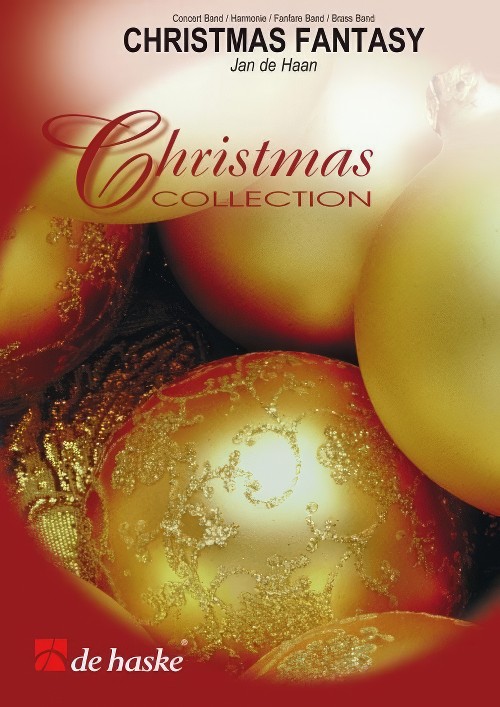
Christmas Fantasy (Brass Band with Optional Choir - Score and Parts) - De Haan, Jan
Christmas Fantasy is a fantastic medley by Jan de Haan which features some of the best-known songs from the Christmas season.Includes:Es ist ein Ros' entsprungenO Little Town of BethlehemOnce in Royal David's CityHark! The Herald Angel's SingGod Rest Ye Merry GentlemenGood King WenceslasEnglish and Dutch choral parts are also availble for this work.Duration: 9.00
Estimated dispatch 7-14 working days
-
 £60.99
Constellation (Brass Band - Score and Parts)
This easy concert march can be divided into two parts. The first part, which is rhythmical, beautifully contrasts with the second part, which is lyrical. Each section of the band has its turn in this concertmarch, which, in spite of its easy level of difficulty, deserves the designation "five-star piece." 03:45
Estimated dispatch 7-14 working days
-
 £15.00
Four Favourite Carols (Brass Band - Score and Parts) - Masters, Dennis
Arranged for Small Brass Band, the instrumentation is: 1st and 2nd Cornets, 1st and 2nd Eb Horns, Trombone/Baritone, Euphonium/Bb Bass, Eb Bass. Optional parts included for Eb Soprano and Bass Trombone.Four Favourite Carols includes:Good King WenceslasO Little Town of BethlehemAway in a MangerWinchester Old (While Shepherds Watched).
Estimated dispatch 7-14 working days
-
 £35.00
Gymnopedie No.1 (Brass Band - Score and Parts) - Satie, Erik - Littlemore, Phillip
Erik Satie's Gymnopedies are a series of three short piano pieces that were first published in 1888. These atmospheric pieces, all written in 3/4 time and sharing a common theme and structure, are recognised the world over and are his most famous compositions. Gymnopedie No.1?is divided into two almost identical parts, with a steady accompanying rhythm of crotchet-minim, crotchet-minim (short-long, short-long) that remains constant throughout - with the exception of the last two bars of each part! This gently lilting background supports an expressive melodic line which creates the occasional dissonance, yet seems impressively tension free. Duration: 8:10
Estimated dispatch 7-14 working days
-
 £60.99
Mr. Sandman (Brass Band - Score and Parts)
Who doesn't remember this international 70's hit for Emmylou Harris with it's special 'barber shop' style harmony. The three parts are given to the cornets as soloists with subtle band accompaniment featuring a great part for your vibraphone player. Everyone will leave your concert humming this great tune. 02:04
Estimated dispatch 7-14 working days
 View Music