Searching for Wind Band Music? Visit the Wind Band Music Shop
We've found 1000 matches for your search. Order by

Results

  • £37.50

    HAUGHMOND VARIATIONS for Brass Band (score & parts) - Denny, Mike

    Parts included for Brass Band Brass, Orchestral Brass, Percussion & Flute

    In Stock: Estimated dispatch 1-3 working days
  • £27.50

    ALLEGRO DECISO (score & parts) - Handel, George Frideric (1685-1759)

    For 10 or more brass players, with parts also enclosed for orchestral brass (no percussion)

    In Stock: Estimated dispatch 1-3 working days
  • £27.50

    CHRISTMAS IS HERE for Brass Band (score & parts) - Biddulph, Adrian

    Parts included for Brass Band Brass, Orchestral Brass, Percussion & Flute. Also includes a copy of the song sheet in PVG format with a photocopiable word sheet (CMT3811). A Level 2 Wind Band (CMT3814) arrangement is also available.

    In Stock: Estimated dispatch 1-3 working days
  • £37.50

    AMAZING GRACE (New Orleans Style) (score & parts) - McKenzie, Jock

    Needs a minimum of 10 brass players + 2 percussion, with parts for brass band brass and orchestral brass, plus percussion. Grade 5-6 standard.

    In Stock: Estimated dispatch 1-3 working days
  • £40.00

    (I've Had) The Time Of My Life - (Donald Markowitz, Franke Previte, John Denicola arr. by David Beal) - Brass Band Music Full Score & Parts - LMAM096

    Any purchases from this site cannot be made please click on the link belowAny purchases from this site cannot be made please click on the link aboveCOMPOSER: Donald Markowitz, Franke Previte, John DenicolaARRANGER: David Beal"(I've Had) The Time of My Life" is a song composed by Franke Previte, John DeNicola, and Donald Markowitz. It was recorded by American singers Bill Medley and Jennifer Warnes and used as the theme song for the 1987 film Dirty Dancing. The song has won a number of awards, including the Academy Award for Best Original Song, the Golden Globe Award for Best Original Song, and the Grammy Award for Best Pop Performance by a Duo or Group with Vocals.Scored For :FluteOboeBassoonClarinet 1 in BbClarinet 2 in BbClarinet 3 in BbAlto Clarinet in EbBass Clarinet in BbAlto Saxophone 1Alto Saxophone 2Tenor Saxophone 1Tenor Saxophone 2Baritone SaxophoneTrumpet 1 in BbTrumpet 2 in BbTrumpet 3 in BbTrumpet 4 in BbHorn 1 in FHorn 2 in FTrombone 1 in CTrombone 2 in CTrombone 3 in CBaritone (BC)Baritone (TC)TubaBass GuitarDrum Kit (1)Percussion 2Mallet Percussion (4)Timpani 3Alternative partsHorn in EbTrombone in BbTuba in Eb (TC)Tuba in Bb (TC)Any purchases from this site cannot be made please click on the link above

    In Stock: Estimated dispatch 3-5 working days
  • £30.00

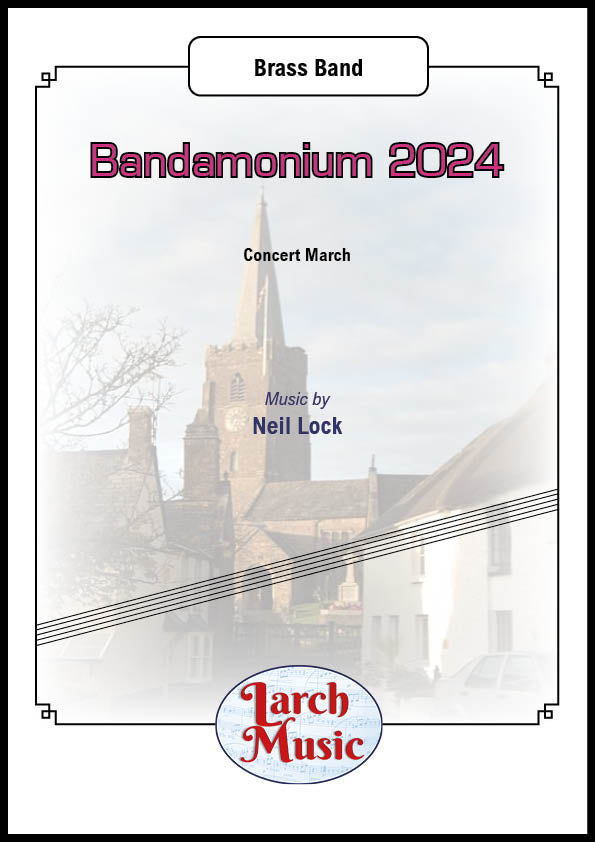
    Bandamonium 2024 (Neil Lock) - Brass Band Sheet Music Full Score & Parts - LM541

    COMPOSER: Neil LockThis march was submitted to the march composers' competition for "Bandamonium 3"in Hatherleigh, Devon in July 2024. The winning march was played by massed bands at the conclusion of the celebrations on Saturday 27th July 2024. Unfortunately, this march took second place in the competition, behind the march of Paul Pennicotte-Henrie, conductor of Okehampton Silver Band.The march can be played with or without the singing. (Even at the Whit Friday marches, begad!) I suggest that it should be introduced by 3-beat rolls.When played with singing, the "Bandamonium" lyrics (bars 10-13 and 56-57) are to be sung by all players, keeping to their own parts, with appropriate octave adjustment for their individual singing voices. Conductor and percussionists should sing with the main theme (Db and C at bars 10-13, F at 56-57). Listen to the 3rd cornet players!There is an additional part for Singers, in which the trio melody (bars 58 onwards) can be sung by Soprano and Tenor singers at a moderate choir standard. An octave-down option is also provided in the higher bars. This part can be given to "spare" singers within the band, or to singers external to the band if opportunity permits. The lyrics are:We are in Devon,We're in Hatherleigh,Whit Friday heaven,But we're marching free!Now it's past seven,Time to party,At BandamoniumIn Hatherleigh!LM541 - ISMN : 9790570005413

    In Stock: Estimated dispatch 3-5 working days
  • £139.99

    Missa Brevis Brass Band (Score & Parts)

    Missa Brevis is a major work for choir and brass band for performance in church or in the concert hall. For this mass, there are many performance possibilities depending on the musicians available. In addition to the standard orchestration of choir and band a brass quartet can also play the choral parts. For this it is desirable for the brass quartet to be positioned separately from the rest of the band (on a gallery, for example), so that the idea of two choirs is heard. It is also possible to perform the work with brass band and organ. A truly flexible religious masterpiece. 20:00

    Estimated dispatch 7-14 working days

     PDF View Music

  • £55.00

    The Cowboys (Score & Parts) - John Williams

    In a career that's spanned over five decades, composer John Williams has scored fewer than five Westerns which, judging from his exemplary work on this 1972 score The Cowboys, seems something of a shame. Williams offers up a robust, brassy score that the composer hopes 'people will find genuine pleasure in'. Brass Band Grade 5: 1st Section Duration: 6 minutes

    In Stock: Estimated dispatch 1-3 working days
  • £65.00

    Second Suite in F - Brass Band Sheet Music Full Score & Parts - LM602 - Gustav Holst

    COMPOSER: Gustav HolstTRANSCRIBED : Daniel S. AugustineA brand transcription from Holst's manuscript score for brass band.A very authentic version from the original for Military Band.Can be used as a testpiece in your next own choice contestSuitable for Section 3 bands upwardsSecond Suite in FOp. 28, No. 2 (1922)1. MarchThe "March" of the Second Suite begins with a simple five note motif between the low and high instruments of the band. The first folk tune is heard in the form of a traditional British brass band march using the morris-dance tune "Glorishears". After a brief climax, the second strain begins with a euphonium solo playing the second folk tune in the suite "Swansea Town". The theme is repeated by the full band before the trio. For the trio, Holst modulates to the unconventional subdominant minor of Bb minor and changes the time signature to 6/8, thereby changing the meter. Usually one would modulate to subdominant major in traditional march form. While Sousa, reputably the "king of marches", would sometimes change time signatures for the trio (most notably in "El Capitan"), it was not commonplace. The third theme, called "Claudy Banks",[2] is heard in a low woodwind soli, as is standard march orchestration. Then the first two tunes are repeated da capo.2. Song without Words "I'll Love My Love"Holst places the fourth folk song, "I'll Love My Love" in stark contrast to the first movement. The movement begins with a chord and moves into a solo over a flowing accompaniment. The solo is then repeated, forming an arc of intensity. The climax of the piece is a fermata, followed by a cornet pick-up into the final measures of the piece.3. Song of the BlacksmithAgain, Holst contrasts the slow second movement to the rather upbeat third movement which features the folk song "A Blacksmith Courted Me". There are many time signature changes (4/4 to 3/4) making the movement increasingly difficult because the accompaniment has a pick up on the up-beats of each measure. The band joins in on the melody around the body of the piece and are accompanied with the sound of a blacksmith forging metal with an anvil called for in the score. The final major chord has a glorious, heavenly sound, which opens way to the final movement.This chord works so effectively perhaps because it is unexpected.4. Fantasia on the "Dargason"This movement is not based on any folk songs, but rather has two tunes from Playford's Dancing Master of 1651. The finale of the suite opens with a solo based on the folk tune "Dargason", a 16th-century English dance tune included in the first edition of The Dancing Master. The fantasia continues through several variations encompassing the full capabilities of the band. The final folk tune, "Greensleeves", is cleverly woven into the fantasia by the use of hemiolas, with Dargason being in 6/8 and Greensleeves being in 3/4. At the climax of the movement, the two competing themes are placed in competing sections.As the movement dies down, a duet forms a call back to the beginning of the suite with the competition of low and high registers.The name 'dargason' may perhaps come from an Irish legend that tells of a monster resembling a large bear (although much of the description of the creature has been lost over time), the Dargason tormented the Irish countryside. During the Irish uprising of the late 18th century, the dargason is supposed to have attacked a British camp killing many soldiers. This tale aside, 'dargason' is more likely derived from an Old English word for dwarf or fairy, and the tune has been considered English (or Welsh) since at least the 16th century. It is also known as 'Sedony' (or Sedany) or 'Welsh Sedony'.

    In Stock: Estimated dispatch 3-5 working days
  • £125.00

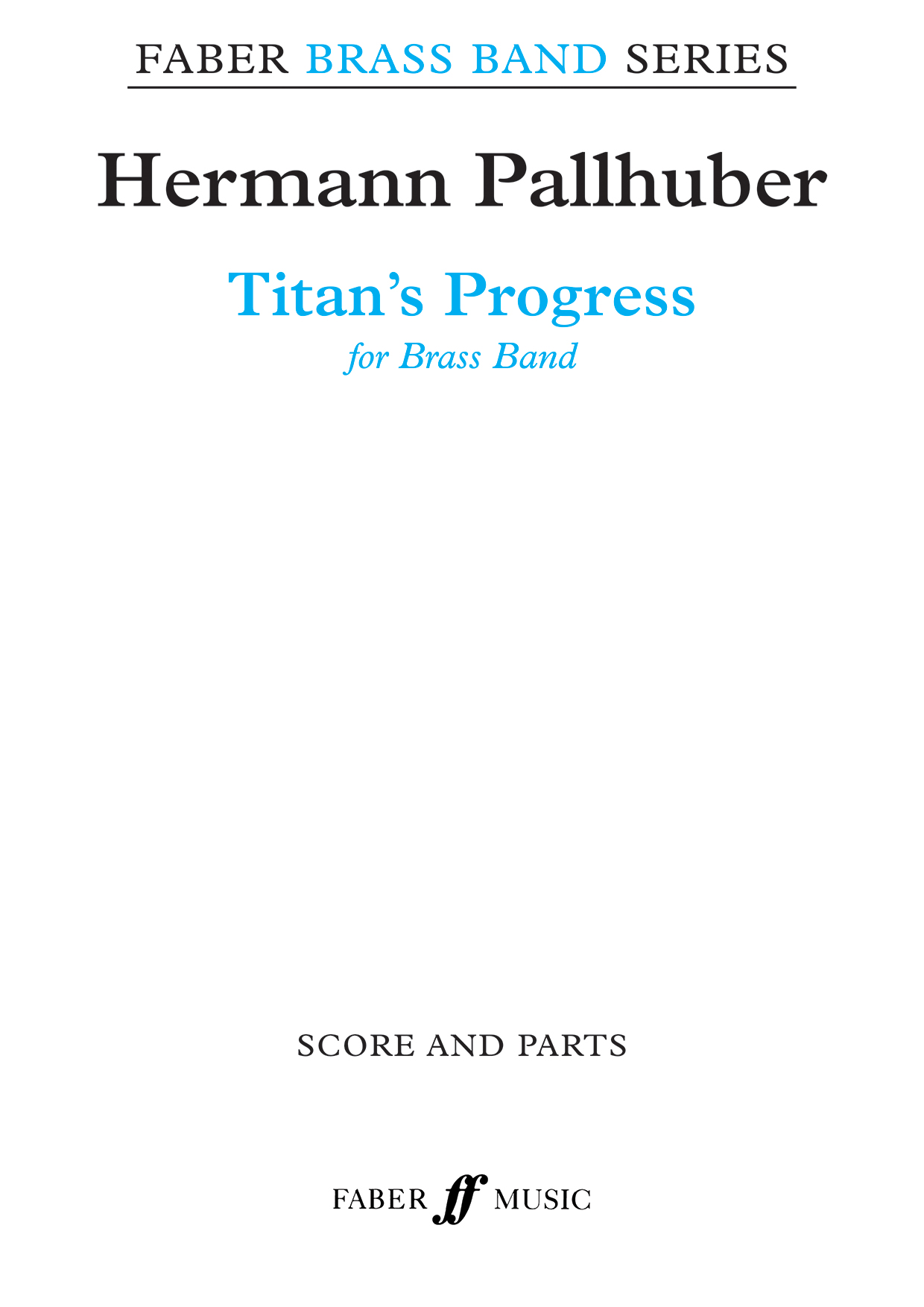
    Titan's Progress (Score & Parts) - Hermann Pallhuber

    Commissioned by Austria's leading brass band, Brass Band Oberoesterreich, Titan's Progress is a series of descriptive, virtuoso episodes based on the principal character of the novel by Jean Paul. This was also the original subject of Mahler's Symphony No. 1, from which Hermann Pallhuber derives much of his material. The work has proved an exceptionally popular test piece all over the world. Titan's Progress was the selected test piece for the British Open Brass Band Championship, held at Symphony Hall, Birmingham on Saturday 12th September 2009. Brass Band Grade 6: Championship Duration: 17 minutes The score provided with this set is a larger format, B4 size.

    In Stock: Estimated dispatch 1-3 working days