
Results
-
£44.95
LYRIC VARIATIONS (Euphonium Solo with Brass Band Set) - Ray Steadman-Allen
This solo was written at the request of Stephen Cobb and was premiered by Derick Kane with The International Staff Band of The Salvation Army in 1999. The theme, commonly known as 'Lord of the Dance', is followed by four variations (waltz, soft shoe, brillante, lento) and a blistering finale!
Estimated dispatch 7-14 working days
-
£24.95
TO MUSIC (Cornet Solo with Brass Band Set) - Franz Schubert - Michael Kenyon
This beautiful melody became popular in The Salvation Army after it appeared with a new set of words by Will Brand under the title More than these in January 1949. This arrangement for cornet and brass band was originally published in 1961.
Estimated dispatch 7-14 working days
-
£34.95
EVERLASTING PRAISE (Brass Band Set) - Nicholas Samuel
Written for the 25th anniversary of The Salvation Army Anglia Youth Band, this exciting music features the hymn tunes of 'Ascalon', 'Miles Lane' and 'Old Hundredth' with references to 'Praise, my soul, the King of Heaven'.
Estimated dispatch 7-14 working days
-
£29.95
TO WIN THE WORLD (Cornet and Trombone Double Trio with Brass Band Set) - Stephen Bulla
This double trio (three cornets and three trombones) was written for the National Capital Band of The Salvation Army in memory of Colonel William Maltby and is based on his own chorus, 'Keep on marching with a fighting faith'. Each solo part is of equal importance so six competent soloists will be required in order to make the piece sparkle!
Estimated dispatch 7-14 working days
-
£59.95
LORD IS KING, The (Brass Band Set) - Ray Steadman-Allen
Ray Steadman-Allen was for many years the driving force in Salvation Army music. His publication list of both brass and vocal works can be measured literally by the hundred. 'The Lord is King' is arguably his crowning achievement of over twenty major works for brass band. Although described as a suite, the work is more symphonic in conception and scale as well as being formidable to perform. The work is based on the Welsh hymn tune 'Llangollen' to which the hymn 'The Lord is King, I own His power' are associated. The three movements derive inspiration from the lines 'My joy, my toil, my craftman's skill, all have their place, and serve His will' found in verse five of the hymn.
Estimated dispatch 7-14 working days
-
 £77.00
General Series Brass Band Journal, Numbers 2254 - 2257, April 2025
2254: Be glorified today (Martin Cordner)Built around Bob Kilpatrick's song In my life, Lord, be glorified today (S.A.S.B. 593), this concert opener was composed for Cambridge Citadel Band (UK and Ireland Territory) at the request of Bandmaster Simon Fisher. The piece pays homage to the city.2255: Driven by mission (Stephen Bulla)Stephen Bulla wrote this piece to commemorate Willis Howell and his wife's retirement from active officership. Bulla references St. Denio (S.A.S.B. 37), Melita (T.B. 442), For your mission and Men of Harlech (T.B. 756), and the assembling of the tunes and all they represent reflects the masterful artistry that always marks Bulla's works.2256: The Lord's my shepherd (Paul Sharman)This arrangement brings together two settings of Psalm 23; the familiar hymn tune Crimond (T.B. 68) and the more recent melody by Stuart Townend (T.B. 863).2257: Cornet Solo - I love you, Lord (Ian Robinson)Laurie Klein's chorus I love you, Lord (S.A.S.B. 369) has been popular for many years with Salvation Army congregations around the world and this work combines unconventional harmonies with sparse scoring to feature the soloist.
Estimated dispatch 7-14 working days
-
 £34.95
Light Song (Brass Band - Score and Parts)
This energetic arrangement was written for the Canadian Staff Band's visit to Los Angeles, California, USA, in 2016, to participate in the first ever gathering of five top North American Salvation Army bands. Two well-known songs are given an atypical stylistic treatment, featuring some unusual harmonic and metric variations to keep both players and listeners 'on their toes'.The music itself is a study in contrasts, starting with the dynamics in the whole tone scalic figures in the opening bars. The melody Jesus is my light (T.B. 709) is used with changing time-signatures along with a soft, yet rhythmic approach to the tune Walk in the light (T.B. 909). The work finished with a bright and energetic ending.
Estimated dispatch 7-14 working days
-
 £38.95
Unity Series Band Journal - Numbers 518 - 521, June 2023
518: March - A Christmas cavalcade (Morgan Juel Stavik)This march contains several Christmas carols and songs. Some are easy to recognise and are identified in the score, while other references are more subtle.519: Christmas bossa nova (Kevin Larsson)Using Jingle Bells, The First Nowell, It came upon the midnight clear and Ding dong! merrily on high, here is a great bossa nova to liven up your Christmas concert.520 (1): In te Domine speravi (Des Prez trs. Zachary Docter)This piece is a transcription of an early 16th century choral work by the Renaissance composer Josquin des Prez. Josquin was a well-known and highly regarded composer in his day. Like many composer of this period, Josquin wrote linearly, valuing independent free-flowing lines over vertical harmonies. As a result, the interlocking counterpoint in this work can be quite complex and the tied rhythms challenging.520 (2): Excerpt from 'Vespers' (Rachmaninoff trs. Andrew Poirier)Sergei Rachmaninoff's setting of the All-Night Vigil (Vespers) Op.37, of which this excerpt is taken, was composed in January and February 1915. The outbreak of World War I in August 1914 took many people by surprise, and to Rachmaninoff it was a severe shock. This compelled him to write a piece that reminded him of his childhood and the importance of the Russian Orthodox Church within the national identity of Russia. The excerpt transcribed here has a quality and enigmatic charm that never fails to move the souls of those that listen to it.521: March - Walk of faith (Stanley Makau)This march introduces Stanley Makau to the band journals. Stanley is currently the Deputy and Youth Bandmaster at Quarry Road Citadel Corps in Nairobi, Kenya. His inspiration for the march primarily came from Psalm 91: 11-12, and the march is in keeping with the traditional style that has been a staple for Salvation Army music-making.
Estimated dispatch 7-14 working days
-
 £29.95
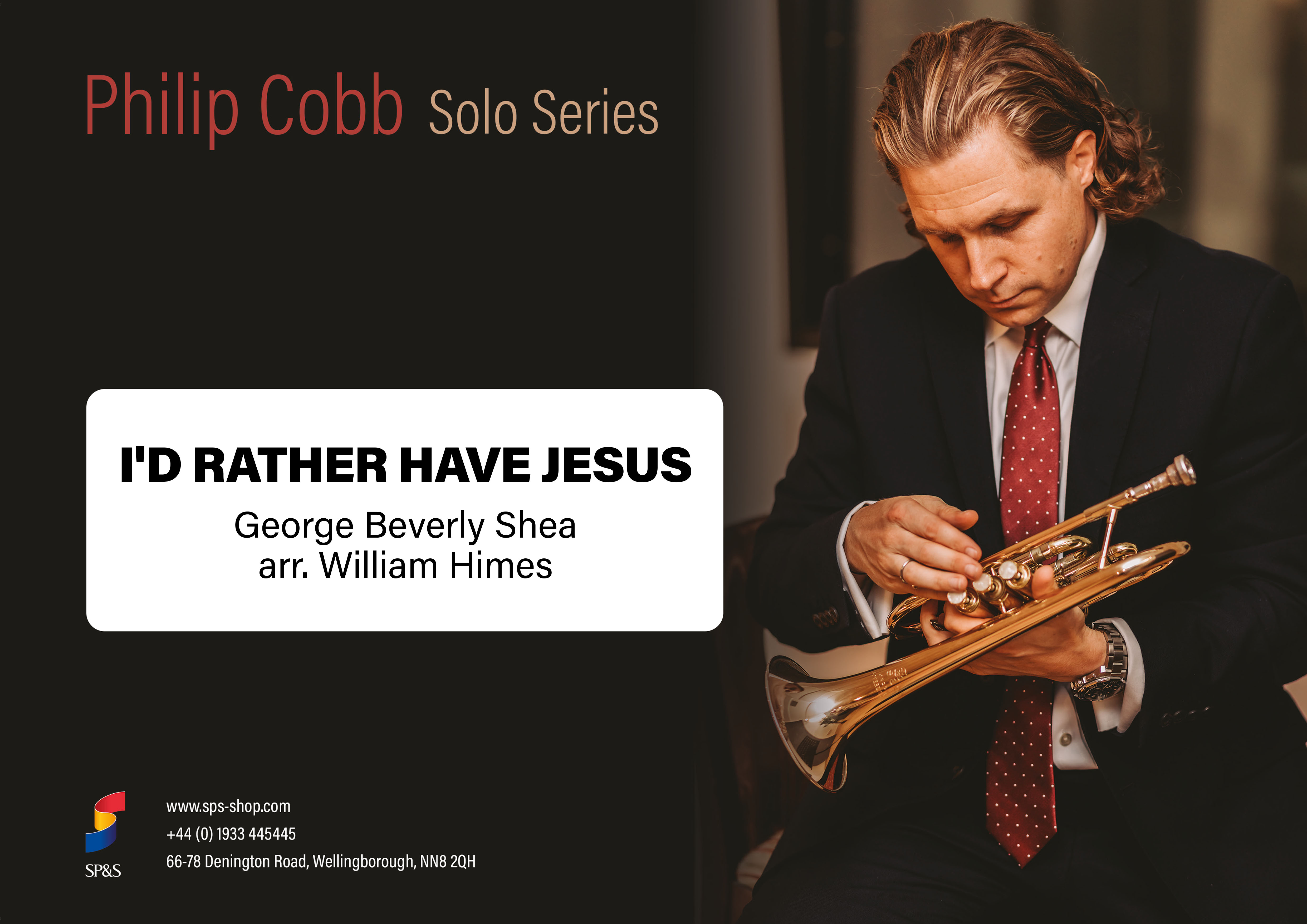
I'd Rather Have Jesus (Cornet Solo with Brass Band - Score and Parts)
The poem, I'd rather have Jesus, was written in 1922 by Rhea Miller with the tune written by George Beverly Shea. This arrangement by William Himes was originally written for William Scarlett, trumpet player with the Chicago Symphony Orchestra and former member of the Chicago Staff Band of The Salvation Army.Duration: 3.15
Estimated dispatch 7-14 working days
-
 £74.95
The Pilgrim's Progress (Brass Band - Score and Parts)
Drawing inspiration from John Bunyan's Christian allegory, 'The Pilgrim's Progress' and Eric Ball's setting of Bunyan's 'Pilgrim's Hymn', Rodney Newton has expertly crafted a set of variations, each outlining a chapter in the Pilgrim's journey to the Celestial City.The work was written in 2003 (Eric Ball's centenary year) for Bandmaster Stephen Cobb and The International Staff Band of The Salvation Army to whom it is dedicated.Suitable for 2nd Section Bands and aboveDuration: 14.00
Estimated dispatch 7-14 working days