Results
-
£37.50
Brass Monkey's Occasions - Gavin Somerset
Never be caught out again on a concert with this selection that caters for just about every occasion. Your training band will be prepared to perform anything from a Fanfare to the National Anthem and even 'He's A Jolly Good Fellow'. The music included in this publication is used all over the world, all year around. "Land Of Hope & Glory" is also included, in the same key as the popular senior band arrangement (by J. Ord Hume) so your training band can join in with the senor band in a proms concert finale. This release puts well-known, often requested tunes in one publication letting your training band shine, whatever the occasion. Music included isaAFANFARENATIONAL ANTHEM (God Save The Queen/King)ROYAL NAVY HYMN (Melita)HARVEST HYMN (St. George's Windsor)ONWARD CHRISTIAN SOLDIERS (St. Gertrude)DANNY BOY (Londonderry Air)HE'S A JOLLY GOOD FELLOWF.A. CUP THEME (Eventide)LAND OF HOPE & GLORY (Pomp & Circumstance March No.1)
In Stock: Estimated dispatch 1-3 working days
-
 £84.99
Gandalf the Wizard - Johan de Meij
Johan de Meij's first symphony The Lord of the Rings is based on the trilogy of that name by J.R.R. Tolkien. This book has fascinated many millions of readers since its publication in 1955. The symphony consists of five separate movements, each illustrating a personage or an important episode from the book. This transcription for brass band, arranged by the composer has the following movements: I. GANDALF (The Wizard), IV. JOURNEY IN THE DARK (The Mines of Moria and The Bridge of Khazad-D m), V. HOBBITS. The symphony was written in the period between March 1984 and December 1987, and had its premiere in Brussels on 15th March 1988, performed by the The Royal Band ofthe Belgian Guides under the baton of Norbert Nozy. In 1989, the symphony The Lord of the Rings was awarded a first prize in the Sudler International Wind Band Composition Competition in Chicago, and a year later, the symphony was awarded a grant by the Dutch Composers Fund. In 2001, the orchestral version was premiered by the Rotterdam Philharmonic Orchestra and recorded by the London Symphony Orchestra.
Estimated dispatch 5-14 working days
-
 £89.99
Journey in the Dark - Johan de Meij
Johan de Meij's first symphony The Lord of the Rings is based on the trilogy of that name by J.R.R. Tolkien. This book has fascinated many millions of readers since its publication in 1955. The symphony consists of five separate movements, each illustrating a personage or an important episode from the book. This transcription for brass band, arranged by the composer has the following movements: I. GANDALF (The Wizard), IV. JOURNEY IN THE DARK (The Mines of Moria and The Bridge of Khazad-D m), V. HOBBITS. The symphony was written in the period between March 1984 and December 1987, and had its premiere in Brussels on 15th March 1988, performed by the The Royal Band ofthe Belgian Guides under the baton of Norbert Nozy. In 1989, the symphony The Lord of the Rings was awarded a first prize in the Sudler International Wind Band Composition Competition in Chicago, and a year later, the symphony was awarded a grant by the Dutch Composers Fund. In 2001, the orchestral version was premiered by the Rotterdam Philharmonic Orchestra and recorded by the London Symphony Orchestra.
Estimated dispatch 5-14 working days
-
 £89.99
Hobbits - Johan de Meij
Johan de Meij's first symphony The Lord of the Rings is based on the trilogy of that name by J.R.R. Tolkien. This book has fascinated many millions of readers since its publication in 1955. The symphony consists of five separate movements, each illustrating a personage or an important episode from the book. This transcription for brass band, arranged by the composer has the following movements: I. GANDALF (The Wizard), IV. JOURNEY IN THE DARK (The Mines of Moria and The Bridge of Khazad-D m), V. HOBBITS. The symphony was written in the period between March 1984 and December 1987, and had its premiere in Brussels on 15th March 1988, performed by the The Royal Band ofthe Belgian Guides under the baton of Norbert Nozy. In 1989, the symphony The Lord of the Rings was awarded a first prize in the Sudler International Wind Band Composition Competition in Chicago, and a year later, the symphony was awarded a grant by the Dutch Composers Fund. In 2001, the orchestral version was premiered by the Rotterdam Philharmonic Orchestra and recorded by the London Symphony Orchestra.
Estimated dispatch 5-14 working days
-
 £65.00
Four Sketches - Simon Dobson
Simon Dobson wrote his 'Four Sketches' at the request of Peter Bossano, Head of Brass at the Royal College of Music, in recognition of the 25th anniversary of Benjamin Britten's death. The first movement, 'Fanfare',quotes directly from the opening violin melody from Britten's song cycle Les Illuminations. This melodic line is superimposed upon sonorous Lydian mode chords to project a majestic sound. The second movement, 'Prayer', is adefinite contrast, being and much more reflective and pensive in it's mood, and featuring a dream like euphonium cadenza. The third movement, 'Funeral March', builds from a soft chordal opening to a chaotic andconfusedfortississimo climax with flourishes in the cornets and pounding tri-tones across the basses, before plunging into silence for a flugel cadenza to finish. The final Finale movement is much more positive from the off, withits jaunty melodies over a Brittenesque ostinato. The block chordal passages offer a crashing climax, making for an exciting conclusion to an excellent new work for the medium. Simon Dobson's 'Four Sketches' was the winningentry in the European Brass Band Composer Competition held in Brussels in March 2002.
Estimated dispatch 5-14 working days
-
 £115.60
Generalstabens Honnormarsj - Oscar Borg - Svein H. Giske
This march was written in 1919 by Norways own March King Oscar Borg (1851-1930).He was born in the town of Halden in the southeast of Norway and received his education at the Royal Academy in Stockholm, Sweden.Upon his return to Halden he became a driving force in the towns musical life in several respects. He conducted choirs, amateur bands and played the organ in church.Borg was also the conductor of 1. Brigades Musikkorps (today The Norwegian Wind Ensemble) from 1881 to 1918.His significance for the Norwegian military bands and their repertoire is unquestionable.He wrote over 60 marches and he played several instruments; the violin, flute, cornet and the organ.This arrangement was written for Askoy Brass Band in 2021.Svein H. Giske
Estimated dispatch 5-14 working days
-
 £50.00
Festive Overture - Kenneth Hesketh
A Festive Overture received its world premire on 23rd March 2002 at the BASBWE International Conference, Royal Northern College of Music, Manchester by the Central Band of the RAF, conducted by WingCommander Rob Wiffin. The outer sections are busy and colourful, framing an expansive middle section, where Hesketh introduces a typically broad melody. Brass Band Grade 6: Championship Duration: 7 minutes
Estimated dispatch 5-14 working days
-
 £30.00
92 Squadron - Brass Band Sheet Music Full Score & Parts - LM372
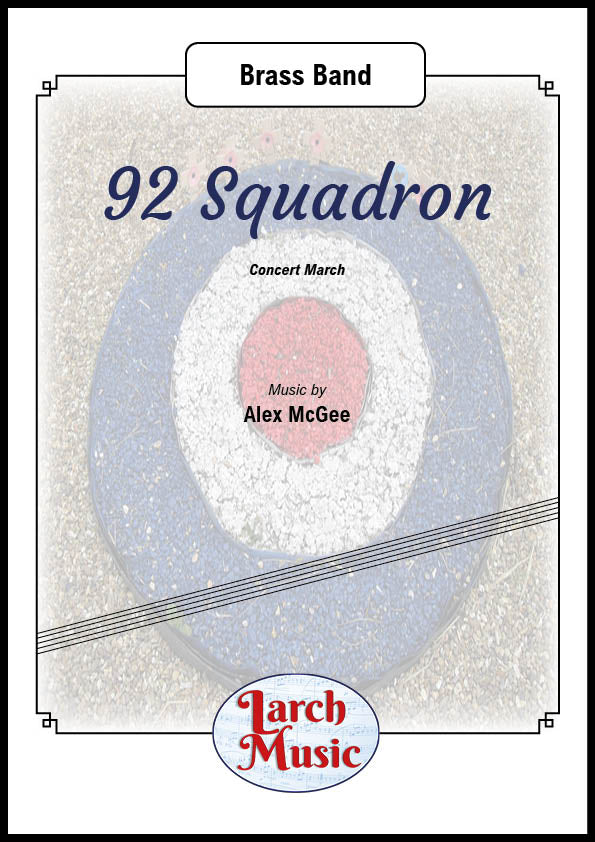
COMPOSER: Alex McGeeA concert march for brass band dedicated to 92 SquadronNumber 92 Squadron, also known asNo. 92 (East India) Squadronand currently asNo. 92 Tactics and Training Squadron, of theRoyal Air Forceis a test and evaluation squadron based atRAF Waddington,Lincolnshire. It was formed as part of theRoyal Flying CorpsatLondon Colneyas a fighter squadron on 1 September 1917. It deployed to France in July 1918 and saw action for just four months, until the end of the war. During the conflict it flew both air superiority and direct ground support missions. It was disbanded atEilon 7 August 1919. Reformed on 10 October 1939,at Tangmere Airfield, the unit was supposed to be equipped with medium bombers but in the spring of 1940 it became one of the first RAF units to receive theSupermarine Spitfire, going on to fight in theBattle of Britain.LM372 - ISMN : 9790570003723
In Stock: Estimated dispatch 3-5 working days
-
 £24.95
Wings (Claribel)
This set is march card sizedThe official Regimental March of The Royal Engineers
Estimated dispatch 7-14 working days
-
£50.00
A Festive Overture - Kenneth Hesketh
A Festive Overture received its world premire on 23rd March 2002 at the BASBWE International Conference, Royal Northern College of Music, Manchester by the Central Band of the RAF, conducted by Wing Commander Rob Wiffin. The outer sections are busy and colourful, framing an expansive middle section, where Hesketh introduces a typically broad melody.Brass Band Grade 6: ChampionshipDuration: 7 minutes
In Stock: Estimated dispatch 1-3 working days
 View Music