Results
-
£24.50Calon Lan - John Hughes - Rob Westacott
A new take on this this famous Welsh song is the perfect way to introduce your band to the concert stage. With stage directions, the band appears over the familiar 'Bolero' side drum rhythm one section at a time. Calon Lan has as in recent years become associated with the Welsh Rugby Union, being sung before almost every Test match involving the Welsh national team. This arrangement is accessible to Youth bands as well as senior bands and a lovely way to add something different to your concerts.
In Stock: Estimated dispatch 1-3 working days
-
£29.50
New Horizons - Max Stannard
This composition was originally written for the Horwich RMI Band to commemorate the life of Matthew Densfield, who has a drummer in his school brass band before his passing at an early age. This is a lively and energetic concert opener which encapsulates Matthew's love of live and rhythm as a drummer. This would be an excellent opener for your next concert and suitable for most bands from 4th to championship section to play. Duration: 3 minutes.
In Stock: Estimated dispatch 1-3 working days
-
£24.50
Fakenham Fair - Traditional - A. Cook
The origins of the song Fakenham Fair are somewhat obscure. It was collected by Peter Bellamy, who performed it unaccompanied on his first solo LP, "Mainly Norfolk" in 1968, giving credit to a Peter Bullen of Norwich from whom he had learned it, Bullen in turn giving credit to his grandfather. But beyond that, other than it definitely being a Norfolk folk song, the rest is a mystery.Over the years, Fakenham Fair has become a firm favourite among folk audiences, probably the most famous version being the 2008 recording by folk supergroup 'Bellowhead' which this setting for brass band pays tribute to. A bright, quirky, and bouncy 5:4/10:8 waltz, the band parts dance back and forth from simple time to compound time and back again, giving a constant flow that somehow always feels natural despite the irregular rhythm... but which will also keep your audience guessing where the beat will land next! With solos and features for principal chairs around the band, nobody is left out of the fun. Engaging to listen to and even more so to play, Fakenham Fair is a perfect light concert item for the band that likes to show off their rhythmic and lyrical sides at the same time.
In Stock: Estimated dispatch 1-3 working days
-
£24.50
Triumphant - Bill Willis
TriumphantThis is a bright concert march in a traditional style and should pose no problems for the majority of bands.The first half of the march moves between the related keys of A min and C majThe march starts with a bold opening 2 bar statement in A min. At B the rhythm from the middle of the band should not be allowed to slow the pace of the march. C sees a majestic bass melody from Baritones downwards moving to D where a repeat of the original theme is presented before moving to the TRIO section. This moves between the related keys of F maj and D min. The melody heard at E is repeated at G with a florid counter-melody heard from 1st Baritone and Euphonium leading to the finish.
In Stock: Estimated dispatch 1-3 working days
-
£105.20Pineapple Punch - Haakon Esplo
Pineapple Punch, a lively, fun and lively piece of music with challenges for all instrumental groups. You have a great opportunity to work with both rhythm, articulation and understanding of style.Pineapple Punch is entertaining and suitable for any concert.The piece has a light Latin touch and is fun to play for the musicians. The first voices provide a challenge, while the lower voices are simpler in rhythm and range.
Estimated dispatch 5-14 working days
-
£54.99
Studio-Pop - Kees Vlak
Studio-Pop consists of five movements. The first movement, entitled Marching on a String, is an energetic rock march in a modern rhythm. Next, the charming Dreaming of Summer has been composed in three-four time - which is quite unusual in modern pop music. The inspiration for the third movement, Chicken-Charley was a youngman selling chicken legs from a stall. His supple, dancing movements can be recognised in the music. The fourth movement, Candlelight is a modern, attractive ballad. Finally, Discoteca takes us along on a night visit to a Spanish discotheque. The typically Spanish chords and the stirring, high-spirited rhythm provide an exuberant closing to Studio-Pop.
Estimated dispatch 5-14 working days
-
£54.99Baion - Roland Kernen
'Baion' is the name of a slow Brazilian rhythm, recognizable by a beat followed by an equally long pause, followed by two further half-beats. Baion is also the name of a slower samba-variation that, along with the rhythmic Baion, migrated to Europe in the 1950's. This rhythm is used in Roland Kernen's exciting new composition with flexible six-part instrumentation.
Estimated dispatch 5-14 working days
-
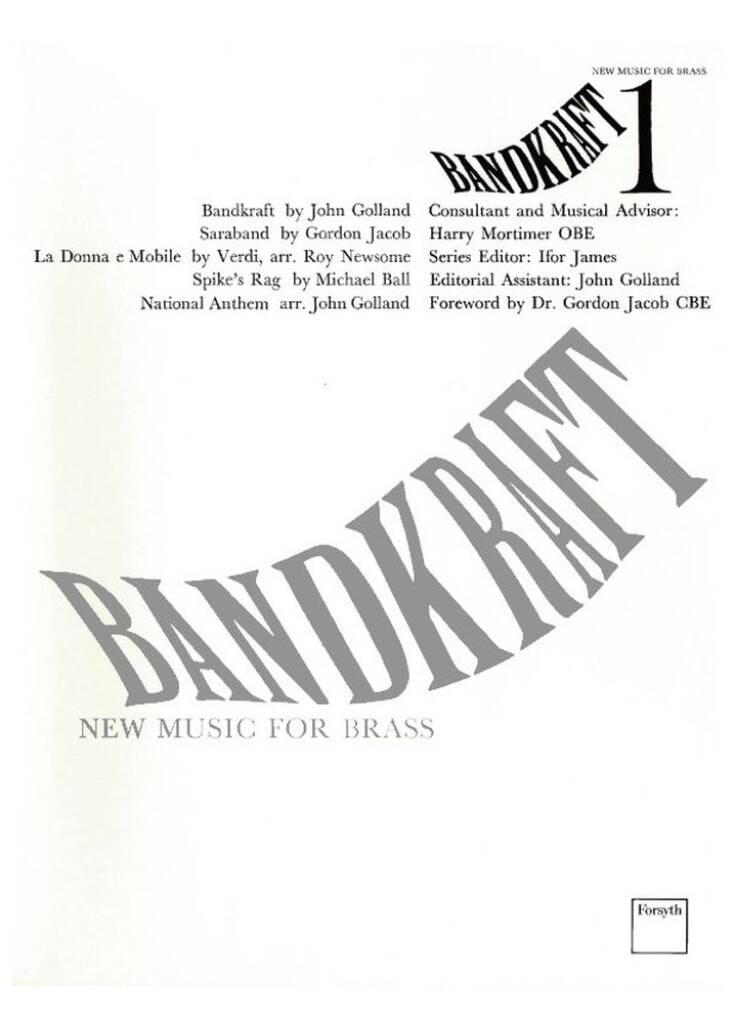
£19.95Bandkraft 1
The first of three superb sets of new music and arrangements for brass ensemble, edited by John Golland.1. Bandkraft - John Golland: A substantial piece with an exciting syncopated rhythm introduced in the opening bars and referred to throughout in a fanfare-like manner, to which a hint of dissonance adds extra thrill to the sound.2. Saraband - Gordon Jacob: A stately Elizabethan dance of great beauty, utilising modal harmony in Jacob's characteristic style. Constant speed, full note values and careful playing will achieve a beautiful, delicate effect.3. La Donna E Mobile - Verdi, arr. Roy Newsome: An amusing arrangement of this popular favourite by a conductor and adjudicator of international acclaim. Easy and enjoyable to play and to listen to.4. Spike's Rag - Michael Ball: A skilfully written piece in the true tradition of Scott Joplin, with the ragtime rhythm the backdrop to an unfolding conversation between the sections of the band. Really persuasive entertainment.5. National Anthem - arr. John Golland: A simple first verse setting the scene for the colourful and majestic second, utilising chromatic harmonies and an optional tenor counter melody for added splendour.
Estimated dispatch 5-14 working days
-
£54.99Jamaica - Timothy Travis
Jamaica is an island in the Caribbean. In 1494 it was discovered by Christopher Columbus, who used it as private property until 1509. After some skirmishes it fell under British rule and the sugar trade on the island flourished. After the abolition of slavery in 1834 it was only granted Home Rule in 1944, but it remained a member of the British Commonwealth of Nations. Whereas the export of cane sugar used to be Jamaica's main export product for many years, nowadays music has taken over this role. At first American music used to be very popular on the island. Later, however, Jamaican musicians started to experiment and thus in the end created their ownmusical style called Reggae. Well-known Reggae musicians are Bob Marley and Peter Tosh. The most important instruments used in Reggae are the bass and the drums. Together they form the base for the style: the riddim. A bass drum accent on the second and fourth beat are characteristic of a typically reggae drum beat. To this syncopic patterns are often added. The rhythm guitarist plays chords in a characteristic Reggae rhythm, not on, but between the beats.
Estimated dispatch 5-14 working days
-
£80.00St. Magnus - Kenneth Downie
Dedicated to Alastair Massey, an inspirational music teacher. Commissioned by the Scottish Brass Band Association for the 2004 European Brass Band Championships in Glasgow. This music is a set of variations on the tune known as St Magnus, which is attributed to Jeremiah Clarke. Most people will associate it with Thomas Kelly's hymn which begins: "The Head that once was crowned with thorns is crowned with glory now". The tune is very simple, consisting of just two, four-bar phrases. Neither is there much in the way of rhythmic variety, every note being a crotchet with the exception of two quavers, and the last note in each phrase. Within such a simple structure, however, lies considerable strength. THEME The listener is given the opportunity of hearing it twice, in full, at the beginning, starting with one player but soon taken up by the full ensemble. It returns in the middle of the music and is stated again near the end. This has been done quite deliberately in the hope that there will be an appreciation of what material is being developed, by the listener as well as by those with access to the score, who are able to see the visual connections. VARIATION 1 This takes the rhythm of the last part of the theme and also uses the shape of the opening as a recurring figure. The mood is whimsical and skittish, with short, teasing rhythmic figures tossed around the band, and quick interplay with percussion, at a fast tempo. An energetic flourish finishes this variation before the Andante espress. VARIATION 2 This commences with chords related to the opening of Variation 1. The cantabile on solo comets establishes a new, lyrical mood and there is scope for expressive playing in a series of short solo passages. The theme works its way unobtrusively into the texture before a reprise of the solo cornet melody and some more lyrical interchanges between Eb bass, euphonium, flugel horn and comets. The variation ends serenely with clear references to the last phrase of the theme. VARIATION 3 The first idea to dominate is clearly linked to the shape of the theme's first phrase. There is a frenetic feel to much of this variation, with considerable energy and instability created by extensive use of cross-rhythms. A thinning-out of the score marks a clear change to development of the start of the second phrase of the theme. This proves to be short-lived however, and the opening material returns leading to a restatement of the theme, "Maestoso," after which a euphonium cadenza links to Variation 4. VARIATION 4 Here we have some solos for euphonium, cornet, trombone and Eb bass set against a background of horns and baritones presenting a pensive statement of the theme's opening. VARIATION 5 This commences Allegro, with lively work for cornet and euphonium spreading to the whole band before attention focuses on the beginning of the second phrase of the theme which is initially presented in diminution, then in regular rhythm, then in inversion. An increase in tempo coupled with a decrease in volume, requires dexterity and control, with several metrical challenges thrown in for good measure. The same fragment of phrase becomes an ostinato which generates a frenzied climax, punctuated by short, dramatic silence, before the opening figure returns and the music gradually winds down. The tubular bells herald the final return of the theme, in augmentation, marking the start of the Finale. FINALE This features the running semiquavers of the previous variation sounding in counterpoint. A fast, furious coda speeds the work to a conclusion while references to the opening of the theme are still trying to break into the texture of the music. Kenneth Downie
Estimated dispatch 5-14 working days