
Results
-
 £59.99
Merry-Go-Round (Brass Band - Score and Parts) - Sparke, Philip
Merry-Go-Round is a mini concerto for band in which each section takes a turn as soloist. On a merry-go-round the viewpoint is constantly changing, this being portrayed by different instrumental groups playing variations on the main theme, continually coming to the fore. This attractive work will bring all the excitement of the fairground to your concert.Duration: 3.30
Estimated dispatch 7-14 working days
-
 £42.95
Shout! (Trombone Solo with Brass Band - Score and Parts) - Wiffin, Rob
Shout! was written for Brett Baker to demonstrate a particular musical aspect of his trombone playing.It is a Latin jazz piece subtitled CCC 4 BB - Cha cha cha for Brett Baker - and shows the trombone's ability to act as a declamatory jazz voice, covering much of the range and expressive power of the instrument. In one sense the title also refers to the jazz tradition of a Shout chorus which often appears towards the end of a jazz piece, bringing the players together after they have all taken their improvised solos.Shout! should hopefully be enjoyable to listen to and, although not without its technical challenges, fun to play.Duration: 3.45Recorded on Polyphonic QPRL227D SHOUT!
Estimated dispatch 7-14 working days
-
 £59.99
Once in Royal David's City (Brass Band - Score and Parts) - Gauntlett, Henry - Sparke, Philip
Sparkling and majestic brass playing introduce this wonderful arrangement of the classic carol! Each of the four verses are treated differently, creating beautiful textures and a multi-faceted setting of the familiar tune. This fresh arrangement for developing bands is a great choice for both church and school!Duration: 4:30
Estimated dispatch 7-14 working days
-
 £134.99
Dreams (Brass Band - Score and Parts)
This composition by Bertrand Moren presents various dreams which could have an effect on a dreamer's life. Its very high level of difficulty provides a great challenge for the conductor and musicians. You will be taken through a living Nightmare, with spine-chilling passages as dissonant chords alternate with aggressive percussion. Daydream is a patchwork of solos with all the brass band soloists playing serene and soft melodic lines with a virtuosic trombone cadenza. Finally, Visions portrays visions of insanity reflected by violent and discordant descending motifs leading to visions of joy presented in a sparkling and cheerful finale. 15:00
Estimated dispatch 7-14 working days
-
 £67.50
Tone Builders for Developing Bands (Brass Band - Score and Parts) - Curnow, James
Exceptionally useful! This collection of 24 etudes is specifically designed to help develop good individual and ensemble tone production and intonation. Citing tone production as one of the most important facets of good playing, Jim Curnow starts beginning players with material they have learned in their beginning method books, and then moves on to new and more advanced concepts. A great aid for your program!
Estimated dispatch 7-14 working days
-
 £76.99
Animal Kingdom - William Vean
In this composition William Vean takes you on a journey through the fascinating and exciting world of animals. Apart from it being a composition filled with "special effects", Animal Kingdom contains many educational elements, such as playing inswing (triplets feeling), chromatics, flutter tonguing, gypsy tuning, varying keys, and, of course, dynamics and articulation. The melodic lines occur in all four voices, as well as in all percussion parts, providing each musician with theopportunity to play a solo or to accompany. Highly recommended for your youth band! William Vean is an educational composer. He knows how to musically shape the special elements from our daily lives. His music is therefore veryexpressive, containing creative solutions to possible problems. Special ways of playing make his music particularly interesting for the winds, but the percussion section is also featured in his special effects. The world of the animalsalways plays on ones imagination. In Animal Kingdom, William Vean has portrayed a number of animals in a special manner: Kevin Kangaroo - The jumping character of this animal can be heard in different voices. The swing style alsoemphasizes the characteristic movements of the kangaroo. Playing in swing style can be practised by using scales. Eddy Elephant - For some of his smaller fellow fauna friends this can be quite an ordeal, but for Eduard (Eddy for friendsand intimates) it is his daily walk. Baldrick Bat - Baldrick the Bat is a mysterious character. This can be heard in the fast moving valves and keys, accompanied by special effects in the percussion section. Curtis Camel - Curtisthe Camel trudges across the desert, feeling bored. The idea that the horizon will never change does not affect him anymore. He has accepted his fate. The distinctive tones from the gypsy scale provide the suitable oriental sounds. BettyButterfly - Butterfly Betty elegantly, and without worries, flutters from flower to flower in the garden. Her motto: Carpe Diem (Seize the Day). Betty is a one-day butterfly. Marvin Monkey - A "swing" monkey stirs up the feelings. Evenmembers of the orchestra will look like real monkeys. How about your audience? Each part has its own difficulties and challenges. Important in the first part is playing "in swing" (triplets feeling). This can be practised usingscales. In the second part ensemble playing and balance are important. In Baldrick additional information on the effects that have to be played might be useful. "New" sounds are, of course, welcome. Curtis the Camel introduces thegypsy scale. Additional explanation of the use of the scale might be useful. Key changes are interesting in this part. A slight accent on the first beat of the bar will add to the charm of this part. Marvin the Monkey brings back the swingrhythm that was introduced in the first part, alternated by a "straight" part with attention to chromatics and articulation. A story teller will definitely be an asset when performing this composition.
Estimated dispatch 5-14 working days
-
 £84.99
For a Flower - Hermann Pallhuber
For a Flower is a very melodic and virtuosic solo work for euphonium and brass band. It opens with a gentle solo introduction on euphonium, which develops into a grand hymnal theme. Following this comes a faster and more virtuosic section in a traditional Irish style, with a varied dialogue between the band and the soloist. The work closes triumphantly with the hymnal theme of the opening. For a Flower showcases both the musical and technical capabilities of this wonderful instrument. The euphonium soloist must naturally master both skills: lyrical playing and virtuoso playing. For a Flower was commissioned by the Dutch euphonium virtuoso Robbert Vosand is dedicated to his wife, Evi.
Estimated dispatch 5-14 working days
-
 £80.00
St. Magnus - Kenneth Downie
Dedicated to Alastair Massey, an inspirational music teacher. Commissioned by the Scottish Brass Band Association for the 2004 European Brass Band Championships in Glasgow. This music is a set of variations on the tune known as St Magnus, which is attributed to Jeremiah Clarke. Most people will associate it with Thomas Kelly's hymn which begins: "The Head that once was crowned with thorns is crowned with glory now". The tune is very simple, consisting of just two, four-bar phrases. Neither is there much in the way of rhythmic variety, every note being a crotchet with the exception of two quavers, and the last note in each phrase. Within such a simple structure, however, lies considerable strength. THEME The listener is given the opportunity of hearing it twice, in full, at the beginning, starting with one player but soon taken up by the full ensemble. It returns in the middle of the music and is stated again near the end. This has been done quite deliberately in the hope that there will be an appreciation of what material is being developed, by the listener as well as by those with access to the score, who are able to see the visual connections. VARIATION 1 This takes the rhythm of the last part of the theme and also uses the shape of the opening as a recurring figure. The mood is whimsical and skittish, with short, teasing rhythmic figures tossed around the band, and quick interplay with percussion, at a fast tempo. An energetic flourish finishes this variation before the Andante espress. VARIATION 2 This commences with chords related to the opening of Variation 1. The cantabile on solo comets establishes a new, lyrical mood and there is scope for expressive playing in a series of short solo passages. The theme works its way unobtrusively into the texture before a reprise of the solo cornet melody and some more lyrical interchanges between Eb bass, euphonium, flugel horn and comets. The variation ends serenely with clear references to the last phrase of the theme. VARIATION 3 The first idea to dominate is clearly linked to the shape of the theme's first phrase. There is a frenetic feel to much of this variation, with considerable energy and instability created by extensive use of cross-rhythms. A thinning-out of the score marks a clear change to development of the start of the second phrase of the theme. This proves to be short-lived however, and the opening material returns leading to a restatement of the theme, "Maestoso," after which a euphonium cadenza links to Variation 4. VARIATION 4 Here we have some solos for euphonium, cornet, trombone and Eb bass set against a background of horns and baritones presenting a pensive statement of the theme's opening. VARIATION 5 This commences Allegro, with lively work for cornet and euphonium spreading to the whole band before attention focuses on the beginning of the second phrase of the theme which is initially presented in diminution, then in regular rhythm, then in inversion. An increase in tempo coupled with a decrease in volume, requires dexterity and control, with several metrical challenges thrown in for good measure. The same fragment of phrase becomes an ostinato which generates a frenzied climax, punctuated by short, dramatic silence, before the opening figure returns and the music gradually winds down. The tubular bells herald the final return of the theme, in augmentation, marking the start of the Finale. FINALE This features the running semiquavers of the previous variation sounding in counterpoint. A fast, furious coda speeds the work to a conclusion while references to the opening of the theme are still trying to break into the texture of the music. Kenneth Downie
Estimated dispatch 5-14 working days
-
 £19.95
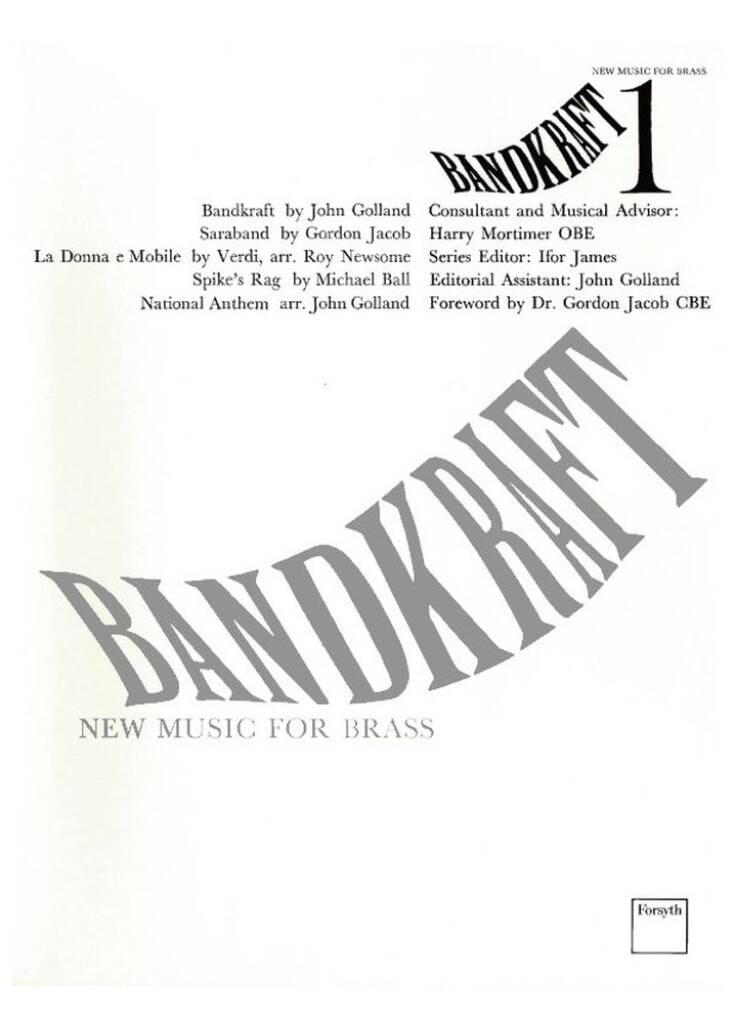
Bandkraft 1
The first of three superb sets of new music and arrangements for brass ensemble, edited by John Golland.1. Bandkraft - John Golland: A substantial piece with an exciting syncopated rhythm introduced in the opening bars and referred to throughout in a fanfare-like manner, to which a hint of dissonance adds extra thrill to the sound.2. Saraband - Gordon Jacob: A stately Elizabethan dance of great beauty, utilising modal harmony in Jacob's characteristic style. Constant speed, full note values and careful playing will achieve a beautiful, delicate effect.3. La Donna E Mobile - Verdi, arr. Roy Newsome: An amusing arrangement of this popular favourite by a conductor and adjudicator of international acclaim. Easy and enjoyable to play and to listen to.4. Spike's Rag - Michael Ball: A skilfully written piece in the true tradition of Scott Joplin, with the ragtime rhythm the backdrop to an unfolding conversation between the sections of the band. Really persuasive entertainment.5. National Anthem - arr. John Golland: A simple first verse setting the scene for the colourful and majestic second, utilising chromatic harmonies and an optional tenor counter melody for added splendour.
Estimated dispatch 5-14 working days
-
 £60.99
Artemis - Jan Van der Roost
Artemis is the Greek goddess of hunting and forests. In western art she is often pictured with deer, lions or bears with a bow in her hand. The tempo of this march is stately and the themes are "concertante" in character making Artemis best suited as a concert march rather than a street march. Technically this march is not too difficult although at times some dexterous fingering is necessary. The trio melody is especially lyrical and offers various sections within the band the possibility to show off their skill in playing the expressive melody. This excellent new concert march is sure to become a classic and be performed time and time again.
Estimated dispatch 5-14 working days
 View Music