
Results
-
 £35.00
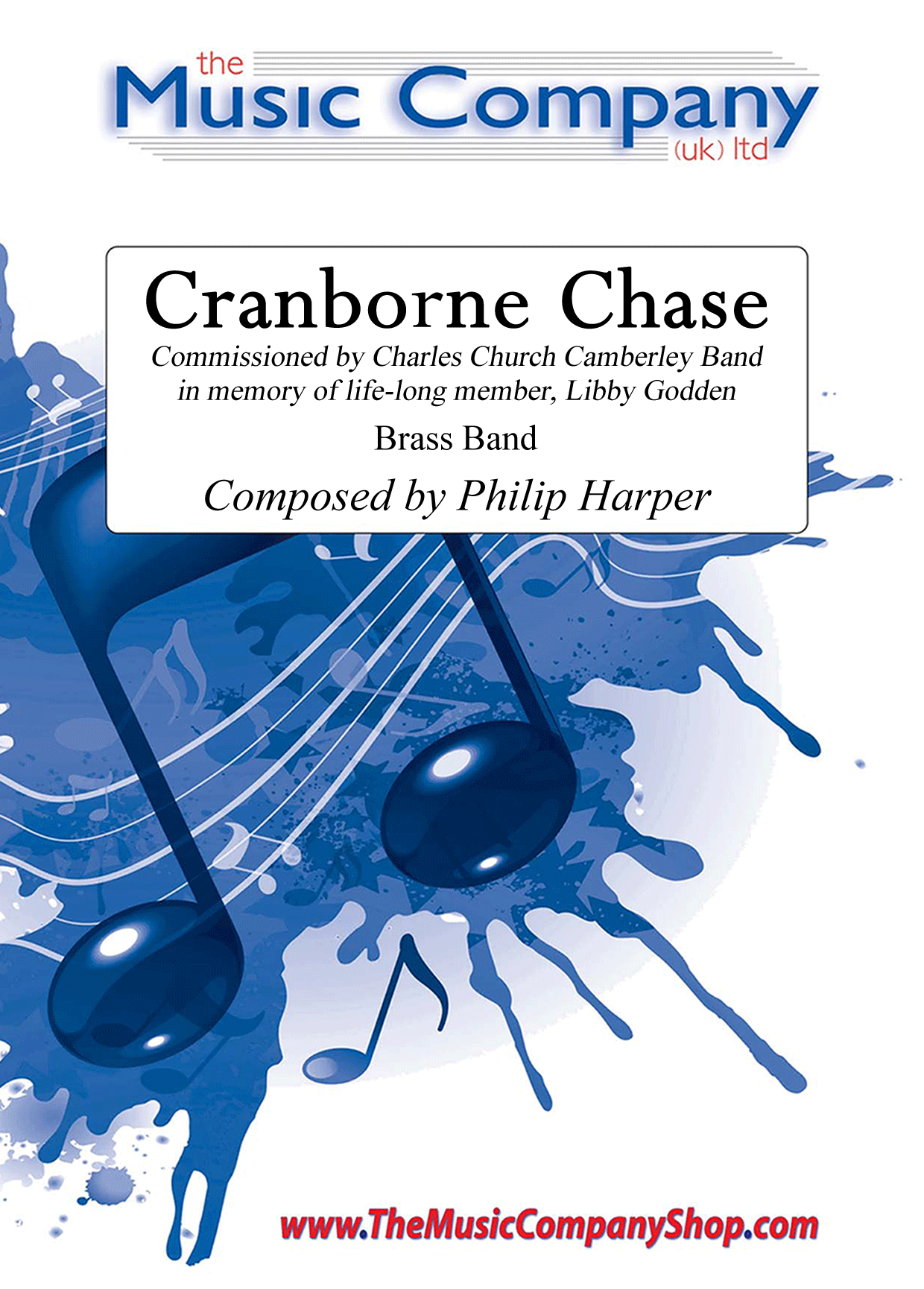
Cranborne Chase - Philip Harper
Cranborne Chase was commissioned by the Charles Church Camberley Band in 2011 in memory of solo horn player and life-long member Libby Godden.Libby joined the band in 1966 which marked the start of a long association, during which she progressed to the solo horn position, recruited four family members to play with the band, and had spells on the committee as publicity officer and chairman. Most recently she led the Training Ensemble in her role as Assistant Bandmaster. Libby continued to be active with the band despite a diagnosis of cancer, which finally claimed her life in February 2011.Programme notes from the composer, Philip Harper:The Music: As well as invoking the joyous spirit befitting Libby's approach to life, there are several musical ideas woven into the score. After a brief introduction, the main theme uses the musical letters of Libby's surname: G, O(A), D, D, E, N(G), whilst the harmonic progression here is based on that of the slow movement of Edward Gregson's Partita for Brass Band, one of Libby's favourite passages of music.To further imbue the piece with Libby's persona, the lyrical theme is first introduced as a traditional brass band quartet (two cornets, horn and euphonium), one of her favourite musical genres.After the first rehearsal of the piece the band members, with the composer's blessing, decided on the name Cranborne Chase, which is the name of a place in Dorset with which Libby Godden had a great affinity.Raising Funds for Cancer Research UK. The Music Company (UK) Ltd has been involved in charitable work for many years both nationally and internationally. Through publishing Cranborne Chase, The Music Company is extending its charitable support by helping to raise funds for the Cancer Research UK charity, in memory of Libby Godden (a band-friend since childhood of Clair Tomalin, Business Director of The Music Company (UK) Ltd).A donation will therefore be made by The Music Company (UK) Ltd for every purchased set of this piece. There is a hope that every band in the UK will have Cranborne Chase as part of their library and included in their concert programmes, enabling a significant amount of money to be raised for Cancer Research UK through the enjoyment of music.
In Stock: Estimated dispatch 3-5 working days
-
 £30.00
Janacek's 'Taras Bulba' - Janacek
Comments from Tim Paton, the arranger of Janacek's 'Taras Bulba': "I will never forget the day in 1967 when I was introduced to the music of Leos Janacek, a Czech composer born in 1854, who died in 1928. Janacek was little known in Britain until the 1960's, when the conductor Charles Macherras introduced his unique music. I heard a recording of Macherras conducting the Pro Arte Orchestra in a performance of Janacek's "Sinfonietta".It was in 1969 that I first heard Janacek's Symphonic Rhapsody, "Taras Bulba".Janacek's music is exciting, powerful, emotive, impassioned and unpredictable.I have taken the first and third movements of this piece, and adapted them for Brass Band, which was at times extremely difficult, but rewarding. It sometimes took up to an hour to be satisfied that a mere several bars had been reproduced to convey the composer's intentions.The Death of AndriThe Cossaks, under the leadership of Taras Bulba, are fighting against the Poles in the 17th century. Taras's son Andri seeks to rescue his love, a Polish princess, from a city which is being besieged by the Cossaks. Having found her, he throws in his lot with the Poles, but is finally captured by his father, who executes him as a traitor before riding off again to battle.Prophesy and Death of Taras BulbaTaras himself is finally captured and condemned to be nailed to a tree and burned alive. As the flames creep around him, Taras has the satisfaction of seeing histroops escape, and as he dies, sees a vision of his country freed at last.This is incredibly descriptive music. The mood is constantly changing, creating feelings of love and anger, celebration and melancholy, despair and triumph.This Brass Band EditionThe duration of the original symphonic rhapsody, three movements, is approximately 23 minutes. I chose the first and third movements, so the Brass Band edition is approximately 14 minutes. The main reason is twofold: Being realistic about the demands this music would place on the stamina of the brass player; Keeping the piece less than 15 minutes, so that, if desired, it could be used on the contest platform.Two unique qualities of Janacek's music had to be taken into account when preparing this brass band version. His compositional technique was individual, at times not sticking to traditional expectations, in both form and orchestration. I imagined what the genius himself would have said looking at my work, and how to tackle a particular section to emulate his original intentions. This was particularly the case when dealing with high woodwind and violin parts, the use of tremolo in string parts, and the orchestral harp.Percussion: Janacek included timpani, side drum, cymbals, triangle and tubular bells. For reasons stated previously, I have also included xylophone and glockenspiel. I have also added the gong in a couple of places to enhance the dramatic effect of the music.
In Stock: Estimated dispatch 3-5 working days
-
£25.00
Zephyrus - Andrew Duncan
The Big Blow', was a formal record attempt to create the largest brass band in the world. It took place at Butlin's Resort, Skegness on 20 January 27 and in addition to the fun generated by the event itself, it's main goal was to raise money in support of the work of Brass Band Aid, and specifically to provide long-term sponsorship for two children in the village of Adet, Ethiopia.The Music Company (UK) Ltd were one of the Official Partners of The Big Blow, providing the performance piece for the record attempt. As Editorial Director of the company, Andrew Duncan wrote 'Zephyrus' to mark the occasion.Originally presented at the event as 'March - The Big Blow', the published re-titling of 'Zephyrus' provides a more subtle alternative, taking its name from the Greek God of the West Winds.'Zephyrus' is a traditional British brass band march with an interesting African-feel lilt to the trio. This is enhanced by optional percussion instruments including djembi and bongos, which can also be covered by standard drum kit. A positive, upbeat concert march to reflect the sentiment behind 'The Big Blow' record attempt.There were 443 participants in total, including:Soprano Cornets x 12Cornets x 152Flugels x 19Tenor Horns x 68Baritones x 32Euphoniums x 32Trombones x 55Eb Basses x 35Bb Basses x 17Percussionists x 21The Music Company are pleased to continue their support of Brass Band Aid by offering a donation to this worthy charity for every set of this music sold.
In Stock: Estimated dispatch 3-5 working days
-
Diamonds - Jerry Lordan - Len Jenkins
In November 1962, ex-Shadows members Jet Harris and Tony Meehan decided to work as a duo and went to No 1 with a Jerry Lordan composition, "Diamonds". Harris, a bass player, took an ordinary Fender guitar and detuned every string a whole tone to enable him to hit notes which were lower than an ordinary guitar. However, it was apparently difficult to work with on stage since once the strings were slackened they would go out of tune very easily. The duo went on to have a second Top 10 hit with "Scarlett O'Hara" which is also available from Wobbleco Music in an arrangement for brass band. Both arrangements seek to capture the characteristic style of 60's rock music and retain the signature drum solos for which they are rightly remembered. But in addition, both pieces also appeal to a younger generation who may not have heard the originals. Our young kit drummer in Woburn Sands 'A' Band commented "...the (drum) part has the slightest shuffle feel to it, which improves the groove of the song, and to replicate the vintage snare-drum sound, I have heard that you can place a towel or a cloth over the head of the drum. I think it would work well...(otherwise) the drum part stays relatively simple and repetitive"...Chance to re-create the sound of the 60's.....Go for it!
-
 £32.00
Coventry Variations (Score only) - Bramwell Tovey
A work which has quickly found a place in the repertoire of many brass bands - it is so full of invention, glorious melodies, energy, and exciting sounds. Players will enjoy both rehearsal and performance, and while there are technical demands, they always serve the music. The famous Coventry Carol is used as a basis - and it appears triumphantly at the work's conclusion, like the new city of Coventry rising, Phoenix-like, from the ashes of the old.
Estimated dispatch 7-9 working days
-
 £42.00
Coventry Variations (Parts only) - Bramwell Tovey
A work which has quickly found a place in the repertoire of many brass bands - it is so full of invention, glorious melodies, energy, and exciting sounds. Players will enjoy both rehearsal and performance, and while there are technical demands, they always serve the music. The famous Coventry Carol is used as a basis - and it appears triumphantly at the work's conclusion, like the new city of Coventry rising, Phoenix-like, from the ashes of the old.
Estimated dispatch 7-9 working days
-
 £42.00
Unholy Sonnets (Score only) - Philip Wilby
Pieces for voice and brass band are rare, so Unholy Sonnets, with provocative words by Mark Jarman, occupies an unusual place in the repertory. The four movements are: 'Time to admit my altar is a desk', 'Two forces rule the Universe', 'There was a pious man', and 'If God survives us, will His kingdom come?' Also available with piano.
Estimated dispatch 7-9 working days
-
 £52.00
Unholy Sonnets (Parts only) - Philip WIlby
Pieces for voice and brass band are rare, so Unholy Sonnets, with provocative words by Mark Jarman, occupies an unusual place in the repertory. The four movements are: 'Time to admit my altar is a desk', 'Two forces rule the Universe', 'There was a pious man', and 'If God survives us, will His kingdom come?' Also available with piano.
Estimated dispatch 7-9 working days
-
 £14.95
Unholy Sonnets - Philip WIlby
Pieces for voice and brass band are rare, so Unholy Sonnets, with provocative words by Mark Jarman, occupies an unusual place in the repertory. The four movements are: 'Time to admit my altar is a desk', 'Two forces rule the Universe', 'There was a pious man', and 'If God survives us, will His kingdom come?'
Estimated dispatch 7-9 working days
-
£50.00
Peniel - Ball, E
This work is not intended to actually portray in music the events described in Genesis, Chapter 32, although the varying moods were evoked by a re-reading of the story. However, the following sequence of ideas may sometimes prove useful in presenting the work to audiences.Under Divine compulsion, Jacob sets out with Family, retainers, servants and cattle, to return to his homeland (Introduction and Sections 1 - 3).He is brought news of possible attack by his estranged brother Esau (Sections 4 - 6).Jacob seeks guidance in a lone vigil and, wrestling with a divine visitor, at last wins acceptance at the place he names Peniel--The Prince of God. He goes forward with his people and becomes reconciled with Esau (Section 12 to the end).Eric BallDuration 9 mins
In Stock: Estimated dispatch 1-3 working days
 View Music