Searching for Wind Band Music? Visit the Wind Band Music Shop
We've found 551 matches for your search. Order by

Results

  • £38.95

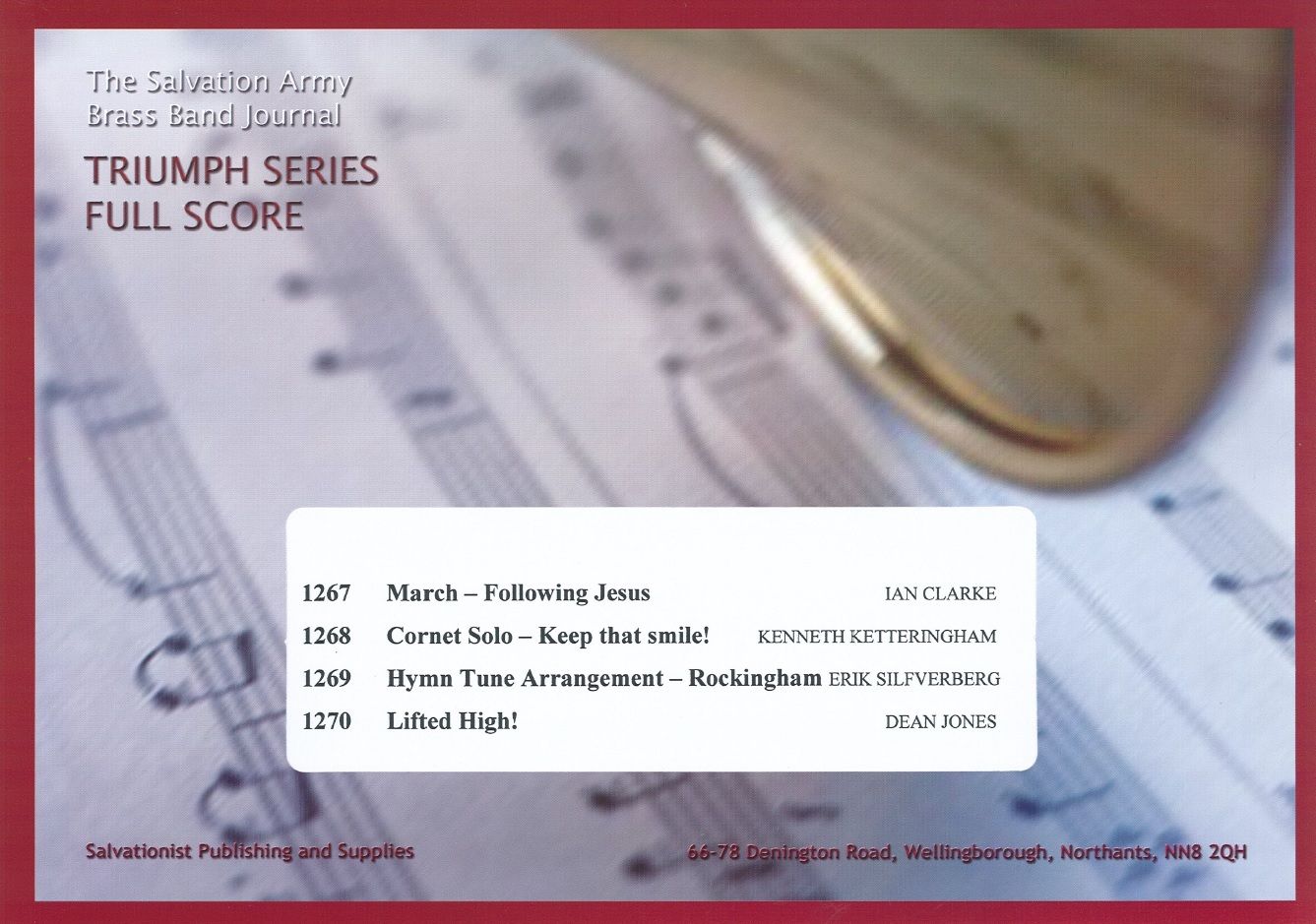
    Unity Series Band Journal October 2013 Numbers 410 - 413

    No. 410 March - Go Forth! (Paul Drury)This march was written as a tribute to Bandmaster Jack Spowart and the Bo'ness Salvation Army Band. The composer lives in the twon of Bo'ness and has had numerous opportunities to share with the band and the wider corps at various events. This march serves as recognition of the faithful service given in the Lord's name in the town by The Salvation Army for over 100 years. Two tunes are featured, both well-known and instantly recognisable, namely, Forward! be our watchword and We're marching on.No.411 (1) O give thanks (Marian Parker)The composer, Marian Parker, is a new contributor and is the Recruiting Sergeant at Leicester South Corps. This simple, yet rhythmic piece should not pose any technical problems for most bands and features the attractive arrangement of Joanne Pond's contemporary song, 'O give thanks'.No.411 (2) Hymn Tune Arrangement - St Michael (David Rowsell)The hymn tune 'St Michael' was composed in 1551 by French composer Louis Bourgeois and the composer provides a very useful arrangement of this historic hymn.No. 412 Precious Lord, take my hand (Erik Silfverberg O.F.)This well-known Gospel Song is a favourite of many. It has been recorded by many great artists, including Rosetta Tharpe, Elvis Presley and Aretha Franklin. The words were written by Reverend Thomas A. Dorsey, who is often known as the 'Father of Gospel song'.No. 413 Search Me (Gavin Whitehouse)The second new contributor to this journal is Gavin Whitehouse. gavin is the Assistant Music Director for the Greater New York Division and is also the USA Eastern Territorial Songster Leader. This piece combines two songs - one old and one new - which speak of a God who knows us intimately. 'Search me, O God and know my heart today' (associated with the beautiful Maori melody, 'Now is the hour') is woven with a contemporary setting of Psalm 139 by Rebecca St James, the first line of which says, 'You searchme, you know me'.

    Estimated dispatch 7-14 working days
  • £50.00

    Judd: Beulah Land

    Wilfred Heaton began to assemble material for 'Beulah Land' in the early 1990s following a request from the Amsterdam Staff Band for a new work. Despite reminding himself on the manuscript that he should either complete or destroy the work before his death, ultimately he did not manage either. This edition was subsequently realised in 2003 for the tour of the USA Western States by the Amsterdam Staff Band. 'Beulah Land' is Heaton's vision of the joy that awaits the Christian in Heaven and, according to his family, is reminiscent of the kind of music he often improvised at the piano. The three movements are as follows; 1. Better World; a waltz sequence on the tune 'Zealley' to which the words 'There is a better world, they say' are sung.2. Heavenly Home; an elegiac cortege using the tunes 'My home is in Heaven', 'I have a home that is fairer than day' and 'The home over there'.3. Happy Land; Beginning in waltz rhythm this soon gives way to a sequence of free variations on the song 'There is a happy land, Far, far away'.

    Estimated dispatch 7-14 working days
  • £34.95

    Rondo Alla Turk (Xylophone Solo with Brass Band - Score and Parts)

    Rondo Alla Turk has been a popular concert piece for many performers the world over. This is an arrangement I have done for solo xylophone that shows off the technical dexterity of both the piece and the instrument. Starting in a brisk tempo, the soloist performs the main themes of the piece with the major key fanfare-like interludes introducing each new section.The main melody from the opening returns with an even brighter tempo that takes the soloist into a flamboyant cadenza section. The cadenza section is scored out for the xylophone but the ad-lib marking allows the soloist in true Mozart fashion to improvise (if they wish) the cadenza section which leads into the finale.The finale brings back the major key motifs from the opening to a coda section that concludes in a breathless flurry from the soloist.Paul Lovatt-Cooper Suitable for 3rd section bands and above, soloist grade 8

    Estimated dispatch 7-14 working days
  • £94.95

    Dances and Arias (Brass Band - Score and Parts)

    This work was commissioned by Boosey & Hawkes Band Festivals (with funds provided by the Arts Council of Great Britain) for the National Brass Band Championships of Great Britain, held at the Royal Albert Hall, London, on 7th October 1984.Dances and Arias is in one continuous movement, but as the title suggests is a series of alternating fast and slow sections as follows: Dance - Aria I - Dance (scherzo) - Aria II - Dance. The opening dance is energetic and introduces a four-note motif (on trombones) which is the basis for much of the melodic material in the work. Throughout, there is a continuous process of thematic cross-reference and transformation.The first aria unfolds a long melody on solo cornet, eventually continued by all the solo cornets, and dissolving into a shimmering harmonic background (muted cornets, horns and baritones) over which is heard a brief self-quotation on solo tuba. This leads into the second dance, a frenetic scherzo, followed by the second aria, in the style of a lament (solo euphonium, followed by two flugel horns). This builds to a powerful climax which subsides, leaving the percussion to introduce the final toccata-like dance. It transforms material from the opening before a coda brings the music to a triumphant close. The large percussion section is an integral part in the work and uses a wide variety of instruments including timpani, glockenspiel, vibraphone, xylophone, tubular bells, tom-toms, snare drum, bongos and tam-tam.

    Estimated dispatch 7-14 working days
  • £99.95

    Malcolm Arnold Variations (Score and Parts)

    MALCOLM ARNOLD VARIATIONS was commissioned by Philip Biggs and Richard Franklin for the 20th All England Masters International Brass Band Championship held in the Corn Exchange, Cambridge on 25 May 2008. The work is dedicated to Anthony Day, long time carer of Sir Malcolm Arnold in his final years. I first met Malcolm and Anthony in 1990 and remained in constant touch until Malcolm's passing in 2006. Anthony, of course, remains a friend and plays his own role subliminally in this piece. The work is not based on any of Malcolm Arnold's own themes, rather it is a portrait of him (and by association Anthony Day) through my eyes and as a result of my friendship with both parties over some 18 years. If there is any theme as such it is the personalities of the players, the protagonist and his carer placed together by my own efforts coloured and influenced by aspects of Arnold's style and technique without recourse to direct quotation but through allusion and parody. It is of course designed as a brass band test piece but in my eyes is first and foremost a musical challenge. The pyrotechnical elements are there but always secondary to the musical thrust of the work's structure. I have long beforehand submerged myself in Malcolm Arnold's music and ultimately delivered this tribute. Music Directors will be advised to acquaint themselves with the composer's personal music, particularly the film scores, symphonies, concertos and ballets: the solutions towards a successful interpretation of my piece are all in there - and YES, I want, and sanction, this piece to be interpreted, and therein lies the challenge for those of you 'up front'! The challenge for players is that of virtuosity, ensemble and careful attention to where they are individually in relation to their colleagues - a question of balance, taste and insight. With regard to tempi, as is my usual custom, I have indicated all metronome marks with the prefix circa. I would suggest that the fast music is played at these tempos but that the more rubato moments can be allowed some freedom in expression and fluidity of line. With regard to the type of mutes to be employed - this decision I leave to the discretion of players and conductors. Structurally the work is cast as an Introduction, 20 Variations and a Finale. Some variations are self contained, others run into each other as sequences in the same tempo. In other variations, segments are repeated and developed. I could describe the overall concept as a miniature ballet or a condensed film score - there is much drama and character and the repeated elements assist this in driving the action forward. I have deliberately avoided the more extremely dark qualities of Malcolm's own music in this, my celebration of this master-composer, as I have always viewed (and evidenced by my previous Masters scores Tristan Encounters and Chivalry) that the Cambridge contest is a 'sunshine- affair' and firmly believe that Malcolm Arnold would have had it no other way too!

    Estimated dispatch 7-14 working days
  • £49.95

    Malcolm Arnold Variations (Score Only)

    MALCOLM ARNOLD VARIATIONS was commissioned by Philip Biggs and Richard Franklin for the 20th All England Masters International Brass Band Championship held in the Corn Exchange, Cambridge on 25 May 2008. The work is dedicated to Anthony Day, long time carer of Sir Malcolm Arnold in his final years. I first met Malcolm and Anthony in 1990 and remained in constant touch until Malcolm's passing in 2006. Anthony, of course, remains a friend and plays his own role subliminally in this piece. The work is not based on any of Malcolm Arnold's own themes, rather it is a portrait of him (and by association Anthony Day) through my eyes and as a result of my friendship with both parties over some 18 years. If there is any theme as such it is the personalities of the players, the protagonist and his carer placed together by my own efforts coloured and influenced by aspects of Arnold's style and technique without recourse to direct quotation but through allusion and parody. It is of course designed as a brass band test piece but in my eyes is first and foremost a musical challenge. The pyrotechnical elements are there but always secondary to the musical thrust of the work's structure. I have long beforehand submerged myself in Malcolm Arnold's music and ultimately delivered this tribute. Music Directors will be advised to acquaint themselves with the composer's personal music, particularly the film scores, symphonies, concertos and ballets: the solutions towards a successful interpretation of my piece are all in there - and YES, I want, and sanction, this piece to be interpreted, and therein lies the challenge for those of you 'up front'! The challenge for players is that of virtuosity, ensemble and careful attention to where they are individually in relation to their colleagues - a question of balance, taste and insight. With regard to tempi, as is my usual custom, I have indicated all metronome marks with the prefix circa. I would suggest that the fast music is played at these tempos but that the more rubato moments can be allowed some freedom in expression and fluidity of line. With regard to the type of mutes to be employed - this decision I leave to the discretion of players and conductors. Structurally the work is cast as an Introduction, 20 Variations and a Finale. Some variations are self contained, others run into each other as sequences in the same tempo. In other variations, segments are repeated and developed. I could describe the overall concept as a miniature ballet or a condensed film score - there is much drama and character and the repeated elements assist this in driving the action forward. I have deliberately avoided the more extremely dark qualities of Malcolm's own music in this, my celebration of this master-composer, as I have always viewed (and evidenced by my previous Masters scores Tristan Encounters and Chivalry) that the Cambridge contest is a 'sunshine- affair' and firmly believe that Malcolm Arnold would have had it no other way too!

    Estimated dispatch 7-14 working days
  • £89.95

    Revelation (Score and Parts)

    Symphony for Double Brass on a theme of Purcell 1995 marked the tercentenary of Purcell's death, and my new score Revelation has been written as a tribute to his music and the ornate and confident spirit of his age. There are five major sections: 1 Prologue 2 Variations on a ground bass I 3 Fugue 4 Variations on a ground bass II 5 Epilogue and Resurrection The score uses many features of the Baroque Concerto Grosso, and arranges players in two equal groups from which soloists emerge to play in a variety ofvirtuoso ensembles. It quotes freely from Purcell's own piece Three Parts on a Ground in which he has composed a brilliant sequence of variations over a repeating six-note bass figure. This original motif can be heard most clearly beneath the duet for Cornet 5 and Soprano at the beginning of the 2nd section. There is, of course, a religious dimension to Revelation as the title suggests, and the score is prefaced by lines by the 17th century poet John Donne. His Holy Sonnet paraphrases the Book of Revelation in which the dead are raised at the sounds of the last trumpet. Donne's trumpets are themselves placed stereophonically ". . . At the round Earth's imagined corners" and it is this feature that today's players represent as they move around the performing area. Their final apocalyptic fanfares can be heard at the close of the score, as Purcell's music re-enters in a lasting tribute to England's first composer of genius. Philip Wilby September 1995 At the round Earth imagined corners, blow your trumpets, angels, and arise, arise from death, you numberless infinities Of souls, and to your scattered bodies go. All whom the flood did, and fire shall o 'erthrow All whom war, dearth, age, agues, tyrannies, Despair, law, chance hath slain, and you whose eyes Shall Behold God, and never taste death woe. John Donne after Revelation Ch. 11 v.15

    Estimated dispatch 7-14 working days
  • £44.95

    Revelation (Score Only)

    Symphony for Double Brass on a theme of Purcell 1995 marked the tercentenary of Purcell's death, and my new score Revelation has been written as a tribute to his music and the ornate and confident spirit of his age. There are five major sections: 1 Prologue 2 Variations on a ground bass I 3 Fugue 4 Variations on a ground bass II 5 Epilogue and Resurrection The score uses many features of the Baroque Concerto Grosso, and arranges players in two equal groups from which soloists emerge to play in a variety ofvirtuoso ensembles. It quotes freely from Purcell's own piece Three Parts on a Ground in which he has composed a brilliant sequence of variations over a repeating six-note bass figure. This original motif can be heard most clearly beneath the duet for Cornet 5 and Soprano at the beginning of the 2nd section. There is, of course, a religious dimension to Revelation as the title suggests, and the score is prefaced by lines by the 17th century poet John Donne. His Holy Sonnet paraphrases the Book of Revelation in which the dead are raised at the sounds of the last trumpet. Donne's trumpets are themselves placed stereophonically ". . . At the round Earth's imagined corners" and it is this feature that today's players represent as they move around the performing area. Their final apocalyptic fanfares can be heard at the close of the score, as Purcell's music re-enters in a lasting tribute to England's first composer of genius. Philip Wilby September 1995 At the round Earth imagined corners, blow your trumpets, angels, and arise, arise from death, you numberless infinities Of souls, and to your scattered bodies go. All whom the flood did, and fire shall o 'erthrow All whom war, dearth, age, agues, tyrannies, Despair, law, chance hath slain, and you whose eyes Shall Behold God, and never taste death woe. John Donne after Revelation Ch. 11 v.15

    Estimated dispatch 7-14 working days
  • £22.50

    Petite Suite de Ballet (Score Only)

    This composition consists of four 'miniatures', simple in construction, yet not without technical demands upon the players.The music is for a ballet which so far exists only in the imagination! Like most ballet, it has a touch of the fantastic, and must be interpreted with a light, deft touch.The first movement, Parade, brings many characteristics on to the stage, marching perkily, leggily, with almost puppet-like movements.In the next movement, Pas Seul (Solo Dance), one lone figure holds the stage, with a mixture of grace and sauciness. At the end he (or she) runs off with a snap of the fingers.The third movement is a Minuet. A chosen few, richly garbed, perform this stately, courtly dance, while the rest of the company look on at some ritual in which they are not allowed to join.The final Ensemble commencing with the return of the lone figure, gradually brings the whole company to the stage. Various groups come forward for a few moments, and then rejoin the general pattern of the dancing. Towards the end a stately procession is formed, but this finally breaks up in a sudden flurry of leaping and capering, and in a moment, as though at some magic call, the dances have disappeared, whilst the sonorous tones of the final bars of music follow them with a rather disapproving air.Our little fantasy in over.

    Estimated dispatch 7-14 working days
  • £44.99

    Korobeiniki - Russian Traditional

    ABOUT THIS PIECE: "Korobeiniki" is a nineteenth-century Russian folk song that tells the story of a meeting between a peddler and a girl, describing their haggling over goods in a veiled metaphor for courtship. Outside of Russia, "Korobeiniki" is widely known as the Tetris theme (titled "A-Type" in the game), from its appearance in Nintendo's 1989 version of the game. One of our most popular arrangements, this piece is high-paced and features all the usual trappings associated with this musical style - fireworks to start, a slow, melancholy iteration of the melody, an unruly accelerando, and all finished with a loud shout ('Oi!') from the band! ENSEMBLE: Standard British Brass Band WHEN YOU BUY THIS PRODUCT, YOU GET: High-quality printed score and parts LEVEL: 2 (choose your tempo wisely!) LISTEN: DURATION: c. 3-minutes EXAMPLE SCORE: Click here LEVEL GUIDE: Level 1- Accessible to all Level 2 - c. UK third section and higher Level 3 - c. UK second section and higher Level 4 - c. UK first section and higher Level 5 - c. UK championship section level

    Estimated dispatch 5-7 working days