
Results
-
 £120.00
New London Pictures (Brass Band - Score and Parts)
New London Pictures represents elements of London in the 21st Century. The Millennium Bridge describes the pedestrians journey across this wonderful new landmark bridge over the Thames, starting at the imposing Tate Modern, crossing the busy river, and onwards to St. Pauls Cathedral with its bells ringing out over the great city. London Eye is an incredibly large ferris wheel situated on the South Bank of the River Thames. This movement depicts a flight on this riverside wheel, at the top of which the panoramic view of London is breath-taking and the expanse of the music is a suitable depiction of the view. As with all modern cities, London is over-crowded with motor vehicles. London is the first major city in Europe to adopt a Congestion Charge, and this piece (with its stop and go traffic lights) is both racy and comical. Here are Londoners attempting to go about their business in the face of overwhelming odds..... Suitable for Premier Youth/2nd Section Bands and above. Duration: 15.00
Estimated dispatch 7-14 working days
-
 £34.95
Rondo Alla Turk (Xylophone Solo with Brass Band - Score and Parts)
Rondo Alla Turk has been a popular concert piece for many performers the world over. This is an arrangement I have done for solo xylophone that shows off the technical dexterity of both the piece and the instrument. Starting in a brisk tempo, the soloist performs the main themes of the piece with the major key fanfare-like interludes introducing each new section.The main melody from the opening returns with an even brighter tempo that takes the soloist into a flamboyant cadenza section. The cadenza section is scored out for the xylophone but the ad-lib marking allows the soloist in true Mozart fashion to improvise (if they wish) the cadenza section which leads into the finale.The finale brings back the major key motifs from the opening to a coda section that concludes in a breathless flurry from the soloist.Paul Lovatt-Cooper Suitable for 3rd section bands and above, soloist grade 8
Estimated dispatch 7-14 working days
-
 £34.99
Millennium Bridge (from New London Pictures) (Brass Band - Score and Parts)
Millennium Bridge describes the pedestrians journey across this wonderful new landmark bridge over the Thames, starting at the imposing Tate Modern, crossing the busy river, and on to St. Pauls Cathedral with its bells ringing out over the great city. This piece is the first movement of Nigel Hess's New London Pictures, which represents elements of London in the 21st Century. Suitable for Premier Youth/2nd Section Bands and above. Duration: 4.00
Estimated dispatch 7-14 working days
-
 £29.95
Judd: To Regions Fair
Clive Bright, in his score note when To Regions Fair was originally published in 1958, predicted that the march would 'have a good run'. In retrospect, this turned out to be something of an understatement as this march (and many other Bearcroft marches) remains vibrantly active fifty years after its original publication. The title is derived from the song 'Meet in bliss' which is featured in the trio section.
Estimated dispatch 7-14 working days
-
 £74.95
Variations on an Enigma (Score and Parts)
Variations on an Enigma was commissioned by Howard Snell for the Desford Colliery Band and first performed by them in Gillingham, Dorset, England in September 1986.The 'Enigma' is a short snatch of a phrase taken from a well-known brass band test piece - a phrase which caught the imagination of the composer who took it as the basis of a sort of concerto for band with each section featured in turn. First the cornets have their turn, with a 'moto perpetuo', and they are followed by the horns and flugel whose variation is delicate and decorative. Trombones follow, each having there own tune in turn and then combining them together. Euphoniums and baritones have an expressive funeral march which is interrupted by percussion and basses who share a rhythmic, syncopated variation. A climax is reached and this is followed by a fugue (based on the theme) against which snatches of the preceding variations appear. The fugue heralds what turns out to be the theme on which all the variations are based, appearing in full at last, whose first five notes are derived from the 'enigma' theme. The piece ends with an emphatic final statement by the timpani.
Estimated dispatch 7-14 working days
-
 £37.95
Variations on an Enigma (Score Only)
Variations on an Enigma was commissioned by Howard Snell for the Desford Colliery Band and first performed by them in Gillingham, Dorset, England in September 1986.The 'Enigma' is a short snatch of a phrase taken from a well-known brass band test piece - a phrase which caught the imagination of the composer who took it as the basis of a sort of concerto for band with each section featured in turn. First the cornets have their turn, with a 'moto perpetuo', and they are followed by the horns and flugel whose variation is delicate and decorative. Trombones follow, each having there own tune in turn and then combining them together. Euphoniums and baritones have an expressive funeral march which is interrupted by percussion and basses who share a rhythmic, syncopated variation. A climax is reached and this is followed by a fugue (based on the theme) against which snatches of the preceding variations appear. The fugue heralds what turns out to be the theme on which all the variations are based, appearing in full at last, whose first five notes are derived from the 'enigma' theme. The piece ends with an emphatic final statement by the timpani.
Estimated dispatch 7-14 working days
-
 £4.99
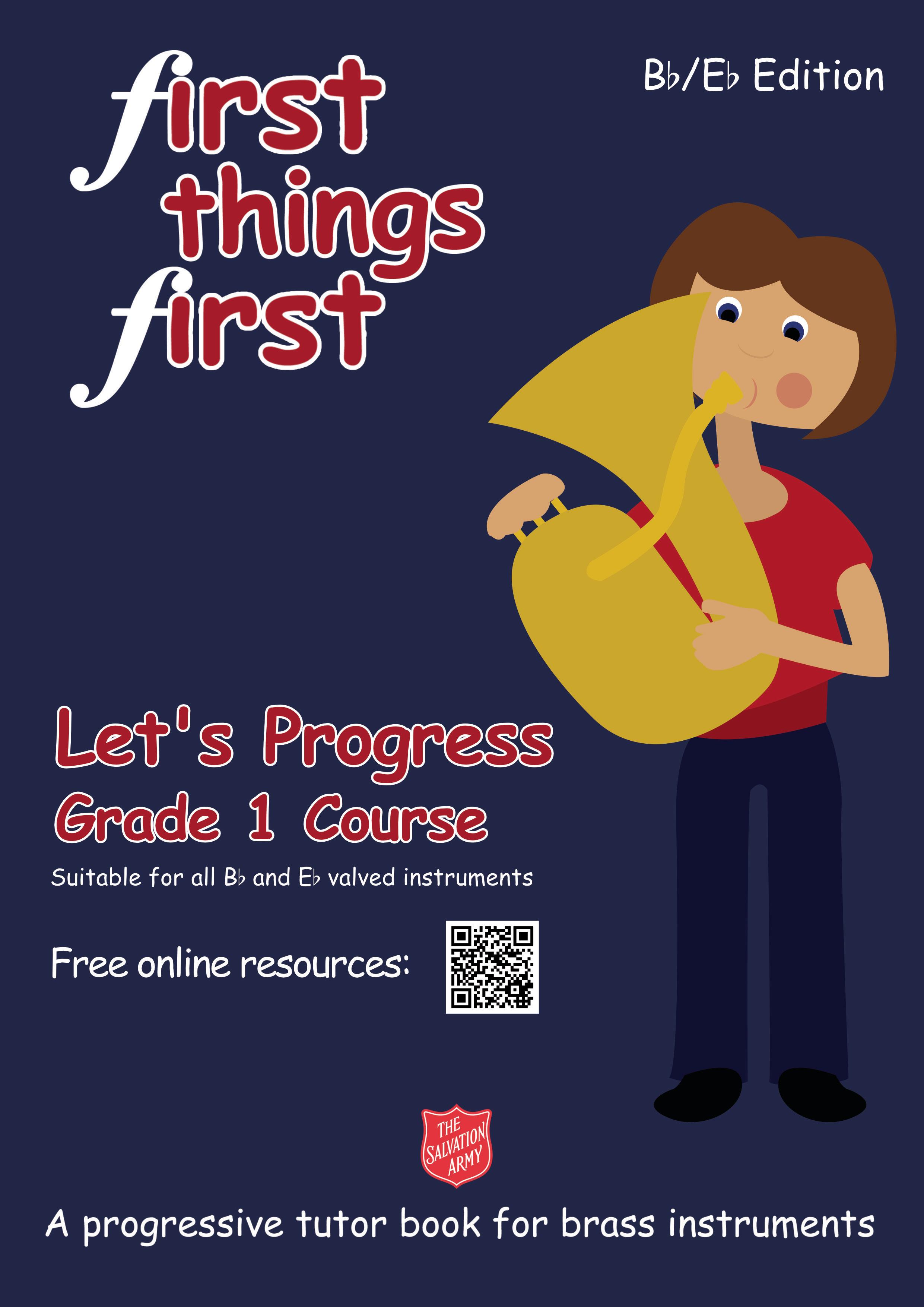
£4.99First Things First - Let's Progress (Grade 1 Course) Bb/Eb Edition
Let's Progress (Grade 1 Course) extends the range to middle C and sets out to provide beginners with the basic essentials, preparing them to tackle some of the challenges they will meet in their first experience of playing in a band.Includes link to downloadable resources including backing and demonstration tracks, online course assessment sheets and personalised course certificates.In this book you will meet:new notes, extending you rage both higher and lowernew rhythms, 3/4 timesharps, flats and key signaturesslurringquavers
Estimated dispatch 7-14 working days
-
 £40.00
Elemental (Score and Parts)
The opening number in Cory Band's 2015 'Four Elements' themed Brass in Concert programme, this piece sets out a mysterious introduction transporting us back to the time of the Greek Philosophers, after which it presents short musical depictions of Fire, Air, Water and Earth. Designed to start your concert with a bang.
Estimated dispatch 7-14 working days
-
 £44.95
Fantasy on Sempre Libera (Euphonium Solo with Brass Band)
During the 19th century the great instrumental virtuosi reined supreme. Pianists Liszt and Thalberg and violinists Paganini and Saraste amazed audiences with their wide-ranging technical and artistic abilities, fuelled by increasingly difficult paraphrases and variations on popular tunes of the day.The Fantasy on Sempre Libera looks back with affection to this period and provides an opportunity for present day euphonium virtuoso David Thornton to demonstrate the skills which mark him out as one of the world's finest players.
Estimated dispatch 7-14 working days
-
 £34.95
Judd: Salsalvation
In writing this piece I set out to emulate the sound of the Stan Kenton big band and music of that 'golden' era. The piece itself is based around two Salvation Army tunes that are associated with the word, 'salvation'; Steadily forward march! (T.B. 799) and Hark, hark, my soul (T.B.542).The music is intentionally flamboyant and requires a secure grasp of the style and rhythm to be successful. It was featured at the Belfast Temple Music School to great effect.Andrew Mackereth
Estimated dispatch 7-14 working days