
Results
-
 £164.99
Music of the Spheres (Brass Band - Score and Parts)
Music of the Spheres was commissioned by the Yorkshire Building Society Band and first performed by them at the European Brass Band Championships in Glasgow, May 2004. The piece reflects the composers fascination with the origins of the universe and deep space in general. The title comes from a theory, formulated by Pythagoras, that the cosmos was ruled by the same laws he had discovered that govern the ratios of note frequencies of the musical scale. ('Harmonia' in Ancient Greek, which means scale or tuning rather than harmony - Greek music was monophonic). He also believed that these ratios corresponded to the distances of the six known planets from the sun and thatthe planets each produced a musical note which combined to weave a continuous heavenly melody (which, unfortunately, we humans cannot hear). In this work, these six notes form the basis of the sections Music of the Spheres and Harmonia. The pieces opens with a horn solo called t = 0, a name given by some scientists to the moment of the Big Bang when time and space were created, and this is followed by a depiction of the Big Bang itself, as the entire universe bursts out from a single point. A slower section follows called The Lonely Planet which is a meditation on the incredible and unlikely set of circumstances which led to the creation of the Earth as a planet that can support life, and the constant search for other civilisations elsewhere in the universe. Asteroids and Shooting Stars depicts both the benign and dangerous objects that are flying through space and which constantly threaten our planet, and the piece ends with The Unknown, leaving in question whether our continually expanding exploration of the universe will eventually lead to enlightenment or destruction.Duration: 18:00
Estimated dispatch 7-14 working days
-
 £24.50
Christmas Jig - Naomi Styles
With a different take on the traditional Christmas medley, this jolly selection takes several well-known Christmas carols written in 6/8 time and puts them in the style of a gleeful jig. Featuring In Dulci Jubilo, On Christmas Night, I Saw Three Ships, Christ was Born on Christmas Day & Here we Come a-Wassailing, the piece is a great workout for the band, whilst audiences will struggle to remain still throughout in this lively piece.
In Stock: Estimated dispatch 1-3 working days
-
 £29.50
Run - Snow Patrol - Gavin Somerset
Very few songs covered by other artists are greeted with the same reception as Leona Lewis' cover version of this hit song. Whilst already a hit for Snow Patrol back in 2004, when Leona Lewis performed the song on BBC Radio One's 'Live Lounge', the DJ's and producers there on the day were reported to be tears. This highly emotional song lends itself well to the brass band sound and this arrangement by Gavin Somerset ensures your band can encapsulate audiences both on the bandstand and in the concert hall. The song's title may not be too familiar, however after just a few bars, the tune is instantly recognisable. A hit with the younger members of your band and one that people of all ages will know. A perfect addition to your concert programme and one that could see some of your audience singing!
In Stock: Estimated dispatch 1-3 working days
-
 £44.50
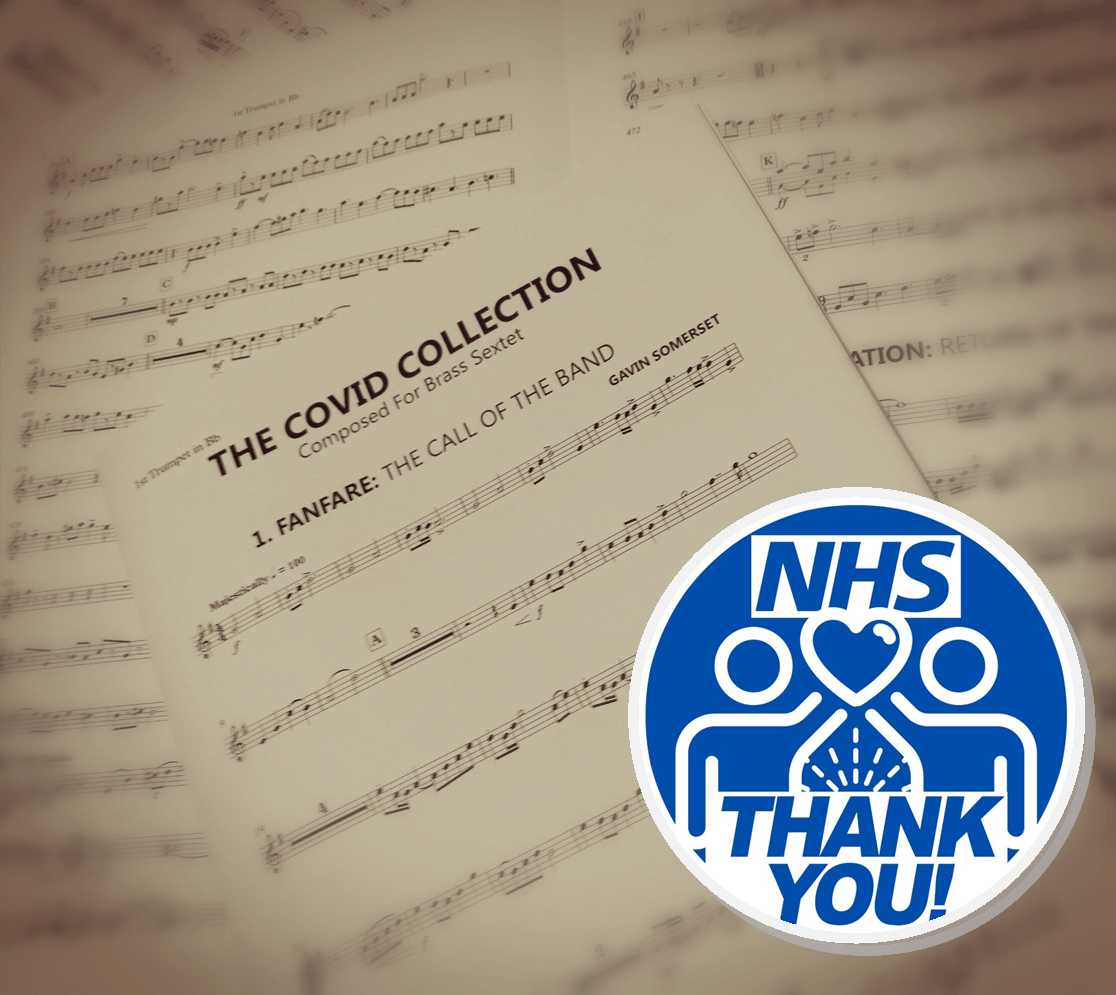
The Covid Collection - Gavin Somerset
This exciting new 22-minute concert suite for Brass Sextet has been composed during the months of lockdown charting the feelings of a nation, with seven movements playable by 6 (or more) players. The music was composed with the intention for players to perform either together live in a small group, in isolation by way of a virtual performance (downloadable backing tracks are available to play along to) and ultimately, to give players something to enjoy as we all miss our brass band families. This concert suite is the perfect addition to all bands' libraries at a time when rehearsals are limited. Several of the movements are already in preparation for a full band edition to be released at a later date: (also available as a digital download worldwide - purchase now & print to play). Bands purchasing this sextet edition will be eligible for a discount on the upcoming full brass band edition of the concert suite. ------------------------------------------------------------------------------------- Movement 1: FANFARE: The Call of the Band - CLICK HERE TO DOWNLOAD PLAYBACK TRACK This opening fanfare gives way to a full of life and energy. With catchy melodies and harmonies, it is an effective opening to any concert programme and the perfect way to begin the Suite. Movement 2: March of the Antibodies - CLICK HERE TO DOWNLOAD PLAYBACK TRACK A cheeky little number that keeps on fighting though. Whilst not a March in the traditional brass band sense, players should aim to give a 'happy' performance of this movement ensuring smiles all around for both performers and the audience.Movement 3: Solidarity - CLICK HERE TO DOWNLOAD PLAYBACK TRACK The first slow movement of the concert suite aims to reflect on the isolation many of us felt during the time of lockdown. However, during these times, walks out with loved ones allowed many to connect and enjoy downtime, not often afforded to many. Movement 4: Lazy Days - CLICK HERE TO DOWNLOAD PLAYBACK TRACK A movement whose title really does say it all. A laid back swing number that should be played in an as relaxed manner, as possible!Movement 5: Hymn for Carers (Dedicated to the NHS & Care Workers) - CLICK HERE TO DOWNLOAD PLAYBACK TRACK Dedicated to the NHS & Care Workers, this hymn tune is filled with emotional highs and lows, felt by many of the hospital and care staff who worked tirelessly to keep our people safe, with a timely nod at the end to Vera Lynn & our missed VE day commemorations. Movement 6: Army of the Keyworkers - CLICK HERE TO DOWNLOAD PLAYBACK TRACK A stirring work in 12/8 which rightfully, depicts our heroes who kept the country moving through the most difficult of times. An heroic number for players to enjoy.Movement 7: CELEBRATION: Return of the Band - CLICK HERE TO DOWNLOAD PLAYBACK TRACK Little needs to be said about this movement, as at this time of release, we cannot yet celebrate the return of all players to the band rooms across the country. However, when that time comes, this movement is to be played with the joy of normality we shall all feel. CLICK HERE TO DOWNLOAD THE FULL SUITE BACKING TRACK ------------------------------------------------------------------------------------- Each movement can be performed as a standalone item, or form part of the full 22-minute concert suite. Sextet scored for: x1 Cornet I in Bbx1 Cornet 2 in Bb1x Flugelhorn1x Tenor Horn in Eb1x Euphonium/Baritone in Bb1x Eb Bass*extra parts included are, Cornet parts in Eb & C, Horn in F, Euphonium/Baritone in BC, Trombone (TC and BC), BBb Bass in TC & Tuba in BC.
In Stock: Estimated dispatch 1-3 working days
-
 £24.50
Swanee River - Stephen Foster - Alan Beaumont
The song "Old Folks At Home" over the years has become better known by the lyrics of its first line (Way Down Upon The) Swanee River. The composer Stephen Foster (also known for songs such as "Oh! Suzanna" & "Jeanie With The Light Brown Hair") struggled to find the perfect river to fit his melody, until his brother suggested the "Suwannee" river in Southern Georgia/Northern Florida, although, Foster misspelled the name intentionally to fit the melody line. The song has been the official state song of Florida since 1935. This rousing arrangement by Alan Beaumont will take your audience on a foot tapping, lighthearted journey. With the melody featured in a variety of different styles, the comedy sounds of duck calls, car horns, sirens & other surprises will keep the audience (& players) on their toes. A wonderful addition to any bands library, not to be missed.
In Stock: Estimated dispatch 1-3 working days
-
 £29.50
The Wellerman - Traditional - Gavin Somerset
This traditional Whaling song went viral around the world on social media platform TikTok during the Covid-19 lockdown in early 2021. Starting with a lone voice, more and more singers & instrumentalists began adding their harmonies and improvisations to the melody until, there were literally hundreds of people all working together to create a global voice, including some big name celebrities. This release allows your band to recreate the viral hit and when back on stage, add your own choreography and optional singing with this shanty that has found a new appreciation amongst younger audiences and reflects the hard times many faced during the covid lockdown. To download the playback audio to play along to, please RIGHT CLICK HERE & Save As .
In Stock: Estimated dispatch 1-3 working days
-
 £76.99
On the Movieset - John Emerson Blackstone
Glitter and glamour, good-looking people, a lot of Bling Bling and fast cars images like these will cross our minds when we think of the movie world. However, reality proves to be different : as a rule, a tremendous amount of work will have been done on the set before a film is ready to be shown on the big screen. A visit to an actual movie set inspired John Emerson Blackstone to write a composition bearing the same name. He had both seen a number of characteristic attributes and heard the typical phrases used in film making, and he incorporated them into 'On the Movie Set' . In the first part, 'The Clapboard', a 'director's assistant' is supposed to shout "Quieton the set'" and "Action!", as is done before a real scene is shot. Subsequently, in order to create the right atmosphere, the clacking of a 'Clapboard' should be heard. During a romantic scene we should be transported to another world by means of sweet sounds in the background, so romantic music is of course heard in the next part, 'Love Scene'. At the end of a long working day 'It's a wrap' is called on the set to inform everyone that the filming on that day is completed. Now there is only one more thing left to dream of : an Oscar..... Perf. Note: The use of the right props will add to the performance and appreciation of 'On the Movie Set'. A red carpet and a glamorous reception should give your audience the feeling they are attending a real 'opening night'!
Estimated dispatch 5-14 working days
-
 £76.99
Variations on Shalom Chaverim - Andreas Ludwig Schulte
Shalom Chaverim is an ancient Hebrew (farewell)song, which was originally sung at the end of a celebration or meeting. It was and is mostly sung as a round. Freely translated the words mean "Goodbye, friends, goodbye and see you again!". The varying moods at a parting have been captured very well by Andreas Schulte in his arrangement 'Variations on Shalom Chaverim'. The composer himself says about the song, 'Although the melody is in a minor key, the overall atmosphere in the song is positive. one wishes each other all the best. Saying goodbye, however, also hurts. When you slow down the pace of the melody and add 'blue notes' in the harmonies, this can be sensed immediately.'Schulte refers here to the first variation. The second variation is very intense with possibly even deeper-felt emotions. 'Variations on Shalom Chaverim' ends on a cheerful and positive note, in fast tempo, and with oriental elements in the melody: 'L'hitra'ot, Shalom' (See you again, and farewell!).
Estimated dispatch 5-14 working days
-
 £29.50
The Land Before Time - James Horner - Gavin Somerset
The music of James Horner is known around the world for his strong, heart-warming melody lines that featured in such films at 'Titanic' and 'An American Tail'. Released in 1988, 'The Land Before Time' was made by the same film creators of 'An American Tail' and so, James Horner and Will Jennings were the obvious choice to create the movie's soundtrack, following the success of 'Somewhere Out There' (from 'An American Tail'). They didn't disappoint, and the main title track 'If We Hold On Together' became a success both on the screen and off when it was released as a single by Diana Ross in 1989. Now arranged by Gavin Somerset, this release will take a generation back in time to the story of Littlefoot, who embarks upon journey with 4 friends as they search for the Great Valley. A great item for all bands
In Stock: Estimated dispatch 1-3 working days
-
 £53.50
On a Roll - Oliver Waespi
The title of this piece reflects its upbeat, forward-driven character. It starts out with a soul groove, carrying a prominent theme which invites players and listeners to dance. The slower middle section features a blues with optional solo parts. After the return of the soul beat, the piece concludes with a striking reaffirmation of the initial theme. On a Roll may be performed as an effective opener or as an upbeat rhythm item during a concert or contest. On a Roll was commissioned by the Zurcher Blasmusikverband for the Zurcher Kantonalmusikfest 2024 in Urdorf/Schlieren, Switzerland.
Estimated dispatch 5-14 working days
 View Music