
Results
-
 £34.95
Sirocco - Darrol Barry
Published posthumously, Sirocco is a lively duet for Flugel Horn and Tenor Horn. Cast in ternary form, and consisting of rhythmic Brioso outer sections and a contrasting bluesy central section, the piece takes its name from the Mediterranean wind that...
Estimated dispatch 5-7 working days
-
£40.00
Creative Dreams - Matthew Hall
Creative Dreams was written for the opening of the new Abraham Darby Academy in Telford, Shropshire. This jubilant piece can be performed as a Brass Band work, a Wind Orchestra work, or the forces can be combined.
Estimated dispatch 5-7 working days
-
 £60.99
Canterbury Chorale (Brass Band - Score and Parts) - Van der Roost, Jan
This quiet piece with its broad tones was originally written for brass band on request of Robert Leveugle, chairman of the composer's own band: Brass Band Midden Brabant (Belgium). The direct cause was a visit to the beautiful cathedral of the English city Canterbury, in which so many fine compositions sounded throughout the centuries. Later on, Jan Van der Roost rescored this piece for symphonic wind band, exploring the full richness of colours of this formation. Besides solo phrases for several instruments, there are some massive tutti passages making the wind orchestra sound like a majestic organ. By the way: an "ad libitum" organ part adds an extra richness, colour and power to this piece, making it sound even more broad and grand.Duration: 6:30
Estimated dispatch 7-14 working days
-
 £19.99
Elegy (Brass Band - Score and Parts) - Hesketh, Kenneth
Elegy is a consortium commission in celebration of the 75th birthday of the distinguished wind band conductor Timothy Reynish. The music derives from a youthful symphony written when Hesketh was 16, the same source as his popular Masque. Full of big tunes and bitter-sweet harmonies, Elegy is a heartfelt thank you to a conductor who has done more than most to widen the vision of the wind orchestra movement.Suitable for 1st Section Bands and aboveDuration: 7.00
Estimated dispatch 7-14 working days
-
 £55.00
New York (from East Coast Pictures) (Brass Band - Score and Parts) - Hess, Nigel - Littlemore, Phillip
For anyone who is familiar with this bizarre and wonderful city, this piece needs no explanation. New York is the third movement of East Coast Pictures, originally written for wind band, commissioned in 1985 by the British Youth Wind Orchestra with funds from National Westminster Bank plc. These three short 'pictures' were inspired by several visits by the composer to a small part of the USA's East Coast, an area that provides great extremes in the geography and the people. Suitable for Premier Youth/2nd Section Bands and above. Duration: 6.00
Estimated dispatch 7-14 working days
-
 £64.95
Dance Spirit (Brass Band - Score and Parts) - Wiffin, Rob
Dance Spirit is a three movement suite of dances comprising Stomping Dance, Waltz Interlude and Duende linked by solo dancer cadenzas. It started life as the wind band piece Spirit of the Dance. In it I attempted to capture some of the elements of this most fundamental of human activities, the urge to move our bodies to the rhythm of the music. In re-working it for brass band I extended the duration of the Waltz Interlude and increased the technical level in some areas with the intention of making it a suitable test piece.Stomping Dance - The suite starts with perhaps the most basic dance feeling, the desire to stomp our feet to the music, unrefined, no knowledge of steps needed. The heavy stomp is not always present in the music here, and sometimes you can sense the dancers trying something a little more refined, but it is always lurking in the background, ready to draw us back to the elemental rhythm of the beat.Waltz Interlude - Of course, dance does not always have to have heat, it can be elegant and restrained, emphasising fluidity of line and movement. In the waltz it is occasionally suspended by the held poses before the motion starts again. Unlike the outer movements, the Waltz Interlude is cool, danced in moonlight rather than under the sun. The two dancers sometimes move as one and at other times the man provides a frame for the more intricate arabesques of his partner.Duende - During my time living in Spain I went to watch some flamenco dancing. I was expecting the normal tourist cliches but the dancers were serious students of Flamenco Nuevo y Viejo (new and old). They performed with passion to some pounding asymmetric rhythms and their performance was the inspiration for Duende. Duende as a term is hard to define. It is a spirit of performance - that moment when you are right in the middle of the creative spirit of the music. It is about soul and a heightened state of emotion. Federico Garcia Lorca wrote: I have heard an old maestro of the guitar say, The duende is not in the throat; the duende climbs up inside you, from the soles of the feet. Meaning this: it is not a question of ability, but of true, living style, of blood, of the most ancient culture, of spontaneous creation.- Rob WiffinDuration: 13.45
Estimated dispatch 7-14 working days
-
 £80.00
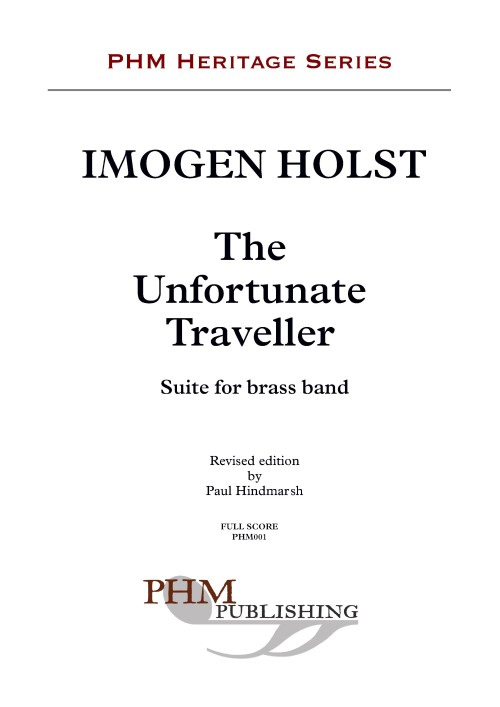
The Unfortunate Traveller (Brass Band - Score and Parts) - Holst, Imogen - Hindmarsh, Paul
Imogen Holst (1907-1984) submitted The Unfortunate Traveller (1929) as her final work as a student portfolio at the Royal College of Music, where her composition teacher was Gordon Jacob. The title was taken from Thomas Nashe's famous 1594 picaresque novel of the same title. The Suite was first performed on 12 February 1933 at her Majesty's Theatre, Carlisle, by the St. Stephen's Band, with the composer conducting. Te concert was given in memory of Holst's uncle, Dr. H.A. Lediard. Holst had been impressed with the band's performance of his A Moorside Suite at the 1928 National Brass Band Championships (The Crystal Palace, South London) and was keen to work with them. Writing in Imogen Holst, a life in music, Christopher Grogan indicates that it was Gustav Holst's suggestion to include his daughter's work in the programme, quoting Imogen Holst's remarks made in interview to The Daily Mail as follows: "....it is the first time, so far as I know, that a woman has conducted a brass band at a public concert....It has been a delight to rehearse the St. Stephen's Band. It was their performance at the Crystal Palace Festival that inspired me to write this Suite, which I have dedicated to them."Imogen Holst accompanied her father to the Crystal Palace in 1928 to hear the performances of A Moorside Suite, and was so excited by the played and, audibly, by her father's music that she decided to write a brass band piece for her final examination. Te result was The Unfortunate Traveller (1929). However, it was not possible for her to present a brass band work for examination. She arranged it for string orchestra so that it could be played before she left the RCM in July 1930. Following the premiere of the original in 1933, the manuscripts did not resurface until 1969 Imogen found them among her late mother's effects. Although she requested score and parts be destroyed, they ended up in the possession of Manchester composer John Golland, who marked up the score presumably with the intention of creating a new performing edition. The original scoring reveals a lack of experience with what can be a tricky medium.With the agreement of the Holst Foundation, a revised edition, with additional percussion, was prepared in 2011 since when the work has been fortunate to travel round the world as a concert and contest piece. The original includes drums in the March only. The title was taken from Tomas Nashe's famous 1594 picaresque novel of the same title. Several Morris Dance tunes are introduced during the course of the four short movements, including Bonnie Green Garters, Shepherd's Hey, The Rose and The Wind Blaws Cauld. Quirky twists and turns of harmony and spirited rhythms that remind us how much Imogen Holst loved tradition English dance music.In September 2025, I made a performing edition of the composer's arrangement for string orchestra. The manuscript lacks the final movement, which I arranged in a similar style, ie. without extending the upper ranges. Making this edition raised some issues regarding the accuracy of my band version and some of the solutions I used to smooth out the voicing. I have used the composer's second thoughts to refine my performing edition and to correct a textual errors.- Paul HindmarshDuration: 10.00
Estimated dispatch 7-14 working days
-
£40.00
The Unfortunate Traveller (Brass Band - Score only) - Holst, Imogen - Hindmarsh, Paul
Imogen Holst (1907-1984) submitted The Unfortunate Traveller (1929) as her final work as a student portfolio at the Royal College of Music, where her composition teacher was Gordon Jacob. The title was taken from Thomas Nashe's famous 1594 picaresque novel of the same title. The Suite was first performed on 12 February 1933 at her Majesty's Theatre, Carlisle, by the St. Stephen's Band, with the composer conducting. Te concert was given in memory of Holst's uncle, Dr. H.A. Lediard. Holst had been impressed with the band's performance of his A Moorside Suite at the 1928 National Brass Band Championships (The Crystal Palace, South London) and was keen to work with them. Writing in Imogen Holst, a life in music, Christopher Grogan indicates that it was Gustav Holst's suggestion to include his daughter's work in the programme, quoting Imogen Holst's remarks made in interview to The Daily Mail as follows: "....it is the first time, so far as I know, that a woman has conducted a brass band at a public concert....It has been a delight to rehearse the St. Stephen's Band. It was their performance at the Crystal Palace Festival that inspired me to write this Suite, which I have dedicated to them."Imogen Holst accompanied her father to the Crystal Palace in 1928 to hear the performances of A Moorside Suite, and was so excited by the played and, audibly, by her father's music that she decided to write a brass band piece for her final examination. Te result was The Unfortunate Traveller (1929). However, it was not possible for her to present a brass band work for examination. She arranged it for string orchestra so that it could be played before she left the RCM in July 1930. Following the premiere of the original in 1933, the manuscripts did not resurface until 1969 Imogen found them among her late mother's effects. Although she requested score and parts be destroyed, they ended up in the possession of Manchester composer John Golland, who marked up the score presumably with the intention of creating a new performing edition. The original scoring reveals a lack of experience with what can be a tricky medium.With the agreement of the Holst Foundation, a revised edition, with additional percussion, was prepared in 2011 since when the work has been fortunate to travel round the world as a concert and contest piece. The original includes drums in the March only. The title was taken from Tomas Nashe's famous 1594 picaresque novel of the same title. Several Morris Dance tunes are introduced during the course of the four short movements, including Bonnie Green Garters, Shepherd's Hey, The Rose and The Wind Blaws Cauld. Quirky twists and turns of harmony and spirited rhythms that remind us how much Imogen Holst loved tradition English dance music.In September 2025, I made a performing edition of the composer's arrangement for string orchestra. The manuscript lacks the final movement, which I arranged in a similar style, ie. without extending the upper ranges. Making this edition raised some issues regarding the accuracy of my band version and some of the solutions I used to smooth out the voicing. I have used the composer's second thoughts to refine my performing edition and to correct a textual errors.- Paul HindmarshDuration: 10.00
Estimated dispatch 7-14 working days
-
£89.95
Infinity (Brass Band - Score and Parts) - Redhead, Robert
In the post-modern age in which we live, 'absolutes' are difficult for many to comprehend. Yet infinity, which means absolute, total, all-embracing, having no limits or boundaries in time, space, extent, or magnitude, has always been central to the Christian's concept of God.Through the ages, as human understanding has grown, particularly at a remarkable rate from the latter part of the twentienth century, Christianity has been continually challenged to interpret traditional beliefs in the light of new discoveries, but always within the reality of the infinite Being. In addition, scripture tells us that 'humanity was made in God's image'. Humankind is part of God's creation and as such, responsible for its upkeep. Such a commission has never been more relevant than in this present age. Psalm 8 creates a great picture of the majesty, eternal, infinte quality of God and yet reveals the desire of God to share in spirit with humankind. It recognises humankind as being, not a tool of the infinite, but as a creative contributing part of the ongoing movement and activity of the infinite. The music is deliberately melodic in context, creating a sense of unity with the infinite, in tandem with the varying expressions of individuality. It is not based on the Psalm but reflects some of the sentiments lying therein. The 'hymn-like' theme expresses the nature of the Divine using the Old Testament image of the infinite God coming to finite humankind, not in the 'wind', the 'earthquake', the 'fire', but in the 'still small voice' of quietness (1 Kings 19: 11-13). The ensuing musical development, in different styles and patterns, expresses this continual link between infinite and finite. Thus the conclusion, rather than being a symbol of might, power and magnificence, reflects the same sentiment as the opening.
Estimated dispatch 7-14 working days
-
£44.95
Infinity (Brass Band - Score only) - Redhead, Robert
In the post-modern age in which we live, 'absolutes' are difficult for many to comprehend. Yet infinity, which means absolute, total, all-embracing, having no limits or boundaries in time, space, extent, or magnitude, has always been central to the Christian's concept of God.Through the ages, as human understanding has grown, particularly at a remarkable rate from the latter part of the twentienth century, Christianity has been continually challenged to interpret traditional beliefs in the light of new discoveries, but always within the reality of the infinite Being. In addition, scripture tells us that 'humanity was made in God's image'. Humankind is part of God's creation and as such, responsible for its upkeep. Such a commission has never been more relevant than in this present age. Psalm 8 creates a great picture of the majesty, eternal, infinte quality of God and yet reveals the desire of God to share in spirit with humankind. It recognises humankind as being, not a tool of the infinite, but as a creative contributing part of the ongoing movement and activity of the infinite. The music is deliberately melodic in context, creating a sense of unity with the infinite, in tandem with the varying expressions of individuality. It is not based on the Psalm but reflects some of the sentiments lying therein. The 'hymn-like' theme expresses the nature of the Divine using the Old Testament image of the infinite God coming to finite humankind, not in the 'wind', the 'earthquake', the 'fire', but in the 'still small voice' of quietness (1 Kings 19: 11-13). The ensuing musical development, in different styles and patterns, expresses this continual link between infinite and finite. Thus the conclusion, rather than being a symbol of might, power and magnificence, reflects the same sentiment as the opening.
Estimated dispatch 7-14 working days
 View Music