
Results
-
 £15.99
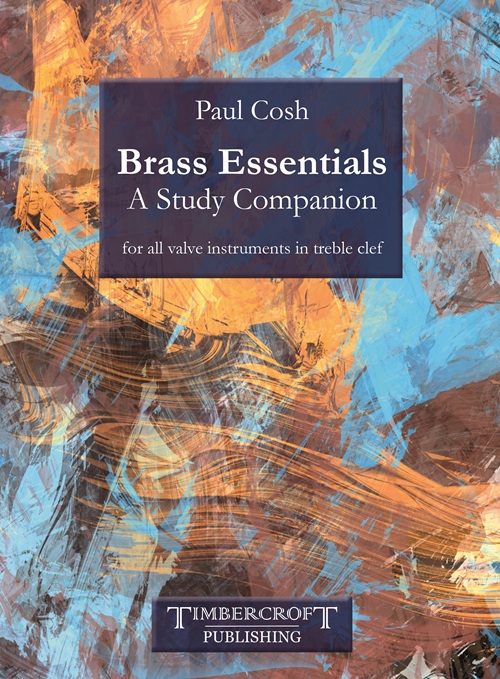
Brass Essentials - An Study Companion (for all valve instruments in treble clef)
This book of 32 studies has been drawn from those Paul Cosh used as a student at the Royal Academy of Music, throughout his years as a professional player and as a teacher at the Guildhall School of Music & Drama.The studies are divided into four main sections: Articulation, Finger Technique, Lyrical & Flexibility and Stamina & Technique and are drawn from those written by Arban, Charlier, Boehme, Brandt, Kopprasch and Sachse. Some of the studies have been re-imagined and edited to include new tempi and expression.There are helpful tips at the start of each section with most of the studies given suggested practice and performance tempi, although these are just a guide. Slow practise of the highly technical passages is vital to adhere to the overriding principle that every note counts.The Brass Essentials Study Companion can also work in conjunction with both the Brass Essentials: Arban Companion and the Brass Essentials: Practice Companion to vary your practice diet.
Estimated dispatch 7-14 working days
-
 £38.95
Unity Series Band Journal - Numbers 534 - 537, October 2024
534: Boldly Going (Wycliffe Kortin)This arrangement is derived from a Kenyan Swahili gospel melody Simama Imara, which means 'to stand firm'. The song is an encouragement to Christians to stay strong in the Lord, even in times of difficulty. The piece has a lively rock feel which requires precision in articulation and a sense of drive throughout.535: Fill me anew (Mark Feltwell)The melody Fill me anew (T.B. 611) has always been a favourite of the composer and this composition was used at the Worchester Corps in their Pentecost services. It is a simple melody with a simple purpose and associated prayer that is the focus of the piece, 536: There's something about that name (William Gaither arr. Kingsley Layton)The chorus (S.A.S.B. 80) from which this piece takes its title was composed by Bill and Gloria Gaither. They wrote it in 1970, having watched their grandparents near the end of their lives and pass away. At the same time, they were, as a couple, embracing parenthood. It resonated with them how the young loved to say the name of Jesus as well as those that were nearing the end of their lives. The chorus reflects the peace and comfort which comes to us when we call on that name during both the good and challenging times in life. The Gaithers are a performing and songwriting couple who have become well-known within the Southern Gospel music genre.537: Selection - Singing Praises! (Noel Jones)A motif, based on the phrase 'Praise him!, Praise him!, Ever in joyful song', appears throughout the selection. Songs also featured include I love to sing of the Saviour (S.A.S.B. 845) and Singing glory, glory, Glory be to God on high (S.A.S.B. 840)
Estimated dispatch 7-14 working days
-
 £44.95
Desire (Brass Band - Score and Parts)
The premise of this piece is the portrayal of the contrasting nature of our desires. The emotions and images depicted within the music reflect the imperfections of humanity - each one of us.The piece opens with the 'desire' theme, the middle section is prayerfully and almost silently with Move, Holy Spirit! Move in my life! (S.A.S.B. 325) quietly referenced in the closing moments of this section. The piece closes with a united proclamation of this powerful chorus, 'Lord, I give you my heart, I give you my soul; I live for you alone' (S.A.S.B. 397).
Estimated dispatch 7-14 working days
-
 £34.95
Trusting Faith (Euphonium Solo with Brass Band - Score and Parts)
This piece is based on the melody Faith is the victory (T.B. 128) and throughout the solo we follow a person's journey of faith. In the first movement, the bold and confident opening depicts a seemingly strong and certain faith, although perhaps a little naive and immature. The music suggests that if we are certain enough, then we will see our prayers immediately answered and will witness miracles. But what happens when we don't see those miracles happen, or our prayers seem unanswered? Doubt creeps in and the music quickly becomes a full struggle continuing through to the end of the moment.What do you do when you faith amounts to something other than what you thought it to be? The beginning of the second movement reflects this questions and starts hesitantly and full of doubt. Soon, a new melody is introduced, Trusting as the moments fly (T.B. 263). The words of the chorus remind us that true faith should bot be affected by fears or disappointments, that our trust in God should remain. Realising that a faith that holds firm, though being tested over time, becoming deeper and stronger, is a liberating truth. We no longer need to struggle in our strength alone, but can lean on God instead.When we lean on God, reset in his care, and feel. safe in his hands, then faith has really become our victory. We will then become strong disciples who can meet life's various challenges without wavering or being afraid. This is depicted in the final movement of the solo when both melodies, whose messages complement each other, are woven together in an explosive finale.
Estimated dispatch 7-14 working days
-
 £40.00
A Song for Bram (Brass Band - Score and Parts)
A Song for Bram is a short work, originally composed piano and brass band, and is dedicated to the memory of Bramwell Tovey, a close friend and colleague of the composer, and a conductor, composer, pianist and musician of huge talent, who sadly passed away before his time in the summer of 2022. In this short piece the composer has tried to imagine what kind of tune Bram would have improvised at the piano, something he frequently engaged in. No doubt it would have been a mixture of bluesy jazz, hymn tune, and love song, and this is how the solo piano takes off. In the middle section of a what is a simple tertiary structure, introduced are quotes from two hymn tunes Bram particularly loved, never having forgotten his Salvation Army roots. Bram's 'Song' returns, this time on a plaintive flugelhorn horn, and which reaches a climax with the full band before receding, literally, into the distance.....(to a new life beyond?).Duration: 6.00
Estimated dispatch 7-14 working days
-
 £77.00
General Series Brass Band Journal, Numbers 2230 - 2233, April 2023
2230: Prelude on 'Ascalon' (Geoffrey Nobes)This prelude was written for the Band of the Free Evangelical Church of Geisweid in Germany. The beautiful hymn tune Ascalon is heard in two complete statement, a free-flowing lyrical section followed by a contrasting section using the phrases of the melody to build to a full final working of the hymn.2231: Salt and light (Mark Feltwell)This original work follows the journey of someone who is finding their way through faith. Using inspiration from Shine, Jesus, Shine and Matthew 5:14, the journey ends with a triumphant fanfare.2232: Hymn Tune Arrangement - Esher (Dudley Bright)A two verse setting of the well know benediction, God be in my head.2233: Song Arrangement - The heart of worship (David Mills)The song The heart of worship (S.A.S.B. 635) speaks of the need to worship without any barriers or obstacles.
Estimated dispatch 7-14 working days
-
 £44.95
Glorified (Brass Band - Score and Parts)
Glorified was composed for the Canadian Staff Band's 50th Anniversary celebrations. This work is based on two tunes, Lord, be glorified (T.B. 738), a significant song at Canada's Territorial Music School over the years, and Great is thy faithfulness (T.B. 641). This song celebrates and signifies God's faithfulness to all associated with the Canadian Staff Band, and the commitment shown by its members through the years.The first half of the work harkens back to those members of the band who tragically perished in the early days on RMS Empress of Ireland, which was en route to England for the 1914 International Congress when it was struck by another vessel and sank. The rhythmic ostinatos heard represent the passing of time over the years. After the somewhat dark introduction, the music settles into a reflective rendition of In my life, Lord, be glorified (S.A.S.B. 593), before bursting into a rhythmic and jagged mixed-metre section. A yearning elegy pays tribute to those who lost their lives.The second half of the piece is celebratory in nature and commemorates the reformation of the band and the rich history which has ensued in the subsequent years. The rhythmic energy found in this section builds to a majestic presentation of the tune Lord, be glorified, which leads into the return of Great is thy faithfulness but in an optimistic fashion.
Estimated dispatch 7-14 working days
-
 £29.95
Lead, Kindly Light (Brass Band - Score and Parts)
This beautiful hymn is one of trust and faith, building in confidence 'till the night is gone.' This arrangement follows that line of confidence. The melody begins unaccompanied, which is to say 'alone', and the eventual accompanying voices enter sombrely. Instead of a traditional final cadence, the 'leading of the light' continues, using the first four notes of the hymn as a motif that leads to a second, more positive statement of the melody, underscored by a walking motion. The positivity grows and lasts through a final grand statement of the hymn. A short meditative coda follows, and the arrangement ends with a solo note of reflection.
Estimated dispatch 7-14 working days
-
 £55.00
Triumph Series Brass Band Journal, Numbers 1339 - 1342, July 2022
1339: Fanfare on 'O come, all ye faithful' (Steve Kellner)The music follow the story of the shepherds as told in Luke 2: 8-20. It first portrays the majestic announcement of Jesus' birth by the heavenly host, then the hushed mystery of the manger scene, followed by the shepherds boisterously glorifying and praising God.1340: In his light (Niels Silfverberg)This is a Bozza Nova setting of the song O soul, are you weary and troubled? by Helen Howarth Lemmel..1341: Merrily on high (Craig Stevens)This bright and energetic setting of the well-know and widely used carol will be well-received by many groups who need an attractive and relatively easy piece to prepare for the festive season.1342: March - Promises (William Gordon)This march features two well-known hymns, Standing on the promises of Christ my King (S.A.S.B. 522) and Holy, holy, holy, Lord God Almighty! (S.A.S.B. 31) set to John Bacchus Dykes' melody Nicaea.
Estimated dispatch 7-14 working days
-
 £45.00
A Song for Bram (Piano Solo with Brass Band - Score and Parts)
A Song for Bram is a short work, originally composed piano and brass band, and is dedicated to the memory of Bramwell Tovey, a close friend and colleague of the composer, and a conductor, composer, pianist and musician of huge talent, who sadly passed away before his time in the summer of 2022. In this short piece the composer has tried to imagine what kind of tune Bram would have improvised at the piano, something he frequently engaged in. No doubt it would have been a mixture of bluesy jazz, hymn tune, and love song, and this is how the solo piano takes off. In the middle section of a what is a simple tertiary structure, introduced are quotes from two hymn tunes Bram particularly loved, never having forgotten his Salvation Army roots. Bram's 'Song' returns, this time on a plaintive flugelhorn horn, and which reaches a climax with the full band before receding, literally, into the distance.....(to a new life beyond?).Duration: 6.00
Estimated dispatch 7-14 working days