
Results
-
 £37.35
Polonaise from 'Scenes de Ballet' (Brass Band) Glazunov arr. Rob Bushnell
Alexander Glazunov was a Russian composer who was a gifted musician from childhood. He was seen as the natural heir to the nationalist revolution that had started with the Mighty Handful. Despite quickly turning from this to absolute forms of music, taking a keen interest in ballet music, his compositions still alludes to Russian folk tunes. He wrote four dance compositions, of which Scenes de Ballet was the first in 1894. The suite Scenes de Ballet, opus 52 has eight movements and was dedicated to the orchestra of the Russian Opera, St Petersburg. First performed in 1895 at a concert of the Imperial Music Society with Glazunov conducting. This arrangement of the final movement is for the British-style brass band, with alternative parts for horns in F and bass-clef lower brass. A recording of the original composition can be found here: https://www.youtube.com/watch?v=BS-Yx-bmxPg Duration: approx. 5.20 minutes Difficulty Level: 2nd Section + PDF download includes parts and score. Sheet music available at www.brassband.co.uk (UK) or https://satradecentral.org (USA) Instrumentation: Soprano Cornet Eb Solo Cornet Bb Repiano Cornet Bb 2nd Cornet Bb 3rd Cornet Bb Flugel Horn Bb Solo Horn Eb 1st Horn Eb 2nd Horn Eb 1st Baritone Bb 2nd Baritone Bb 1st Trombone Bb 2nd Trombone Bb Bass Trombone Euphonium Bb Bass Eb Bass Bb Timpani Percussion 1 - Snare Percussion 2 - Triangle, Cymbal & Bass Drum
In Stock: Estimated dispatch 1-3 working days
-
 £30.00
Deus in Adjutorium
DescriptionMonteverdi's Vespro della Beata Vergine (Vespers for the Blessed Virgin) is a musical setting by Claudio Monteverdi of the evening vespers on Marian feasts, scored for soloists, choirs, and orchestra. It is an ambitious work in scope, style and scoring, and has a duration of around 90 minutes. Published in Venice with a dedication to Pope Paul V dated 1 September 1610 as Sanctissimae Virgini Missa senis vocibus ac Vesperae pluribus decantandae, cum nonnullis sacris concentibus, ad Sacella sive Principum Cubicula accommodata ("Mass for the Most Holy Virgin for six voices, and Vespers for several voices with some sacred songs, suitable for chapels and ducal chambers"), it is mercifully regularly shortened to Monteverdi's Vespers of 1610.Monteverdi was born and spent the first part of his working life in Cremona before moving to Mantua (where he composed the Vespers) and finally attaining one of the top jobs in Italian renaissance music as Maestro di Capella at the Basilica di San Marco in Venice. He is most famous for his vocal music, notably his madrigals and the earliest surviving opera, Orfeo.Watch a preview video of the brass band score below:
Estimated dispatch 7-14 working days
-
 £33.62
Nessun Dorma (Trombone Solo with Brass Band) Puccini arr. Ian Jones
This trombone solo with brass band was arranged by Ian Jones for Ronald Prussing, principal trombone of the Sydney Symphony Orchestra, for a recording with the Melbourne Staff Band. Nessun Dorma is an aria from the final act of Puccini's opera Turandot. It is one of the best loved of all Puccini's arias. To view a follow-the-score video featuring Ronald Prussing performing the solo with the Melbourne Staff Band, please visit www.youtube.com/watch?v=n9fREiH41sQ Sheet music available from: UK - www.brassband.co.uk USA - www.solidbrassmusic.com Instrumentation: Trombone Soloist Bb Soprano Cornet Eb Solo Cornet Bb 1st Cornet Bb 2nd Cornet Bb Flugel Horn Bb Solo Horn Eb 1st Horn Eb 2nd Horn Eb 1st Baritone Bb 2nd Baritone Bb 1st Trombone Bb 2nd Trombone Bb Bass Trombone Euphonium Bb Bass Eb Bass Bb Timpani Percussion
In Stock: Estimated dispatch 1-3 working days
-
 £29.95
El Torero - Jonathan Bates
DURATION: 4'00". DIFFICULTY: 3rd Section+. 'El Torero' was commissioned by the Elland Silver Youth Band for their appearance at the 2019 Brass in Concert Youth Championships, held at The Sage, Gateshead. 'Torero' is the generic term referring to any individual who takes part in bullfighting on foot, with this definition acting as an umbrella term for all ranks of Matador (whom often might sit on a horse for the fight). It also acts as the modern-day alternative to the popular 'Toreador', popularized by Bizet in his opera, 'Carmen'. . 'El Torero' paints every aspect of a bullfight, from the cautios and steady entrance into the bullring, the wild frenzy of the bullfight and ultimately the grandioso conclusion as the bull is slain and the Torero rises victorious. .
In Stock: Estimated dispatch 1-3 working days
-
 £32.00
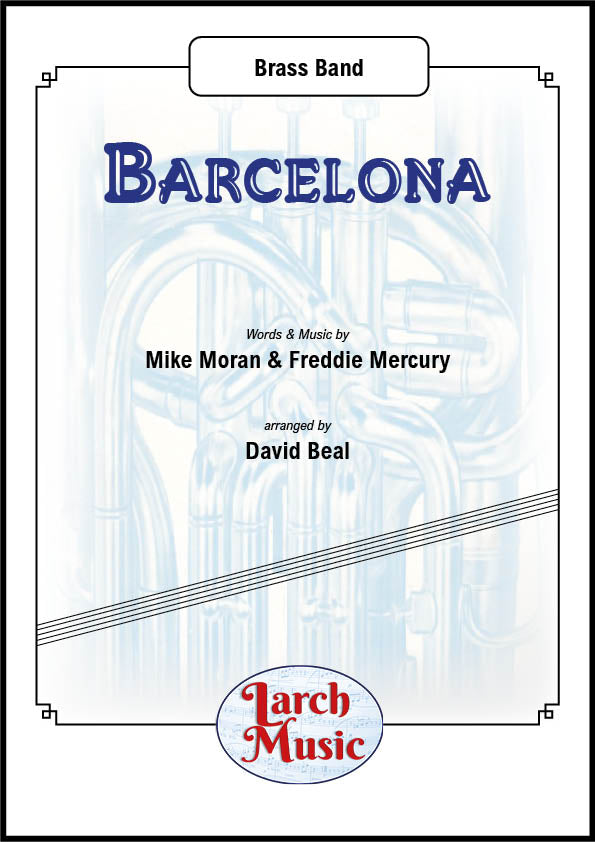
Barcelona - Vocal Duet or Cornet & Euphonium - Brass Band Sheet Music Full Score & Parts - LMAM054
COMPOSER: Mike Moran & Freddie MercuryARRANGER: David Beal"Barcelona" is a single released by Queen vocalist Freddie Mercury and operatic soprano Montserrat Caballe. A part of their collaborative album Barcelona, it also appeared on Queen's Greatest Hits III. The song reflects Mercury's love of opera with his high notes and Caballe's operatic vocals, backed by a full orchestra. Originally released in 1987, it was one of the biggest hits of Mercury's solo career, reaching number eight in the UK singles chart. After Mercury's death in 1991, it was featured at the 1992 Summer Olympics. The single was re-issued on 20 July 1992, after which the track climbed even higher, peaking at number two in the UK, the Netherlands and New Zealand. In 2004, BBC Radio 2 listed Barcelona at number 41 in its Sold On Song Top 100.Scored here for British Brass Band.
In Stock: Estimated dispatch 3-5 working days
-
 £62.00
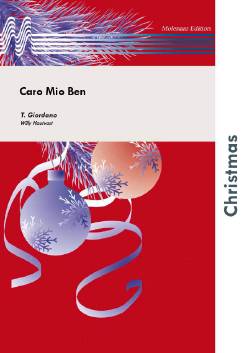
Caro Mio Ben - T. Giordano/Willy Hautvast
Here we have one of the most famous 'Arie antiche' (ancient aria's) from the 18th century, written in the style of Handel. For many years it has been attributed to Giuseppe Giordani, opera and sacred music composer of the Neapolitan school. However, recent investigations clearly established that this song had actually been composed by his son Tommaso (1733-1806). This delicate wind band arrangement by Willy Hautvast can also be performed with a vocal soloist or a mixed choir.
Estimated dispatch 10-14 working days
-
 £30.00
Fantasia on themes by Purcell - Ian Shepherd
Fantasia consists of three distinct sections that use thematic material from three separate pieces by Henry Purcell. The first section is based on the march from Funeral Music for Queen Mary which is dramatically dark and powerful but also uplifting. The Second section uses the devastatingly beautiful aria Dido's Lament or When I am laid in earth from the opera Dido and Aeneas as its basis and builds to enormous proportions, unlike the original aria. The third section begins with a haunting reference to the Rondo from Abdelazer. Gradually, this builds towards an exciting re-statement of the theme in the first section to the finale.
-
£45.00
Barcelona - Mercury & Moran - Harper, P
'Barcelona' was one of the biggest hits of Freddie Mercury's solo career. Reflecting his love of opera with high notes and Montserrat Caballe's operatic voacls it was a key part of the 1992 Summer Olympics. A wonderful piece arranged by Philip Harper
In Stock: Estimated dispatch 1-3 working days
-
Blake's 7 - theme - Dudley Simpson - Len Jenkins
Blake's 7 was a British science fiction television series produced by the BBC and broadcast between 1978 and 1981. It was popular from its first broadcast, watched by approximately 10 million people in the UK and shown in 25 other countries. Although many aspects of space opera were present, its budget was inadequate for its interstellar narrative. It still remains well regarded for its strong characterisation, ambiguous morality and pessimistic tone - but has also been described as "classically awful". It has cult status. After over 30 years of silence, the theme music has now been arranged for full Brass Band and is a strident 'opener', or 'closer' for any concert.
-
£45.00
Liebestod - Wagner, R - Harper, P
Philip Harper has arranged the closing moments of the famous 'Love Death' from Wagner's opera Tristan and Isolde which builds to an immense climax before subsiding into tranquility and calm to close.Championship sectionDuration 4 mins 30 secs
In Stock: Estimated dispatch 1-3 working days
 View Music