
Results
-
 £79.95
Amundsen - Jonathan Bates
DURATION: 14'00". DIFFICULTY: 1st+. 'Amundsen' was commissioned by rskog Brass, Norway for their winning performance at the 2020 Norwegian National Championships held at the Grieghallen in Bergen. In December 1911, Norwegian Roald Amundsen gained global fame by becoming the first explorer to lead a team to the geographic South Pole. Amundsen and 4 other members of his team arrived 5 weeks ahead of a rival team from the UK led by Robert Falcon Scott, all of which perished on their attempted return from the pole. Initially when Amundsen's team set out in 1910, they were under the impression that they would be making the far shorter journey to the arctic drift to attempt to reach the North Pole, but Amundsen had received news that American explorers Peary and Cook had beaten them to this goal, and so Amundsen's focus changed southward. 'Fram, Forward' - 'Fram' (translating to English as "forward") was the name of the ship Amundsen used for this particular polar expedition. Amundsen had only informed 2 people of his real intentions of conquering the South Pole when the ship first left port in Kristiansand before heading south to the Portuguese island of Madeira in the Atlantic Ocean. After weeks at sea - causing the uninformed members of the crew to raise a number of questions and produce a general feel of uncertainty and low spirits - it was here that Amundsen announced his true plans to the rest of his crew. They were asked whether they wished to continue with their expedition, to which all - some begrudgingly - agreed to sail on to the South Pole, through the great Ice Barrier before docking in the Bay of Whales on the Ross Ice Shelf. 'Ross Ice Shelf' - Upon Amundsen's arrival in the Bay of Whales, the team were greeted by the sight of the enormous ice plateau's and glaciers, towering into the Antarctic sky. In 1907, Ernest Shackleton had attempted - and failed - to reach the South Pole, but his route and mapping was by now well documented. Scott and the UK team were to follow this route, whereas Amundsen and his men forged their own way to the pole through unchartered territory and deadly terrain littered with deep crevasses and canyons. The music here though, is a picture of tranquility. The eerie silence of total emptiness with only the heavy snow falling around Amundsen as Fram and the Bay of Whales disappears into the distance, faced by the maginute of the expedition ahead. 'Advance to Polheim' - The first new challenge Amundsen discovered on this route was a rough, sharp and extremely steep glacier (which was later named the Axel heiberg Glacier after the Norwegian monarch who funded much of the expedition), which would take his team up from sea level to an altitude of over 9,000ft in just 20 miles, with most of this over just 7 miles. Once scaled, only the vast Antarctic Plateau stood between Amundsen and the pole. Here the race began, with only one aim - victory for himself, his team, and for the whole of Norway. .
In Stock: Estimated dispatch 1-3 working days
-
 £30.00
The Sword and the Star
DescriptionThe Sword and the Star was written in 2006 for the Middleton Band at the request of their Musical Director, Carl Whiteoak. The inspiration for the work was the band's badge, which features a medieval archer. The town of Middeton's historical link with the symbol of the Archer came from the English victory at the Battle of Flodden in September 1513, where bowmen from Middleton and Heywood under the command of Sir Richard Assheton played a vital part in crushing the invading Scottish army. Sir Richard captured one of the Scottish commanders and presented the prisoner's sword to the St Leonard's church in Middleton in recognition of the town's contribution. As long time Lords of the Manor, the Assheton family crest was for centuries featured in the coat of arms of Middleton council, and when Middleton became part of the Metropolitan Borough of Rochdale the black star from the Assheton crest was used to represent Middleton in the new borough's coat of arms. Hence the title The Sword and the Star, for a piece which attempts to give an impression of the town as it was then and as it is now.The music is in three short sections - a fanfare, a lament and a bright scherzo - and simply aims to contrast the medieval hamlet of Middleton with the bustling urban centre it has now become. The central lament features a Scottish song called "The Flowers of the Forest", written to mourn the loss of so many of Scotland's young men on the field of Flodden; the song returns in a much more positive form at the end of the piece.
Estimated dispatch 7-14 working days
-
 £59.77
We Seven (Brass Band) Derek Jenkins
We Seven, the title of this work, comes from a book by the same name written by the United States's first astronauts. The composer writes: 'In 1959, the United States entered the space race by starting a programme whose main aims included sending a solo astronaut into space and recovering him safely. Project Mercury, as this programme was so called, recruited the first seven American astronauts and successfully sent six of them into space. These men were Scott Carpenter, Gordon Cooper, John Glenn, Gus Grissom, Wally Schirra, Alan Shepard, and Deke Slayton, and collectively they became known as the 'Mercury Seven.' Through their efforts and those of countless others, the United States Space Program accomplished much with these six flights, including successfully sending an astronaut into space, putting a man in orbit, and keeping him up there for more than 24 hours. In 1962, shortly after Glenn and Carpenter's orbital flights, the 'Mercury Seven' co-wrote the book We Seven and throughout it, the astronauts discuss the events leading from their selection into the programme up through Carpenter's flight in May of 1962. The primary material for the work comes from two sources: the use of musical cryptograms to encode the astronauts names and initials into pitches and the aria 'Un bel di vedremo' from Giacomo Puccini's opera, Madame Butterfly. The inclusion of the latter comes directly from one of Glenn's chapters in the book. Together with a couple of the other astronauts, he would often listen to the opera to unwind from a long day of training. I would like to think that as he was orbiting the Earth that this opera, particularly this aria, would be running through his mind.' This work commemorates the Project Mercury on the 50th anniversary of its conclusion and was written for Joseph Parisi and the University of Missouri-Kansas City Wind Ensemble. This version for brass band has been prepared by the composer for the Fountain City Brass Band. To view a video of Fountain City Brass Band performing the work please visit: www.youtube.com/watch?v=yD3sBWhGkOo Sheet music available from: UK - www.brassband.co.uk USA - www.solidbrassmusic.com Difficulty Level: 1st Section + Instrumentation: 1 Soprano Cornet (Eb) 9 Cornets (Bb) [Both 3rd Cornets double Crystal Glasses] 1 Flugelhorn 3 Tenor Horns (Eb) [2nd Horn doubles Crystal Glasses] 2 Baritones (Bb) 2 Trombones (Bb) 1 Bass Trombone 2 Euphoniums (Bb) 2 Basses (Eb) 2 Basses (Bb) 4 Percussion
In Stock: Estimated dispatch 1-3 working days
-
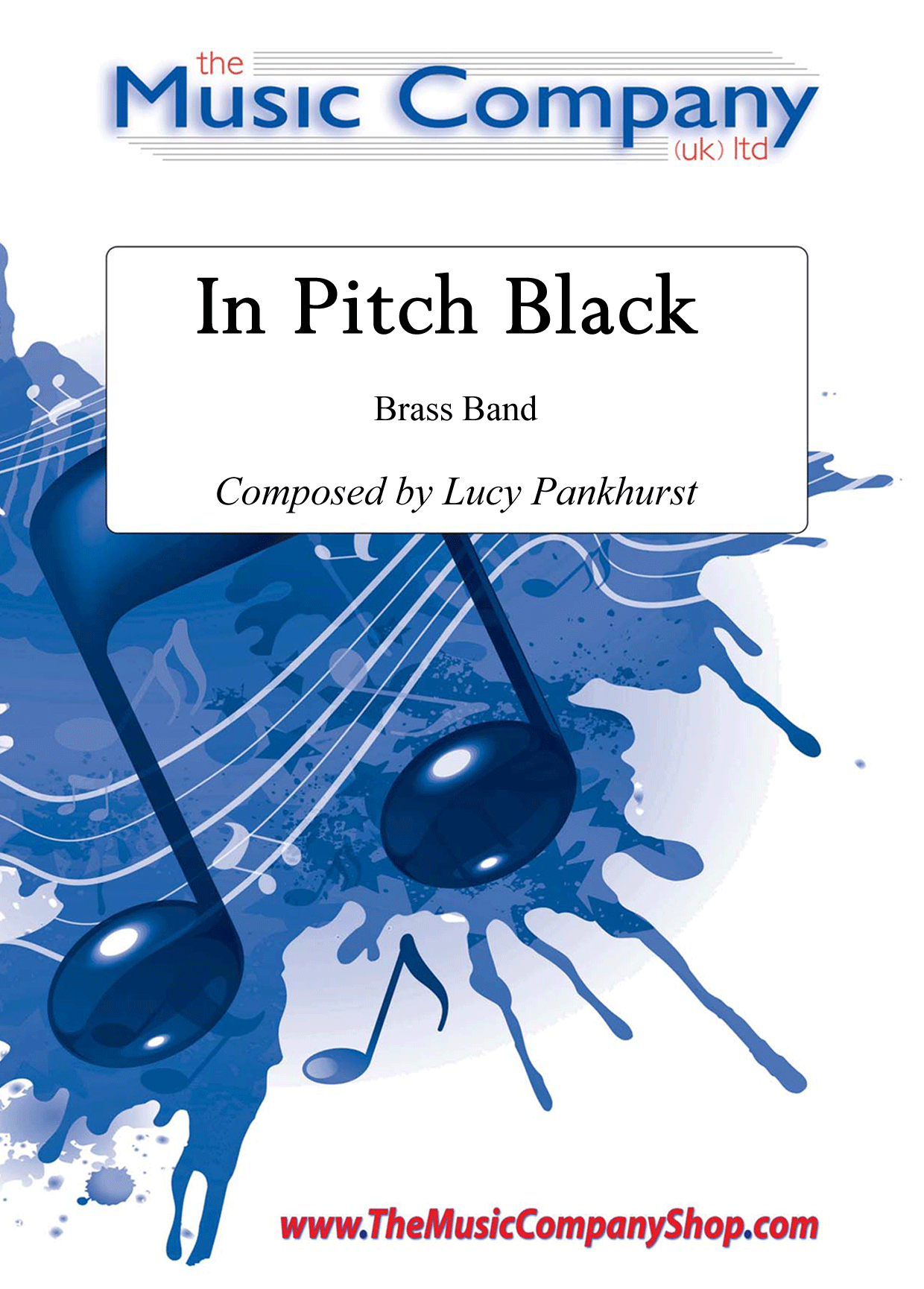 £35.00
In Pitch Black - Lucy Pankhurst
An extremely emotional and poignant work for brass band composed by Lucy Pankhurst, in memory and tribute to those affected by the Pretoria Pit disaster in Lancashire on 21st December 1910. The piece is chilling in its depiction of the tragic story, sensitively conveying the atmosphere and emotions as perceived before, during and after the event. Through its use of playing techniques, effects, sound combinations and even silences, In Pitch Black offers a powerfully reflective piece.Pritoria Pit DisasterLancashire's worst pit disaster and Britain's third largest loss of life from a single mining accident happened at the No. 3 Bank Pit belonging to the Hulton Colliery Company, just 4 days before Christmas 1910. The pit known as the 'Pretoria Pit' was situated on Hulton Parkland on the border of Atherton and Westhoughton. An explosion occurred at 7.50 am on Wednesday, 21 December 1910, resulting in the death of 344 men and boys, including many members of The Wingates Band.The Writing ExperienceDuring Lucy's research for this work, she acknowledges that she found the harsh reality from the shocking images and historical accounts of the event most disturbing, and is not embarrassed to disclose that it was wholly a very emotional experience in creating the composition. Consequently, she chose to create something to illustrate the true emotion of the situation. She wanted to pay tribute to the lives lost and the devastation which remained in their absence, by creating a piece of music which begins in darkness; desolate and claustrophobic, whilst still leaving the audience feeling uplifted and thoughtful in the final bars.The significance and musical appreciation for the creation of In Pitch Black was formally recognised by BASCA in 2011, when Lucy Pankhurst won the internationally acclaimed British Composer Award (the first time a brass band work had received the award, and the first time a female composer had won the category).Full programme notes are included in the product images.Look and Listen (performance courtesy of Manchester University Brass Band):
In Stock: Estimated dispatch 3-5 working days
-
 £52.30
A Renaissance Christmas (Brass Band) Kevin Norbury
VIEW SCORE PDF This magnificent festive suite was written by Kevin Norbury for the Pierre Elliott Trudeau High School Wind Symphony and features several well known carols set in a Renaissance style. Here it has been set for brass band. Three contrasting movements comprise the work: i. Processional (Personent hodie - On this day earth shall ring) This is a short piece imagining a torchlight Yuletide procession (perhaps bearing the traditional roasted wild boar), using a well-known Christmas melody from the large collection of music compiled in the 16th century called Piae Cantiones (1582). The tune is presented twice with accompanying, related melodic material. ii. Pastorale (Quem pastores laudavere - Shepherds sang their praises o'er him) This is a 14th-century melody which was originally collected by Michael Praetorius at the end of the 16th-century. The treatment throughout is very lyrical without overly complex harmonies. The melody is heard three times with brief linking episodes and a short coda. iii. Celebration! (In dulci jubilo - In sweet celebration - Ding-dong merrily on high)) This magnificent 13th-century melody was also a part of Michael Praetorius's collection. It is traditional associated with the words 'Good Christian men, rejoice!' The opening is a straight transcription of the great chorale prelude for organ by J.S.Bach. After the grandeur of the opening, the tune is heard in more of a 'folky' style. A lot of related melodic material is then presented before the tune Ding-dong merrily on high is heard. After another episode of previously used music In dulci jubilo reappears in a joyful conclusion to the piece. Sheet music available from: UK - www.brassband.co.uk USA - www.solidbrassmusic.com Difficulty Level: 3rd Section + Instrumentation: Soprano Cornet Eb Solo Cornet Bb Repiano Cornet Bb 2nd Cornet Bb 3rd Cornet Bb Flugel Horn Bb Solo Horn Eb 1st Horn Eb 2nd Horn Eb 1st Baritone Bb 2nd Baritone Bb 1st Trombone Bb 2nd Trombone Bb Bass Trombone Euphonium Bb Bass Eb Bass Bb Percussion 1-4
In Stock: Estimated dispatch 1-3 working days
-
 £29.88
Coventry Carol (Brass Band) Traditional arr. Stephen Tighe
VIEW SCORE PDF The Coventry Carol is an English Christmas carol dating from the 16th century. The carol was traditionally performed in Coventry as part of a mystery play called The Pageant of the Shear Men and Tailors. The play depicts the Christmas story from chapter two in the Gospel of Matthew: the carol itself refers to the Massacre of the Innocents, in which Herod ordered all male infants under the age of two in Bethlehem to be killed, and takes the form of a lullaby sung by mothers of the doomed children. Stephen Tighe has here given this well loved tune an update to allow it to appeal to a broad audience. Sheet music available from: UK - www.brassband.co.uk USA - www.solidbrassmusic.com Difficulty Level: 4th Section + Instrumentation: Soprano Cornet Eb Solo Cornet Bb Repiano Cornet Bb 2nd Cornet Bb 3rd Cornet Bb Flugel Horn Bb Solo Horn Eb 1st Horn Eb 2nd Horn Eb 1st Baritone Bb 2nd Baritone Bb 1st Trombone Bb 2nd Trombone Bb Bass Trombone Euphonium Bb Bass Eb Bass Bb Percussion 1-3
In Stock: Estimated dispatch 1-3 working days
-
 £40.00
Moon Pictures - Andrew Duncan
Moon Pictures is a piece depicting mans enduring fascination with our nearest neighbour in the sky, the Moon.Following the introduction there are four continuous sections.1. Moon Dance, describes the ancient and widespread worship of the moon by many cultures.2. Tidal Flows, is about the soothing and constant heartbeat of our oceans and seas.3. Invasion of the Little Green Men, is a more light-hearted depiction of a 1950's Sci-Fi style invasion by silver suited aliens from the moon.4. 1969 A.D, describes the preparations, launch and eventual touchdown on the Moon of the historic Apollo 11 mission.Moon Pictures was written for the Todmorden Old Band in 21 with funds provided by the Millennium Commission and recorded by them on their CD 'Moon Pictures'.
In Stock: Estimated dispatch 3-5 working days
-
 £41.09
Christmas Day (Brass Band) Gustav Holst arr. Philip Rayment
VIEW SCORE PDF Well-known English composer, Gustav Holst (1874-1934) wrote this choral fantasy in 1910, about five years before his renowned orchestral suite, The Planets. The piece was originally composed for SATB choir and orchestra and dedicated to the students of Morley College, where Holst taught music. In the years since, it has been arranged for various combinations of voice and/or instruments. This arrangement is in the original key and could be adapted for use with choir and/or organ. Christmas Day features three carols in their entirety: Good Christian Men, Rejoice; God Rest Ye Merry, Gentlemen and Come, Ye Lofty, Come, Ye Lowly (an old Breton melody). There are also references to The First Nowell. Although well-received initially, this work (like many of Holst's) was neglected for many years and has not been widely recorded. It is hoped that it will be useful for brass bands during the festive season, particularly in a large acoustic. To listen to the Canadian Staff Band performing the work please visit www.youtube.com/watch?v=ccXkbWi_iWE Sheet music available from: UK - www.brassband.co.uk USA - www.solidbrassmusic.com Difficulty Level: 3rd Section + Instrumentation: Soprano Cornet Eb Solo Cornet Bb Repiano Cornet Bb 2nd Cornet Bb 3rd Cornet Bb Flugel Horn Bb Solo Horn Eb 1st Horn Eb 2nd Horn Eb 1st Baritone Bb 2nd Baritone Bb 1st Trombone Bb 2nd Trombone Bb Bass Trombone Euphonium Bb Bass Eb Bass Bb Percussion 1-3
In Stock: Estimated dispatch 1-3 working days
-
£132.00
Abstractions - Torstein Aagaard-Nilsen
Verket ble bestilt av Norges Musikkorpsforbund som pliktnummer til NM for Brass Band 2. divisjon (na 1. divisjon) 1990.Satstitlene er abstraksjoner der synsopplevelser er tenkt gjenskapt som musikk, altsa en abstrakt fremstilling av et motiv, likt et abstrakt bilde der man ikke umiddelbart kan se likheten.1. Aurora Borealis (Lento espressivo) Inspirert av Nordlyset som kan vaere svaert intenst vinterstid.Det er aldri i ro og antar nye fasonger og farger hele tiden mens det farer over nattehimmelen.The first movement is inspired by the northern lights. It constantly changes in colour and shape.2. Rocks (Moderato ben ritmico)I denne satsen er tittelen et ordspill. Ordet "rock" er velkjent i musikken, men er ogsa en enorm stein eller del av et fjell.The title of the second movement is a play with the word "rock" is a well-known word describing a musical genre. But it is also a giant stone or a part of a mountain.3. Seascape (Allegro)I denne satsen forsoker jeg a fange ulike aspekter ved havet, samtidig som satsen samler opp musikalske ideer fra de to foregaende satsene. Denne satsen videreforer, oppsummerer og avslutter verket.The third movement is inspired by different aspects of the sea. It also sums up different ideas that occurs in the two previous movements to round off the whole piece.Tredje utgave - 2015Third Edition - 2015
Estimated dispatch 7-14 working days
-
£79.00
Luftforsvarets jubileumsmarsj - Frode Thingnaes
Frode Thingnaes was one of the "Grand Old Men" of the Norwegian Military Bands. This march was commissioned by the Norwegian Air Force to it's 50 years anniversary in 1994.There was a wish tht the march should give associations to Glenn Miller, a wish that Thingnaes put into the trio part of the march in the most elegant manner.
Estimated dispatch 7-14 working days
 Watch video