
Results
-
 £34.95
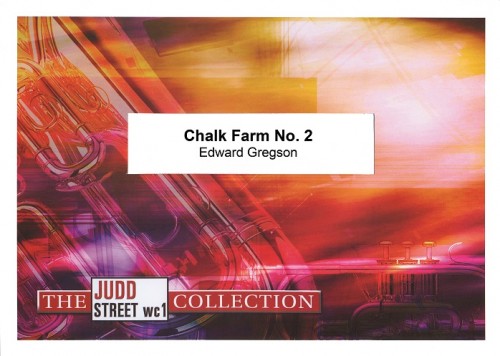
Chalk Farm No.2 (Brass Band - Score and Parts) - Gregson, Edward
Like so many of the best composers for brass band - Eric Ball, Wilfred Heaton, Elgar Howarth and Robert Simpson - Edward Gregson's youthful talents came to the fore in the Salvation Army. In 1975 Gregson was commissioned by the Chalk Farm Band of the Salvation Army to write a march for the centenary of the birth of the band's most long-serving bandmaster Alfred W Punchard, who conducted the band from 1894 to 1944. In 1909 the Salvation Army published a march called Chalk Farm featuring the old Army chorus 'March on, we shall win the day'.Gregson uses the same tune in his Chalk Farm No 2 march, but this is a symphonic march clearly to be played sitting down. He includes irregular bars of 5 and 7 beats as well as a tongue-in-cheek treatment of the tune, complete with bongos (in the march) and bi-tonality (in the trio). Chalk Farm No 2 imaginatively composed. Gregson's own main theme 'fits' the chorus as a counter-subject. The playful irreverence of the style has more in common with Wilfred Heaton's Praise or Glory, than the conventional Salvation Army March.Duration: 4.00
Estimated dispatch 7-14 working days
-
 £40.00
Slavonic Dance No.8 (Brass Band - Score and Parts) - Dvorak, Antonin - Littlemore, Phillip
Antonin Dvorak composed his first set of eight Slavonic Dances in 1878. The music is lively and overtly nationalistic, although the tunes themselves are all original and are not taken from any Slavic folk dances. Slavonic Dance No.8 is high-spirited and in the style of a furiant, the boldest of Czech folk dances. Although written in a 3/4 metre throughout, Dvorak creates cross-rhythms that shift this metre in to 2/4, which is an important characteristic of the furiant. Duration: 4.10
Estimated dispatch 7-14 working days
-
 £56.00
Orpheus in the Underworld, Finale from (Brass Band - Score and Parts) - Offenbach, Jacques - Woodfield, Ray
Slightly reduced Brass Band instrumentation (no rep cornet, no 2nd horn, no 2nd trombone part)
Estimated dispatch 7-14 working days
-
 £40.00
Pomp and Circumstance March No.2 (Brass Band) - Littlemore, Phillip
Following the spectacular success of his Pomp & Circumstance March No. 1, which received over 100 performances in its first year, it was almost inevitable that Elgar would write a second. However, what is not commonly known is that the initial sketches for what was to become the?Pomp & Circumstance March No. 2?were written first! Due to the successes of the first march, not least because it now features at every Prom concert, it is forgotten that not only did Elgar submit the manuscript for both marches to his publisher at the same time, but both marches were premi?red at the same concert and both performed a few days later at the same Promenade Concert. Duration: 5:00
Estimated dispatch 7-14 working days
-
 £52.40
Rolling in the Deep (Brass Band - Score and Parts) - Adkins & Epworth - Hume, Rob J.
Slightly reduced Brass Band instrumentation (no rep cornet, no 2nd horn, no 2nd trombone part)
Estimated dispatch 7-14 working days
-
 £56.00
Trouble in the Air (Brass Band - Score and Parts) - Fernie, Alan
Slightly reduced Brass Band instrumentation (no rep cornet, no 2nd horn, no 2nd trombone part)
Estimated dispatch 7-14 working days
-
 £35.00
Gymnopedie No.1 (Brass Band - Score and Parts) - Satie, Erik - Littlemore, Phillip
Erik Satie's Gymnopedies are a series of three short piano pieces that were first published in 1888. These atmospheric pieces, all written in 3/4 time and sharing a common theme and structure, are recognised the world over and are his most famous compositions. Gymnopedie No.1?is divided into two almost identical parts, with a steady accompanying rhythm of crotchet-minim, crotchet-minim (short-long, short-long) that remains constant throughout - with the exception of the last two bars of each part! This gently lilting background supports an expressive melodic line which creates the occasional dissonance, yet seems impressively tension free. Duration: 8:10
Estimated dispatch 7-14 working days
-
 £79.95
The Lost Village of Imber (Brass Band - Score and Parts) - Bond, Christopher
The Lost Village of Imber was commissioned by Bratton Silver Band in 2019 in celebration of 160 years of the band; 1859-2019. Structured in three movements, the complete work was premiered by Cory Band at Wiltshire Music Centre in February 2020.The village of Imber on Salisbury Plain had been inhabited for over one thousand years when it was evacuated in 1943 to make way for military training in the Second World War. At the time, with preparations for the Allied invasion of Europe underway, most villagers put up no resistance, despite being upset, with the belief that they'd return once the war had concluded. To this day, Imber and its surrounding land remain a military training ground. The villagers never returned, and just the shell of what was once a community remains.Structured in three movements, it is on this very real story that the work is based, setting out the series of events of 1943 in chronological order.The first movement, On Imber Downe, portrays a sense of jollity and cohesiveness, a community of individuals living and working together before news of the evacuation had broken. Sounds of the village are heard throughout, not least in a series of percussive effects, the anvil of the blacksmith; the cowbell of the cattle and the bells of the church.The second movement, The Church of St. Giles, begins mysteriously and this sonorous, atmospheric opening depicts Imber in its desolate state and the apprehension of residents as they learn they have to leave their homes. Amidst this is the Church, a symbol of hope for villagers who one day wish to return, portrayed with a sweeping melodic passage before the music returns to the apprehension of villagers facing eviction around their sadness at losing their rural way of life.In complete contrast, the third movement, Imemerie Aeternum, portrays the arrival of the military, complete with the sounds of the ammunition, firing and tanks, sounds which were all too familiar to those living in the surround areas. To close, the Church of St. Giles theme returns in a triumphant style, representing the idea that the church has always been, even to this day, a beacon of hope for the villagers and local community, both the centrepiece and pinnacle of a very real story.Duration: 13.30
Estimated dispatch 7-14 working days
-
£89.99
Ross Roy (Brass Band - Score and Parts) - De Haan, Jacob
In this composition, Jacob de Haan sees the "Ross Roy" as a metaphor for the years spent at school (a monument in time), where one's personality is formed. So, the opening theme the artist calls the Ross Roy theme initially has monumental characteristics.The rhythmic motion, which strides along in the lower register and percussion at the beginning of the next section is typical of "Tempo di Marcia". This movement, accompanied by repetitions of sound, is a metaphor for the structure and discipline in school. This is the introduction to a march theme, symbolic of "passing through" the classes up to the final examinations.Then, the Ross Roy theme is dealt with again, now in a playful, humorous variation. As if the composer is saying there should also be time for a smile in school. The same theme can be heard in major key and a slower tempo in the following section, expressing pride and self-confidence. This is also the introduction to the expressive middle section that represents love, friendship and understanding.We then return to the march theme in a slightly altered construction. The oriental sounds, constituting the modulation to the final theme, are symbols of the diversity of cultures in the school. The characteristic final theme first sounds solemn, but turns into a festive apotheosis. It is no coincidence that the final cadence is reminiscent of the close to a traditional overture, for the school years can be considered the "overture" to the rest of one's life.Duration: 9:20
Estimated dispatch 7-14 working days
-
 £90.00
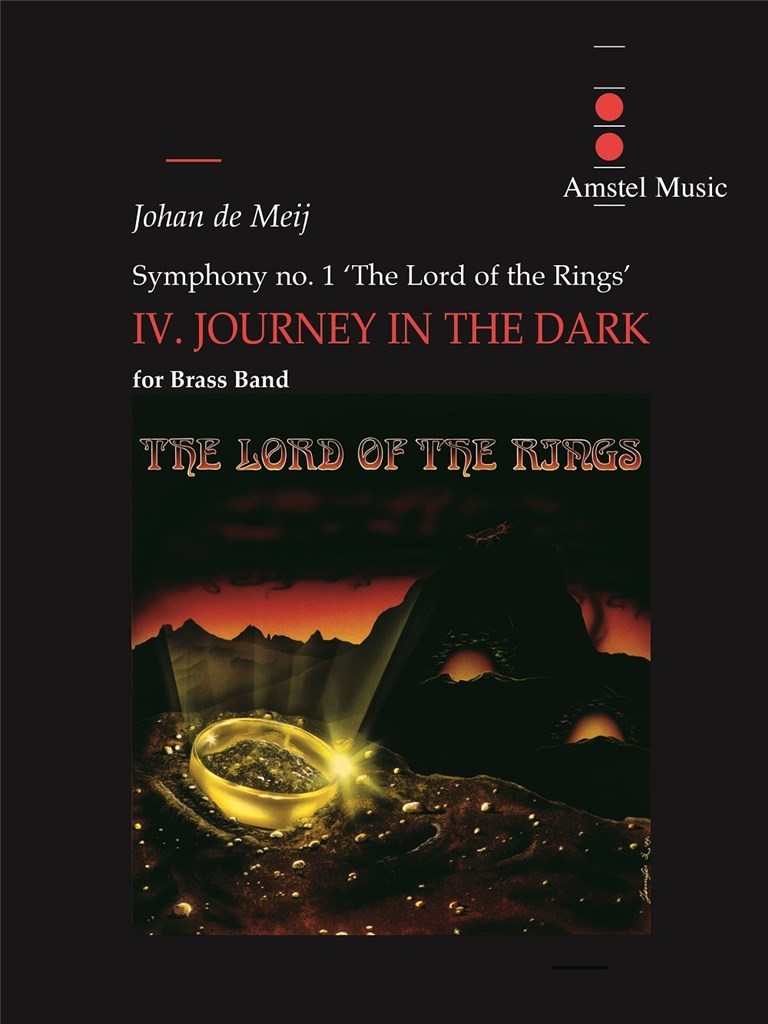
Journey in the Dark (from Symphony No.1: The Lord of the Rings) (Brass Band - Score and Parts) - De Meij, Johan
Johan de Meij's first symphony The Lord of the Rings is based on the trilogy of that name by J.R.R. Tolkien. This book has fascinated many millions of readers since its publication in 1955. The symphony consists of five separate movements, each illustrating a personage or an important episode from the book. This transcription for brass band has been arranged by the composer. The symphony was written in the period between March 1984 and December 1987, and had its premiere in Brussels on 15th March 1988, performed by the The Royal Band ofthe Belgian Guides under the baton of Norbert Nozy. In 1989, the symphony The Lord of the Rings was awarded a first prize in the Sudler International Wind Band Composition Competition in Chicago, and a year later, the symphony was awarded a grant by the Dutch Composers Fund. In 2001, the orchestral version was premiered by the Rotterdam Philharmonic Orchestra and recorded by the London Symphony Orchestra. Duration: 9.00
Estimated dispatch 7-14 working days
 View Music