
Results
-
 £94.95
Of Men and Mountains - Edward Gregson
Of Men and Mountains was commissioned by the Netherlands Brass Band Championships for their tenth anniversary contest in Drachten in December 1990. In July the previous year, Edward Gregson and his wife took the Trans Canadian Railway from Toronto to Vancouver. The journey through the Rocky Mountains was the starting point for Of Men and Mountains. Gregson writes that: 'its high peaks and shafts of sunlight breaking through the clouds, its canyons and ferocious rapids made me understand a little more about the majesty of nature and the fragility of humanity. The eternal struggle between man and nature was personified in the building of this incredible railway... hence my title (after Blake).' The work is dedicated to the memory of Eric Ball, who died shortly before the writing of the work was commenced. Of Men and Mountains is in one continuous movement with a duration of approximately 17 minutes. Its form is difficult to describe because of its motivic and accumulative nature, but it is essentially a symphonic tone poem in search of a theme, which eventually comes in its final and complete state in the majestic ending after an ever-increasing paced scherzo. Of Men and Mountains has been selected as the test pieces for the 2023 National Brass Championships of Great Britain at the Albert Hall.
Estimated dispatch 5-14 working days
-
 £54.99
Ding-a-Dong - Thijs Oud
The group Teach-In, from the Netherlands, won the Eurovision Song Contest in 1975 with the song Ding-a-Dong. It was the fourth time that a Dutch entry had won the prestigious festival but since then no Dutch artist has even come near first place again. The original Ding-a-Dong was performed, in keeping with tradition, with the accompaniment of a large orchestra. This sparkling arrangement of the catchy song provides a cheerful note in every concert. The melody will certainly stay in the audience's memory long after the performance.
Estimated dispatch 5-14 working days
-
 £8.50
£8.50PATER NOSTER for Flugel (score) - Lundberg, Rebecca
Pater Noster for Flugel Horn & Fanfare Band has been arranged by Marten van der Wal and is available from AM Music in the Netherlands www.ammusic.nl
In Stock: Estimated dispatch 1-3 working days
-
 £27.50
PATER NOSTER for Flugel (score & parts) - Lundberg, Rebecca
Pater Noster for Flugel Horn & Fanfare Band has been arranged by Marten van der Wal and is available from AM Music in the Netherlands www.ammusic.nl
In Stock: Estimated dispatch 1-3 working days
-
 £32.00
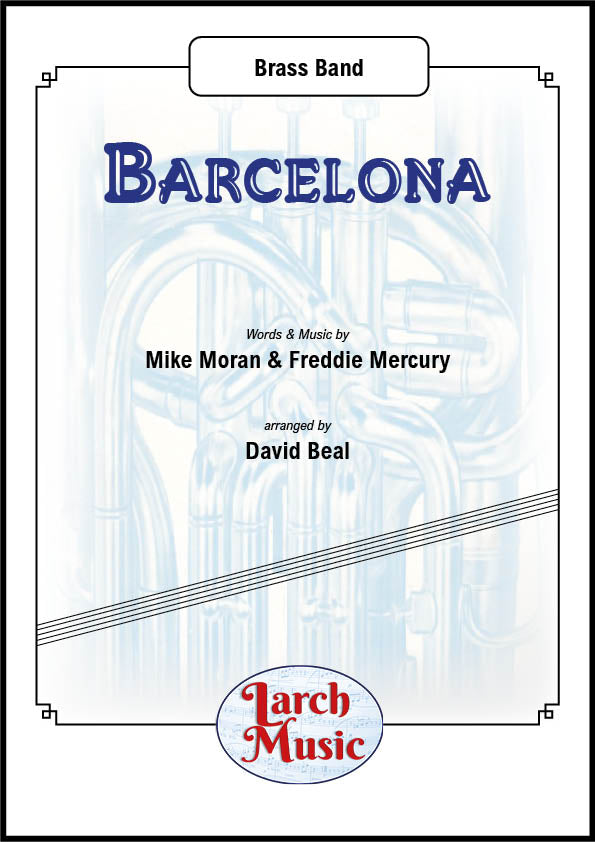
Barcelona - Vocal Duet or Cornet & Euphonium - Brass Band Sheet Music Full Score & Parts - LMAM054
COMPOSER: Mike Moran & Freddie MercuryARRANGER: David Beal"Barcelona" is a single released by Queen vocalist Freddie Mercury and operatic soprano Montserrat Caballe. A part of their collaborative album Barcelona, it also appeared on Queen's Greatest Hits III. The song reflects Mercury's love of opera with his high notes and Caballe's operatic vocals, backed by a full orchestra. Originally released in 1987, it was one of the biggest hits of Mercury's solo career, reaching number eight in the UK singles chart. After Mercury's death in 1991, it was featured at the 1992 Summer Olympics. The single was re-issued on 20 July 1992, after which the track climbed even higher, peaking at number two in the UK, the Netherlands and New Zealand. In 2004, BBC Radio 2 listed Barcelona at number 41 in its Sold On Song Top 100.Scored here for British Brass Band.
In Stock: Estimated dispatch 3-5 working days
-
 £57.00
Tribute to IMMS NL - Harrie Janssen
A classical march in the style of Henk van Lijnschooten in honour of IMMS Netherlands. "The International Military Music Society". A brilliant composition by Harrie Janssen that once again shows that there are still plenty of possibilities within the traditional march form to create a surprising whole.
Estimated dispatch 10-14 working days
-
 £75.00
Old Market Square - Joris Bolhaar
In the second part of the two-piece work Metropolis of the East is the Old Market, the centre point of the city of Enschede in the Netherlands. Elements such as the Great Church, the monument to the city fire of 1862, and historical events such as the textile strike can be heard in this piece, as well as the sounds of the many al-fresco cafes, the theatre Concordia, and the many festivals. This piece is coupled with The Cotton Phoenix (Alex Poelman) but functions well as a stand-alone work.
Estimated dispatch 10-14 working days
-
 £80.00
Dual - Andrew Pearce
Dual (for euphoniums and band) was commissioned by Robbert Vos and Anteun Hoesen of Altena Brass, the Netherlands. Pearce strived to write a fun, melodic and challenging piece that showed off the vast range and virtuosity of these fine players. The octatonic scale forms the harmonic basis for much of the piece, which is a musical competition or race between our mighty Euphonium soloists! Rapidly ascending and descending atonal lines create constant drama for both soloists and band, culminating in a more expressive and tonal ending.
Estimated dispatch 10-14 working days
-
 £92.00
Shaffy - Ramses Shaffy/Gerhart Drijvers
Ramses Shaffy is one of the greatest and most popular singers The Netherlands have known in the 20th century but he had never been honoured with any arrangement for wind band of his songs. At last, the present medley 'Shaffy' fills this gap. With: Shaffy Cantate, We zullen doorgaan, Pastorale, Sammy, Zing - Vecht - Huil - Bid - Lach - Werk en Bewonder.
Estimated dispatch 10-14 working days
-
 £92.00
Reclamation - Feike van Tuinen
Here is a splendid composition by Feike van Tuinen commissioned by the municipality 'Het Bildt' on the occasion of its 500th anniversary in 2005. The score describes the history of the place situated in a nice area near to the Waddenzee, a sea bordering the Northern part of The Netherlands. It starts with the very first reclamation in 1505, and then comes the hard labour of the workers in the mud, the joy of winning new land on the sea, the continuous struggle or game between the wind and the water, and finally the festivities in 2005. This composition challenges both the conductor and the musicians to bring this score to life.
Estimated dispatch 10-14 working days
 Listen to MP3
 View Music