
Results
-
 £29.95
The Strong Tower (Brass Band - Score and Parts)
Following the popularity of Turris Fortissima, I decided, albeit many years later, to revisit some of the material it contains and create a shorter piece, expanding on some of the ideas and motifs, allowing myself to follow those in different directions altogether. The result is this piece which I hope will also excite players and listeners alike.The music is marked at a quick tempo from the start, but despite several changes in meter, the tempo doesn't change until the small accelerando leads us into the presto section. In order to maintain the excitement and drama, it's important to set the pace and keep it consistent throughout.Section A introduces a few of the motifs that will be developed during the piece, including the main Turris Fortissima theme from bar 13 to 18.At section B, ensure the quavers are tight across the whole band with a strong attack, making an obvious difference in dynamic when fff is marked, in bars 23, 25 and 27. A more lyrical approach will be effective from the Horns in section C, with vigorous interruptions from the rest of the band breaking up their melody.Section D features long notes from muted 1st and 2nd Cornets and Trombones, with crescendos each time. These should be significant and sound as though they emerge from nowhere, completely cutting through the overall texture.Section D features long notes from muted 1st and 2nd Cornets and Trombones, with crescendos each time. These should be significant and sound as though they emerge from nowhere, completely cutting through the overall texture.Sections E and F are both passages of building intensity. Various contrasting motifs are layered, including a subtle reference to the hymn tune Ein' feste Burg (A mighty fortress is our God) from the Euphonium. The music becomes more busy and muddled, before reaching its climax at section G where the lyrical melody is heard again, this time from the Solo Cornets and Euphonium.In bars 141 to 145, there is a reference to Dean Goffin's My strength, my tower in the Basses, as used in Turris Fortissima. Allow this motif to dominate, keeping the notes full and grand-sounding. In bars 149 to 151 there is further use of the line from Ein' feste Burg in the Baritones, Trombones, Euphoniums and Basses leading into the final section.- Steven Ponsford
Estimated dispatch 7-14 working days
-
 £77.00
General Series Brass Band Journal, Numbers 2238 - 2241, December 2023
2238: Fanfare and allegro on the Doxology (Steve Kellner)The Doxology, set to the tune Old Hundredth (T.B. 31), is used widely around the world by Christian denominations, including Salvationists. This concert opener is based on the short but powerful hymn of praise to the Triune God.2239: To the endless day (Kenneth Downie)This is a meditation on the hymn tune Ruth (T.B. 191), written by Samuel Smith. It is a particular favourite of Don Jenkins, whose late wife was also called Ruth. This music is dedicated to Don, a distinguished trombone soloist and former Band master of Bristol Easton Corps Band.The music is always associated with the hymn by William Walsham How, whose words begin 'Summer suns are flowing over land and sea' (S.A.S.B. 59) with the title coming from the end of the final verse.2240: Euphonium Solo - He giveth more grace (Ray Steadman-Allen)This 1996 arrangement of Blacklands (T.B. 527), the composers own hymn tune written in 1963, is being published posthumously. The hymn tune sets the words 'He giveth more grace as our burdens grow greater' (S.A.S.B. 30) with an emphasis on the generosity of God.2241: The Calvary effect (Ian Clarke)Around AC 30, on a hill often refered to as Mount Calvary, an event took place that was to change the world forever. The Calvary effect is a reflection, in musical form, on that event and what it still means to people today. If features two tunes: first, in a quiet reflective mood, we hear the highly emotive Healing Stream, associated with the words 'Jesus, keep me near the cross; There is a precious fountain' (S.A.S.B. 178). This then makes way for the chorus; 'Lord, make Cavalry real to me' (S.A.S.B. 182), which is at times indistinct and almost lost in its surroundings, reflecting the sentiments of the chorus. A return to the main tune follows, this time in a positive, passionate setting. The music finishes with a triumphant 'Hallelujah!'.
Estimated dispatch 7-14 working days
-
£29.95
WAR CRY (Brass Band Set) - Dorothy Gates
This work was written as the opener for the New York Staff Band's 125th anniversary concert in Carnegie Hall in March 2012. Based on the song, 'Ever is the war cry'. the music is quite militant in nature which is a direct reflection of the text. While the composer pays homage to the past in this fitting salute, the overall musical style is decidedly that of the 21st century.
Estimated dispatch 7-14 working days
-
£44.95
JOY THROUGH THE AGES (Brass Band Set) - Howard Evans
This work was written for the 125th anniversary of Boscombe Band, celebrated in November 2011, and is the title track of the band' album released in the same year. The music is celebratory in nature and is dedicated to all those who have served in the band during its 125 year history. The theme of the work is a song by Charles Hutchison Gabriel which was the favourite of the band's librarian, Gerald Whittingham, who was 'promoted to Glory' after a long battle with a brain tumour. The title comes from the last verse, 'When with the ransomed in Glory, his face I at last shall see, 'twill be my joy through the ages, to sing of his love for me'.
Estimated dispatch 7-14 working days
-
 £77.00
General Series Brass Band Journal, Numbers 2250 - 2253, December 2024
2250: Prelude on 'Rhosymedre' (Ralph Vaughan Williams trs. Douglas Engle)The English composer Ralph Vaughan Williams' work Three Preludes (founded on Welsh Hymn Tunes) was published for the organ in 1920. This is a transcription of the second movement of that work. The words associated with the hymn tune are by Samuel Crossman, My song is love unknown (S.A.S.B. 149), and vividly depict the events of Holy Week. The music is gentle and solemn and would be appropriate for a Good Friday service or as a moment of repose in a concert. 2251: Hosanna Shuffle (Sam Creamer)The half-time shuffle groove is a popular feel developed by alternative rock/pop bands of the 1980s. It marries elements of rock and swing styles together to form a new and infectious feel - Hosannah Shuffle being written as a tribute to this fusion of musical styles. Contrary to a swing style, shuffle brings the pulse back onto the beat while maintaining the swung quaver rhythms to create a rock-type rhythmic drive. 2252: Everlasting Love (Keith Manners)This piece was written for the London North East Music School in 2004. The theme of the week was 'Making a stand for Christ', reminding the school that it only takes one person to make such a stand before others follow. The music starts with a lone Solo Cornet playing the melody of Graham Kendrick's song Such Love (S.A.S.B. 199). One by one, other parts join in with the theme.2253: Festival March (Michael Cooper)This piece represents the first published brass composition of Bandmaster Michael Cooper, who is the Bandmaster at Brisbane City Temple Corps. This imposing festival march features the tunes I want to be a soldier (T.B. 683), Lift up the banner (T.B. 90) and My Jesus, I love thee (T.B. 506). These tunes depict the idea that spiritual warfare is an essential component of one's faith, success of which is articulated in the final verse of My Jesus, I love thee (S.A.S.B. 878).
Estimated dispatch 7-14 working days
-
 £95.00
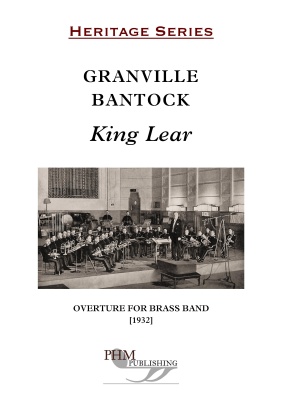
King Lear (Brass Band - Score and Parts)
Sir Granville Bantock (1868 - 1946) composed the second of his five major brass band work for Callender's Cableworks Band, completing the commission on 30 November 1932. Based in the Thames-side district of Belvedere near Erith, the band was active between 1898 and 1961. The works band of the Callender Cable & Construction Co. Ltd, it was at the peak of its popularity during the 1930s and was a frequent broadcaster on the radio. The band employed an in-house arranger and played saxophones in its lighter material. King Lear was one of the band's major commissions and was not published in Bantock's lifetime. The manuscript score and parts were thought to be lost for decades, but were found in the library of the Haydock Band (Lancashire), which had inherited part of Callender's library of manuscripts material and bespoke arrangements after it has been transferred to nearby Prescott Cables Band after Callender's Cable Works closed.King Lear is a substantial work, in essence a dramatic tone poem in the romantic Tchaikovskian manner, presenting a series of character portraits of the foolish old king and his three daughters, Goneril, Regan and Cordelia. The music is dramatic and lyrical by turns, with the most generous lyrical episode revealing perhaps the warm-hearted Cordelia. An expansive melody that flows from this is brought back towards the end as the main climax of the work.In 2001, Bantock's score was recorded by the University of Salford Brass Band, conducted by Dr. Roy Newsome. The original is serviceable, but in comparison with the orchestral version he made in 1936 (part of which was recorded on a Paxton 78 rpm) and later brass band scores, performing editions of which were prepared by others, it lacks colour and range typical of Bantock's orchestral work. Above all it lacks percussion, which can be heard on the recorded extract. With the kind permission of the Bantock Estate, I have prepared a performing edition for publication that incorporates percussion, derived from the orchestral recording and added editorially in similar manner elsewhere. I have revoiced some of the low- lying instrumental parts to present the material in more comfortable ranges. Editorial interventions more elaborate than revoicing the original text have been identified as cue notes.- Paul HindmarshDuration: 15.00
Estimated dispatch 7-14 working days
-
£40.00
King Lear (Brass Band - Score only)
Sir Granville Bantock (1868 - 1946) composed the second of his five major brass band work for Callender's Cableworks Band, completing the commission on 30 November 1932. Based in the Thames-side district of Belvedere near Erith, the band was active between 1898 and 1961. The works band of the Callender Cable & Construction Co. Ltd, it was at the peak of its popularity during the 1930s and was a frequent broadcaster on the radio. The band employed an in-house arranger and played saxophones in its lighter material. King Lear was one of the band's major commissions and was not published in Bantock's lifetime. The manuscript score and parts were thought to be lost for decades, but were found in the library of the Haydock Band (Lancashire), which had inherited part of Callender's library of manuscripts material and bespoke arrangements after it has been transferred to nearby Prescott Cables Band after Callender's Cable Works closed.King Lear is a substantial work, in essence a dramatic tone poem in the romantic Tchaikovskian manner, presenting a series of character portraits of the foolish old king and his three daughters, Goneril, Regan and Cordelia. The music is dramatic and lyrical by turns, with the most generous lyrical episode revealing perhaps the warm-hearted Cordelia. An expansive melody that flows from this is brought back towards the end as the main climax of the work.In 2001, Bantock's score was recorded by the University of Salford Brass Band, conducted by Dr. Roy Newsome. The original is serviceable, but in comparison with the orchestral version he made in 1936 (part of which was recorded on a Paxton 78 rpm) and later brass band scores, performing editions of which were prepared by others, it lacks colour and range typical of Bantock's orchestral work. Above all it lacks percussion, which can be heard on the recorded extract. With the kind permission of the Bantock Estate, I have prepared a performing edition for publication that incorporates percussion, derived from the orchestral recording and added editorially in similar manner elsewhere. I have revoiced some of the low- lying instrumental parts to present the material in more comfortable ranges. Editorial interventions more elaborate than revoicing the original text have been identified as cue notes.- Paul HindmarshDuration: 15.00
Estimated dispatch 7-14 working days
-
 £45.00
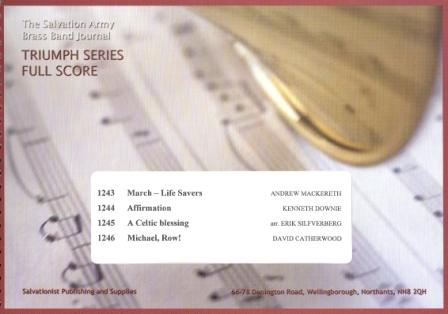
Triumph Series Band Journal November 2013 Numbers 1243-1246
No. 1243 March - Life Savers (Andrew Mackareth)This march was written for the band weekend at Belfast Citadel and incorporates the tune Jesus Saves (T.B. 703)No. 1244 Affirmation (Kenneth Downie)The title comes from the affirming tone of the chorus on which the music is built, He is the Lord, which itself is inspired by Phillippians, chapter 2. The chorus does not appear in its entirety at any point, but is obvious to a greater or lesser extent, in the texture of the music.No. 1245 A Celtic Blessing (arr. Erik Silfverberg)This is a simple arrangement of c Celtic traditional tune used to the lyrics of the familiar blessing:May the road rise to meet you,May the wind be always at your back,May the sun shine warm upon your face,The rain fall soft upon your fields,Until we meet again,May God hold you in the palm of his hand.No. 1246 Michael, Row! (David Catherwood)This arrangement of the traditional chous, 'Michael, row the boat ashore' (T.B. 285), is in a light swing style and also incorporates the tunes, 'Love lifted me' (T.B. 725) and 'Will uour anchor hold?' (T.B. 60).
Estimated dispatch 7-14 working days
-
 £44.95
Joy Through the Ages (Brass Band - Score and Parts)
This work was written for the 125th anniversary of Boscombe Band, celebrated in November 2011, and is the title track of the band' album released in the same year. The music is celebratory in nature and is dedicated to all those who have served in the band during its 125 year history. The theme of the work is a song by Charles Hutchison Gabriel which was the favourite of the band's librarian, Gerald Whittingham, who was 'promoted to Glory' after a long battle with a brain tumour. The title comes from the last verse, 'When with the ransomed in Glory, his face I at last shall see, 'twill be my joy through the ages, to sing of his love for me'.
Estimated dispatch 7-14 working days
-
 £29.95
Judd: Christ the Lord
This festival prelude was written for the North York Temple Band to open the 2011 'Glory of Easter' concert. The piece is based on the Welsh tune of Llanfair (T.B. 271), associated with the words 'Christ the Lord is risen today'. The music is meant to be a celebration and awakening of our spirits to rejoice in the awesome wonder that is the Easter story; Christ thre Lord came to die for the worlds sins, but has risen, today!Marcus Venables
Estimated dispatch 7-14 working days