
Results
-
 £29.95
Trip the Light Fantastic - Dan Price
Horn virtuoso Owen Farr commissioned a new concert item for tenor horn from composer Dan Price in 2009, Trip the Light Fantastic was the resulting work. The piece is music absolute, with no particular aim to tell a story or...
Estimated dispatch 5-7 working days
-
£44.95
POLOVTSIAN DANCES, The (Excerpts from Prince Igor) (Brass Band Set) - Alexander Borodin - Kevin Norbury
Alexander Borodin (1883 - 1887) was a Russian composer who made his living as a chemist. He was a member of the group of composers called "The Five" (or "The Mighty Handful") who were dedicated to producing a specifically Russian kind of art music. He is best known for his symphonies, his two string quartets, and his opera "Prince Igor". The opera contains "The Polovtsian Dances" which is often performed as a stand-alone concert work.
Estimated dispatch 7-14 working days
-
£34.95
HIS EYE IS ON THE SPARROW (Tenor Horn Solo with Brass Band Set) - Leonard Ballantine
A traditional gospel spiritual originally written in 1905 by Civilla D. Martin and Charles H. Gabriel, the song is most associated with actress-singer Ethel Waters. The song has been covered extensively in gospel music, with notable versions by Shirley Caesar, Marvin Gaye, Kirk Franklin and the Family, Lauryn Hill and Tanya Blount (from Sister Act 2), Mahalia Jackson, Sister Rosetta Tharpe, Dottie West, Barbara Mandrell and Jessica Simpson.
Estimated dispatch 7-14 working days
-
£44.95
PRAISE TRIBUTE (Brass Band Set) - Kenneth Downie
Wilfred Heaton's march 'Praise' has long been a favourite of Kenneth Downie. In 'Praise Tribute', written for The International Staff Band, he deliberately adopts a Heaton style and follows the key scheme of the original while developing the music from the old Manx revival hymn 'The Good Old Way'.
Estimated dispatch 7-14 working days
-
 £44.95
Judd: Excerpts from Polovtsian Dances
Alexander Borodin (1883 - 1887) was a Russian composer who made his living as a chemist. He was a member of the group of composers called "The Five" (or "The Mighty Handful") who were dedicated to producing a specifically Russian kind of art music. He is best known for his symphonies, his two string quartets, and his opera "Prince Igor". The opera contains "The Polovtsian Dances" which is often performed as a stand-alone concert work.
Estimated dispatch 7-14 working days
-
 £34.95
Judd: His Eye is on the Sparrow
A traditional gospel spiritual originally written in 1905 by Civilla D. Martin and Charles H. Gabriel, the song is most associated with actress-singer Ethel Waters. The song, now in the public domain, has been covered extensively in gospel music, with notable versions by Shirley Caesar, Marvin Gaye, Kirk Franklin and the Family, Lauryn Hill and Tanya Blount (from Sister Act 2), Mahalia Jackson, Sister Rosetta Tharpe, Dottie West, Barbara Mandrell and Jessica Simpson. This version is for tenor horn soloist with brass band accompaniment.
Estimated dispatch 7-14 working days
-
 £38.00
Finale from Symphony No. 2 (The Resurrection)
One of the most life-affirming pieces of music ever composed, Mahler's 2nd Symphony, subtitled 'The Resurrection', was first performed in Berlin in 1895. Mahler's interest in the mysteries of the afterlife is well-known and is a recurring theme through
Estimated dispatch 7-14 working days
-
£40.00
I See The Light - Menken, A - Barry, D
This beautiful song is taken from Pixar's animated feature Tangled. The opening section features the solo horn against a light accompaniment. The music builds to a change of key where the melody moves over to the euphoniums and baritones. This is a useful concert item and playable by all levels of bands.4th section +Duration 3.44 mins
In Stock: Estimated dispatch 1-3 working days
-
£60.00
Soaring the Sky - Geert Jan Kroon
Soaring the Sky is a short piece in a typical brass band style with influences from popular music. It captures a feeling of freedom: a feeling of flying in total harmony with your surroundings. To soar literally means flying without propulsion, furthermore it means to ascend to an unknown height.
-
 £57.00
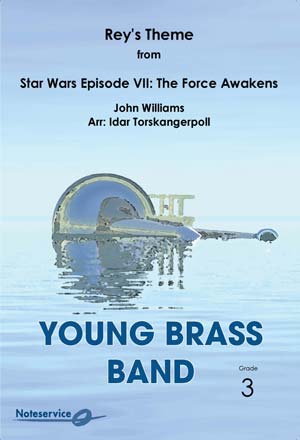
Rey's Theme from Star Wars Eposide VII: The Force Awakens - John Williams/Idar Torskangerpoll
The iconic soundtrack composed by John Williams continues with "The Force Awakens", the seventh Star Wars movie.This arrangement for Young Band tries to capture the rich timbre of the original orchestral music. It is very important to be aware of the balance in the band when performing this music. The horns should stand out dynamically when they plays the melody. Also make shure that the rhythmic are played as clear as possible, especially in the bass tubas and other low instruments. You may choose whether to play the upper or lower octave in the trumpet parts.
Estimated dispatch 10-14 working days
 View Music