
Results
-
 £107.95
Symphony in Two Movements (Brass Band - Score and Parts) - Gregson, Edward
Selected as the Championship Section test piece for the National Brass Band Championships of Great Britain 2025This work was jointly commissioned by the National Youth Brass Band of Great Britain (NYBBGB) and the National Youth Brass Band of Wales (NYBBW), the latter with funding from T Cerdd (Music Centre Wales), to celebrate their 60th and 30th anniversaries respectively. The first performances were given at Cadogan Hall, London, in April 2012, by the NYBBGB, conducted by Bramwell Tovey; and at the Great Hall, Aberystwyth University, in July 2012, by the NYBBW, conducted by Nicholas Childs.When I was approached about a joint commission to write a new work to celebrate the anniversaries of these two outstanding youth bands I was delighted to accept, and decided to respond by writing a work apposite for the magnitude of these special occasions, namely a 'symphony for brass'.Through a long journey of writing music for brass band, which commenced with Connotations (1977), and continued with Dances and Arias (1984), Of Men and Mountains (1991), The Trumpets of the Angels (2000) and Rococo Variations (2008), I arrived at what I regard as the most important work of the cycle to date, combining as it does serious musical intent with considerable technical demands. It is perhaps my most abstract work for brass band, avoiding any programmatic content.The symphony lasts for some 19 minutes and is structured in two linked movements. The form is based on that used by Beethoven in his final piano sonata (Op.111), which is in two movements only: a compact sonata-form allegro, followed by a more expansive theme and four variations. Prokofiev also adopted this model in his 2nd Symphony of 1925.The opening Toccata of this Symphony is highly dramatic but compact, whilst still retaining the 'traditional' structural elements of exposition, development and recapitulation; indeed, it also has the 'traditional' element of a contrasting second subject - a gentle, lyrical modal melody first heard on solo cornets.In contrast, the longer and more substantial second movement Variations is built around a theme and four variations. The slowly unfolding chorale-like theme accumulates both added note harmony and increasing instrumentation, whilst the four variations which follow are by turn mercurial (fast, starting with all the instruments muted), march-like (menacing, with short rhythmic articulations underpinning an extended atonal melody), serene (a series of 'romances' for solo instruments alongside echoes of the chorale) with an emerging theme eventually bursting into a climax of passionate intent; whilst the final variation is a dynamic scherzo (concertante-like in its series of rapid-fire solos, duets, trios and quartets) with the music gradually incorporating elements of the main ideas from the first movement, thus acting as a recapitulation for the whole work. It reaches its peroration with a return to the very opening of the symphony, now in the 'home' tonality of F, and thus creating a truly symphonic dimension to the music.Most of the melodic material of the symphony is derived from the opening eleven-note 'row', which contains various intervallic sets, and although the work is not serially conceived it does use some typical quasi-serial procedures, such as canons, inversions, and retrogrades. The symphony uses somewhat limited percussion, in line with a 'classical' approach to the sound world of the brass band, alongside a use of multi-divisi instrumentation, whereby each player has an individual part rather than the traditional doubling within certain sections of the band.- Edward GregsonDuration: 19.00
Estimated dispatch 7-14 working days
-
 £57.95
Symphony in Two Movements (Brass Band - Score only) - Gregson, Edward
Selected as the Championship Section test piece for the National Brass Band Championships of Great Britain 2025This work was jointly commissioned by the National Youth Brass Band of Great Britain (NYBBGB) and the National Youth Brass Band of Wales (NYBBW), the latter with funding from T Cerdd (Music Centre Wales), to celebrate their 60th and 30th anniversaries respectively. The first performances were given at Cadogan Hall, London, in April 2012, by the NYBBGB, conducted by Bramwell Tovey; and at the Great Hall, Aberystwyth University, in July 2012, by the NYBBW, conducted by Nicholas Childs.When I was approached about a joint commission to write a new work to celebrate the anniversaries of these two outstanding youth bands I was delighted to accept, and decided to respond by writing a work apposite for the magnitude of these special occasions, namely a 'symphony for brass'.Through a long journey of writing music for brass band, which commenced with Connotations (1977), and continued with Dances and Arias (1984), Of Men and Mountains (1991), The Trumpets of the Angels (2000) and Rococo Variations (2008), I arrived at what I regard as the most important work of the cycle to date, combining as it does serious musical intent with considerable technical demands. It is perhaps my most abstract work for brass band, avoiding any programmatic content.The symphony lasts for some 19 minutes and is structured in two linked movements. The form is based on that used by Beethoven in his final piano sonata (Op.111), which is in two movements only: a compact sonata-form allegro, followed by a more expansive theme and four variations. Prokofiev also adopted this model in his 2nd Symphony of 1925.The opening Toccata of this Symphony is highly dramatic but compact, whilst still retaining the 'traditional' structural elements of exposition, development and recapitulation; indeed, it also has the 'traditional' element of a contrasting second subject - a gentle, lyrical modal melody first heard on solo cornets.In contrast, the longer and more substantial second movement Variations is built around a theme and four variations. The slowly unfolding chorale-like theme accumulates both added note harmony and increasing instrumentation, whilst the four variations which follow are by turn mercurial (fast, starting with all the instruments muted), march-like (menacing, with short rhythmic articulations underpinning an extended atonal melody), serene (a series of 'romances' for solo instruments alongside echoes of the chorale) with an emerging theme eventually bursting into a climax of passionate intent; whilst the final variation is a dynamic scherzo (concertante-like in its series of rapid-fire solos, duets, trios and quartets) with the music gradually incorporating elements of the main ideas from the first movement, thus acting as a recapitulation for the whole work. It reaches its peroration with a return to the very opening of the symphony, now in the 'home' tonality of F, and thus creating a truly symphonic dimension to the music.Most of the melodic material of the symphony is derived from the opening eleven-note 'row', which contains various intervallic sets, and although the work is not serially conceived it does use some typical quasi-serial procedures, such as canons, inversions, and retrogrades. The symphony uses somewhat limited percussion, in line with a 'classical' approach to the sound world of the brass band, alongside a use of multi-divisi instrumentation, whereby each player has an individual part rather than the traditional doubling within certain sections of the band.- Edward GregsonDuration: 19.00
Estimated dispatch 7-14 working days
-
 £39.95
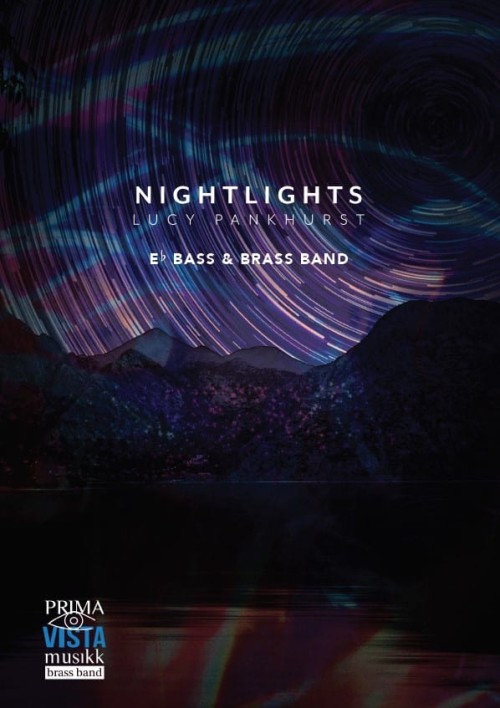
Nightlights (Eb Bass Solo with Brass Band - Score and Parts) - Pankhurst, Lucy
Nightlights was commissioned by Chris Jeans and Don Collins for Youth Brass 2000, to be used as part of their programme at the 2019 European Championships. Written during January 2019, Nightlights received its world premiere by Youth Brass 2000, conducted by Chris Jeans with Siobhan Bates as soloist, at the 2019 European Brass Band Championships in Montreux, Switzerland.Originally written as a Tenor Horn solo, this version for Tuba was arranged for and is dedicated to Dr Joanna Ross Hersey.Nightlights is intended to illustrate a winter's evening looking out across Lake Geneva from Montreux. Tiny lights appear beneath the mountains from faraway homes and vehicles, flickering in the distance and shimmering in the reflections on the water. Tiny, blinking nightlights against the inky blue of the clear sky. Thousands of stars shine above, blurring the boundaries between land, water, and the heavens into a sparkling ether. Transfixed, the bustle of sounds and lights from Montreux seems a lot further away than it is in reality. Eventually, each little light blinks out, one at a time, leaving the chill of the cold night air and an empty sky.Duration: 4.30
Estimated dispatch 7-14 working days
-
 £39.95
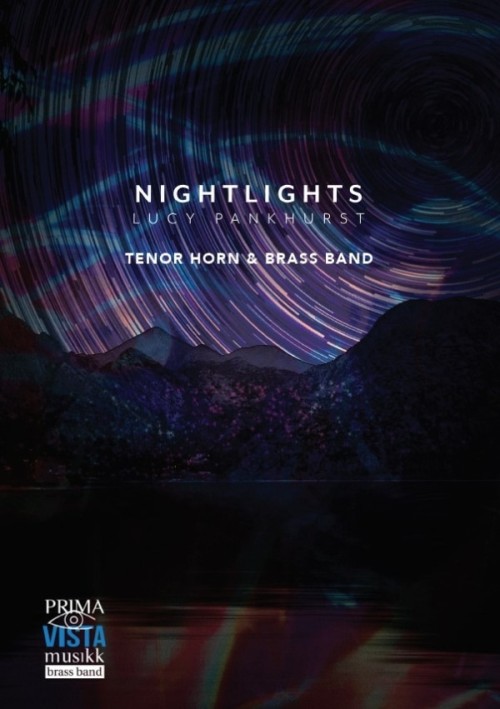
Nightlights (Tenor Horn Solo with Brass Band - Score and Parts) - Pankhurst, Lucy
Nightlights was commissioned by Chris Jeans and Don Collins for Youth Brass 2000, to be used as part of their programme at the 2019 European Championships. Written during January 2019, Nightlights received its world premiere by Youth Brass 2000, conducted by Chris Jeans with Siobhan Bates as soloist, at the 2019 European Brass Band Championships in Montreux, Switzerland.Nightlights is intended to illustrate a winter's evening looking out across Lake Geneva from Montreux. Tiny lights appear beneath the mountains from faraway homes and vehicles, flickering in the distance and shimmering in the reflections on the water. Tiny, blinking nightlights against the inky blue of the clear sky. Thousands of stars shine above, blurring the boundaries between land, water, and the heavens into a sparkling ether. Transfixed, the bustle of sounds and lights from Montreux seems a lot further away than it is in reality. Eventually, each little light blinks out, one at a time, leaving the chill of the cold night air and an empty sky.Duration: 4.30
Estimated dispatch 7-14 working days
-
 £24.00
O Magnum Mysterium (Brass Band - Score and Parts) - Lauridsen, Morten
For centuries, composers have been inspired by the beautiful O Magnum Mysterium text depicting the birth of the new-born King among the lowly animals and shepherds. This arrangement for symphonic band has been transcribed from the original unaccompanied choral setting. Morten Lauridsen is one of America's most-loved and most-performed living composers, and this arrangement is rich in colour, deeply spiritual and intensely moving.Suitable for Youth/4th Section Bands and above.Duration: 6.00
Estimated dispatch 7-14 working days
-
 £40.00
Fanfare (Brass Band - Score and Parts) - Woolrich, John
This lively Fanfare was composed in 1994 for the brass band of the Guildhall School of Music and Drama Junior Department, which gave the first performance on 4 July 1994. Suitable for Youth/4th Section Bands and above. Duration: 4.00
Estimated dispatch 7-14 working days
-
 £45.00
Born on the Fourth of July (Brass Band - Score and Parts) - Williams, John - Duncan, Andrew
The theme music from the original motion picture, Born on the Fourth of July, starring Tom Cruise. The music was composed by John Williams and this arrangement for brass band is by Andrew Duncan.Suitable for Youth/4th Section Bands and aboveDuration: 5.00
Estimated dispatch 7-14 working days
-
 £22.00
Lullaby (Euphonium Duet with Brass Band - Score and Parts) - Doe, Philip
Lullaby is a beautiful euphonium duet with band accompaniment. The solo and contrapuntal writing, combined with a rich accompaniment from the band, offers peace and serenity. Suitable for Youth/4th Section Bands and above. Duration: 4.00
Estimated dispatch 7-14 working days
-
 £17.99
The Bells of Peover (Cornet Solo with Brass Band - Score and Parts) - Doe, Philip
The Bells of Peover is a beautiful and lyrical cornet solo, conjuring up a pastoral scene with the distant ringing of church bells. The piece is named after a pub in the Cheshire village of Lower Peover, near Knutsford. Suitable for Youth/4th Section Bands and above. Duration: 4.00
Estimated dispatch 7-14 working days
-
 £17.99
The Foggy Dew (Brass Band - Score and Parts) - Doe, Philip
The Foggy Dew is one of those charming Irish melodies which seem to capture the beauty and serenity of that country, all of which is evoked in this delicate arrangement by Philip Doe. Suitable for Youth/4th Section Bands and above. Duration: 5.00
Estimated dispatch 7-14 working days
 View Music