
Results
-
£44.50
Marianne - Martin Bunce
Written in 1974, Marianne is a beautifully lyrical flugelhorn ballad by Martin Bunce, now newly arranged by the composer for brass band.Originally written during a particularly romantic period in Bunce's life, the piece was first performed on the BBC Two television programme In Concert by the National Youth Jazz Orchestra, with Martin himself featured as the flugelhorn soloist. A recording was subsequently released by RCA on 45rpm, and Marianne gradually became an established and much-loved part of the NYJO repertoire. It has since appeared on several of the orchestra's recordings, including the four-CD collection The Very Best of NYJO.The melody has also found a home in the brass band world, notably through Maurice Murphy's recording with the Leyland Band on The Lighter Side of Maurice Murphy. This new brass band arrangement places the flugelhorn's distinctive warm and mellow tone firmly at the heart of the music, supported by sympathetic and accessible scoring throughout the band.Neither the solo part nor the accompaniment is excessively demanding, making Marianne an excellent choice for a wide range of bands and an ideal contrast item for concert programmes. Warm, expressive and immediately appealing, it offers the flugelhorn soloist an opportunity to shine while giving audiences a memorable melody to take away.A charming addition to any brass band library, Marianne is particularly well suited to concerts, solo features and lighter programmes.
In Stock: Estimated dispatch 1-3 working days
-
 £29.50
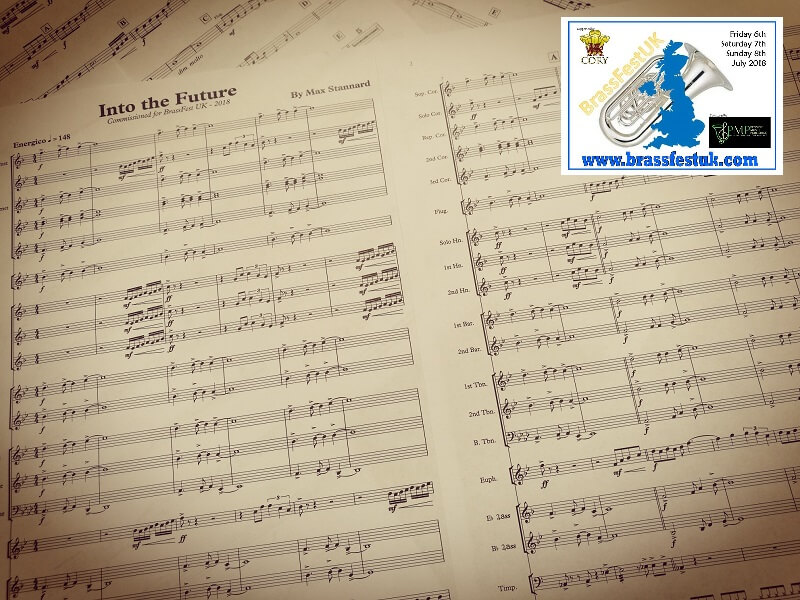
Into The Future - Max Stannard
With the success of the inaugural BrassFest UK events last year and along with it, the commssioned work to celebrate the Brass Band movement, the event this year threw the doors open with a competition to compose the 2018 anthem for bands across the country to enjoy. Judged by Philip Harper, Gavin Somerset and Christopher Bond, this winning work by Max Stannard was written with a view to celebrating the youngsters and future of the Brass Band movement.Click Here for the Youth Band edition
In Stock: Estimated dispatch 1-3 working days
-
 £24.50
Keep The Rhythm Going - Neil Brownless
Keep the Rhythm Going was written for Abingdon Concert Band during the 2020 Coronavirus pandemic as a tribute to musicians around the world who found ways to play together virtually in order to 'keep the rhythm going'. This exciting piece will be a great opener for any concert or contest programme and is available for both brass band and wind band. When performing the wind band arrangement the Cor Anglais, Eb Clarinet and Alto Clarinet parts are optional and can be omitted without affecting the music. The premiere performance can be viewed here: https://youtu.be/b6f7zRzxI7k The piece was premiered virtually on 19th November 2020 by 109 musicians from around the world from the following musical organisations:Abingdon Concert BandAbbey Brass BandAbergavenny Borough BandAbingdon and District Music SocietyAlnwick PlayhouseConcert BandAlnwick Symphonic Wind EnsembleAnything Goes Swing BandAshby Concert BandAylesbury Concert BandAylesbury Symphony OrchestraBacchus Wind OrchestraBanbury Symphony OrchestraBicester Concert BandBisham Concert BandBlaina Town BandBoobs and BrassBourne Concert Band of WokingBrass for AfricaBucks WindBurford OrchestraCastleton BrassCity of Cardiff Melingriffith Brass Band OrganisationCoquet Concert BandCorpo Bandistico G. Puccini - DLF BolognaDarlington Clarinet EnsembleDidcot Concert OrchestraDragon's Big BandDurham Miners' Association Brass BandEast Grinstead Concert BandGoring & Streatley Concert BandHalifax Concert BandHenley Symphony OrchestraJazz ColossusBig BandJupiter BrassKidlington Concert BrassLangtree SinfoniaNantwich Concert BandThe British Police Symphony OrchestraNew Buckenham Silver BandNottingham Concert BandNottingham Daytime OrchestraNottingham Symphonic WindsPaddock OrchestraPeebles Concert BandPotterspury Big BandReading Concert BandRoyal College of MusicRoyal Welsh College of Music & DramaSalvation Army West Midlands Fellowship BandSalvo BrassSaxophone SundaeSevenoaks and Tonbridge Concert BandShirley BandSlinfold Concert BandSouth Norfolk Youth Symphonic BandStockport Silver BandSuper BoneTewkesbury CamerataThame Concert BandThe Band of The Royal British Legion, LeistonVale Symphonic Wind BandTowcester Studio BandUniversity of Nottingham BlowsocThe University of Trinidad and TobegoWadhurst Brass BandWest Forest SinfoniaWeston BrassWindsor & Maidenhead Symphony OrchestraYorkshire Wind OrchestraYoung Musicians Symphony Orchestra...and some freelancers.
In Stock: Estimated dispatch 1-3 working days
-
 £29.50
The Spirit of Brass - Gavin Somerset
Commissioned for BrassFestUK 2017 & recorded by the Cory Band, the Spirit of Brass is an exciting, new energetic work that will fit perfectly into any concert, particularly as an opening item. With memorable themes, the composition takes its roots from that of John Williams' various Olympic themes that he has composed over the years. As well as this 'main version', there is also a youth/training band version of the work available which is more accessible to younger bands. The two versions work as standalone items, or can be performed side-by-side. A great new original piece for Brass Band.
In Stock: Estimated dispatch 1-3 working days
-
 £29.50
Shining Brass - Franner Otter
A perfect opener for lower section bands, 'Shining Brass' was the winning entry from the 2024 British Bandsman composition contest. The contest was run by the popular brass band media outlet to encourage new composers to create a new piece for lower section and youth bands. Following an array of wonderful entries, 'Shining Brass' was selected as the winner, featuring pleasing melodies and an energetic momentum that both players and audiences will love.
In Stock: Estimated dispatch 1-3 working days
-
£24.50
Song Without Words - Max Stannard
This sublimely simple piece is the perfect choice of solo for bands looking to add a special moment to their concerts. With parts not too demanding, this solo would suit up and coming cornet players that would like the chance to fulfil their moment in the spotlight. The gentle ballad flow of the work would work well at any concert occasion and is open to youth bands as well as more seasoned senior bands.
In Stock: Estimated dispatch 1-3 working days
-
 £15.00
Symphony in Two Movements (Study Score Only)
Selected as the Championship Section test piece for the National Brass Band Championships of Great Britain 2025This work was jointly commissioned by the National Youth Brass Band of Great Britain (NYBBGB) and the National Youth Brass Band of Wales (NYBBW), the latter with funding from T Cerdd (Music Centre Wales), to celebrate their 60th and 30th anniversaries respectively. The first performances were given at Cadogan Hall, London, in April 2012, by the NYBBGB, conducted by Bramwell Tovey; and at the Great Hall, Aberystwyth University, in July 2012, by the NYBBW, conducted by Nicholas Childs.When I was approached about a joint commission to write a new work to celebrate the anniversaries of these two outstanding youth bands I was delighted to accept, and decided to respond by writing a work apposite for the magnitude of these special occasions, namely a 'symphony for brass'.Through a long journey of writing music for brass band, which commenced with Connotations (1977), and continued with Dances and Arias (1984), Of Men and Mountains (1991), The Trumpets of the Angels (2000) and Rococo Variations (2008), I arrived at what I regard as the most important work of the cycle to date, combining as it does serious musical intent with considerable technical demands. It is perhaps my most abstract work for brass band, avoiding any programmatic content.The symphony lasts for some 19 minutes and is structured in two linked movements. The form is based on that used by Beethoven in his final piano sonata (Op.111), which is in two movements only: a compact sonata-form allegro, followed by a more expansive theme and four variations. Prokofiev also adopted this model in his 2nd Symphony of 1925.The opening Toccata of this Symphony is highly dramatic but compact, whilst still retaining the 'traditional' structural elements of exposition, development and recapitulation; indeed, it also has the 'traditional' element of a contrasting second subject - a gentle, lyrical modal melody first heard on solo cornets.In contrast, the longer and more substantial second movement Variations is built around a theme and four variations. The slowly unfolding chorale-like theme accumulates both added note harmony and increasing instrumentation, whilst the four variations which follow are by turn mercurial (fast, starting with all the instruments muted), march-like (menacing, with short rhythmic articulations underpinning an extended atonal melody), serene (a series of 'romances' for solo instruments alongside echoes of the chorale) with an emerging theme eventually bursting into a climax of passionate intent; whilst the final variation is a dynamic scherzo (concertante-like in its series of rapid-fire solos, duets, trios and quartets) with the music gradually incorporating elements of the main ideas from the first movement, thus acting as a recapitulation for the whole work. It reaches its peroration with a return to the very opening of the symphony, now in the 'home' tonality of F, and thus creating a truly symphonic dimension to the music.Most of the melodic material of the symphony is derived from the opening eleven-note 'row', which contains various intervallic sets, and although the work is not serially conceived it does use some typical quasi-serial procedures, such as canons, inversions, and retrogrades. The symphony uses somewhat limited percussion, in line with a 'classical' approach to the sound world of the brass band, alongside a use of multi-divisi instrumentation, whereby each player has an individual part rather than the traditional doubling within certain sections of the band.- Edward GregsonDuration: 19.00
Estimated dispatch 7-14 working days
-
 £38.00
Monteverdi Three Miniatures
ABOUT THIS PIECE: Monteverdi - Three Miniatures, is an engaging and educational brass band arrangement by Adam Taylor, originally composed for the British Open Youth Brass Band Contest at the Guild 2015. This piece masterfully reimagines themes from the works of Claudio Monteverdi, presenting them in a contemporary style that's both accessible and inspiring for modern brass ensembles. Ideal for youth bands and ensembles looking to explore early music in a fresh format, Monteverdi - Three Miniatures offers flexibility and creativity. The arrangement includes adaptable tempos to match your interpretation, a featured duet with parts available in both Bb and Eb, and written percussion parts that can be expanded with additional instruments or streamlined for smaller sections. Players are encouraged to add their own ornamentation, allowing for personal expression and an authentic touch to the music. With its nod to the grandeur of the late Renaissance and early Baroque periods, this piece serves not only as an excellent concert addition but also as a valuable educational tool, introducing young musicians to Monteverdi's timeless work. Dive into this vibrant arrangement and bring the essence of Monteverdi's genius to your next performance. ENSEMBLE: Standard British Brass Band (with adaptations) WHEN YOU BUY THIS PRODUCT, YOU GET: High-quality printed score and parts LEVEL: 1 LISTEN: Click here DURATION: 5-minutes, 30-secondsEXAMPLE SCORE: Click here LEVEL GUIDE: Level 1- Accessible to all Level 2 - c. UK third section and higher Level 3 - c. UK second section and higher Level 4 - c. UK first section and higher Level 5 - c. UK championship section level
Estimated dispatch 5-7 working days
-
 £50.00
Dragon Dances
DescriptionDragon Dances was commissioned by Owen Farr, who is also the work's dedicatee, gave the first performance with the Cornwall Youth Band conducted by Richard Evans on 5 April 2010 and has recorded it on his solo CD "A New Dawn" accompanied by the Cory Band conducted by Philip Harper.Being a Welsh composer, writing music for a Welsh soloist, I was naturally keen to reflect this in the music, and I drew inspiration from two particularly Welsh concepts - "hiraeth" and "hwyl". "Hiraeth" is a word that has no direct translation into English, but an approximation would be 'yearning for home'. Like the other celtic nations, Wales has a widespread diaspora of people who left to seek new lives out in the empire and "hiraeth" is a way of summing up the homesickness felt by these exiles, some of whom return each year for a special ceremony at the Royal National Eisteddfod. "Hwyl" is an even more complicated word, variously meaning ecstatic joy, fervour, equable temperament and even the characteristic sing-song oration style of the great Welsh Methodist preachers.I have attempted to make the music reflect both of these, with the melancholy first part of the work inspired by the hymns and solo songs for which Wales is famous, and the second part having a much more dance-like, joyful quality.Performance Notes:2 solo cornets, 2nd and 3rd cornets require cup mutes. 2 solo cornets require harmon mutes with tubes removed (marked 'TR' in the score).1st horn and 1st baritone require straight mutes, preferably fibre. 1st trombone requires a straight mute, 2nd and bass require cup mutes.Percussion instruments required are vibraphone, glockenspiel, timpani, snare drum, suspended cymbal and tam tamWatch/Listen to the score below:
Estimated dispatch 7-14 working days
-
 £15.00
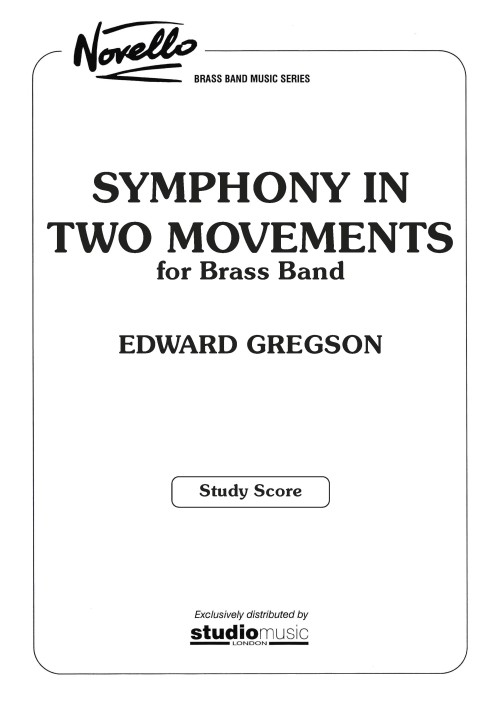
Symphony in Two Movements (Brass Band - Study Score) - Gregson, Edward
Selected as the Championship Section test piece for the National Brass Band Championships of Great Britain 2025This work was jointly commissioned by the National Youth Brass Band of Great Britain (NYBBGB) and the National Youth Brass Band of Wales (NYBBW), the latter with funding from T Cerdd (Music Centre Wales), to celebrate their 60th and 30th anniversaries respectively. The first performances were given at Cadogan Hall, London, in April 2012, by the NYBBGB, conducted by Bramwell Tovey; and at the Great Hall, Aberystwyth University, in July 2012, by the NYBBW, conducted by Nicholas Childs.When I was approached about a joint commission to write a new work to celebrate the anniversaries of these two outstanding youth bands I was delighted to accept, and decided to respond by writing a work apposite for the magnitude of these special occasions, namely a 'symphony for brass'.Through a long journey of writing music for brass band, which commenced with Connotations (1977), and continued with Dances and Arias (1984), Of Men and Mountains (1991), The Trumpets of the Angels (2000) and Rococo Variations (2008), I arrived at what I regard as the most important work of the cycle to date, combining as it does serious musical intent with considerable technical demands. It is perhaps my most abstract work for brass band, avoiding any programmatic content.The symphony lasts for some 19 minutes and is structured in two linked movements. The form is based on that used by Beethoven in his final piano sonata (Op.111), which is in two movements only: a compact sonata-form allegro, followed by a more expansive theme and four variations. Prokofiev also adopted this model in his 2nd Symphony of 1925.The opening Toccata of this Symphony is highly dramatic but compact, whilst still retaining the 'traditional' structural elements of exposition, development and recapitulation; indeed, it also has the 'traditional' element of a contrasting second subject - a gentle, lyrical modal melody first heard on solo cornets.In contrast, the longer and more substantial second movement Variations is built around a theme and four variations. The slowly unfolding chorale-like theme accumulates both added note harmony and increasing instrumentation, whilst the four variations which follow are by turn mercurial (fast, starting with all the instruments muted), march-like (menacing, with short rhythmic articulations underpinning an extended atonal melody), serene (a series of 'romances' for solo instruments alongside echoes of the chorale) with an emerging theme eventually bursting into a climax of passionate intent; whilst the final variation is a dynamic scherzo (concertante-like in its series of rapid-fire solos, duets, trios and quartets) with the music gradually incorporating elements of the main ideas from the first movement, thus acting as a recapitulation for the whole work. It reaches its peroration with a return to the very opening of the symphony, now in the 'home' tonality of F, and thus creating a truly symphonic dimension to the music.Most of the melodic material of the symphony is derived from the opening eleven-note 'row', which contains various intervallic sets, and although the work is not serially conceived it does use some typical quasi-serial procedures, such as canons, inversions, and retrogrades. The symphony uses somewhat limited percussion, in line with a 'classical' approach to the sound world of the brass band, alongside a use of multi-divisi instrumentation, whereby each player has an individual part rather than the traditional doubling within certain sections of the band.- Edward GregsonDuration: 19.00
Estimated dispatch 7-14 working days
 Listen to MP3
 View Music